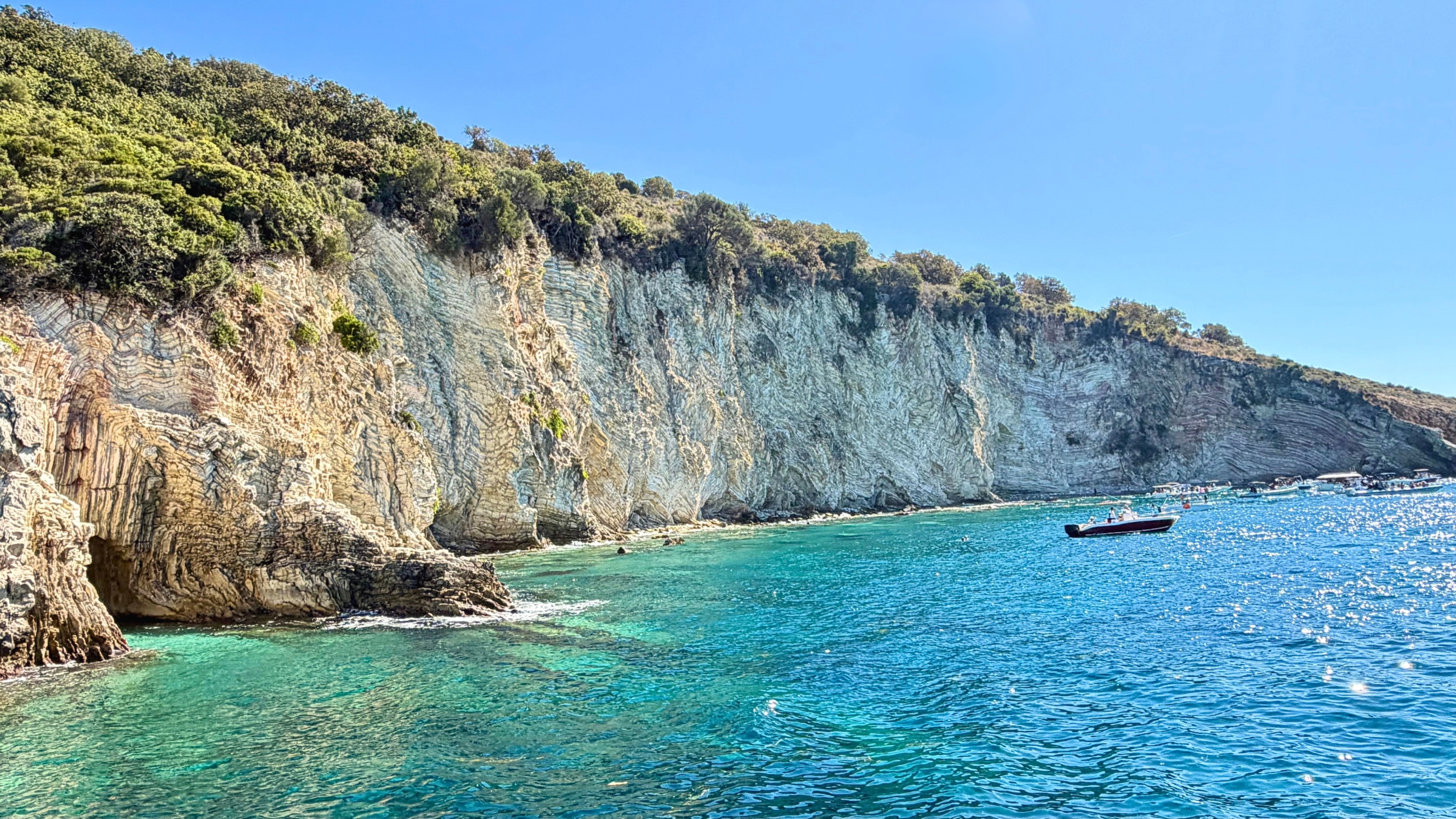
 Pale limestone cliffs rise above clear Ionian water at Gremina, north of Sarandë.
Most of our final week in Sarandë belonged to the water. We went north by wooden boat to swim beneath the cliffs of the Riviera, south by bus to Mirror Beach, and swam along the city shoreline on most of the days in between. One evening, we climbed back to Wine Bar Kristiano for the sunset we had promised ourselves last week.
September brought fewer tourists without taking the life out of the city. Some seasonal restaurants had pulled down their shutters, and a few owners had headed off on vacations of their own. Traffic along the waterfront had eased, but nightlife continued along the promenade. The sea held most of its summer warmth, and afternoon temperatures hovered around 72°F, the kind of weather that makes a long walk or a patio seat the obvious choice.
Today we are on the road to Thessaloniki. After thirty nights, we can say more clearly what Sarandë offers beyond a few days at the beach, what it costs in effort as well as lek to live here, and who we think would enjoy a month of their own.
📍 This Week in Sarandë
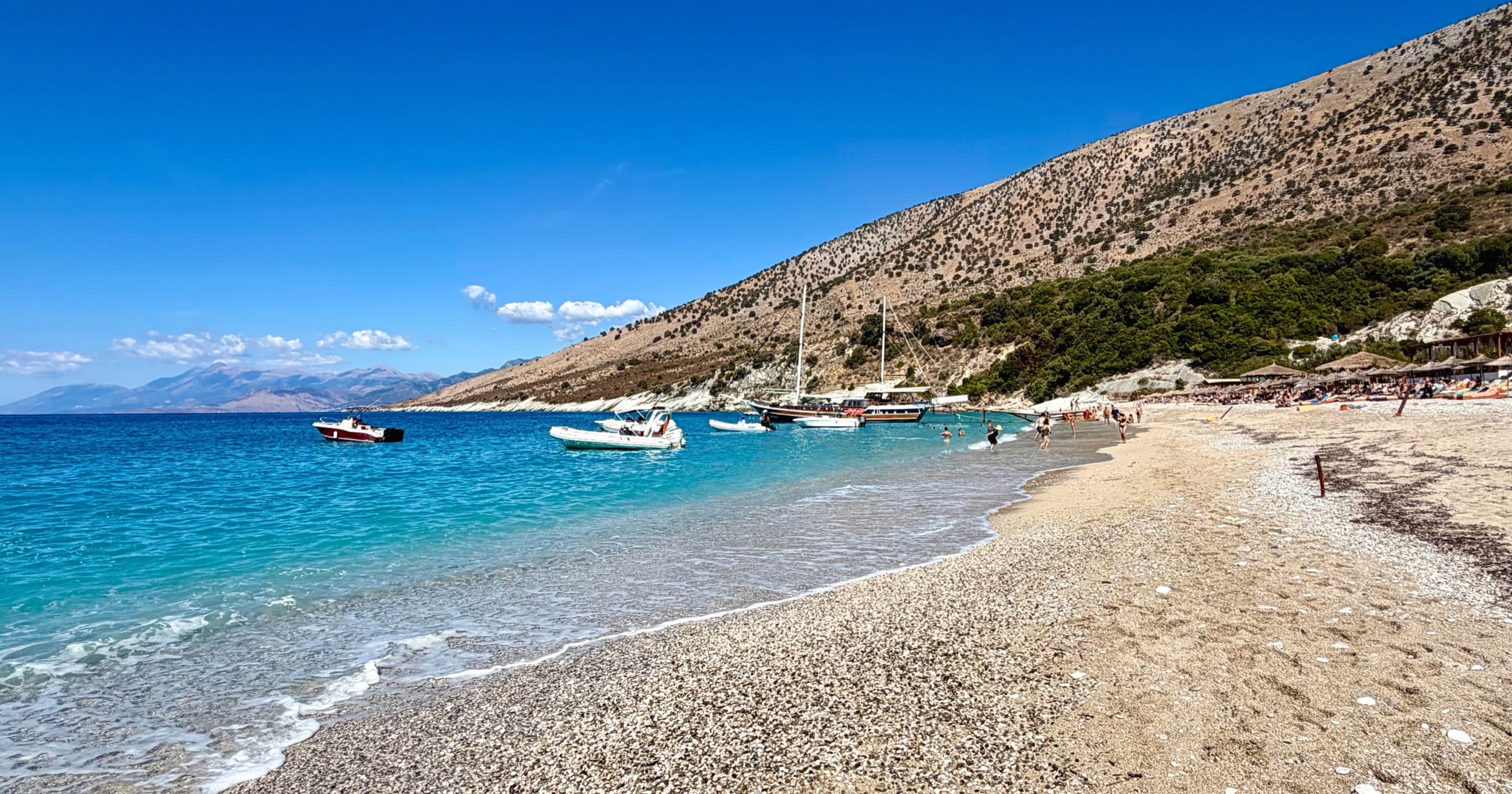 Our long stop at Krorëza, with time for swimming and lounging beneath the Riviera’s dry hills.
North Along the Riviera
For our last long excursion on the Albanian coast, we boarded Prince Ennio, the traditional wooden gulet of about twenty-five meters we had watched moored in the harbor for weeks. The six-hour trip cost approximately 2,900 lek ($35) each and ran north from Sarandë along a coast where dry, steep hillsides come straight down to the sea and the roads mostly stay inland.
The day was close to perfect: full sun, 72°F (22°C), and water still warm enough to enter without a second thought. The boat moved slowly with a gentle roll, and the coastline arrived one headland at a time.
The first stop was for photographs at Gremina, where pale limestone rises almost vertically out of the sea. The water at the base of the cliff was a far deeper blue than anything in the shallow swimming bays. With the boat sitting beneath it, we could appreciate the height from the water.
Farther north, we reached Krorëza, a broad crescent of fine pebbles beneath rough, scrub-covered hills. No road reaches it. Most visitors arrive by boat, though hiking trails also lead there from Lukovë and the Kakome area. We had two and a half hours ashore, with loungers included in our ticket and a few seasonal bars framed in bamboo behind the beach. That was long enough to swim, dry off, swim again, and stop checking the time.
At Kakome, the boat anchored offshore for a thirty-minute swim. A ladder hung from the hull for the climb back aboard, but we went in straight off the deck, into calm turquoise water inside a bay enclosed on three sides by green hills.
The last swim was at Soldiers Bay, Gjiri i Ushtarit, a small rocky cove where the cliff walls continue down into the sea, visible deep below the surface. We jumped from the boat again and swam beneath the slopes surrounding the cove.
On the way home, the captain paused beside Turtle Cave, Shpella e Breshkës, where the white rock resembles a turtle once you drift close enough. Then the boat turned for Sarandë, and the coast fell behind us in the late-afternoon light.
Swimming had become an integral part of life in Sarandë. The boat carried us farther along the coast, placing us inside the landscape of pale cliffs, dry hills, and clear blue bays, with time at each swimming stop to linger and soak it all in.
Mirror Beach
Later in the week, we took the local bus south toward Ksamil one last time. The crowds had thinned elsewhere, but the morning bus was still standing room only; the shoulder season still has plenty of life in it. When the driver stopped at a simple roadside pull-off above Mirror Beach, Plazhi i Pasqyrave, we were the only passengers to get off.
The beach is a recent celebrity. In 2024, a British travel company took unedited Google Maps screenshots of two hundred beaches, sampled the color of each one’s water, and compared the results against the intense hue of YInMn Blue. Mirror Beach came out closest, and the “world’s bluest water” headline traveled widely. Kassiopi, on Corfu, placed third, which pleased us, since we swam there with Bailey during our first week.
The beach cannot be seen from the road. We climbed the hill in front of us and followed the crest until the picturesque beach appeared below, then descended a steep, winding gravel road to the shore. On this coast, the best beaches usually take some effort to reach, and this one held to the pattern.
It was quiet when we arrived. Rows of mostly empty sun loungers sat in front of a lone café. The south end was open and free, and we laid out our towels there beside the few others who had made the trip.
The water lived up to its reputation. The sea was too lively that day to earn the beach’s name, but in the morning sun it was perfectly clear, with shades of blue that deepened sharply against the pale shore and the cliffs behind us. A short swim offshore, a rock formation rises from the sea with a small arch cut through it, a grotto open at both ends. Sunlight entering beneath the waterline filled the inside with a glowing, luminous blue. It was as striking to look at as it was fun to swim through.
We spent the rest of the morning and early afternoon at an easy pace, picnicking on the beach with regular swims in between, while the beach filled gradually without ever becoming crowded. Then we climbed back over the hill to the highway, flagged down the bus, and paid 200 lek ($2.40) each for the twenty-minute ride to Sarandë. We were home by mid-afternoon, where our laptops were waiting.
We loved it. Of all the beaches we have enjoyed along the Albanian coast, we would be hard-pressed to name a favorite ahead of this one. The thin crowds, the weather, and knowing it was our last swim on the Albanian Riviera surely helped its case. We were grateful to have made the trip and enjoyed every hour of it.
Back Up the Hill for Sunset
Lëkurësi Castle is one of Sarandë’s best-known sunset viewpoints. We left it unvisited. We were content to return to a terrace we already liked, on the neighboring hillside.
We climbed toward the Forty Saints again, this time only as far as Wine Bar Kristiano, just below the monastery. Last week, we had stopped there after the hike, before opening hours. This time, we came for the evening. A table with a clear view was easy to find, and there was no crowd around us.
We ordered a half-liter of the house white, a generous charcuterie board, and sparkling water, and watched the light fade across Sarandë Bay while the city lit up below. The bill was 1,730 lek ($21).
We had packed headlamps for the descent and needed them. At the bottom, we joined the crowd on the promenade and made a last visit to Cuci, our favorite grill, for a shared chicken and pork souvlaki platter and two sparkling waters. The meal cost 1,200 lek ($15).
🎨 Cultural Deep Dive
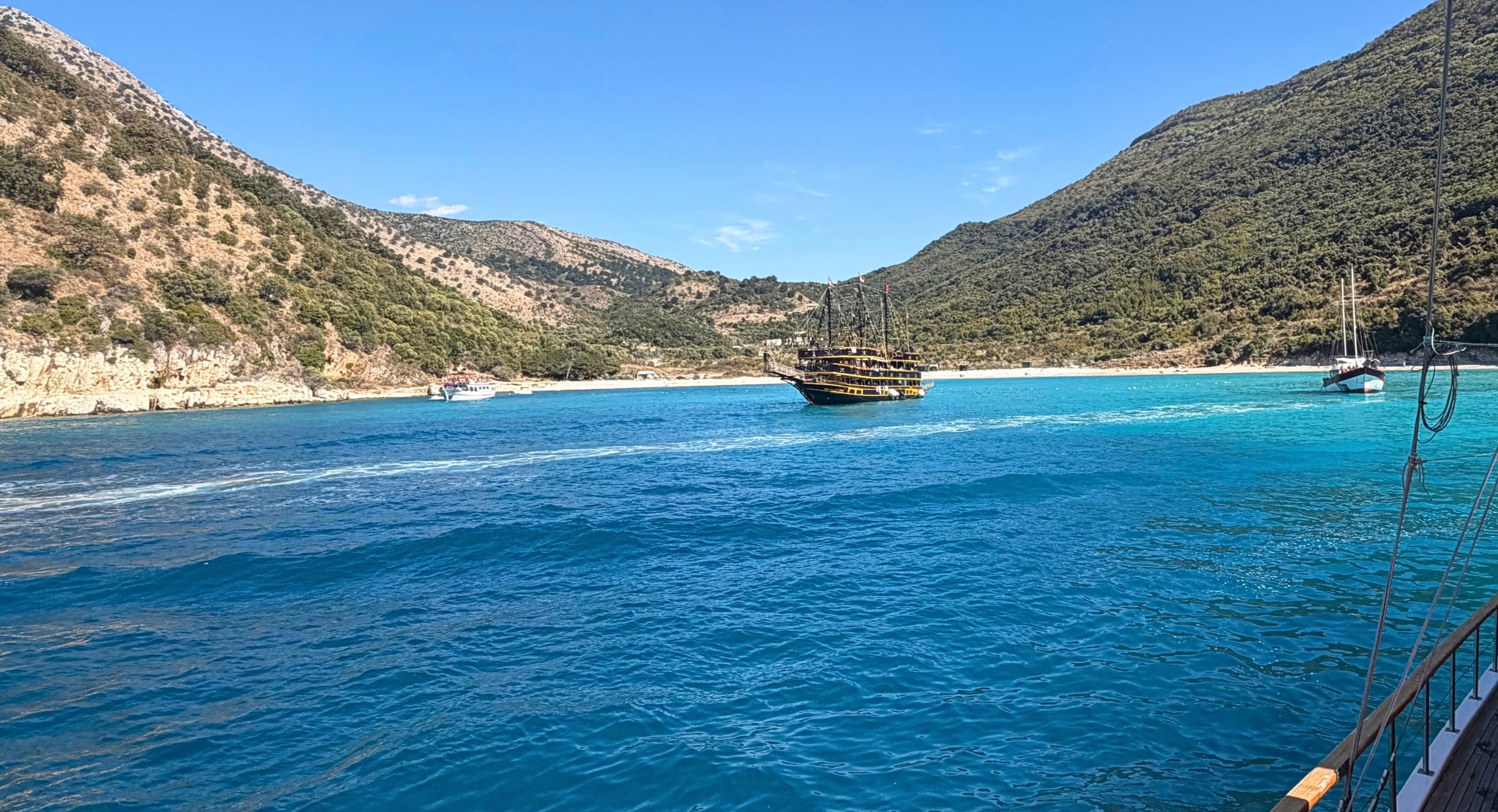 Kakome Bay from our boat, its beach and surrounding hills at the center of a long dispute over ownership and public access.
Soldiers on the Shore
According to a local tourism account, Soldiers Bay takes its name from the communist period. A military post stood on the hill above the cove, and the soldiers stationed there walked down to swim. People passing in boats began associating the small shore with them, and the name endured.
The account belongs within a larger history of coastal militarization and restricted movement. During communist rule, some Albanians attempted to swim to Corfu at night; not all of them made it. The channel we crossed by hydrofoil in forty-five minutes during our first week was a route others attempted at the risk of their lives.
The local story of soldiers descending from their post to swim adds a smaller human detail to that history. Today, excursion boats bring swimmers into the same cove.
Kakome and the Question of Access
From our anchorage, Kakome’s shore looked almost untouched: a pebble beach, a valley, green slopes, and none of the hotels that line so much of this coast. That appearance has a long and contested explanation.
In the mid-2000s, a resort proposal involving Club Med and the Albanian company Riviera encountered opposition from families in nearby Nivicë who claimed ownership of the land. The dispute continued through protests and legal proceedings. By June 2009, Club Med had withdrawn, with unresolved ownership among the issues reported at the time.
The dispute continued after Club Med left. The developer, Riviera Kakome, says its acquisition was lawful and supported by court decisions. Residents have continued to contest the ownership and their exclusion from the coast. For years, fencing restricted access to the shore. Those competing claims connect Kakome to a much wider argument in Albania about property, tourism development, and public access.
The Flamingo Revolution
This summer, Kakome’s fence came down during what Deutsche Welle described as Albania’s largest civic protest movement since the fall of communism. Known as the Flamingo Revolution, it was also part of the Tirana we experienced in August.
The protests gathered force around proposed luxury development at Zvërnec, near Vlorë, beside protected wetlands associated with flamingos and other waterbirds. In 2024, Albania amended its protected-area legislation to allow permits for certain high-end tourism developments within protected areas. A separate resort proposal on nearby Sazan Island received conditional strategic-investor status on December 30, 2024.
Demonstrations over the coast expanded into broader protests against corruption and the government’s handling of development. Participants called for Prime Minister Edi Rama’s resignation, a transitional government, and constitutional reform.
Much international coverage has emphasized the prominent American investors involved. In our conversations in Tirana, Albanians emphasized the decisions made at home: how land changed hands, who authorized development, and whether citizens would benefit. The objections we heard concerned the conduct of Albanian institutions and the future of land people regarded as their own.
The government and developers have defended the projects as lawful investments that would bring economic benefits. Rama has also attributed aspects of the protests to external influences and misinformation. Meanwhile, Albania’s anti-corruption prosecutors have been investigating disputed property transactions associated with the developments.
The movement reached Kakome as well. Municipal workers removed the entrance gate, and on June 21 residents dismantled the remaining fencing. Reporting from the protest described a dispute over ownership and access that had continued for more than two decades.
In Tirana, we saw evening crowds gather at Skanderbeg Square and march toward the Prime Minister’s office, carrying flags and inflatable flamingos and chanting against the sale of their land. The protests did not disrupt our stay and continued after we left, passing one hundred consecutive days in September.
We saw Kakome only from the water and did not test the land approach. The reading afterward showed how much that view left out: family claims, a withdrawn resort proposal, competing accounts of ownership, and a fence removed during a summer of wider demands for access to Albania’s coast.
The bay was beautiful from our anchorage. Understanding its recent history made it a more complicated place to describe as untouched.
🍽️ Local Flavor
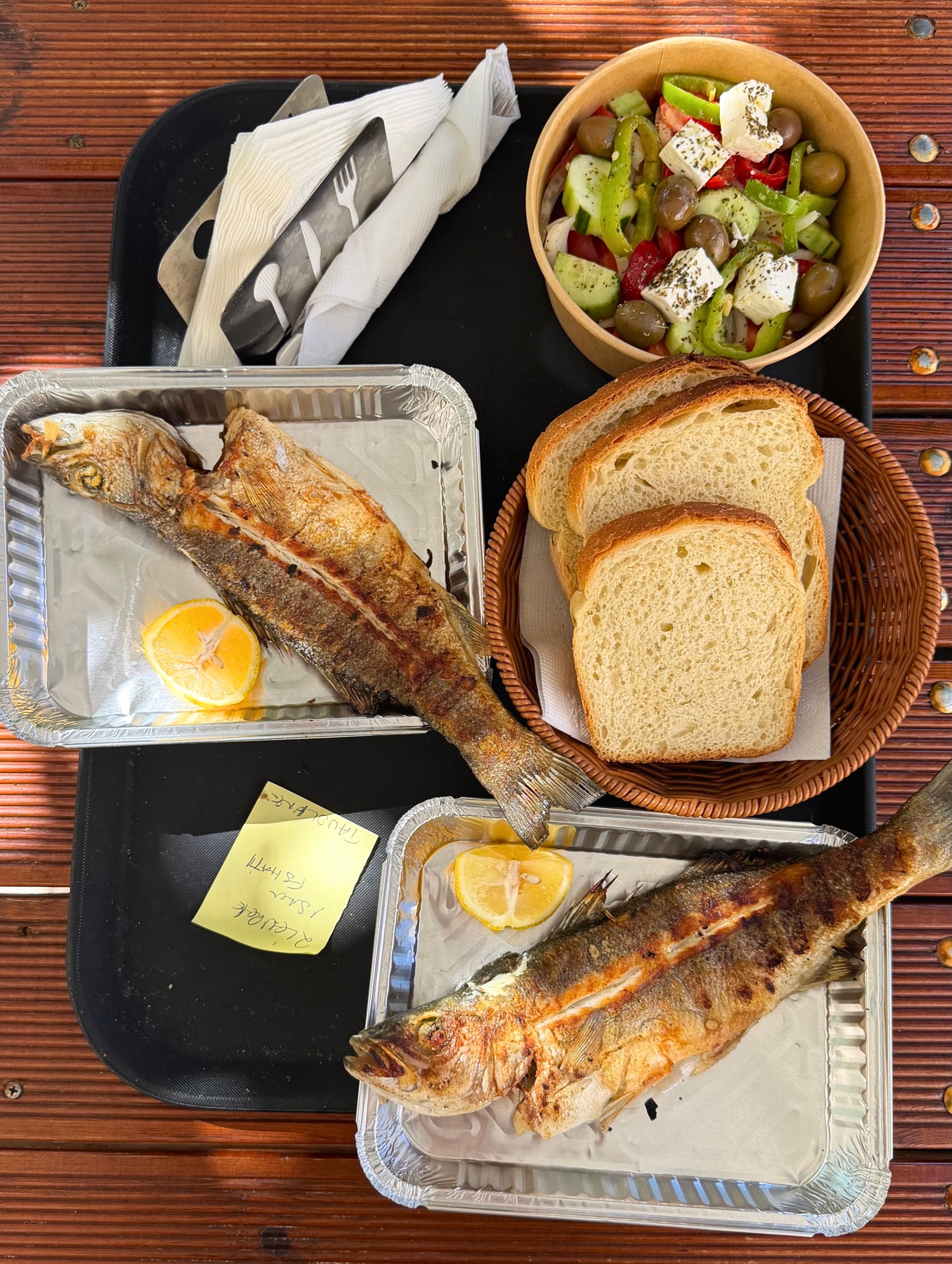 Grilled sea bass and village salad at Pasuria e Detit, eaten at a picnic table beneath the trees.
The Fish Counter Becomes Lunch
By late September, many of Sarandë’s seasonal restaurants had closed and some owners had gone on holiday themselves. We found ourselves returning to places serving the surrounding neighborhoods, and our meal of the week came from one of those places.
Pasuria e Detit, Peshk i Freskët, is a no-frills fish shop on a busy neighborhood intersection above the waterfront. Fish lie on ice inside. You choose what you want and take it home to cook, or ask them to grill it, either to take away or to eat at the picnic tables under the trees along the sidewalk. A short list of salads rounds out the meal.
We chose two sea bass and a village salad and took a table outside on a sunny, 72-degree afternoon, with the neighborhood going about its business around us. The fish came cleaned, grilled, and whole, as is the custom here. After months along the Adriatic and Ionian, a whole fish on the plate has become a familiar sight, and we worked around the bones patiently until very little remained.
The total was 1,700 lek ($21) for both fish and the salad. We estimated a comparable meal at over $100 before tax and tip in Seattle, our former home, though that price would come with a dining room and a server. Here, we were happy beneath the trees, a few steps from the counter and grill.
The neighborhood cats understood the arrangement better than we did. Several sat nearby through the meal, watching closely and waiting with more patience than we expected. We saved them the heads, which they readily accepted.
A shop like this serves the neighborhood both ways, selling dinner to people cooking at home and lunch to anyone content to let someone else tend the grill. It was one of the most satisfying meals of our month.
💰 Nomad Real Talk
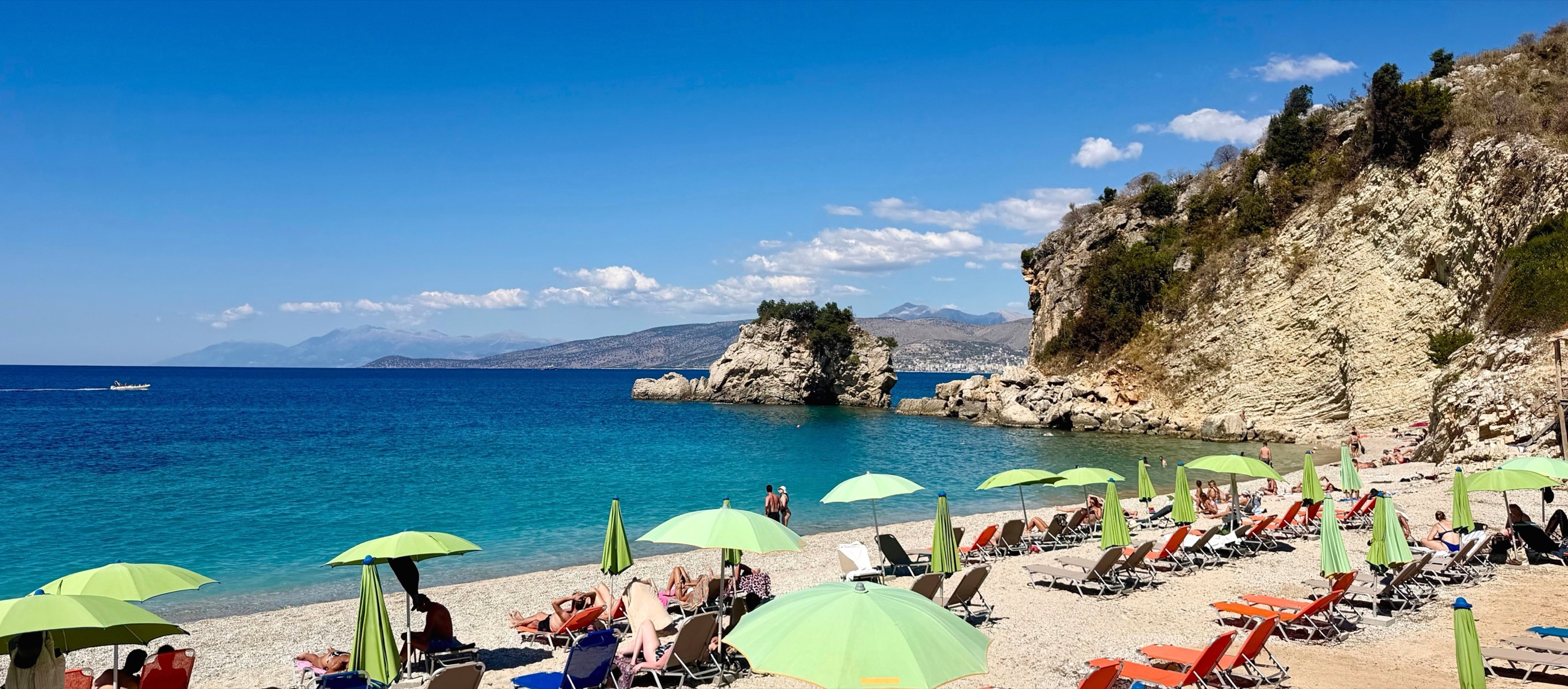 Late September at Mirror Beach, with glistening water beneath the cliffs.
A Month Shaped by the Season
Thirty nights in Sarandë, September 1 to October 1, turned out to be well timed. We arrived while the city still carried the full weight of the summer holidays: busy beaches, loud waterfront bars, and heavy traffic. By our last week, the crowds had thinned, beach prices had softened, and the water was still warm. Temperatures sat in the mid-seventies to eighties Fahrenheit for much of the month, with plentiful sunshine.
That timing shaped the stay. We had weeks of swimming weather while watching the holiday crowds diminish around us. For another long stay on the Riviera, September is the month we would choose again.
The Apartment and the Hill
Our apartment sat uphill off Rruga Mitat Hoxha, with a balcony looking across the whole bay. For the full month, we paid about $1,123, roughly $37 a night. The Wi-Fi was strong throughout, and as the waterfront bars grew quieter later in September, the apartment became an easy place to work.
The climb, which we covered last week, was part of daily life. We are walkers, hills included, but grocery bags made the route home more consequential than it appeared on a map. We would still choose a view in Sarandë. We would also look closely at the actual walking routes connecting the apartment, shops, gym, and water before booking.
What Held Its Value
Food and coffee stayed good value all month. We ate authentic Neapolitan pizza, some of the best souvlaki we have had anywhere, and excellent fresh fish. This week’s meals out ran 1,200 lek ($15) for a shared souvlaki platter at Cuci, 1,700 lek ($21) for grilled sea bass and salad, and 1,730 lek ($21) for wine, charcuterie, and sunset views at Kristiano.
Last week’s dinner for two at Traditional Table was 2,330 lek ($28). The boat excursion was approximately 2,900 lek ($35) each, and the bus to Butrint cost 300 lek ($3.60) per person. These dollar equivalents are approximate.
The macchiato made the clearest case for walking a few blocks. On the promenade, we paid around 150 lek ($1.80); uphill, at the neighborhood cafés where we spent most mornings, as little as 70 lek ($0.85). Moving away from the water roughly halved the bill.
Our gym cost 3,500 lek ($42) a month each for three sessions a week. It was among the lowest membership prices of the journey, with the best gym view we have ever seen.
What Took Effort
Cash remained essential for the businesses we used most. Bakeries, produce stalls, butchers, and family tavernas generally expected payment in lek, so we made fewer, larger ATM withdrawals to limit fees.
We walk nearly everywhere and use public buses when the route makes logistical sense. In Sarandë, that meant walking for daily errands and taking buses south to Ksamil, Mirror Beach, and Butrint. Taxis are expensive, and local booking apps dispatch regular taxis rather than providing an independent ride-share alternative. Since we rarely use them, their prices had little effect on our daily spending.
Café culture here does not lend itself to settling in with a laptop for the afternoon, consistent with what we have encountered elsewhere in Albania and across the Balkans. Many cafés have Wi-Fi, usually with a password available on request, but they function primarily as places to meet, talk, and drink coffee. We did our work at home, where a reliable connection and a comfortable place to sit mattered far more than access to a café network.
Imported groceries and specialty goods, covered in our second week, remained the category where Albania stopped feeling inexpensive.
What Surprised Us
We felt at ease in Sarandë from the first week to the last. We walked home after dinners on steep, lightly trafficked streets and never felt uneasy, and we encountered no scams or pickpocketing. Our experience was much more reassuring than the image of Albania that sometimes reaches audiences abroad.
Another constant was the xhiro, the evening walk we have encountered throughout this part of the Balkans. As the light faded each evening, the promenade filled with families, couples, grandparents, and teenagers walking slowly in both directions, stopping to talk and walking on. It continued as the holiday crowds diminished.
Sarandë also proved a better base than we expected for a household without a car. Across the month, we seamlessly reached a UNESCO archaeological site, stretches of coast in opposite directions, a hilltop monastery, and a Greek island, all while keeping the same apartment overlooking the water and surrounding hillsides.
Who a Month Here Suits
Sarandë suited our combination of frequent swimming, work from a well-connected apartment, and occasional excursions. We could reach Butrint, Riviera beaches, and Corfu without a car, then return to familiar shops, cafés, and a home overlooking the bay. Comfort with hills, cash, and uneven infrastructure helped considerably.
We found fewer opportunities for galleries, concerts, and scheduled cultural events than in Tirana. Sarandë’s history is substantial, but it lives mostly in archaeological sites and hillside ruins rather than museums and performance venues. Anyone who needs consistently flat, even walking routes should choose accommodation carefully along the waterfront; most neighborhoods require steep climbs and uneven footing every day.
🏠 Behind the Nomad Curtain
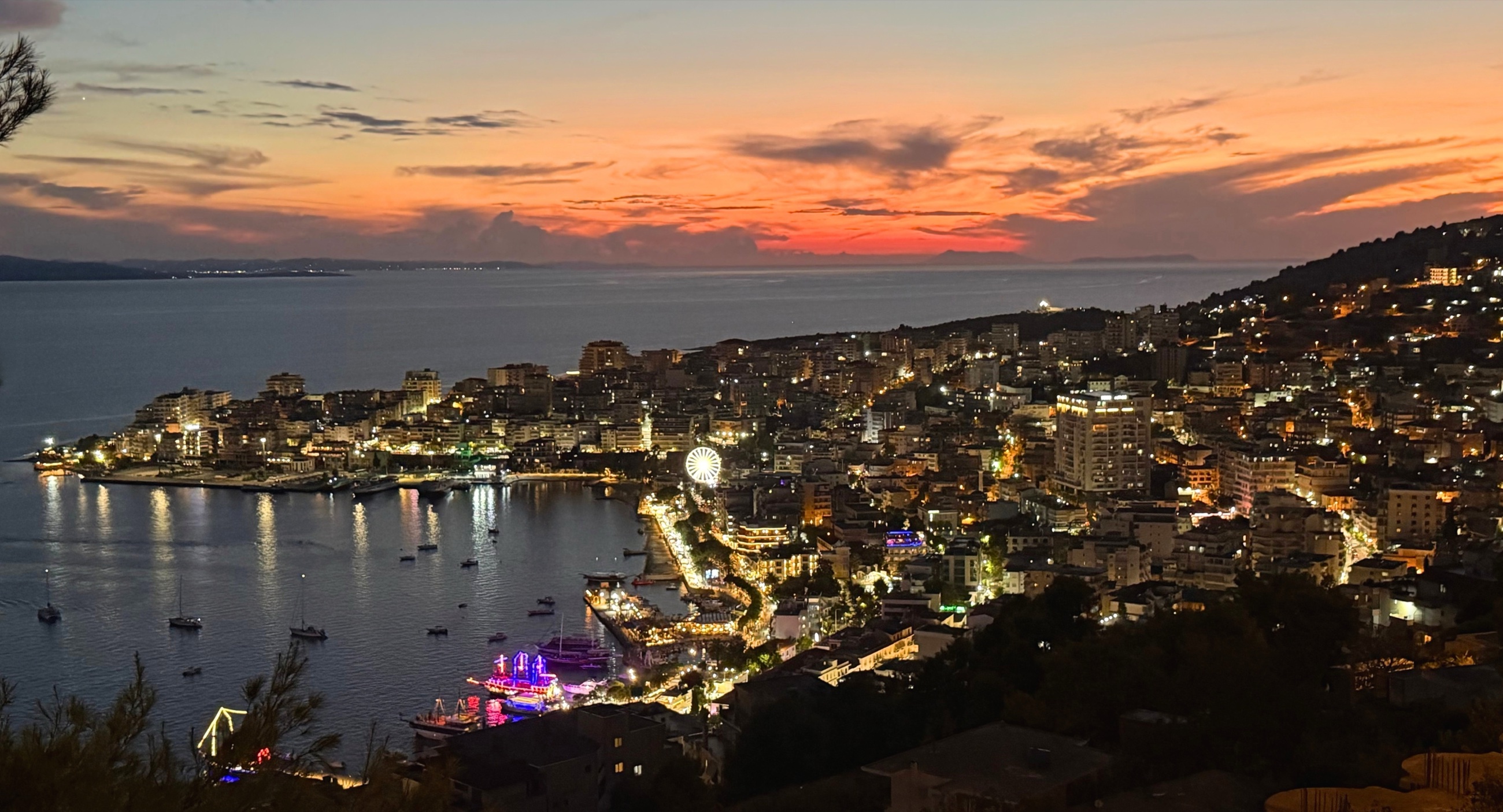 Sarandë at dusk, with the last glow over the Ionian Sea and waterfront lights tracing the bay.
Leaving Takes Planning
A month’s stay ends the same way it begins: with a day built around logistics. Leaving Sarandë means connecting several stages of travel, whichever direction we choose.
Tirana’s airport is several hours north, while Corfu’s requires a ferry crossing and a transfer on the island. For our journey to Thessaloniki, we chose the overland route through Igoumenitsa, with two buses and a border crossing.
The day began with a taxi at 6:00 AM, one of the few we took here, to get us and the luggage to the 7:00 AM bus for Igoumenitsa. Greece runs an hour ahead, so we expect to arrive around 9:30 AM local time, depending on how long the border takes.
The onward bus to Thessaloniki leaves at 3:00 PM. If the station will hold our bags, the gap becomes coffee on the waterfront and a long Greek lunch. If not, it becomes the same with luggage. We expect to reach Thessaloniki between 7:30 and 8:00 PM and take one last taxi to the apartment.
There was also the matter of the local currency. We spent down the cash in our wallets over the final days, planning to exchange any remaining balance for euros before leaving. After a month of making sure we had enough local currency, the final days required the opposite calculation.
Arrival photographs leave much of this out: the schedules, time zones, border crossing, and contingency built around luggage storage at a regional bus station. Longer stays make these travel days less frequent, but each move still needs its share of preparation.
📸 Photo Story
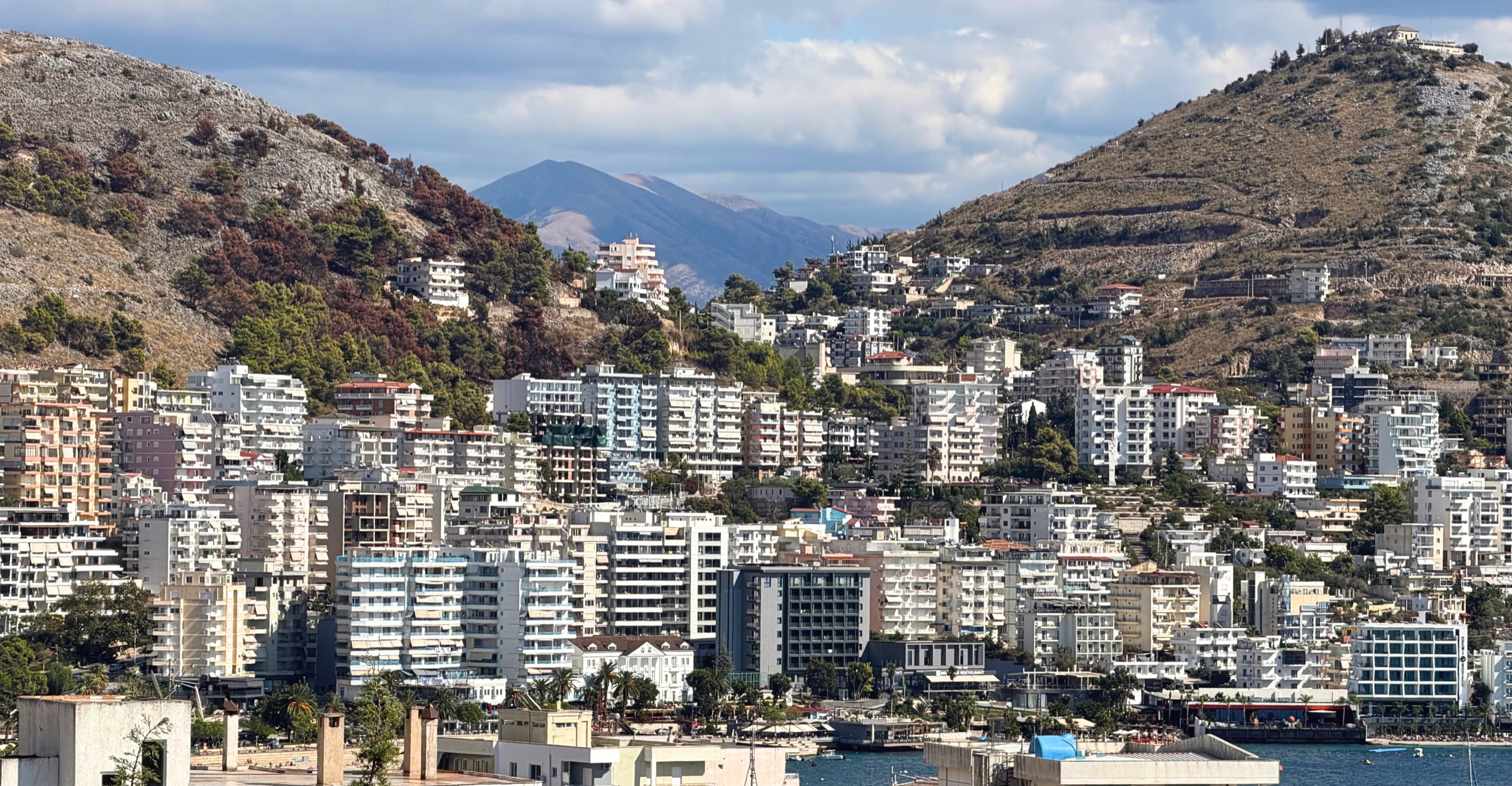 Beyond the waterfront, Sarandë climbs into dry hills and densely packed neighborhoods.
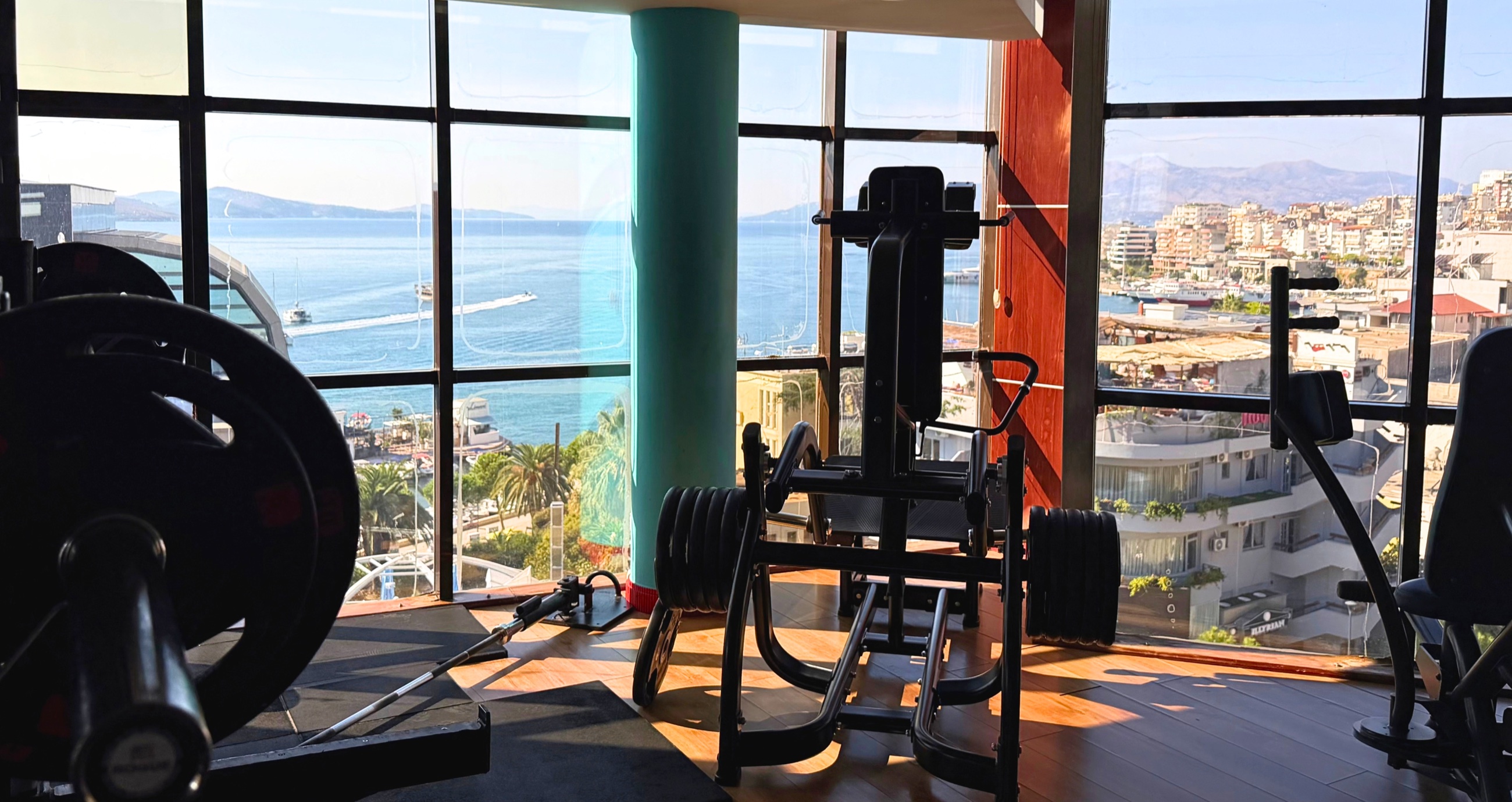 Keeping our gym routine in Sarandë, with the bay just beyond the windows.
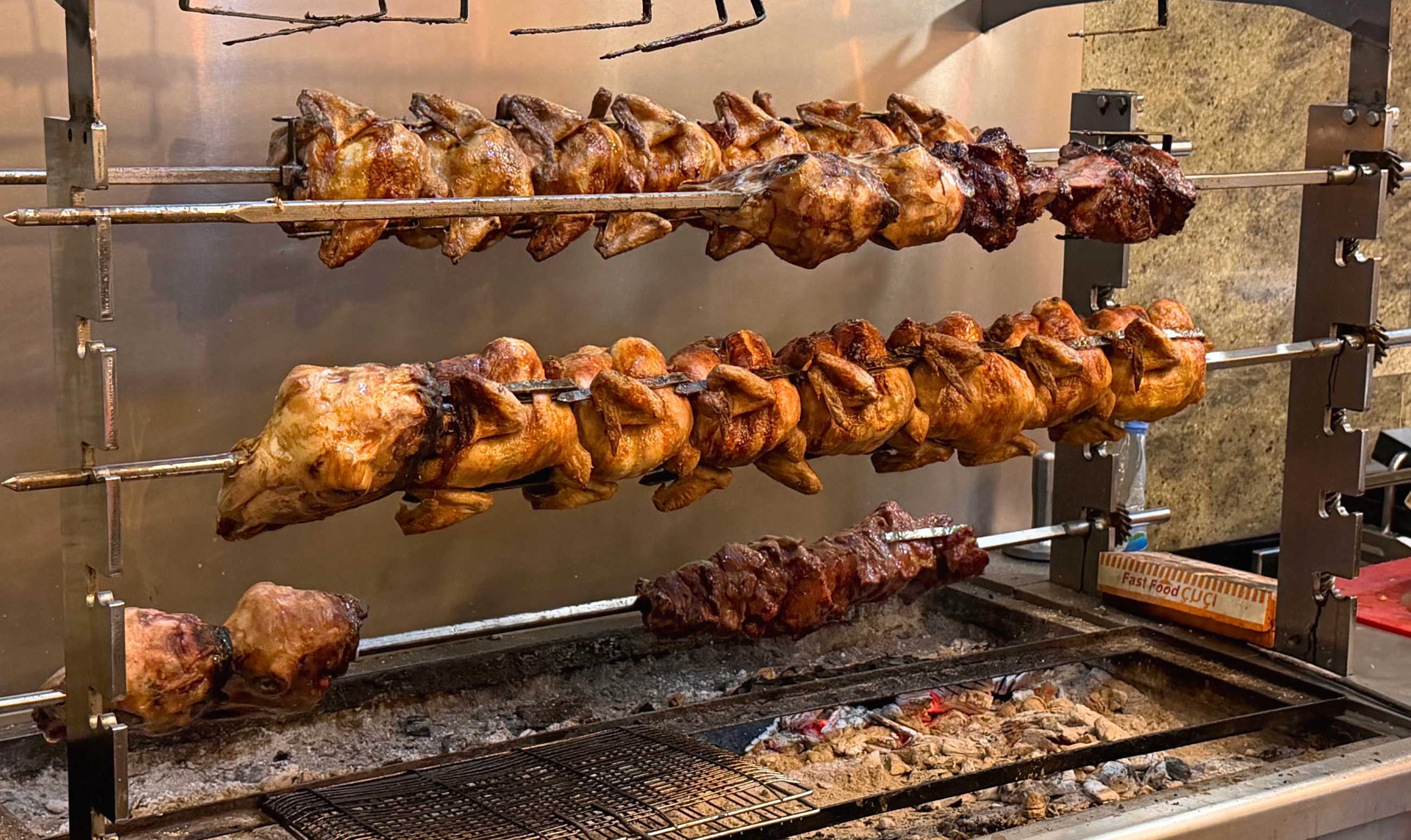 Meat roasting over the coals at Cuci, our favorite stop in Sarandë for grilled meats and souvlaki.
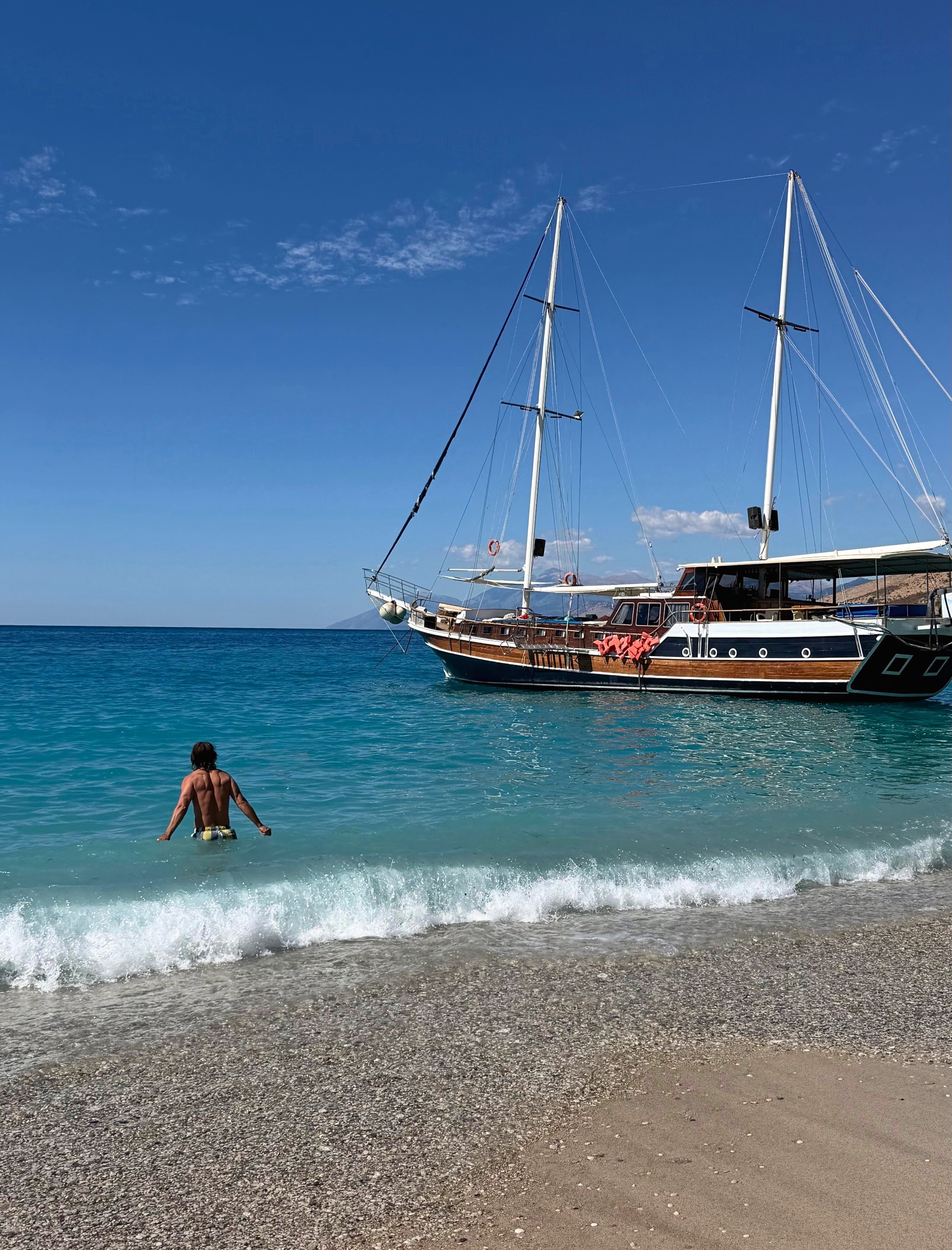 Sam heading into the water at Krorëza, with our wooden excursion boat anchored offshore.
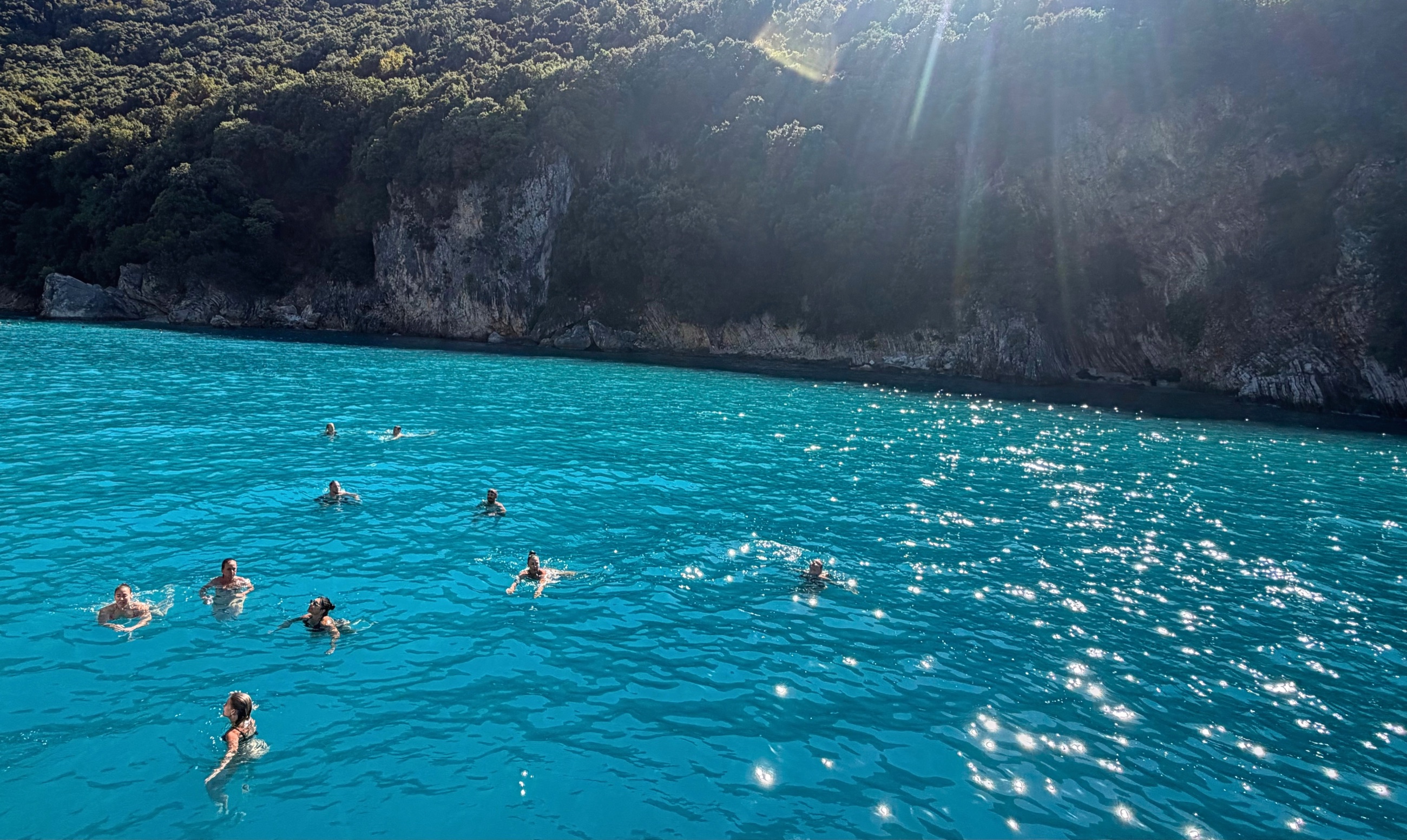 A group swim beneath Kakome’s shaded cliffs, with sunlight catching the turquoise water.
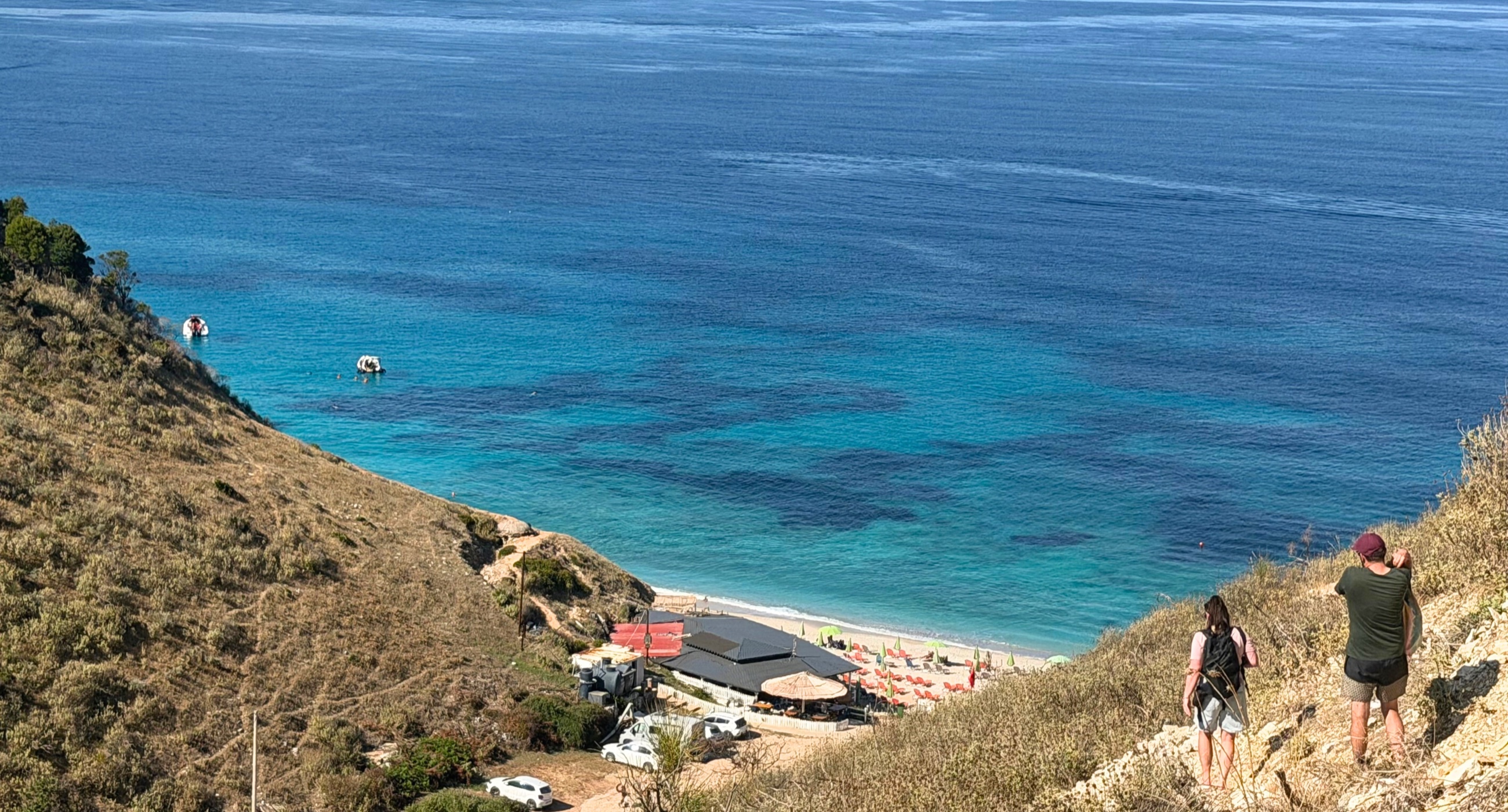 Mirror Beach from the path above, a preview of the blue water waiting for us at the bottom.
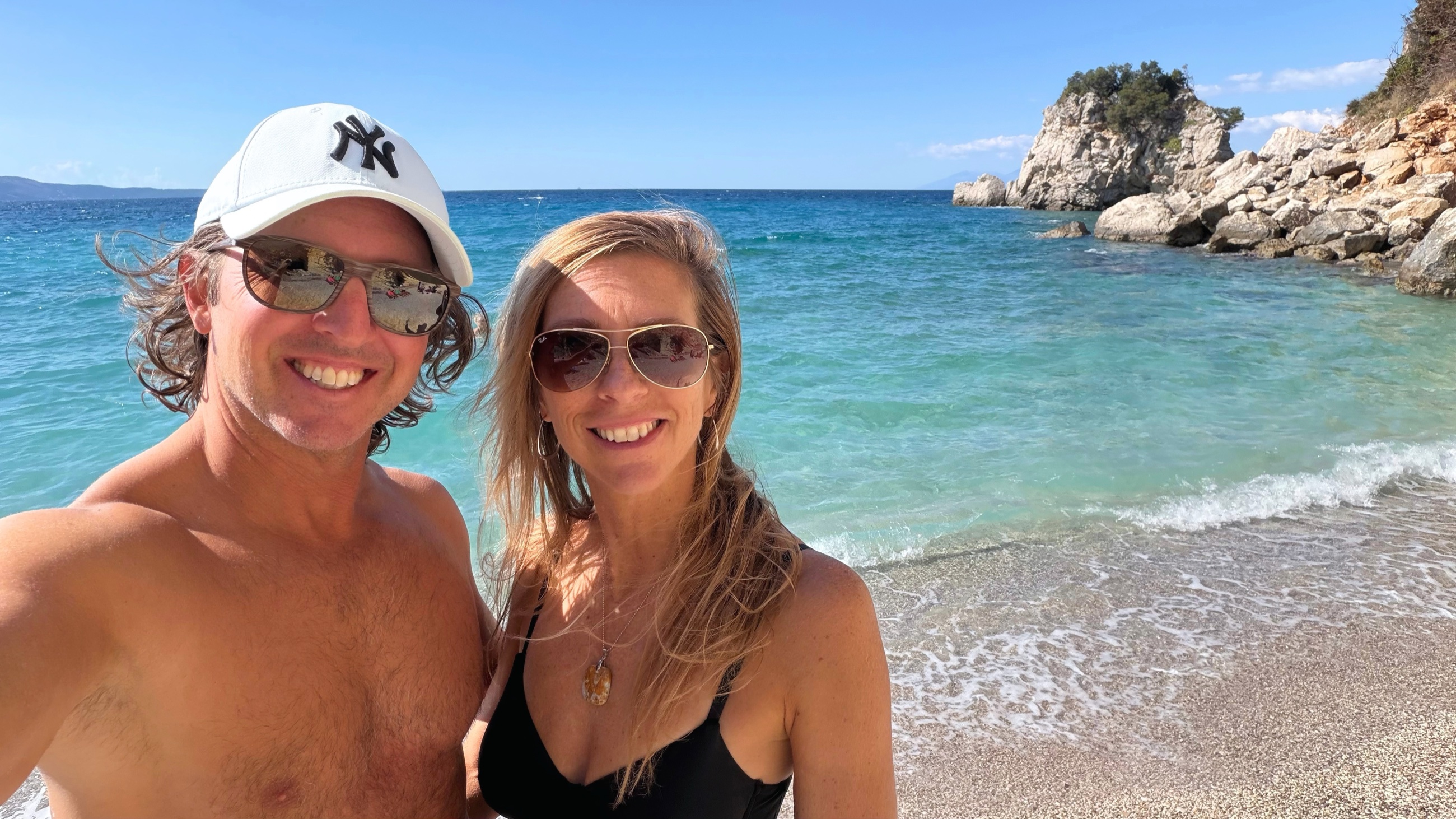 The two of us at Mirror Beach, making the most of the Ionian’s lingering summer warmth.
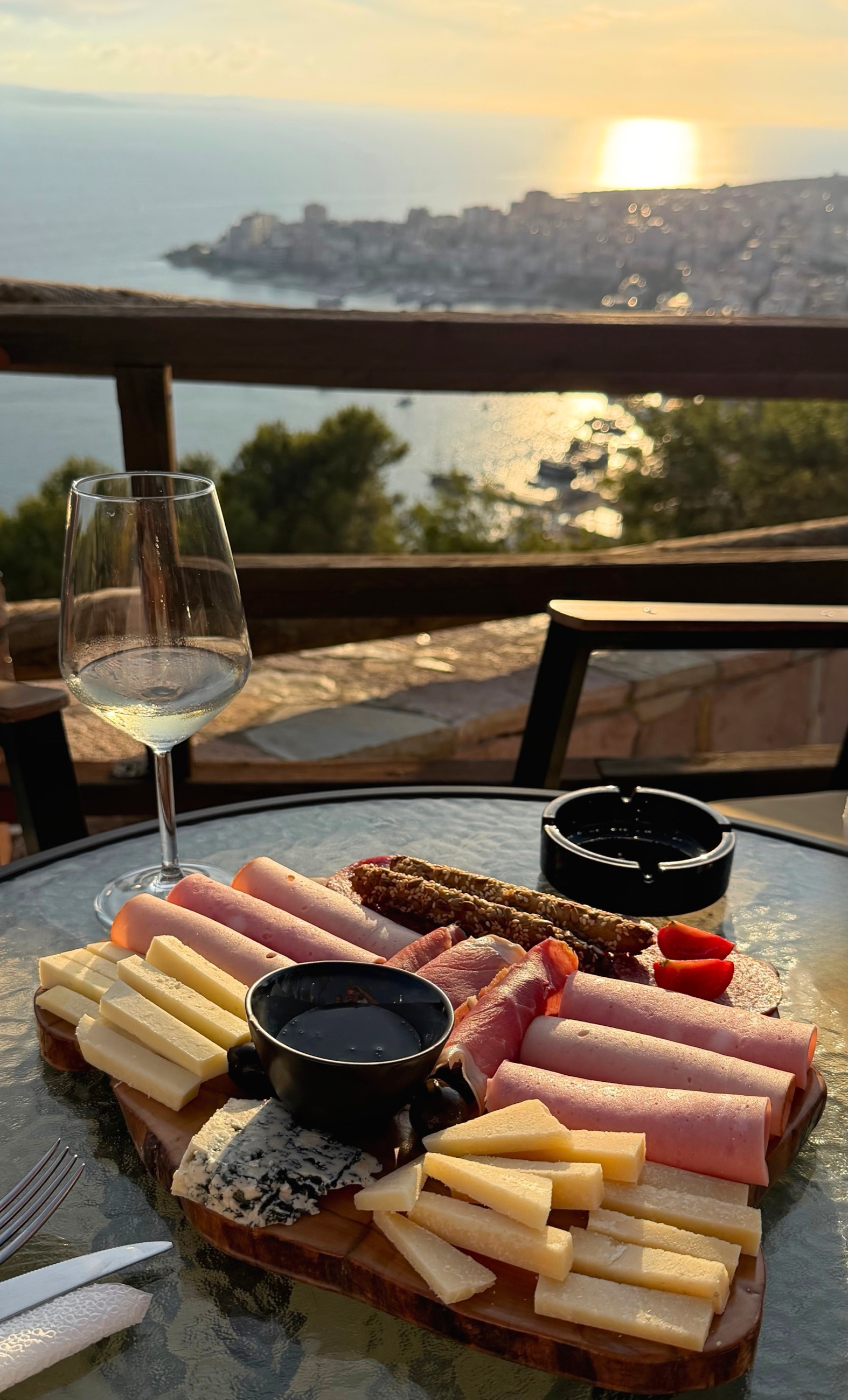 Wine and a charcuterie board at Wine Bar Kristiano as the evening light spreads across Sarandë’s bay.
🎯 Next Week Preview
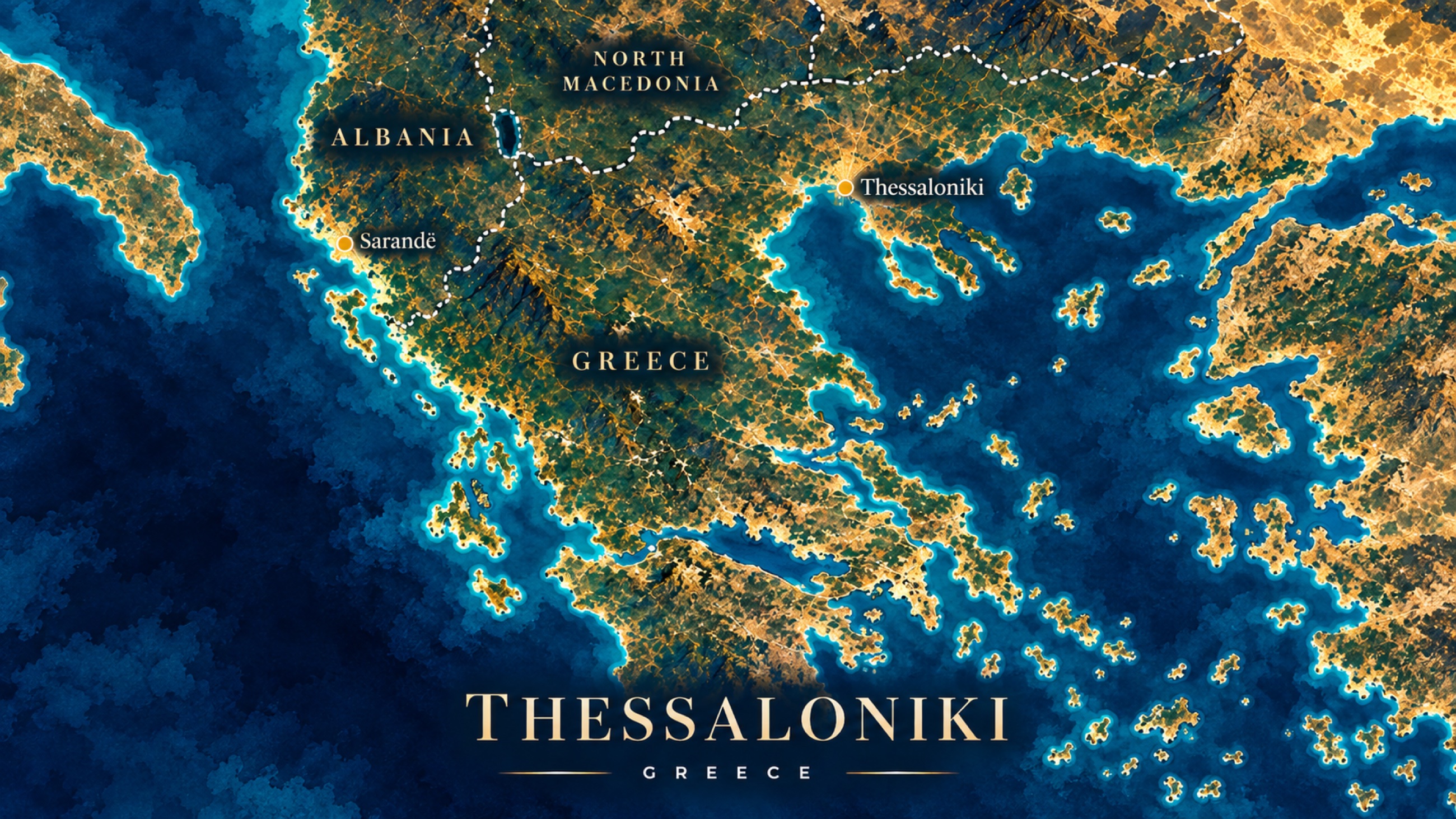 From Sarandë, Albania, to Thessaloniki, Greece: our next chapter begins. Illustrated map.
Our next twelve nights belong to Thessaloniki. We are looking forward to its food, early Christian history, Roman and Byzantine monuments, Ottoman heritage, and the activity of a large university city. After a month on the Albanian Riviera at summer’s end, we anticipate a different pace.
Our stay overlaps with the Dimitria Festival, which runs through much of October, with performances and cultural events across the city. The festival will give us another way into Thessaloniki as we begin learning its neighborhoods and daily life.
Sarandë gave us a good month in the water. Now Thessaloniki gets its turn on land.
💌 Personal Connection
Some of what we will miss most about Sarandë is what we could see from our apartment. We loved looking out the window or sitting on the balcony as the warm evening light spread across the hillside on the other side of the bay. Over thirty nights, that view became a familiar pleasure, one we never tired of.
Living here for a month also changed how we saw the city. The unfinished concrete, broken sidewalks, and motorcycles with no apparent muffler were still there, but they stopped being the first things we noticed. We had favorite places, familiar walks, and people who recognized us. Baristas and market vendors who were reserved in our first days greeted us as regulars by the last, and those brief exchanges became a welcome part of moving through town. We are glad we stayed long enough to feel that familiarity and to enjoy Sarandë with fewer crowds as the season eased.
For much of the past five months, from Split to Sarandë, swimming has been part of life whenever we have stayed near the coast. We will miss those easy days in the clear, sunlit seas as we move into autumn. Thessaloniki has a long waterfront of its own, and we look forward to learning it on foot as we learned this one.
The bus left at seven. By the time the evening light reaches the hillside and the promenade fills for the xhiro, we will be somewhere in northern Greece.
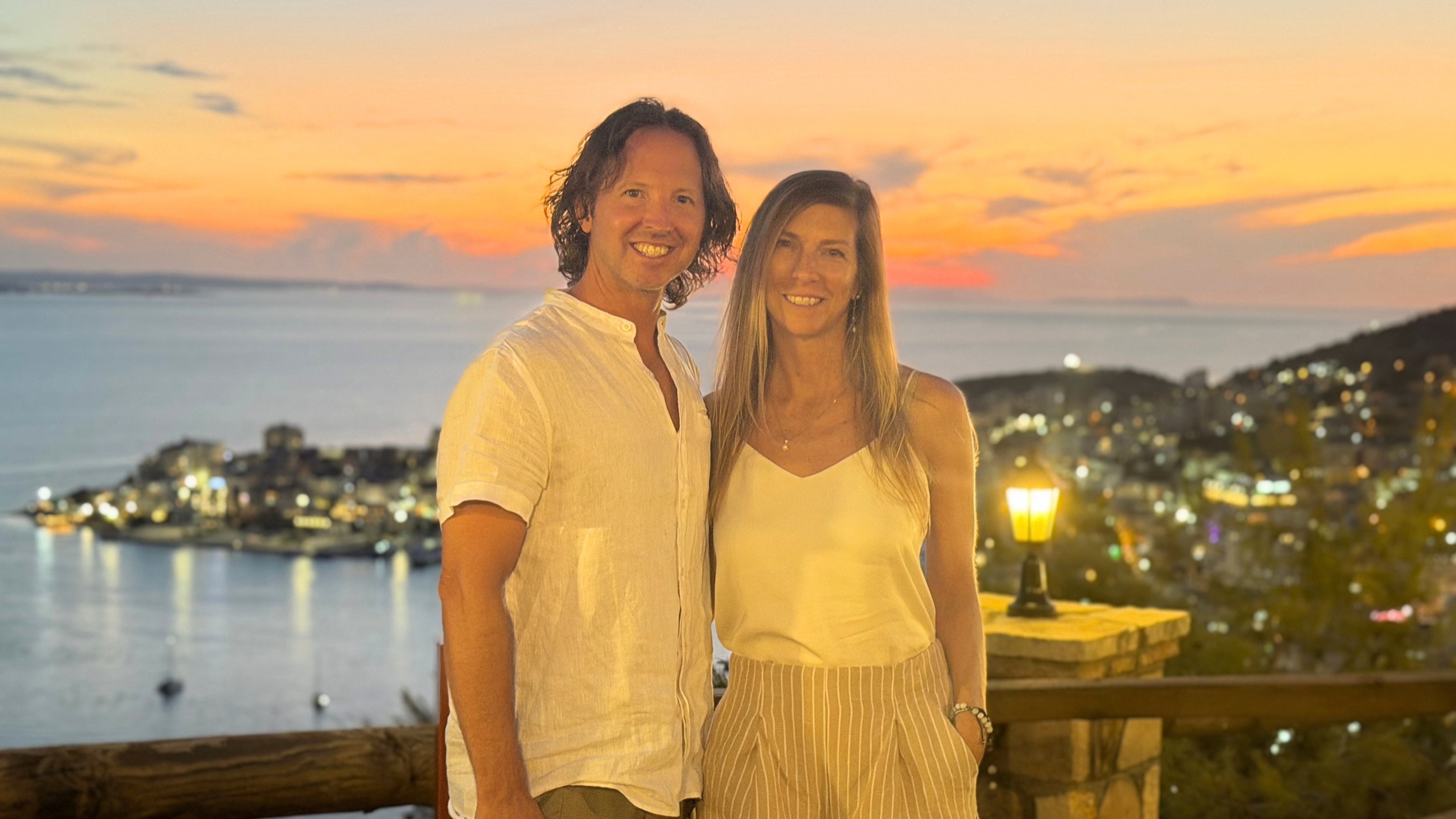 Sunset at Kristiano Wine Bar, overlooking the bay as our month in Sarandë draws to a close.
Until next week,
S&S
Some Great Place · Living Local in a Global World · somegreatplace.com