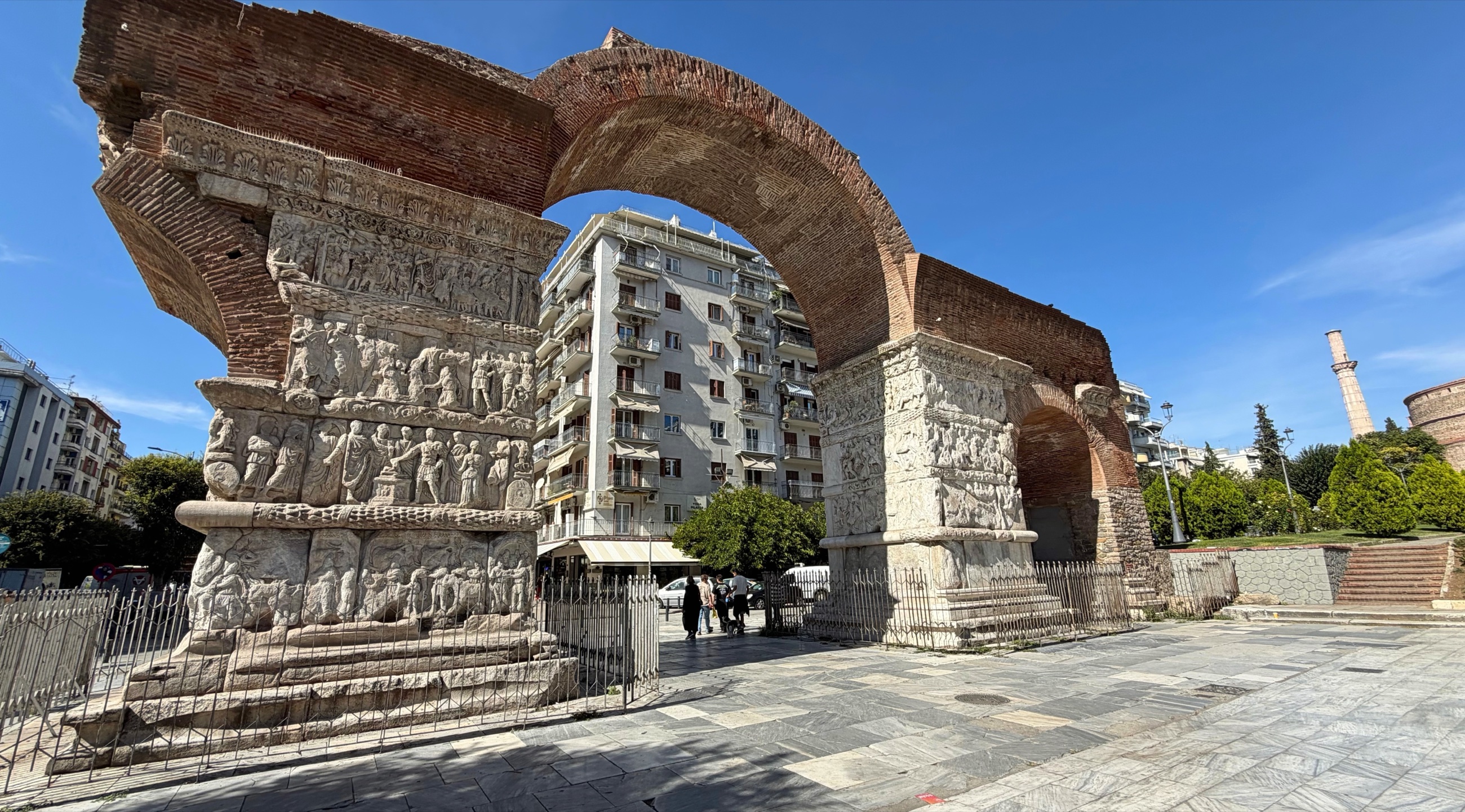
 The Arch of Galerius, or Kamara, still towers over one of central Thessaloniki’s pedestrian corridors, with the modern city built tightly around it.
Getting from Sarandë to Thessaloniki took two buses, two border crossings, a long layover in Igoumenitsa, and most of a day. It also closed a chapter. After four months in Montenegro and Albania, we were back inside the European Union and the Schengen Area, beginning twelve nights in Greece’s second city.
The first bus left Sarandë early and followed SH97 through the valleys of southern Albania, between mountain ridges and long stretches of olive grove. Goats grazed on the slopes. Sheep were herded down the middle of the road. At informal stops in small towns, passengers stood at the roadside with their bags, and the bus pulled over for them. The drivers changed twice, with smoke breaks in between. Half a year into the Balkans, none of it struck us as unusual.
At the border, everyone stepped off. We walked to a window, showed our passports, and crossed on foot while the bus rolled through inspection empty, a dog working its way along the open luggage bays. On the far side we boarded again, then repeated the whole process to enter Greece.
The bus left us on the edge of Igoumenitsa, the ferry port on Greece’s northwest coast, and we walked ten minutes with our luggage to the bus terminal. A bakery nearby supplied our first Greek meal of the stay: bougatsa, a slice of tsoureki, and a Freddo cappuccino that arrived with a few small squares of Greek keik, something like a lighter pound cake. Lunch for two came to €11 ($13).
Once the second bus pulled out, the road climbed east into the Pindus range on the Egnatia Odos, the modern motorway that takes its name from the Roman Via Egnatia. On its eastern stretch, the same road carried Paul and Silas into Thessalonica from Philippi around AD 50, by way of Amphipolis and Apollonia. We lost count of the tunnels. The bus would drop into darkness for what felt like minutes, surface above a green valley or a stone village set into the slope, and go under again. Western and northern Greece are far more mountainous than the islands-and-Aegean picture of the country suggests, and a day on that road made the point better than any map.
We reached Thessaloniki after dark, and within minutes of finding our apartment, the defining fact of the city was already in view. Our two small balconies look down into an interior courtyard with exposed archaeological remains set into its floor. Step out the front door of the building and the ruins of the Palace of Galerius lie across the sidewalk. Walk a minute up the street and the Arch of Galerius spans the avenue; a little farther on, the brick drum of the Rotunda rises above the rooftops. Our street runs along the line of a Roman road. In Thessaloniki, history rarely requires an excursion. Most of the time it is directly under your feet.
📍 This Week in Thessaloniki
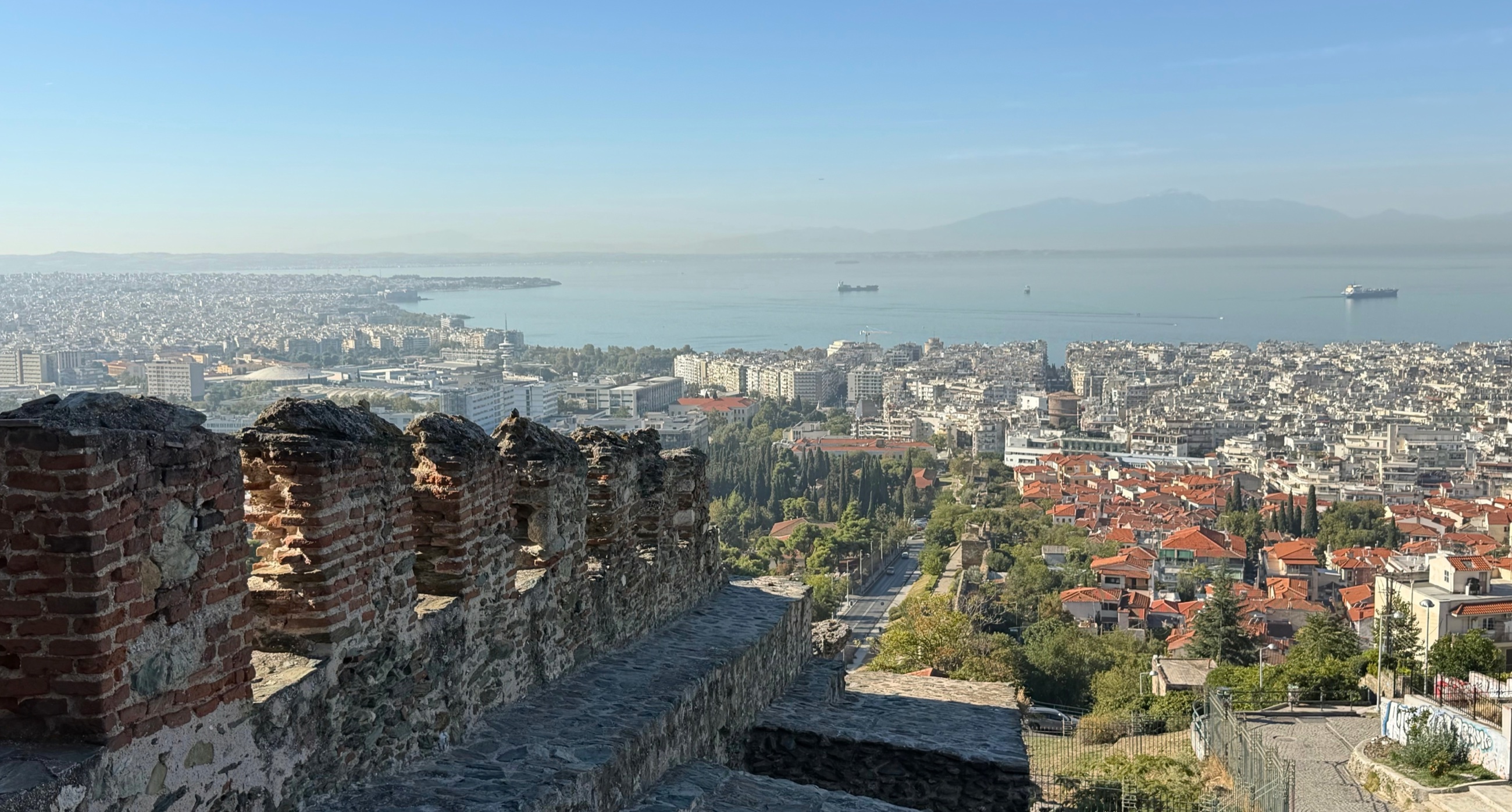 From Ano Poli, Thessaloniki spreads below the surviving Byzantine walls, from the red-tiled upper neighborhoods to the Rotunda and across the dense city center to the Thermaic Gulf.
Thessaloniki follows the curve of the Thermaic Gulf, its center laid out between a long seafront promenade and the steep residential hills of Ano Poli. The city was founded in 315 BC by Cassander, one of the generals who divided Alexander the Great’s empire, and he named it for his wife, Thessalonike, Alexander’s half-sister. That makes the city roughly twenty-three centuries old, and nearly every period of those centuries has left something standing in the center. We spent our first full days learning it on foot.
Saturday’s walk covered about seven miles. We started near the port and followed the waterfront east to the White Tower, now the city’s emblem and the image on half its postcards. Its history is darker than the postcards suggest. The Ottomans built it as part of the harbor fortifications, and it later served as a prison and place of execution, long enough to earn the name Tower of Blood. The usual story holds that a prisoner whitewashed the exterior in the 1890s in exchange for his freedom, and the name changed with the paint. Farther along the promenade, Alexander sits astride Bucephalus, looking toward the sea. Macedonia is never far from the surface here. Alexander was born at Pella, about twenty-five miles west of the city, and the kingdom he inherited grew from this plain.
Turning inland brought us into Aristotelous Square, the city’s grand civic axis, with a bronze Aristotle seated among the cafés. The square belongs to the Thessaloniki that rose after the fire of 1917, which destroyed much of the historic center in a single August weekend. The French architect Ernest Hébrard drew up the new plan, and his broad avenues and long sightlines to the water still organize downtown.
From there, the centuries stack closer together. The Roman Forum lies below street level in a square ringed by apartment blocks, uncovered by accident in the 1960s when the city began digging foundations for a new courthouse. Most of what is visible today, the paved courtyards, the small restored odeon (performance hall), and the vaulted storage galleries called the cryptoporticus, dates to the second century AD, built over the city’s earlier marketplace. That marketplace is where Acts sets the end of Paul’s Thessaloniki stay. His opponents rounded up idlers from the agora, set the city in an uproar, and, unable to find Paul, dragged his host Jason before the city officials, whom Luke calls politarchs. The title is rare in ancient writing, and inscriptions later confirmed Luke’s usage, among them one from the city’s Roman-era Vardar Gate, now in the British Museum. A few blocks away, three of the city’s great Byzantine churches sit inside working neighborhoods, which we return to below.
The afternoon ended in the covered markets. Modiano and Kapani are a dense grid of stalls selling fish from the Aegean, cheese, cured meat, spices, produce, and olives stacked in pyramids by the dozen varieties, with small tavernas and coffee counters wedged between them. We finished in Ladadika, the former oil merchants’ quarter near the port (the name comes from ladi, Greek for oil), where restored nineteenth-century warehouses now hold tavernas and bars and fill up after dark.
We gave Ano Poli, the Upper Town, its own morning, a loop of about five miles from our front door and back. We walked north past the Arch of Galerius and the Rotunda, then climbed through the pine-shaded paths of the Pasha Gardens on the slope below the walls. The climb is steady, but we handled it in stride after a month of climbing the hill daily in Sarandë. The hillside has been enclosed within Thessaloniki’s defensive walls for centuries, rebuilt and extended through the Roman and Byzantine periods. It sat high enough to escape most of the 1917 fire, so the houses standing today, many of them from the Ottoman centuries, survive here and almost nowhere else.
Our first stop was the spring known as Apostle Paul’s Holy Water, just below the Church of Saint Paul. The church was completed in the early twentieth century in the Byzantine style, and its interior is calm and carefully kept. The spring itself, in a small cave, is now covered; we looked in through iron gates. Tradition holds that Paul stopped here to drink as he left the city by night. Visitors are expected to cover shoulders and knees.
From there we followed the eastern Byzantine walls uphill to the Trigonion, a round tower added at the northeast corner of the walls in the early Ottoman period. At the plaza beside it, the city falls away in terracotta roofs to the deep blue of the Thermaic Gulf. Higher still stands the citadel’s keep, the Heptapyrgion, also known by its Ottoman name, Yedi Kule, “seven towers.” It served as a fortress under the Byzantines and the Ottomans, became a state prison in the late nineteenth century, and held inmates until 1989. We walked the dirt path around its outside and climbed onto the broad top of the walls, which run off in several directions farther than we could follow them. At their greatest extent, Thessaloniki’s fortifications circled the city for about 4.3 miles; nearly 2 miles survive, much of it here in Ano Poli.
On the back side of the wall, a small neighborhood café called Brusco gave us a reason to sit for a while in the shadow of the stones, with a Greek coffee and a cappuccino. Nearly everyone else there seemed to live within a few streets.
Just below the citadel, about 427 feet above the sea, sits Vlatadon Monastery, founded in the fourteenth century and the only Byzantine monastery in the city that has operated continuously for nearly seven hundred years. A small flock of peacocks is kept in its courtyard. From the terrace, the geography of Thessaloniki assembles itself: the tiled roofs of Ano Poli directly below, then the dense white blocks of the modern center, then the waterfront and the Gulf, with Mount Olympus standing on the far side. We stepped inside the monastery for a few quiet minutes before starting down.
From the monastery we came down the way Ano Poli’s residents do, through steep cobbled lanes. The houses here carry the neighborhood’s mixed past: timber-framed Macedonian and Ottoman-era homes painted mustard, pink, and dusty blue, with heavy wooden doors and enclosed upper floors, called sahnisia, projecting over the street. Old stone fountains with Ottoman inscriptions in Arabic script still sit in the corners of the lanes. A few days of walking had covered more than two thousand years of urban history without leaving the city we live in.
🎨 Cultural Deep Dive
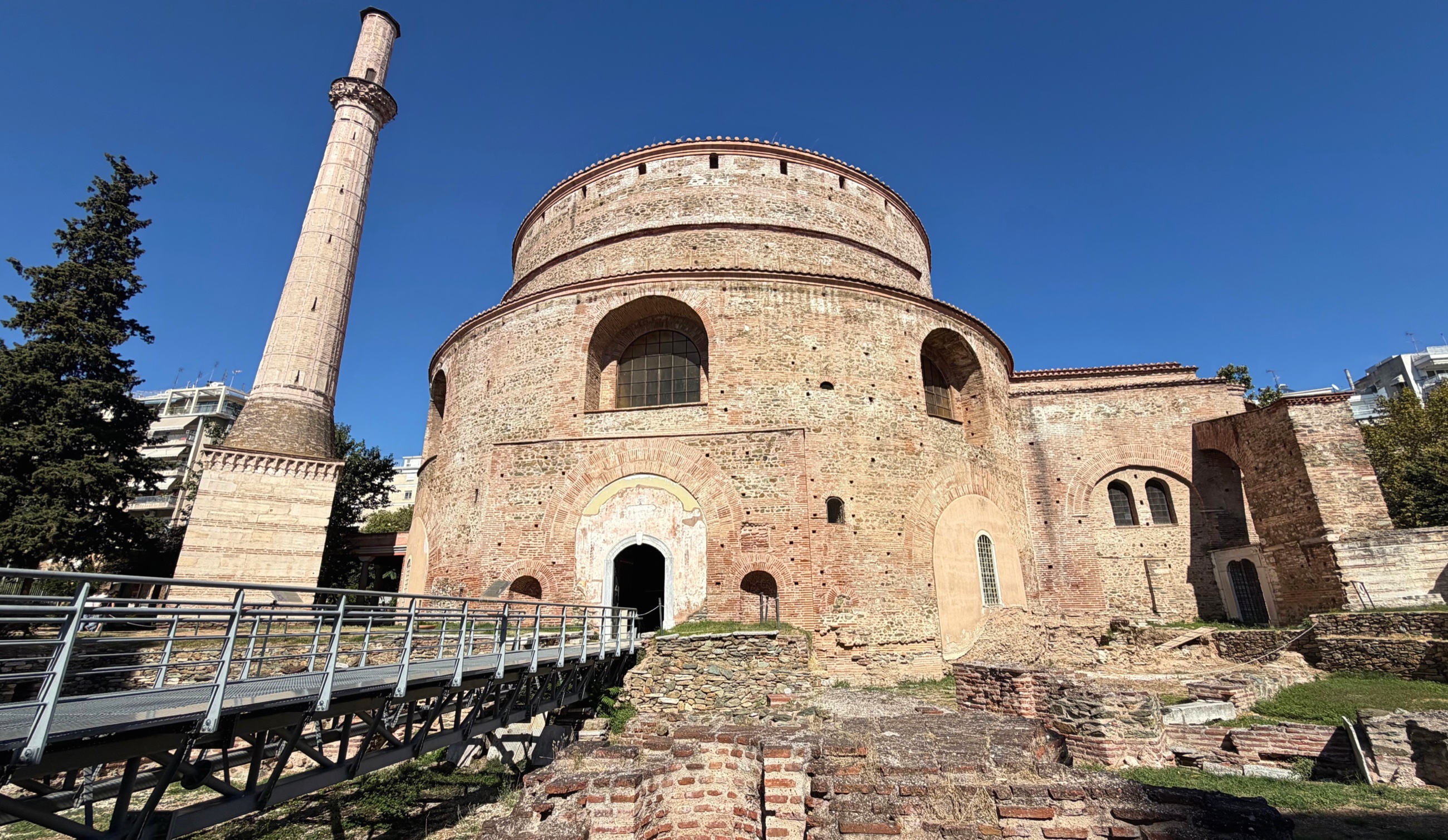 The Rotunda, built under Galerius around AD 306, later served as a church and Ottoman mosque. Today it is a protected monument, with its surviving minaret still standing beside it.
The ruins across the street from our apartment belong to one of the most consequential chapters in Thessaloniki’s history. Around the turn of the fourth century, the emperor Galerius made the city an imperial seat and built a complex to match: a palace, a hippodrome, a ceremonial arch, and the Rotunda, all tied together by a formal processional route. Parts of that route still set the line of the streets we walk every day.
The Story carries a connection to another place we lived this year. Galerius was the son-in-law and chosen successor of Diocletian, whose retirement palace became the old town of Split, Croatia. We spent May walking through that palace every day, past Diocletian’s mausoleum. When Diocletian abdicated in 305 and withdrew to the Dalmatian coast, Galerius became senior emperor in the East and governed from here. In Thessaloniki, we are living among the buildings of the next imperial generation.
The Arch of Galerius, known locally as Kamara, commemorates his campaign against the Sassanid Persians. Its marble reliefs of soldiers, captives, and the emperor himself have weathered badly, but enough survives to follow the scenes, and they sit directly above one of the busiest pedestrian corridors in the city. Students pass beneath it on their way to Aristotle University. People arrange to meet under it the way other cities use a clock tower or a fountain.
Galerius is remembered for more than his monuments. With Diocletian, he drove the Great Persecution that began in 303, the last and most severe imperial campaign against Christians. Each city now honors one of its victims as patron saint. In Split it is Domnius, bishop of nearby Salona, executed under Diocletian in 304. In Thessaloniki it is Demetrius, martyred in the same years, by tradition on Galerius’s orders. In 311, gravely ill, Galerius issued an edict granting Christians legal toleration and asking them to pray for him. Two years later, under the better-known Edict of Milan, Constantine and Licinius extended religious freedom across the empire and restored confiscated Christian property.
Uphill from the arch stands the Rotunda, a massive brick cylinder built around AD 306. Its original purpose is still debated, though it has long been read as the mausoleum Galerius intended for himself, a counterpart to Diocletian’s in Split. If so, it never received him. Galerius died in 311 at Serdica, modern Sofia, and was buried near his birthplace at Felix Romuliana, in what is now eastern Serbia, the country we move to next. The building he left empty went on without him. By the late fourth or fifth century it had become a church, today dedicated to Saint George, and received some of the finest early Christian mosaics in the eastern Mediterranean; it served as a mosque under Ottoman rule, which is why a minaret still stands beside it; and in the twentieth century it passed back into Christian and civic use. Split followed the same course: Diocletian’s mausoleum became the cathedral of Saint Domnius, the bishop he had executed. The two imperial monuments went up within a year or so of each other and are among the oldest standing buildings anywhere now used as churches. The Rotunda came to Christian use first; Split’s mausoleum was consecrated three centuries after it was built.
That pattern of reuse runs through the whole city. Rome took it from the Macedonian kings in 168 BC and built the Via Egnatia through it, the road linking the Adriatic and the Bosporus. Under Byzantium it became one of the empire’s greatest cities, regarded as second only to Constantinople (Istanbul). Western crusaders held it for twenty years after 1204, and Venice for seven, before the Ottomans took it in 1430. Ottoman rule lasted nearly five centuries, until the garrison surrendered to the Greek army in 1912 on the feast day of Saint Demetrius.
The city’s Jewish history reaches back to antiquity; Acts places a synagogue here when Paul arrived. After Spain expelled its Jews in 1492, tens of thousands of Sephardic refugees settled here, and for generations Thessaloniki had one of the largest Jewish communities in the world; the Modiano market where we shopped on Saturday takes its name from the Jewish family who built it in the 1920s. In 1943, under German occupation, more than 45,000 of the city’s Jews were deported to Auschwitz-Birkenau, and very few returned. Fire, war, the population exchange of 1923, and rapid postwar growth followed or overlapped. Pieces of every one of those cities are still visible, though the Byzantine inheritance is the strongest. Fifteen of Thessaloniki’s early Christian and Byzantine monuments together form a UNESCO World Heritage Site, and several are working churches rather than archaeological shells.
Agios Dimitrios is the largest, dedicated to Demetrius himself. The present basilica was largely rebuilt after the 1917 fire on its seventh-century plan, and beneath it a crypt, part of a Roman bath complex, is traditionally held to be the place of his imprisonment and martyrdom. Acheiropoietos dates to the mid-fifth century and is one of the oldest basilicas in the eastern Mediterranean still standing to its original height. It was built directly over Roman baths, and their geometric mosaics are visible through glass panels in the floor. Hagia Sophia, built in the eighth century, shares its name with the great church in Istanbul, where we lived this March, and holds a golden dome mosaic of the Ascension.
That history still functions as more than architecture. On Sunday evening we returned to Hagia Sophia for Vespers. The interior was dimmer than it had been during our daytime visit. Incense hung under the dome, and three male cantors carried the service without instruments, the chant moving between them in sustained tones and responses. Vespers is built almost entirely from Scripture and very old hymnody: the evening psalms, beginning with Psalm 104; verses of Psalm 141 alternating with hymns for the day; the Song of Simeon from Luke 2; and “O Gladsome Light,” a hymn already called ancient in the fourth century. Byzantine chant carries all of it on a single melodic line over a sustained drone called the ison, with no harmony. The hymns and the building serve the same end, the worship of God, and Byzantine builders shaped their domes and vaults to carry the voices raised in it. In 2014, an international team of scholars measured the acoustics of eight of the city’s Byzantine churches, Hagia Sophia among them, to understand how chant and speech reached the people who first worshiped in them. Sitting under the dome, we did not need the measurements. The sound filled the whole space and stayed in the air after each phrase ended. We had spent Saturday studying Byzantine Thessaloniki through mosaics, brickwork, and dates. Sunday evening showed us the purpose those buildings were raised for, still being carried out inside them.
The same continuity reaches up the hill to Vlatadon. Local tradition holds that the monastery’s main church stands on the spot where the Apostle Paul preached to the Thessalonians during his visit around AD 50, on his second missionary journey. The Book of Acts records that he spent three Sabbaths reasoning in the synagogue before the uproar in the marketplace made it dangerous to stay, and the believers sent him and Silas out of the city by night, toward Berea. Tradition places his departure through a small gate in the upper walls, past the spring we stopped at on our way up. The exact locations belong to tradition rather than archaeology, and that distinction matters. What is not in doubt is what came next: within a year or so, Paul wrote to the small congregation he had been forced to leave behind. In it he reminds them that he worked night and day while among them so as not to be a burden to anyone. First Thessalonians is generally counted among the earliest Christian writings that survive, a letter addressed to people who lived in the very streets we have been walking this week.
🍽️ Local Flavor
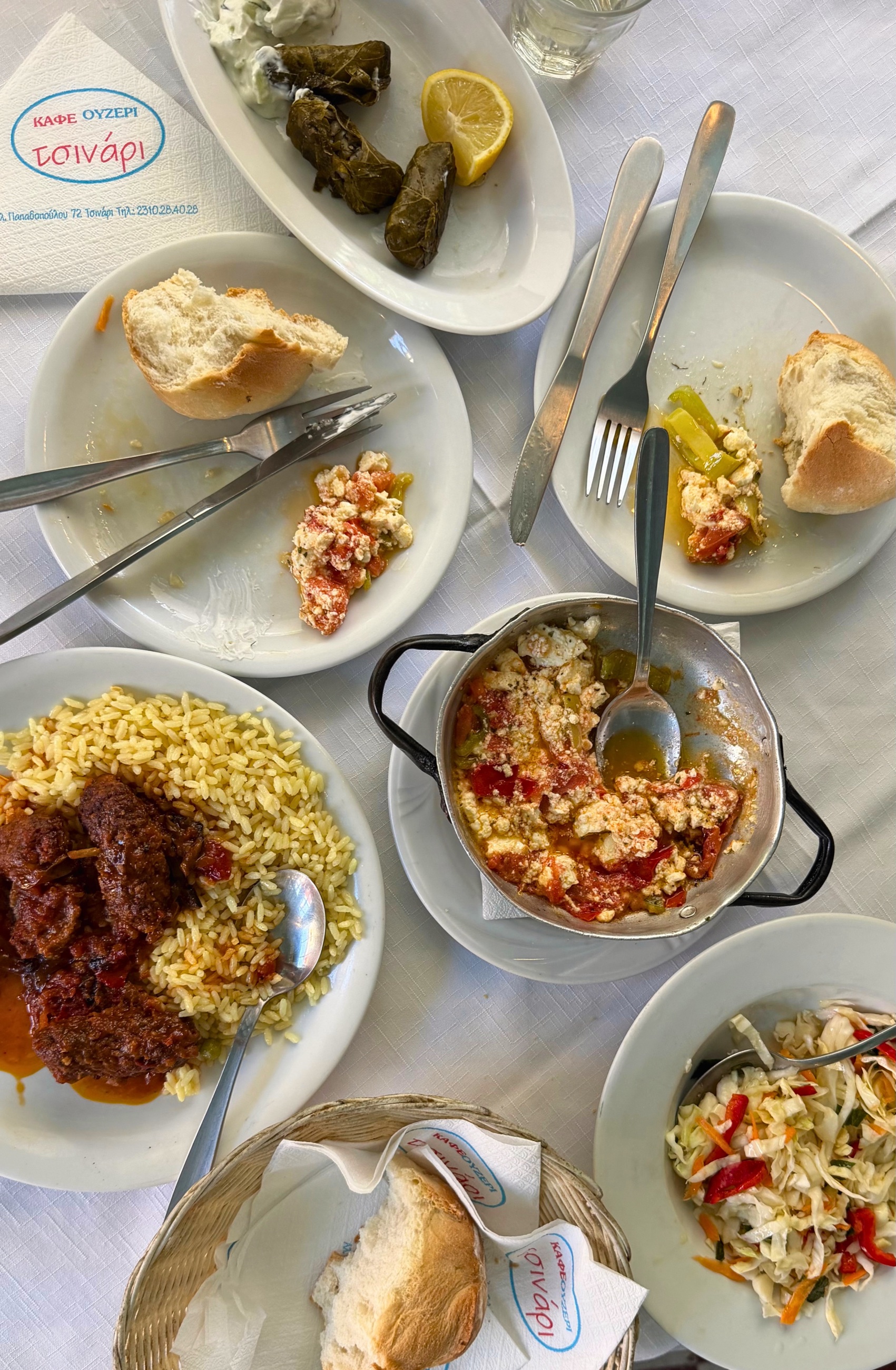 At Ouzeri Tsinari, plates arrived as they were ready, so by the time the bougiourdi, soutzoukakia, politiki salata, and dolmadakia had filled the table, lunch was already well underway.
Our first meal in Greece set the direction. Bougatsa is the pastry most closely tied to Thessaloniki: layers of thin phyllo baked around a filling of semolina custard, cheese, or minced meat, then often cut into squares. The sweet version, dusted with powdered sugar and cinnamon, is the classic breakfast here. We ate the savory version at a bakery in Igoumenitsa, hours before we reached the city it belongs to.
The most useful discovery so far has been the mageireio, the traditional Greek cooked-food kitchen. The format is simple. The day’s dishes sit in large trays behind the counter; you look, point, and either sit down or take a box home. Greeks often describe eating at one as eating at a grandmother’s table, which feels about right. For Sunday lunch we went to To Limeri (Το Λημέρι), a small neighborhood mageireio away from the busiest visitor streets. Traditional Greek music played quietly in the dining room. We ordered the house wine, a large square of pastitsio, baked layers of pasta and spiced ground meat under a thick béchamel, along with papoutsakia, roasted eggplant filled with seasoned ground beef and topped with béchamel, almost like moussaka without the potatoes. We also added a plate of eggplant and peppers slow-cooked in tomato and olive oil until they collapsed. At the end, a dessert we had not ordered arrived at the table. We still are not sure what it was, only that we devoured it. The whole lunch for two came to €19 ($22).
Timing matters with places like this. A mageireio cooks for lunch, not for a late Mediterranean dinner, and many close around 6:00 p.m., once the trays are empty. Arrive early in the afternoon and the full day’s cooking is still on offer.
The same unordered finish followed dinner on Sunday. After Vespers we walked to Nostos, a traditional taverna arranged like part of a Greek house, with music playing and servers moving easily inside and out. We shared several plates and some wine, and then a complimentary dessert appeared. Dinner came to €30 ($35). Apparently, unexpected sweets are becoming a Thessaloniki tradition for us. Earlier in the weekend we kept it simpler: a cocktail at a neighborhood bar, then pizza at Girasole, just off a busy square.
We ended the Ano Poli morning with lunch at Ouzeri Tsinari, an old taverna beside an Ottoman fountain, shaded by a huge plane tree. Every door and window stood open to the autumn air, and from a window seat the street felt like part of the room. With house wine, we ordered four plates. Bougiourdi is a Thessaloniki original: feta baked in a clay pot with tomato, hot peppers, oregano, and olive oil, made to be scooped up with bread. Soutzoukakia smyrneika are oblong beef meatballs heavy with cumin and garlic, slow-cooked in tomato sauce, a dish that came to Thessaloniki with refugees from Smyrna after 1922. Politiki salata, “Constantinople salad,” is shredded cabbage and carrot dressed with vinegar and garlic, refugee cooking from the city we lived in this March. Dolmadakia, grape leaves stuffed with herbed rice, came warm with lemon. Then, came the complementary baklava and a slice of galatopita, a Macedonian milk pie baked without phyllo until its top caramelizes. The pattern held. Lunch for two came to €25 ($29). From there we rolled downhill all the way back to the apartment and an afternoon of work.
Coffee deserves nearly as much attention as the food. Traditional Greek coffee, boiled slowly in a small pot and served with the grounds settled in the cup, still has its place, but modern Thessaloniki runs on the Freddo. Its predecessor, the frappé, was born here: instant coffee shaken with ice and water, improvised at the Thessaloniki International Fair in 1957. The Freddo espresso and Freddo cappuccino are everywhere: specialty cafés, bakeries, takeaway windows, and the hands of students crossing between classes. Our apartment even came with a milk frother, which has let us make our own Freddo’s at home.
That has proved useful, because good coffee costs more here than in our recent Balkan stops. A café drink generally runs €3 to €4 ($3.50 to $4.70), so we have cut back to about four café visits a week and make Freddos at home on the other days. There is also a tax reason behind how Thessaloniki drinks its coffee. Since July 2024, coffee served at a table carries Greece’s standard 24 percent VAT, while coffee sold to take away carries the reduced 13 percent rate, so many cafés post two prices for the same drink. Add a very large university population, and takeaway coffee here feels completely natural. In much of Europe, a coffee to go still reads as a small failure of manners. Here it is simply how a busy student city gets through the morning.
We still sit down when we can. One afternoon we lingered on the patio at Sortie, near the university, watching students and everyone else move along the sidewalk. On another walk we came upon the second-anniversary party for The Old Cookie, where a line had formed for slices of a giant cookie cake and a free Freddo with any cookie purchase. We joined the line, and the cookies justified it.
💰 Nomad Real Talk
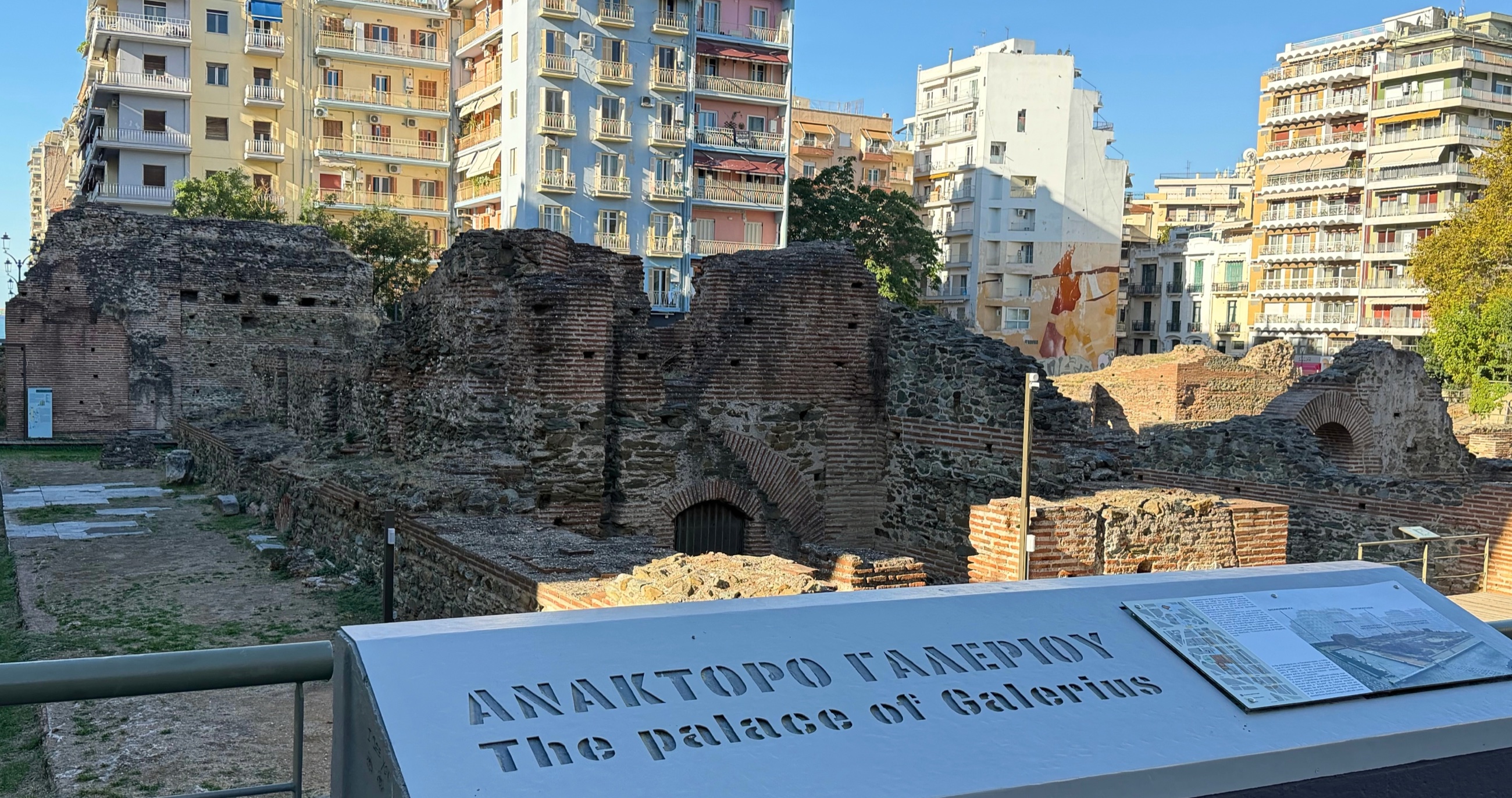 The Palace of Galerius sits directly across the street from our apartment, so we pass Roman ruins every time we step outside.
Twelve nights is relatively short by our slow travel standards. We prefer month-long stays because a month changes how well we know a place and makes apartment living much cheaper per night. Thessaloniki is condensed on purpose. Greece is inside the Schengen Area, so every day here counts against the ninety days we are allowed within any rolling 180-day period, and we need those days later for Italy and Spain. The calendar, more than the city, set the length of this stop.
The costs reflect it. Our apartment cost $998 for twelve nights, about $83 a night, well above the monthly-discount rates we grew used to in Albania, Montenegro, and North Macedonia. Location accounts for some of the premium. We are across the street from the Galerius complex and within walking distance of the waterfront, the university, the markets, the major churches, and most of the restaurants and cafés we want, so we have not needed transportation since we arrived.
The gym followed the same logic. Protypo Fitness Center charges €10 ($12) for a day pass. With four workouts planned, we negotiated a flat €30 ($35) each for the stay, which works out to €7.50 ($8.80) a session. Over a month, both rent and gym fees usually drop considerably per day; on a twelve-night stay, there is less room to negotiate.
Getting here was reasonable. The two coach legs from Sarandë cost €15 ($18) and €41 ($48) per person, about €56 ($65) each for a full day’s travel across a border and a mountain range.
Day to day, Thessaloniki runs higher than our recent Balkan bases, especially for coffee and central lodging, though still well below Athens and the big cities of Western Europe. Food is where the value holds, and where we planned to spend. We love Greek food, and having eaten out less than usual in the Balkans, we had room in the budget for our time here. Two people can eat a substantial traditional meal for €20 to €30 ($23 to $35), often with house wine and a complimentary dessert, a fraction of the cost in Seattle or New York.
Our judgment after the first week: pay the premium for location on a short stay. Twelve central nights cost more per day than a month on the edge of town would, but they let us walk nearly everywhere, spend our limited days in the city rather than getting to it, and preserve the Schengen days the rest of the itinerary depends on.
🏠 Behind the Nomad Curtain
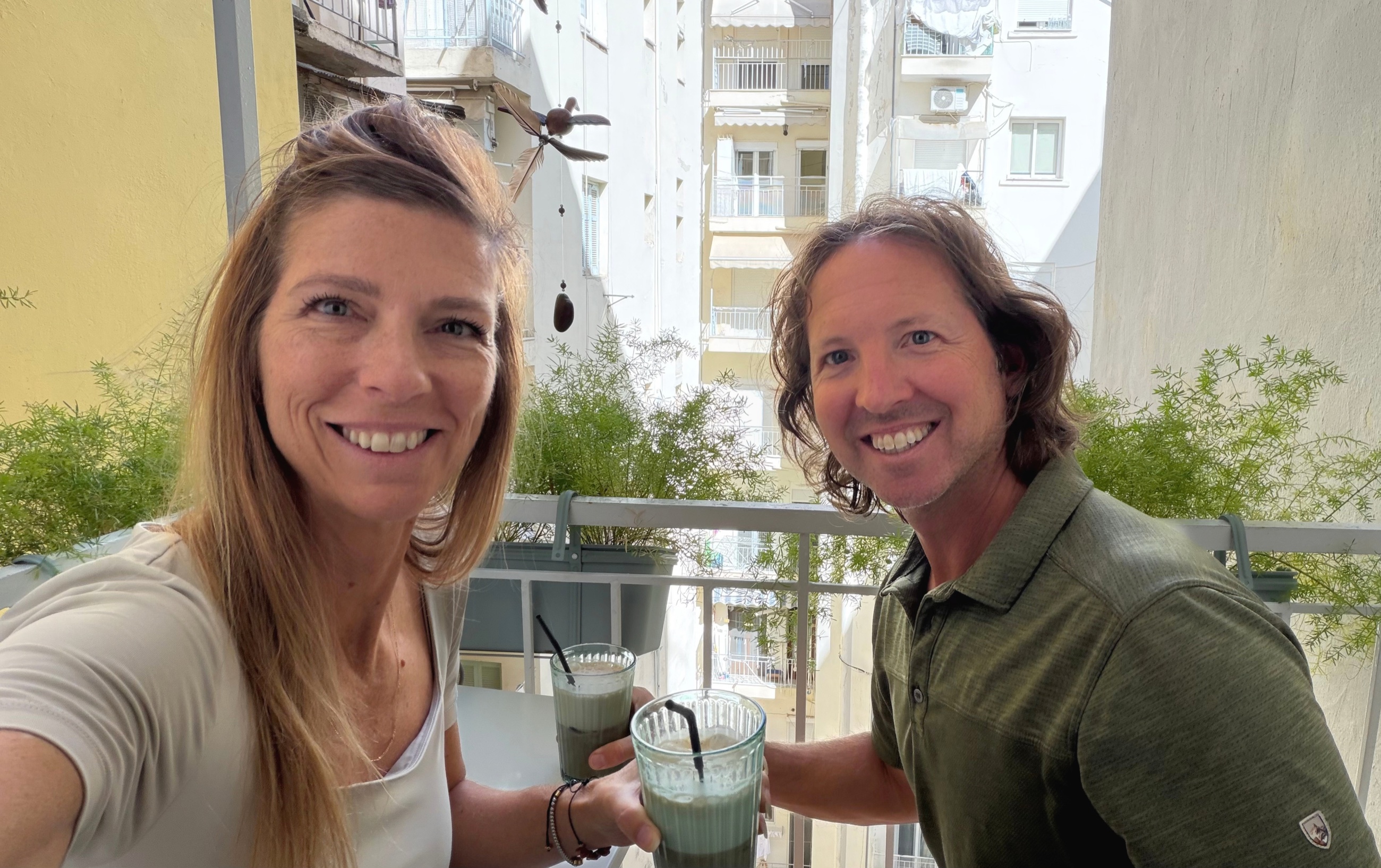 Homemade Freddo cappuccinos on our apartment balcony, one of the little things that makes even a twelve-night stay begin to feel settled.
Our apartment adds another entry to the collection of European building quirks we have gathered this year. We live on what can only be described as floor 5½. The elevator stops at the sixth floor; from there we walk down half a flight to a small landing shared by a couple of apartments. Our two balconies face inward over the central courtyard, where the archaeological remains sit among the modern walls. For Thessaloniki, it feels about right.
We are also using the stay for errands we deliberately put off during our last weeks in Albania. Greece has a strong domestic market for skincare, pharmacy, and personal-care products, with good formulations at fair prices, so we are restocking the basics: vitamins, shampoo, conditioner, face cleanser, lotion, toothpaste, and a full refresh of Stephanie’s makeup. A couple of necklaces and rings have also been waiting for repair, and Thessaloniki has a long tradition of goldsmithing and metalwork, so this is where they are being fixed.
These are small tasks, and they are a real part of what long-term travel looks like eight months in. Supplies run out. A clasp breaks. Dental cleanings come due. Over time we have learned to cluster errands around the places best suited to them rather than treating every stop the same, and to hold some on purpose until the right city comes along.
The medical and dental appointments will wait for Belgrade, where we will have a full month and good-value, well-regarded care, and where we will not have to compress appointments into a tight timeline. For Thessaloniki the list is shorter: live centrally, walk, eat well, train, restock, repair, and use the days.
📸 Photo Story
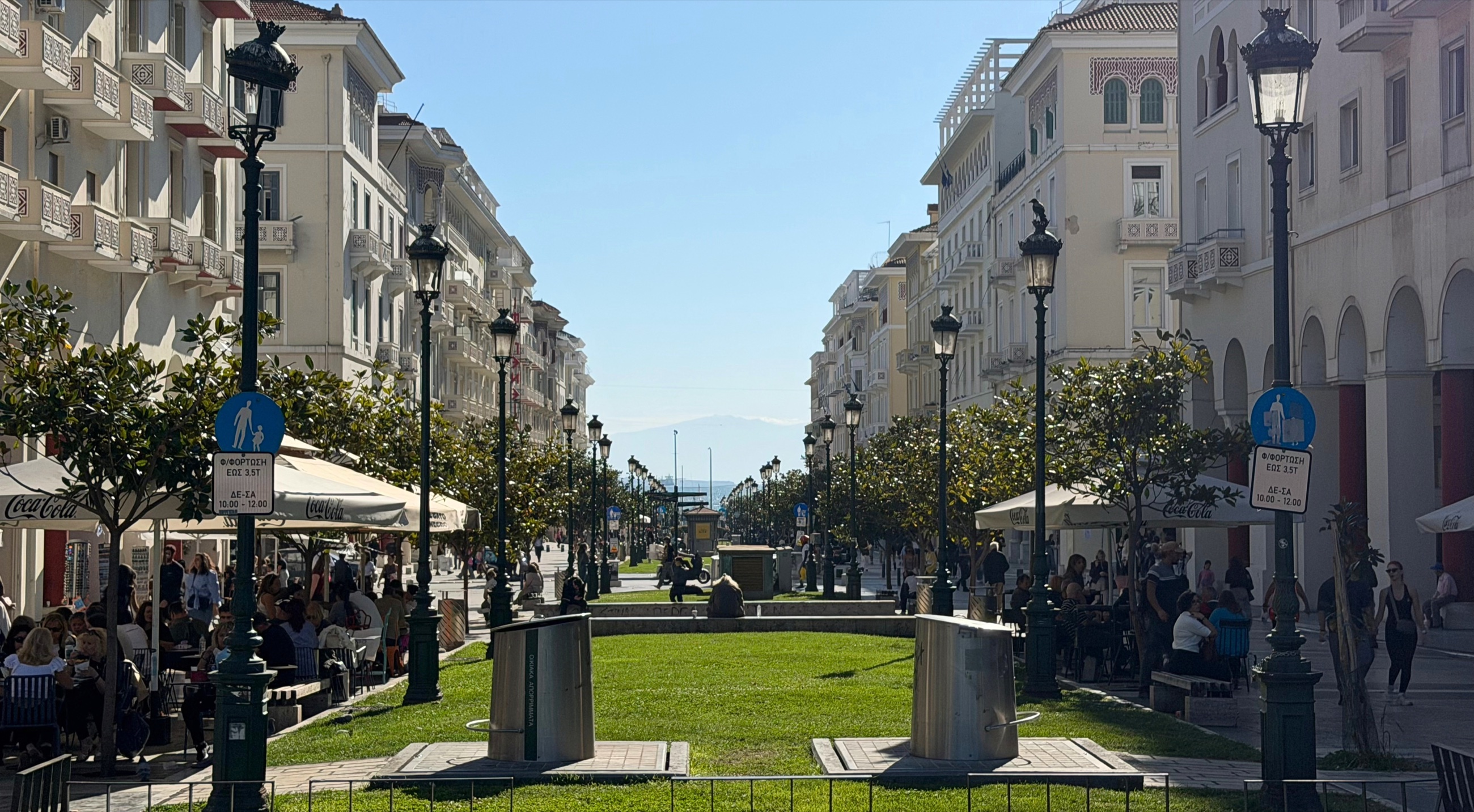 Cafés, shade trees, and apartment façades line the pedestrian approach to Aristotelous Square, with the Thermaic Gulf at the end of the street.
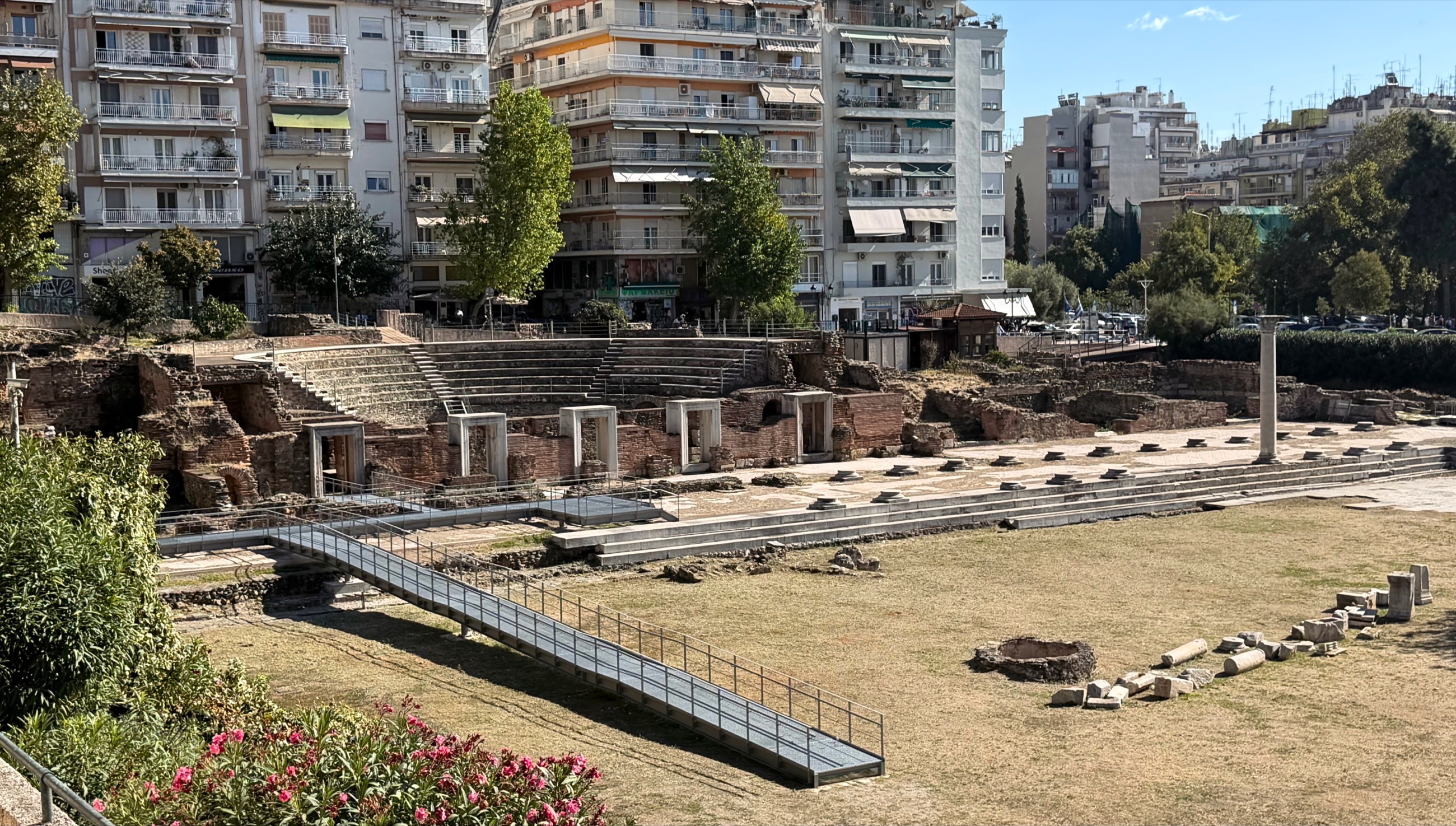 The remains of Thessaloniki’s Roman Forum sit below the surrounding apartment blocks, preserving part of the civic center that once occupied this section of the city.
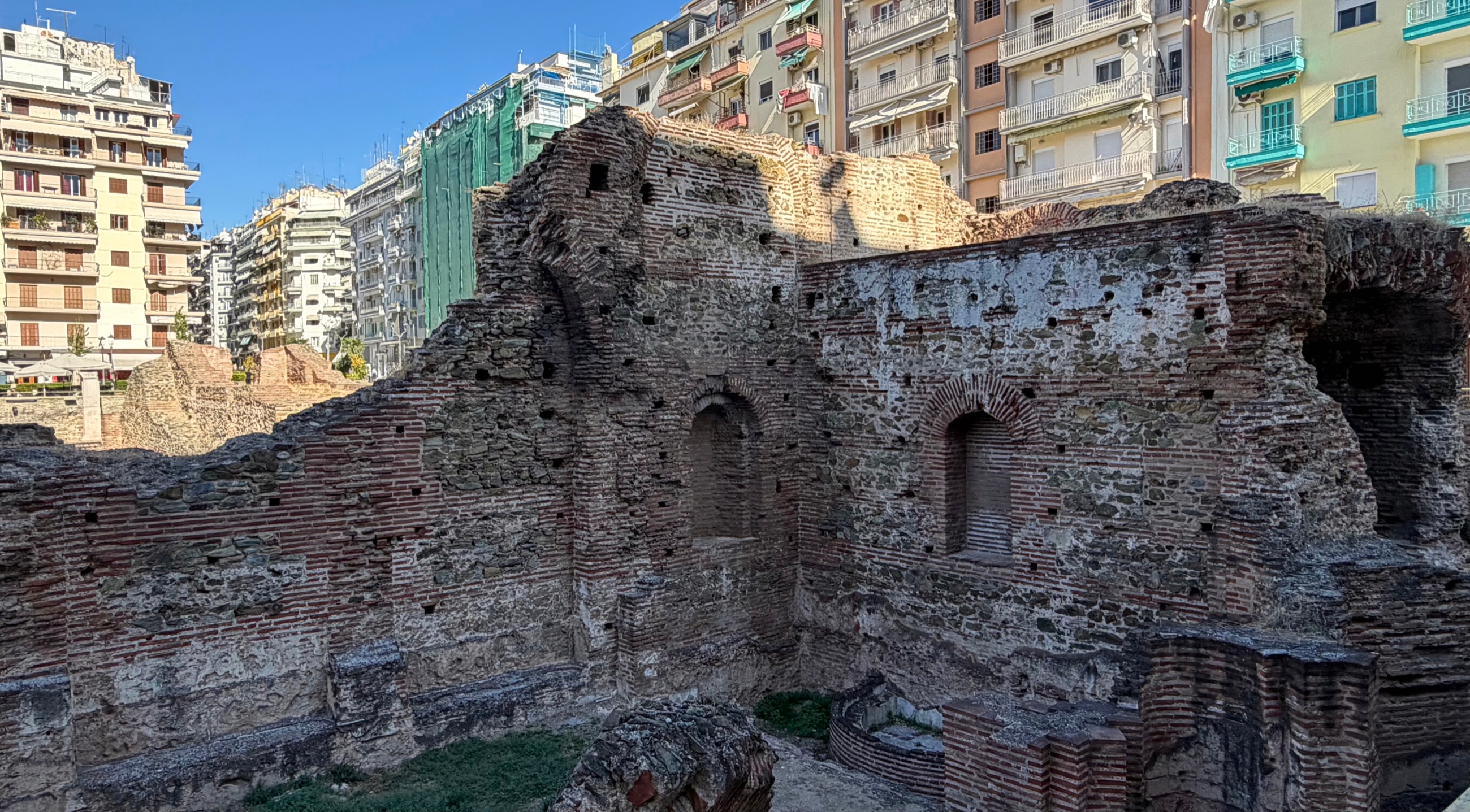 Brick walls and vaulted rooms survive from the Palace of Galerius, now embedded within the dense residential blocks of central Thessaloniki.
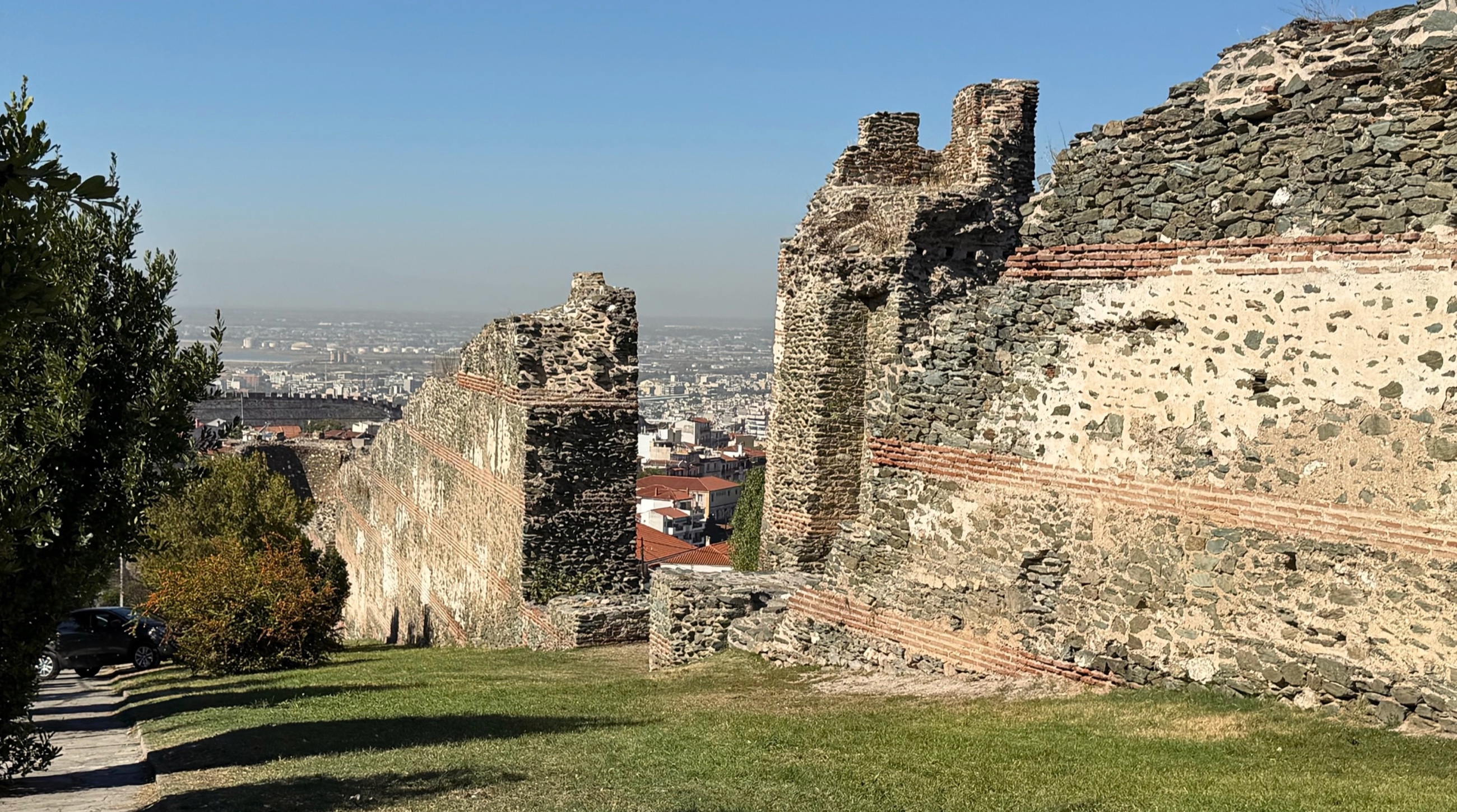 Sections of Thessaloniki’s Byzantine fortifications still descend through Ano Poli, following the steep ground above the modern city.
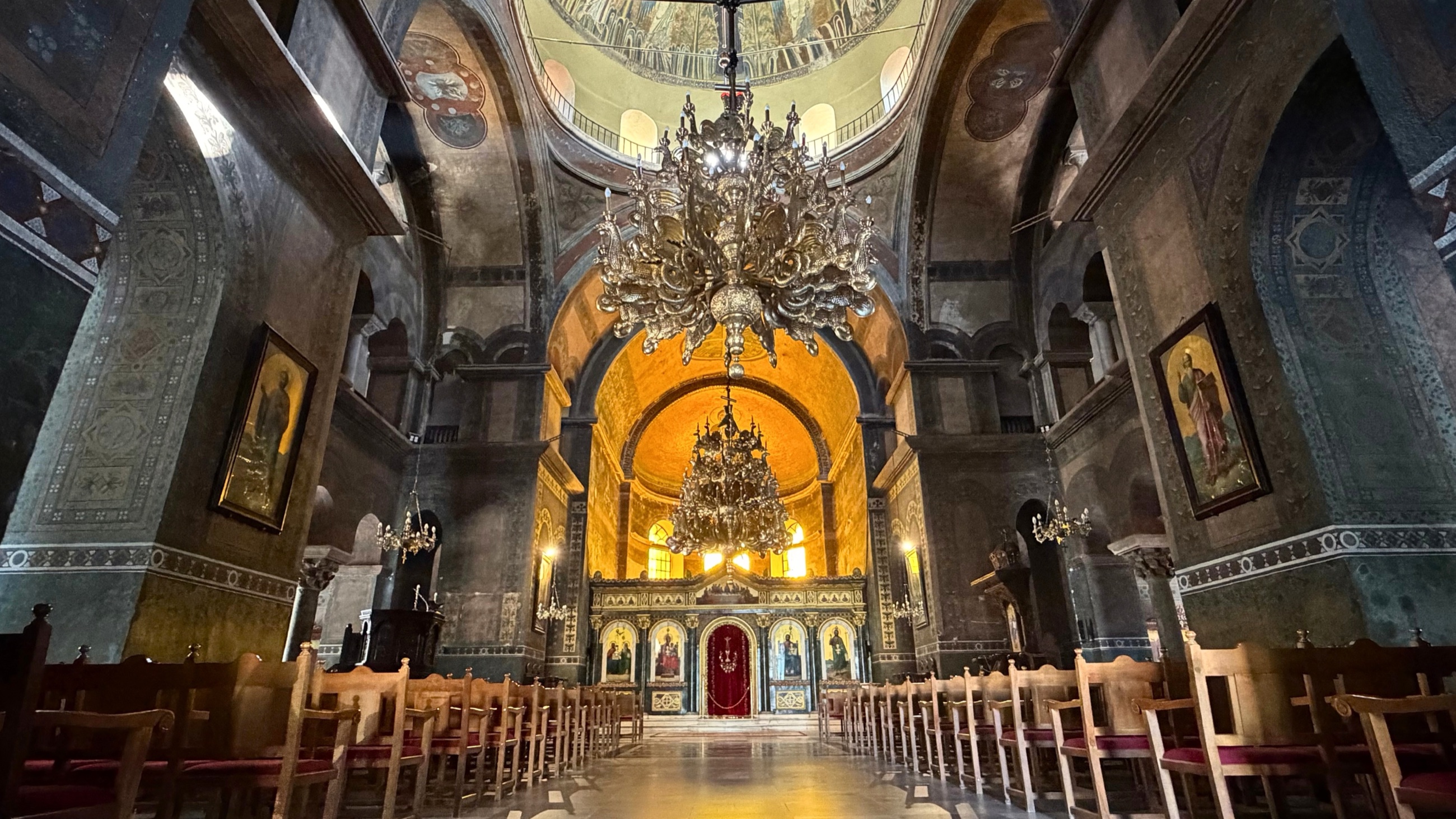 Inside Hagia Sophia, centuries of Orthodox worship remain visible in its mosaics, icons, chandeliers, and worn stone.
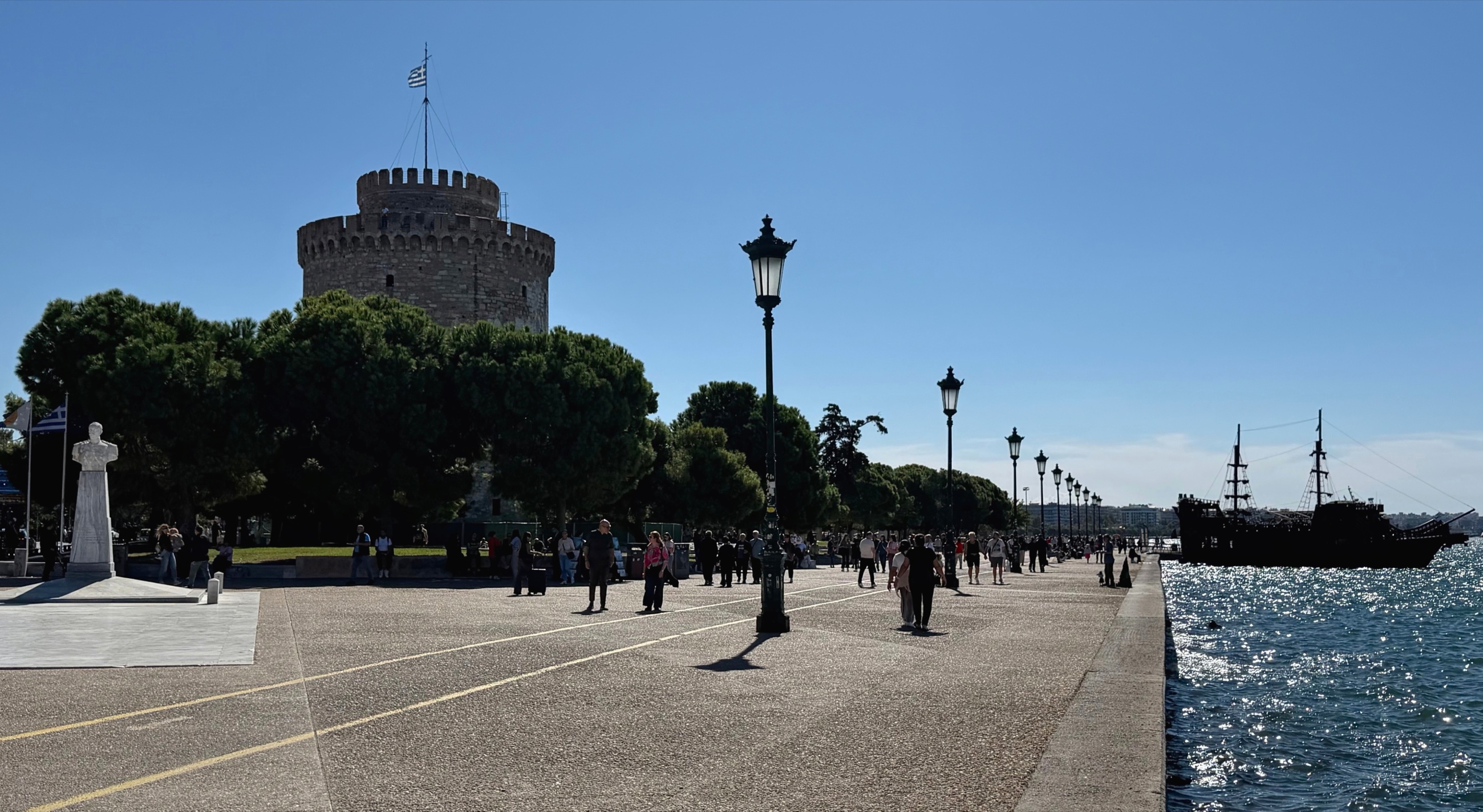 The White Tower anchors Thessaloniki’s waterfront promenade, where walkers, cyclists, cafés, and tour boats keep the shoreline active throughout the day.
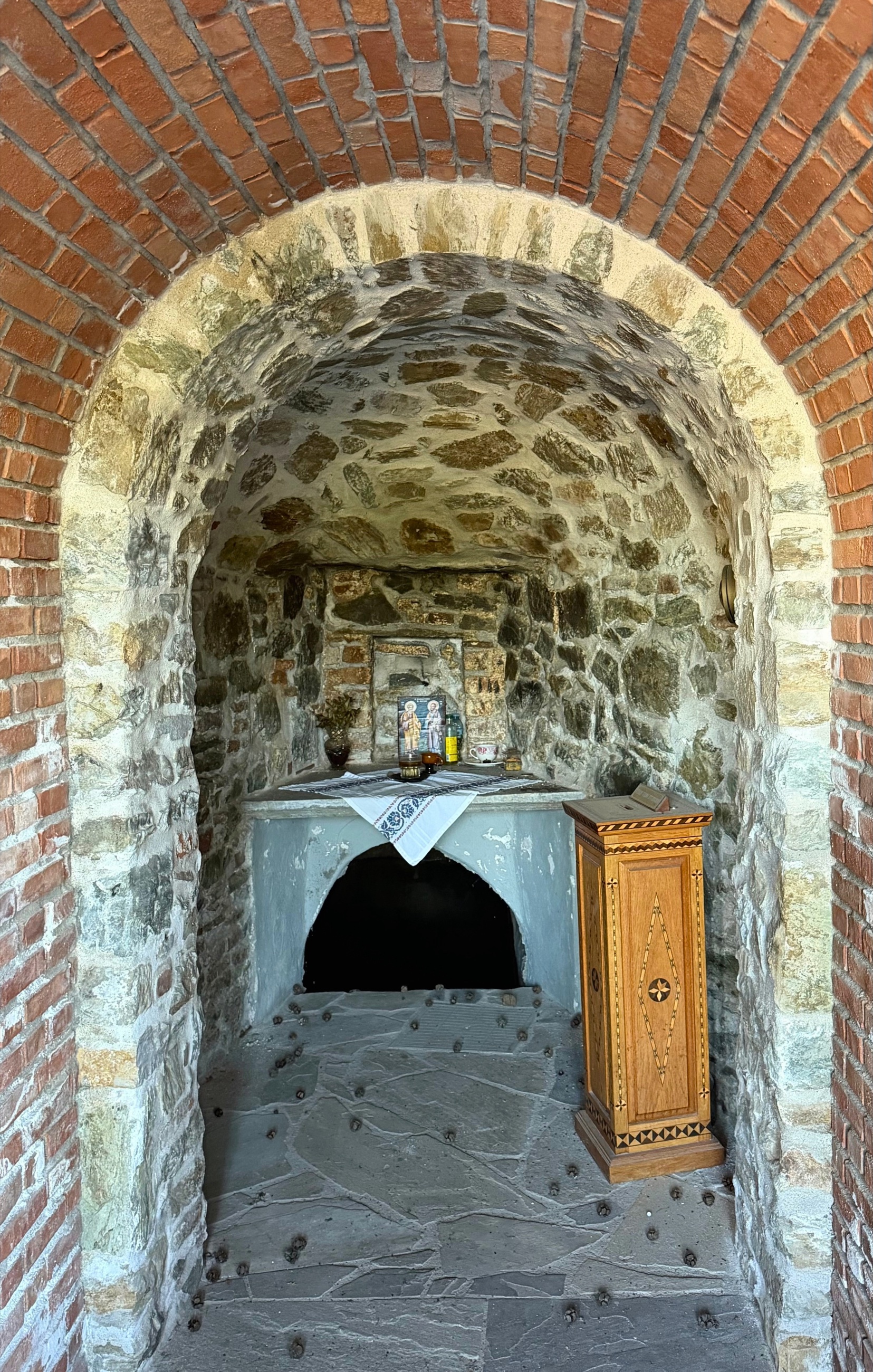 A small stone shrine marks the spring where local tradition holds that the Apostle Paul stopped for water as he left Thessaloniki.
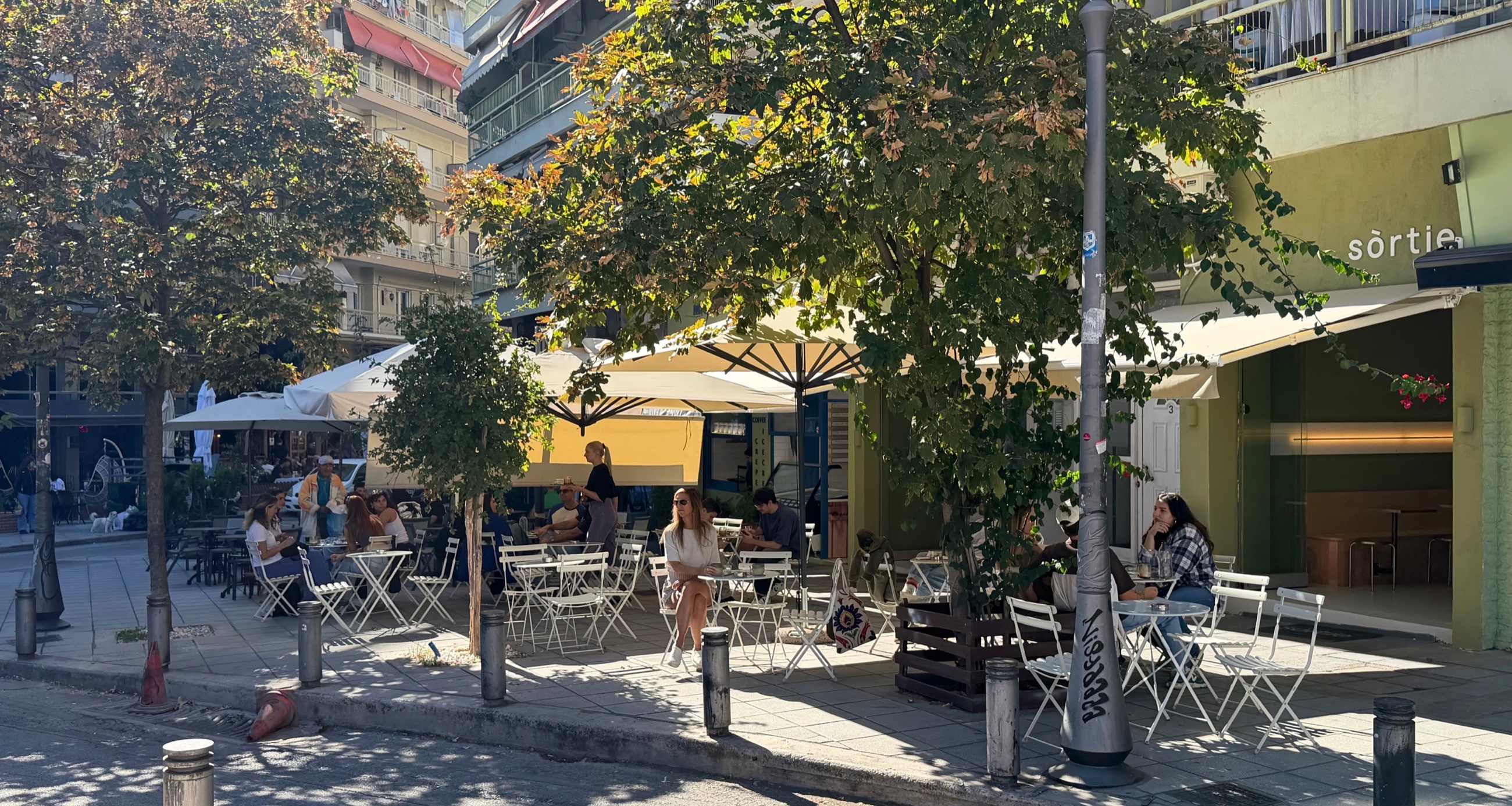 A shaded sidewalk café near our apartment captures a familiar part of daily life in Thessaloniki: long coffees, outdoor tables, and neighborhood streets.
🎯 Next Week Preview
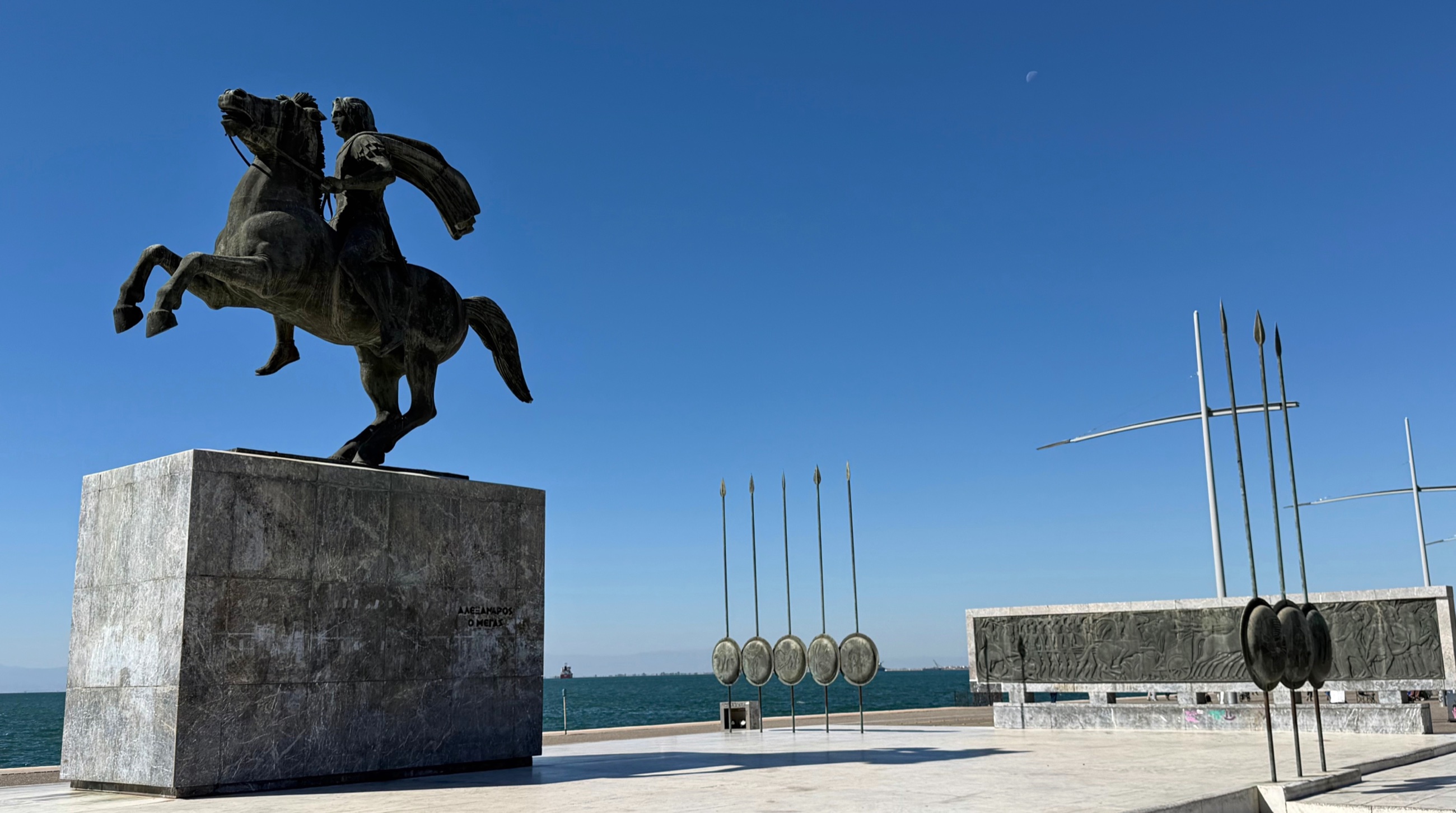 Alexander the Great and Bucephalus on Thessaloniki’s waterfront, pointing ahead to Aigai, where Alexander was proclaimed king in 336 BC.
Macedonian Kings and the Road to Berea
Our remaining days will take us beyond the city. We plan to rent a car for a day west into Macedonia, starting at Aigai, near the modern village of Vergina. This was the first royal capital of Macedon and the burial ground of its kings. Beneath a great earthen mound lie the royal tombs, including the richly furnished burial identified by most scholars as that of Philip II, father of Alexander. Alexander was proclaimed king at Aigai after his father’s assassination in 336 BC, and from there came the campaigns that remade the eastern Mediterranean. Thessaloniki remembers him in bronze on its waterfront; Aigai is where it began.
From Aigai it is a short drive to Veria, the ancient Berea. After Paul and Silas left Thessalonica under cover of darkness, Acts records that they went to Berea and singles out the Bereans for examining the Scriptures daily to test what Paul taught. In the old town, a marble-stepped monument, the Bema of the Apostle Paul, marks the traditional spot where he preached. Veria also keeps dozens of small Byzantine churches and an old riverside quarter, and it lets us pick up the story where the Vlatadon Monastery left it.
That gives us two strands of Macedonian history in a single day: the royal world of Philip and Alexander, and the early Christian communities that took root in the same cities four centuries later.
Then comes Mount Olympus. Greece’s highest mountain rises 9,570 feet almost straight from the Aegean coast. In Greek mythology it was the home of Zeus and the Olympian gods, and it remains one of the country’s great hiking landscapes. We saw it across the Gulf from Vlatadon, and we are not leaving Greece without walking its trails. We are renting a car and heading there for a proper hike.
💌 Personal Connection
On Sunday evening, an eighth-century church stopped being a historical site for about half an hour. We had walked through Hagia Sophia the day before with the eyes of visitors, reading the mosaic, counting centuries. At Vespers it was simply a parish at prayer, and we were two more people in the dim nave listening to the cantors. By Monday morning, students were filling the streets around Kamara again, takeaway Freddos in hand.
Through the spring and summer, in Ohrid, Split, Kotor, and Bar, we lived near old towns where the past is gathered in a historic core and the modern city grows around it. Thessaloniki works differently. Its history is not confined to one quarter, and the closer comparison is Istanbul, where we lived in March. Roman foundations sit between apartment blocks, cars pass under Byzantine walls, and the liturgy continues in buildings that have outlasted fire, war, and several changes of empire. The past runs through the modern city, and daily life moves through both.
We expected to feel the clock on a twelve-night stay. So far we mostly have not. So much of what Thessaloniki holds sits within a short walk of our front door that a week here has gone further than we hoped it could. We leave the apartment, turn uphill or toward the water, and the city does the rest.
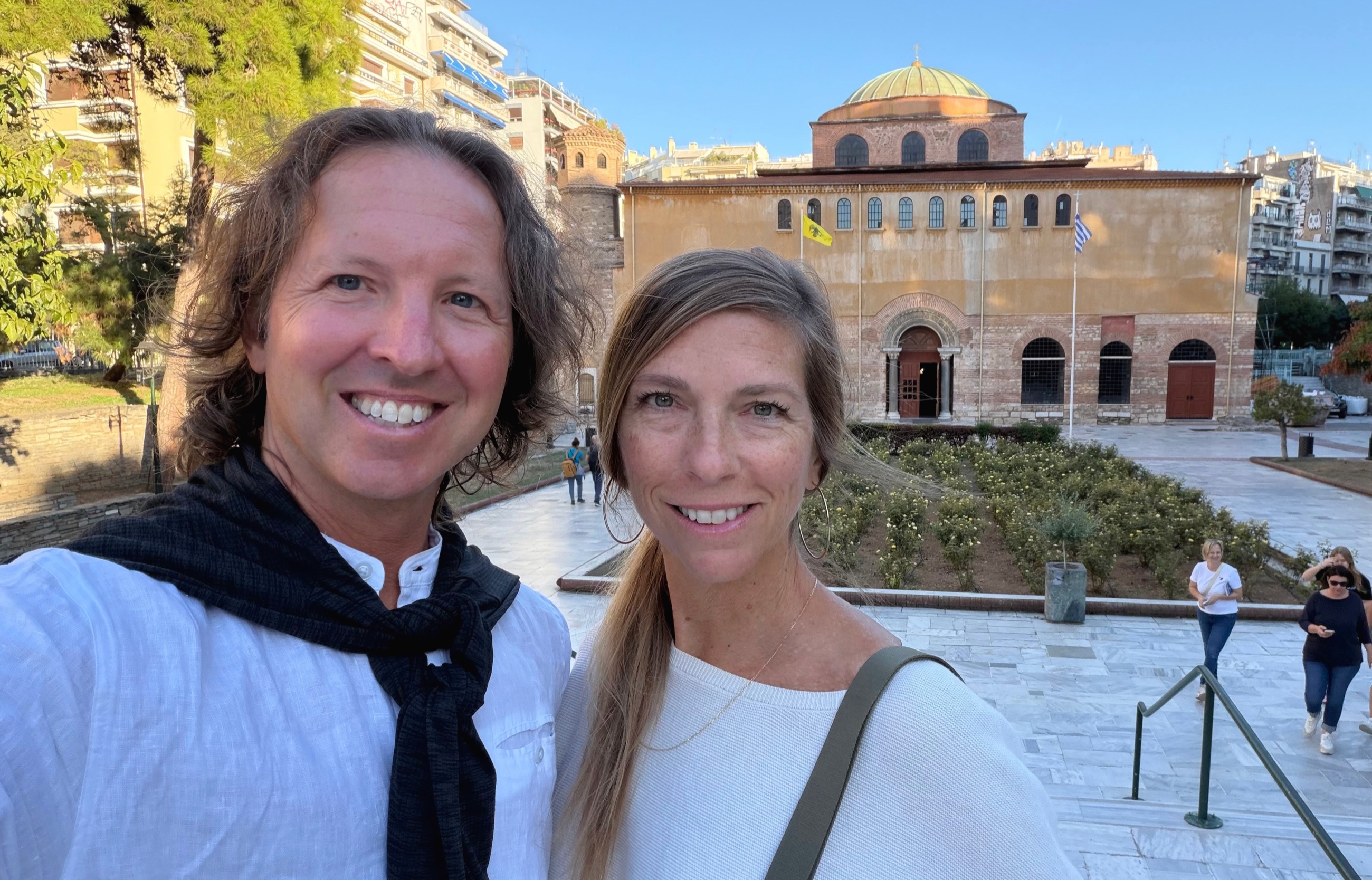 Outside Hagia Sophia before attending Sunday Vespers, where an ancient church became part of our lived experience of Thessaloniki rather than simply another historic site.
Until next week,
S&S
Some Great Place · Living Local in a Global World · somegreatplace.com