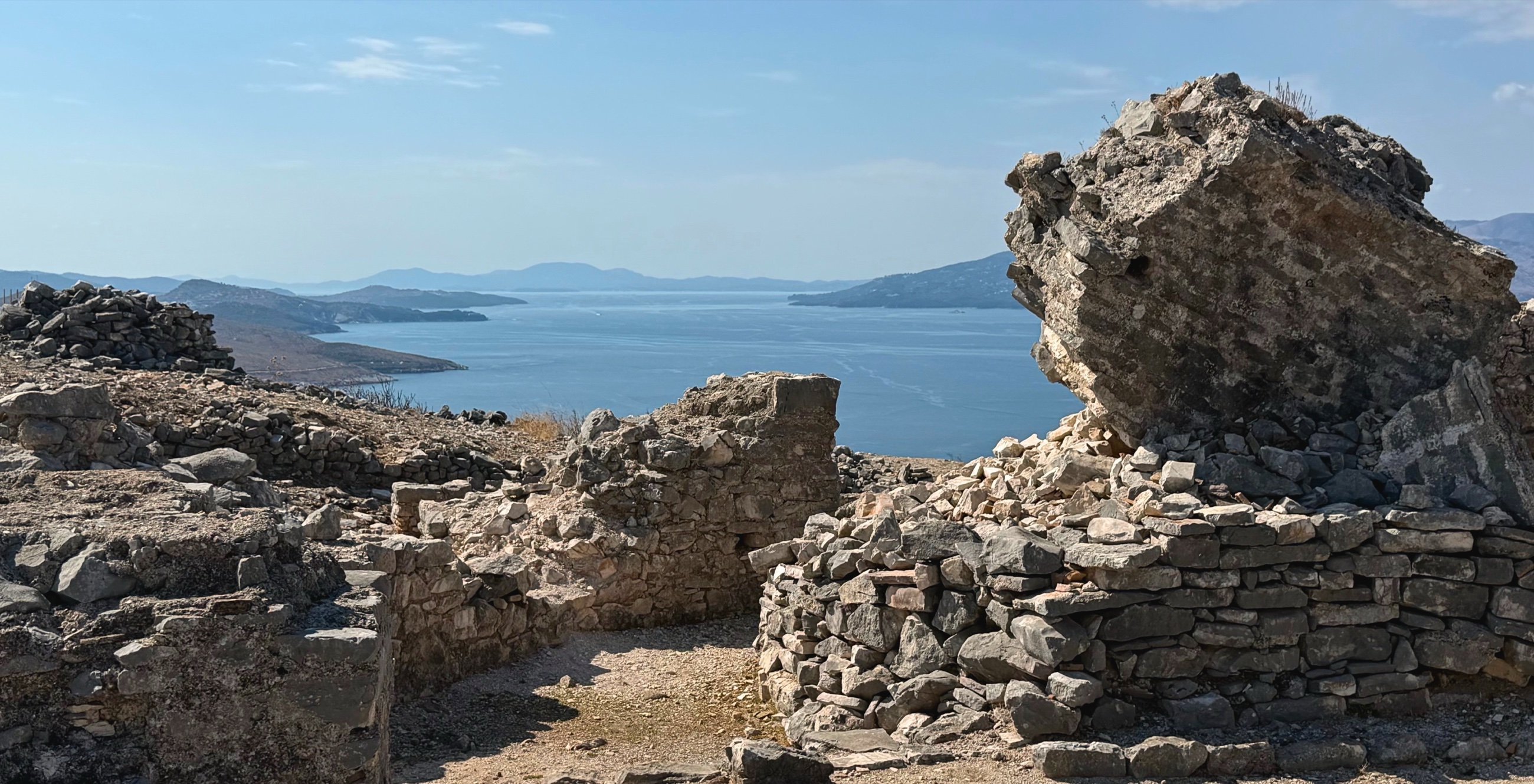
 Weathered stone ruins at the Monastery of the Forty Saints, looking down the Corfu Channel.
For three weeks we had looked up at the monastery that gave Sarandë its name without going to it. The Monastery of the Forty Saints sits on the ridge above the bay, visible from our apartment and easy to take for part of the hillside.
Last week’s Butrint gave us antiquity inside a protected archaeological landscape, with a path, a ticket, and a museum. Sarandë keeps its old city differently. It survives in fragments among apartment blocks, restaurants, bus stops, and beach umbrellas. This week we went looking for those fragments and found that most of them sat on routes we already walked.
📍 This Week in Sarandë
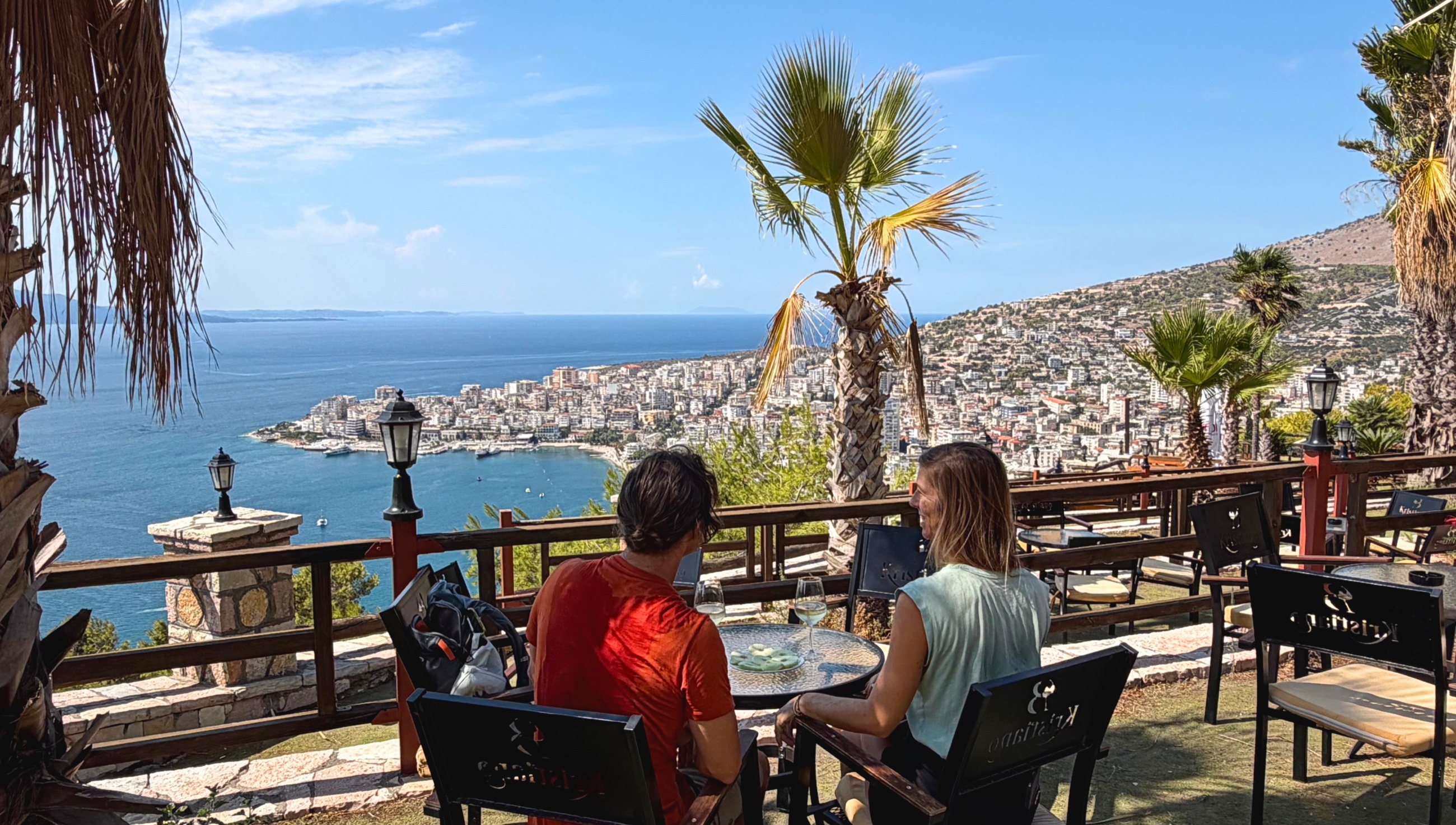 A post-hike stop at Wine Bar Kristiano with Sarandë extending below.
The sea stayed the default. We swam nearly every day, and the week’s history came in two parts around it: a climb to the monastery on the ridge and a stop, at last, at the ruins in the middle of town.
The monastery is about five miles round trip from our apartment, with roughly 750 feet of climbing. The first half is a walk through upper Sarandë. In the second, the streets steepen, the buildings thin out, and the bay widens behind you with every turn. By then we were glad of an excuse to stop, and Relax Cafe supplied one: coffee on a terrace with the city below, the bay beyond it, and Corfu on the horizon.
Above the cafe, the asphalt gives out. The road becomes a dirt track past half-built houses, leftover concrete, and stray animals, with no signage for a site that gave the city its name. There is no ticket booth either. A man in a folding chair under a tree collected 200 lek from each of us, in cash, and that was the whole of the arrival.
What remains is mostly a field of stone rather than a standing church. There are old walls and arches to put a hand on, a few tunnel entrances sealed shut, and open ground to climb across, without ropes, marked paths, or interpretive signs. The view does much of the explaining. Lake Butrint lay pale to the south. Corfu looked closer and clearer than we expected, less a separate destination than the far shore of the same water. Behind us, the hillside dropped into the Gjashtë valley, which we photographed rather than climbed down into.
We started down in late morning and stopped at Wine Bar Kristiano, a short way below the ruins, for cold glasses of Shesh i Bardhë from Çobo Winery, with the bay and Corfu laid out beneath the terrace. We had arrived outside opening hours, and the staff served us anyway. Lunch was our favorite souvlaki from Cuci in town, and the afternoon went to our laptops. We made a note to go back up another day for sunset.
The smaller stop came earlier in the week. The synagogue-basilica ruins sit beside Friendship Park and the central bus stop, and we walk past them every time we go to the gym. This time we stopped long enough to take the place in.
🎨 Cultural Deep Dive
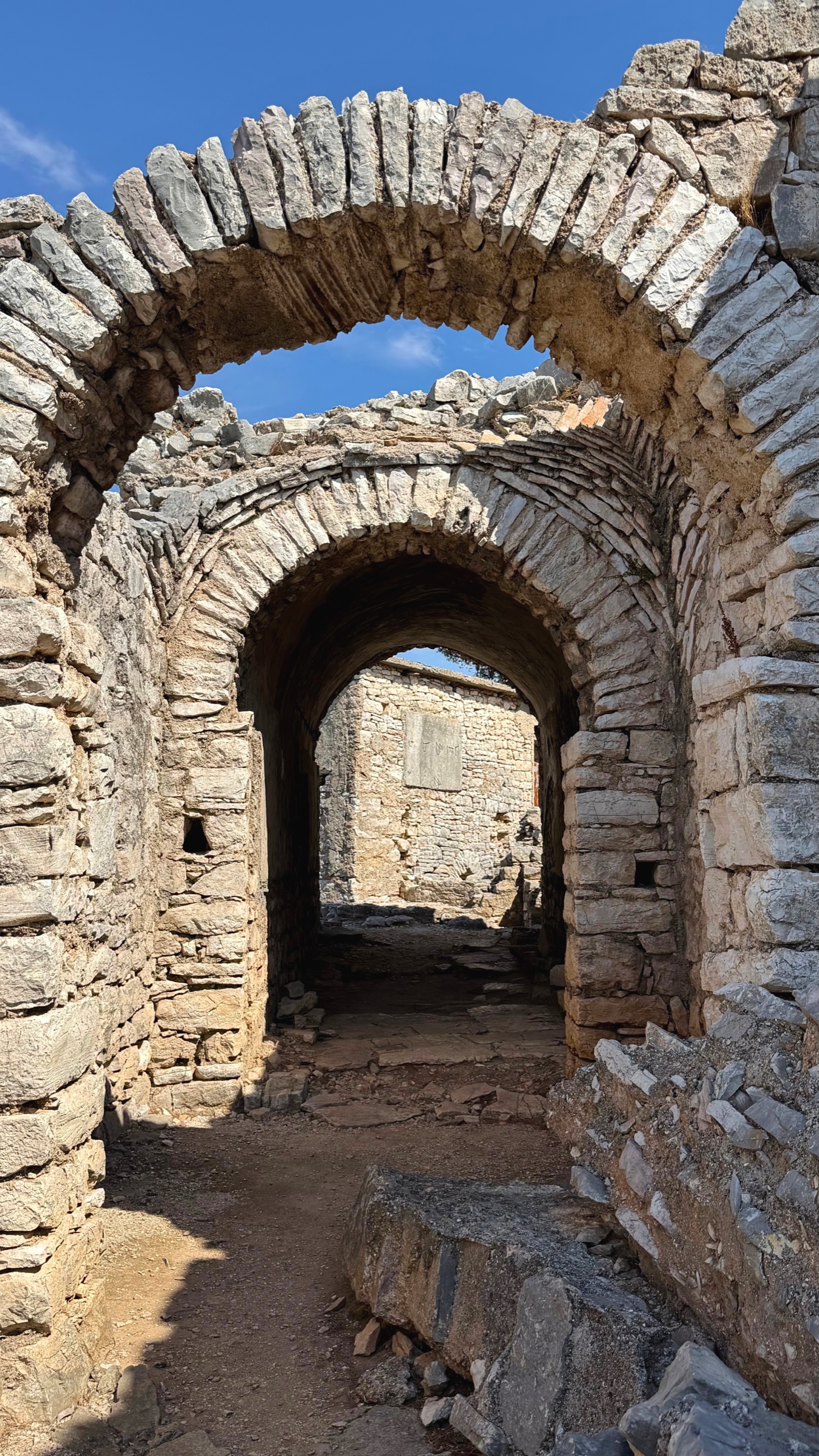 Surviving stone arches within the Monastery of the Forty Saints above Sarandë.
A Name That Outlasted the Building
The Monastery of the Forty Saints was probably founded in the sixth century, under the emperor Justinian, and dedicated to the Forty Martyrs of Sebaste: Roman soldiers who, by Christian tradition, refused to renounce their faith in AD 320 and were left to freeze on a lake. For centuries it drew pilgrims from around the Ionian Sea, and its Greek name, Agioi Saranta, eventually replaced the name of the settlement below.
The town’s changing names trace much of its political history. Ancient Onchesmos became Agioi Saranta. Venetian maps wrote Santi Quaranta, and the Ottomans used Aya Sarandi. In 1537, Suleiman the Magnificent built Lëkurësi Castle on the neighboring ridge. During the Italian occupation of the Second World War, Mussolini renamed the town Porto Edda after his eldest daughter. That name did not outlast the occupation. The Forty Saints did.
The building fared worse than the name. It stood in substantially greater form until October 1944, when British commandos, supported by artillery, took Sarandë from its German garrison. The monastery was largely destroyed in that fighting; local accounts blame British guns, and some sources name German artillery or Allied aircraft instead. Under the communist state that followed, which closed or destroyed many of the country’s places of worship, the ruins became a military installation. Today anyone can walk across them for 200 lek.
The City Beneath the City
Long before any of this, the site was Onchesmos, a port of the Chaonians in ancient Epirus, facing Corfu across the channel. A later tradition tied its name to Anchises, the father of Aeneas, which connects it to last week: Virgil’s Aeneas comes ashore at Butrint, a short way south.
Cicero passed through here. His friend Atticus owned property at Buthrotum, and one of Cicero’s letters preserves the name of Onchesmos in the Onchesmites, a local wind off Epirus that carried him across the Adriatic toward Brundisium.
Most of that port lies under the modern city. The clearest surviving piece sits beside Friendship Park. The archaeologist Kosta Lako uncovered it during road construction in 1984, when Albania was almost entirely closed to outside scholars. He published the finding in a little-read Albanian journal, and the building was initially taken for a church. A joint Albanian and Israeli excavation in the early 2000s showed that it had begun as something else.
The excavators identified five stages. First came two phases of a private house with fine mosaic floors, dated between the second and fourth centuries. Then a synagogue took over, with added rooms and a floor showing a menorah flanked by a shofar and an etrog. A large hall of roughly 20 by 24 meters followed, marking the height of the Jewish community of Onchesmos. Finally, the hall became a church. The building was later destroyed, by fire during the Avar and Slav incursions of the late sixth century in some accounts, by earthquake in others. Few Late Antique synagogues are known in the Balkans; Stobi, in North Macedonia, and Plovdiv, in Bulgaria, are two.
What a visitor sees today is much less. Partial foundations sit behind a fence, beside a park, the central bus stop, and steady traffic. There is no entry fee, no attendant, and no dig in progress. For finds, including mosaics, the town’s Archaeological Museum is the next stop.
The second fragment is at the water. On one of our beach mornings we noticed a mass of stone, mortar, and Roman bricks beside Sarandë Public Beach, with a weathered column standing among it. It looked too substantial to be rubble. Research afterward connected it to the fortifications of Onchesmos, which once ran inland from the waterfront to enclose the town. Today it stands among the beach umbrellas, and swimmers enter the water on both sides of it.
Within a few kilometers we now have a Christian pilgrimage site, the remains of a synagogue that later became a church, and a call to prayer that sounds across town every day. Albania is often noted both for the ease with which people of different religious backgrounds live alongside one another and for marriage across religious lines. The nineteenth-century nationalist line that “the faith of Albanians is Albanianism” is part of that history. Its author, Pashko Vasa, was himself a Catholic from Shkodër, and he wrote it to persuade Albania’s Muslims, Orthodox Christians, and Catholics to unite as Albanians rather than divide politically along religious lines. He was asking for shared national loyalty, not claiming that their beliefs were the same.
The communist period complicates the picture further. Decades of state atheism suppressed religious institutions and practice. Christian and Muslim communities remain part of Albanian life, alongside a very small Jewish community, though practice is low even among those who identify with a faith: in a 2018 survey, about 63 percent of Albanians said they do not actively practice a religion. For most Albanians, religion appears to be a matter of inherited identity and family tradition more than regular practice. The monastery ruins, the synagogue foundations, and the daily call to prayer show how long religion has been part of public life here. They cannot, by themselves, tell us what people believe.
The Same Hillside, Two Directions
The climb to the monastery passes two versions of Sarandë within a few hundred meters. Wine Bar Kristiano is mid-expansion, adding rooms around its terrace and growing from a small bar into something larger. Higher up, the road to one of the town’s oldest sites turns to dirt beside half-built houses and leftover concrete. The monastery is protected as a cultural monument. The road to it is not protected in any way we could see. Private investment is moving faster than public infrastructure, and this one hillside shows both.
The population numbers put that in proportion. Figures as high as 30,000 still circulate online, but the 2023 census counted 19,882 people in the city itself and 22,613 across the municipality, which includes Ksamil. Summer crowds can make Sarandë feel far larger than its year-round population suggests. Outside the peak months, the city depends heavily on hospitality, small tour operations, and a property market shaped in part by foreign buyers.
The contrast with Albania as a whole is notable. The city has added about 4,600 residents since 2001, from roughly 15,200, while the national resident population fell from about 3.07 million to 2.40 million.
The gap between fast private growth and slower public infrastructure is part of why EU accession matters here beyond trade. Albania has opened all 33 negotiating chapters and provisionally closed its first three on July 14. The government aims to conclude negotiations by the end of 2027 and be prepared for membership by 2030. For a fast-growing coastal town, the practical implications include stricter European standards for environmental protection, water, waste, and infrastructure, while eventual membership would bring access to the EU’s broader cohesion funding system.
Support for the idea is broad. In the 2025 Balkan Barometer, 86 percent of Albanians said membership would be good for their country, the highest share in the region, although only 43 percent expected it by 2030. Part of that support traces to the isolation we covered from Tirana. Part traces to 1997, when the collapse of the pyramid investment schemes that had absorbed much of the country’s savings ended in civil unrest and left a lasting distrust of domestic institutions. The same survey found more trust in the European Union than in Albanian political institutions.
The stakes in Sarandë are specific. The mandarin growers inland sell mostly into regional markets today; membership would hold them to the same standards as producers elsewhere in the union and remove the remaining barriers to that market. As for the young Albanians who have spent decades leaving for Western Europe, the census shows Sarandë growing while the country shrinks, though it does not say who is staying and who is arriving. Whether accession would keep more of them at home is the open question.
Protection Above the Doorway
There is another kind of continuity around town that requires no excavation. Garlic hangs above doors, balconies, and the entrances to shops and restaurants, sometimes in braids. On unfinished buildings you can find weathered dolls or stuffed animals hung beside it, and on some older properties, horseshoes, horns, or ram skulls.
They belong to a belief in syri i keq, the evil eye: that envy or a hostile look can bring illness, bad luck, or a failing business. The belief is old and shared across the Mediterranean and much of the Balkans. Garlic is used as a protective amulet. The dolls, called dordolec, work differently. They are meant to catch a stranger’s eye first, so the look lands on something ugly rather than on the house. Store-bought stuffed animals, known as kukull, are a recent addition to the same practice.
Garlic is also traditionally cured in the open air after harvest, so some of what you see may simply be storage.
What is more recent is how visible some of these protective objects became after communism. A 2006 study in the Journal of American Folklore, based on forty interviews in the Albanian countryside, connected the revival of the dordolec with the return of private property and the sudden gap between people who had built new houses and people who had not. New construction is where the dolls tend to appear.
On a hillside where private building is moving fast, that pattern is easy to see. An old folk belief now turns up beside concrete, satellite dishes, balconies, and air-conditioning units.
🍽️ Local Flavor
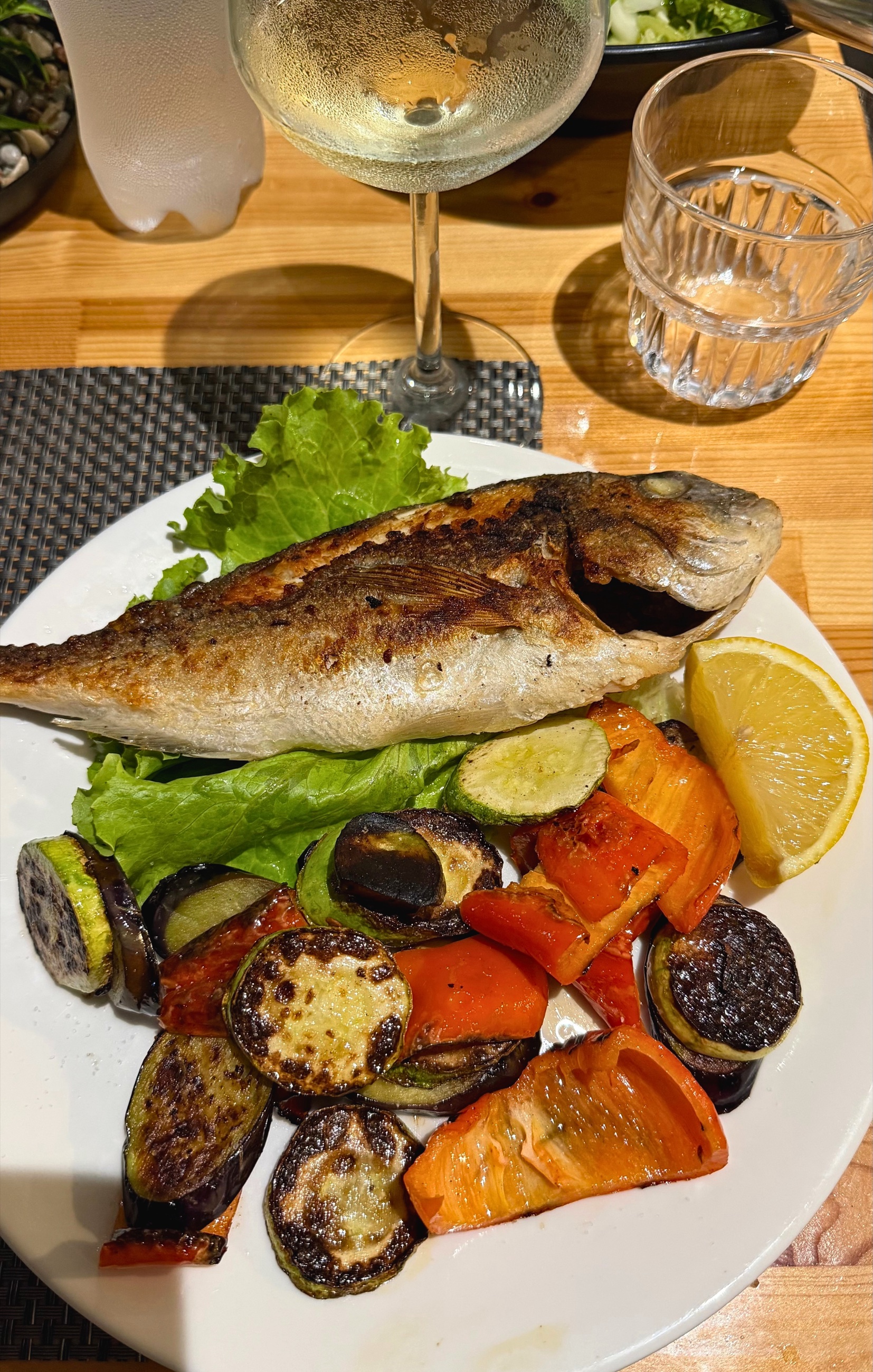 Fresh fish and grilled vegetables at Traditional Table in Sarandë.
The meal of the week was a return to Traditional Table, where we ate our first dinner in Sarandë with Bailey and her friends. This time it was just the two of us: a salad of local produce, fresh fish, stuffed eggplant, bruschetta, a half-liter of house white, and sparkling mineral water for 2,330 lek, about €23. It is a relaxed family-run restaurant, with straightforward Albanian cooking, generous portions, and very good value for the quality.
The meal also sits within a broader food landscape that becomes more visible with time. September market stalls carry figs, pomegranates, grapes, and plums. The mandarins that define the district are still a month or two from harvest. They grow on the plains inland, around Xarrë, Konispol, and Finiq, where a cooperative founded in Xarrë in 1995 was among the first commercial cooperatives in Albania after communism.
In 2019, according to trade figures, the country produced more than 31,000 metric tons of mandarins and exported about 14,000, mostly to regional markets, with the Sarandë area at the center of the trade.
The olive groves on the hillsides above town are old enough that several presses are still worked by the families who own them. South of town, Lake Butrint’s saltwater lagoon supports mussel farming, and Butrint mussels turn up on menus along the Riviera. We saw the lines from the bus on the way to the national park, small dark rows breaking the surface. A small number of olive oil mills, wineries, and restaurants advertising direct sourcing now draw visitors inland and toward the lagoon to see where the food comes from.
The wine on the terrace at Kristiano fits this same picture of cultural continuity. Last week’s Shesh i Zi is a dark-skinned local grape; Shesh i Bardhë is its white counterpart, and a cold glass of it on that terrace was a delightful way to finish the hike.
💰 Nomad Real Talk
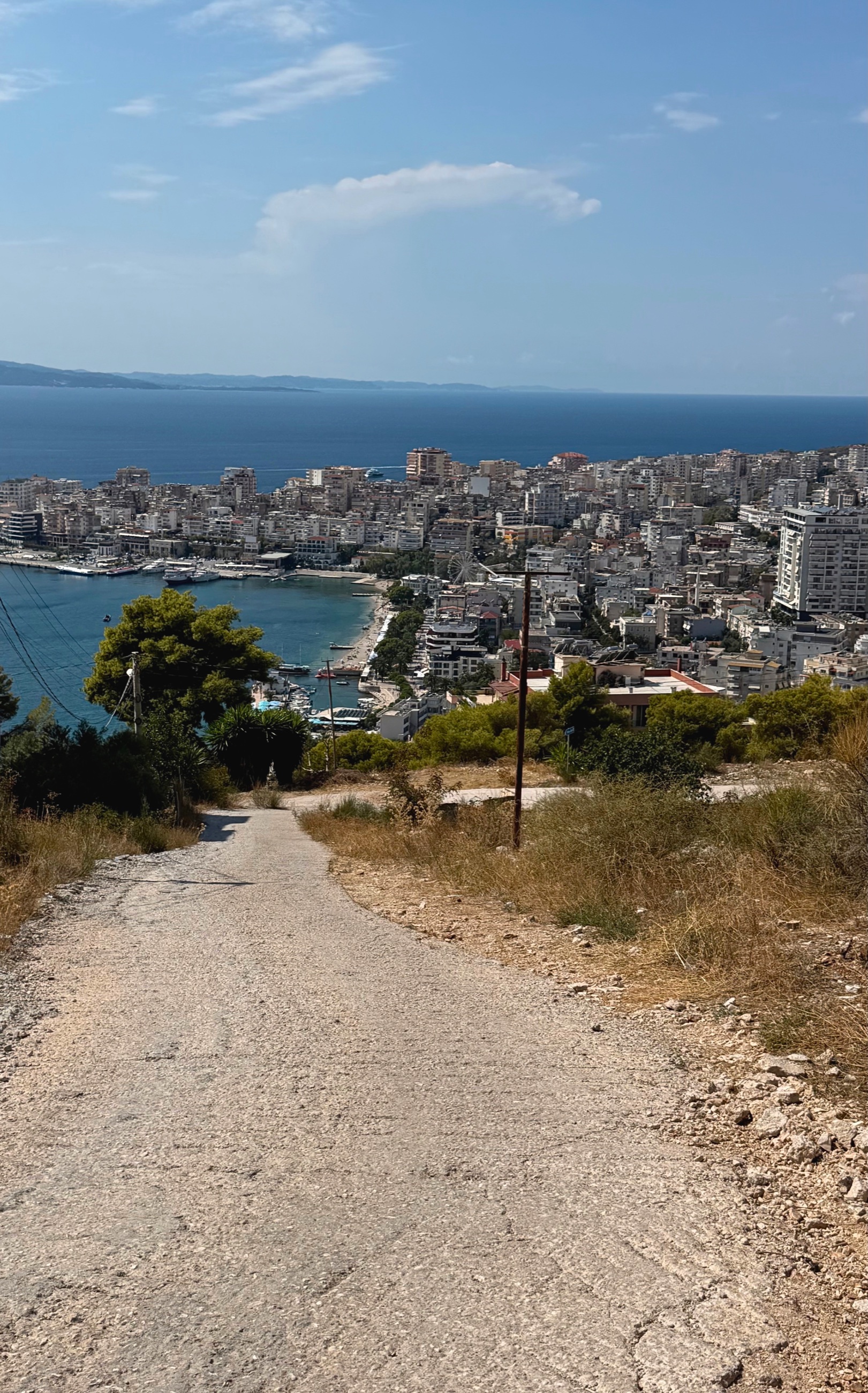 The climb above Sarandë to the Monastery of the Forty Saints.
Walking to the Forty Saints
The monastery looks close on a map. The elevation changes that.
From our apartment, the round trip came to about five miles and 750 feet of climbing, on foot the whole way. That is manageable for anyone comfortable with hills, but the last stretch is the hardest and the least shaded. Go in the morning, carry water, and wear shoes with a real sole for the dirt and gravel track.
Cash matters. Entry was 200 lek per person, about €2, paid to a man in a folding chair, so bring small notes. Relax Cafe is the right midpoint stop, both for the coffee and for one of the better elevated views over the city. Kristiano, just below the ruins, was outside its opening hours when we arrived and served us anyway; do not plan your descent around that.
The Center of Town
The synagogue-basilica costs nothing. The foundations are fenced and visible from Friendship Park at any hour, and there is no attendant. The wall fragment is a short walk away on the public beach along the promenade. Both fit into a gym trip or a swim without planning.
Sarandë is compact, and many daily needs are reachable on foot, but the hills turn short distances into more exercise than the mileage suggests. Living above the waterfront means almost every trip ends with a climb home. On this day, the climb was also the destination.
🏠 Behind the Nomad Curtain
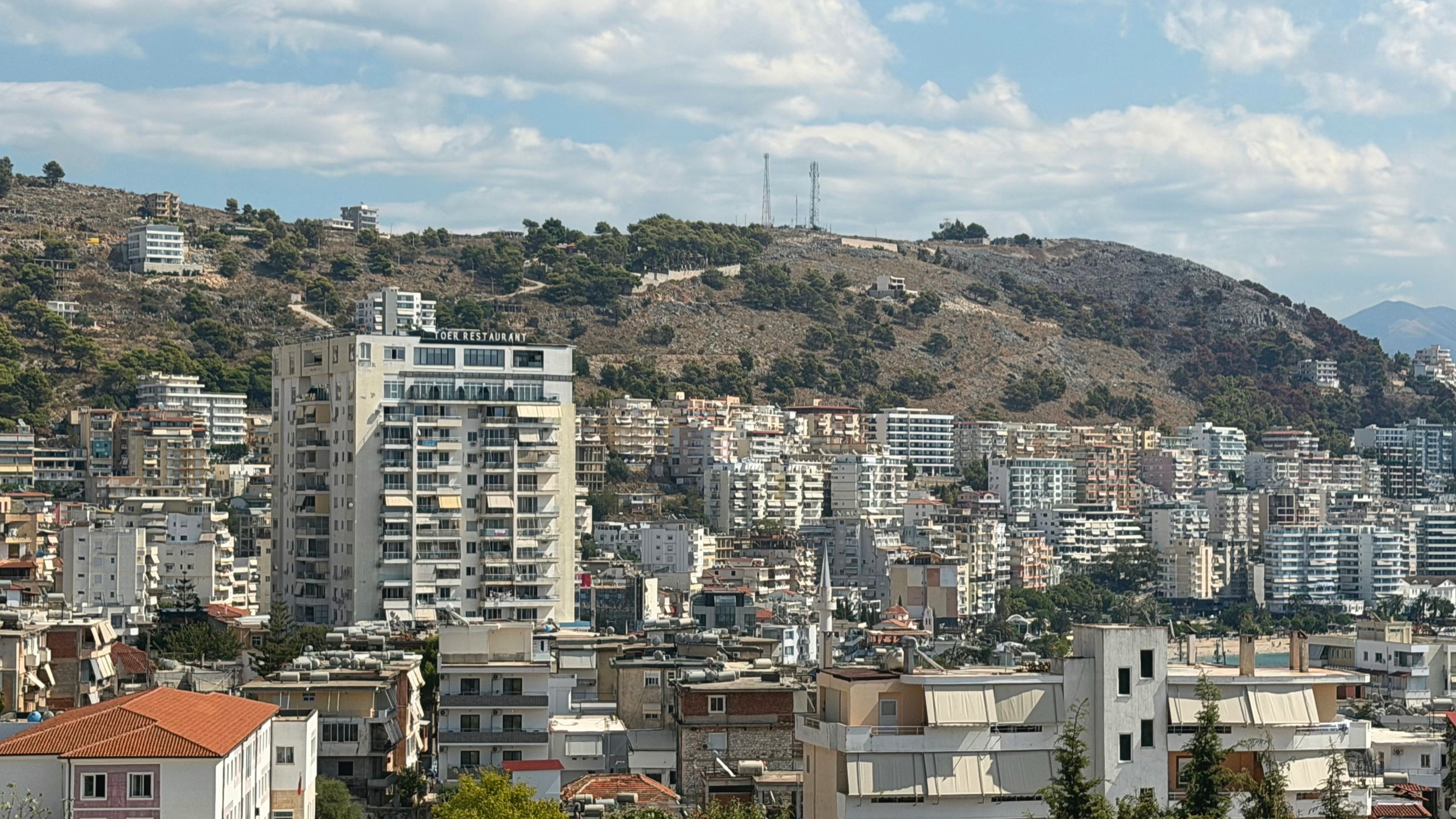 A view from our apartment toward the winding hillside leading to the Monastery of the Forty Saints, with Wine Bar Kristiano below.
Travel photographs favor the hours we spend outside. The monastery produced the obvious pictures this week: old stone, wide views, Corfu across the channel, a glass of local white wine on a terrace above the bay. By early afternoon that part was finished. We ate lunch, walked home, and opened the laptops. Nothing about the next five hours photographs well, and the ridge we had stood on that morning was visible from the desk.
A month changes the arithmetic of a day like that. We did not need to stay at the monastery until we had seen everything because this was not our only chance. We could leave when we were ready, finish the day’s work, and plan to return for sunset. The same reasoning applies to smaller decisions. A beach day moves when the weather turns, errands fit around work, and a place we pass without time to investigate will usually be passed again.
The order in which we learn things has changed too. At the monastery and at the synagogue, there was almost nothing to read on site. We looked, wondered, and got the history afterward, from reading. Most of the Cultural Deep Dive above reached us that way.
We say so plainly because a dispatch can read as though the site explained itself while we stood there. It did not.
📸 Photo Story
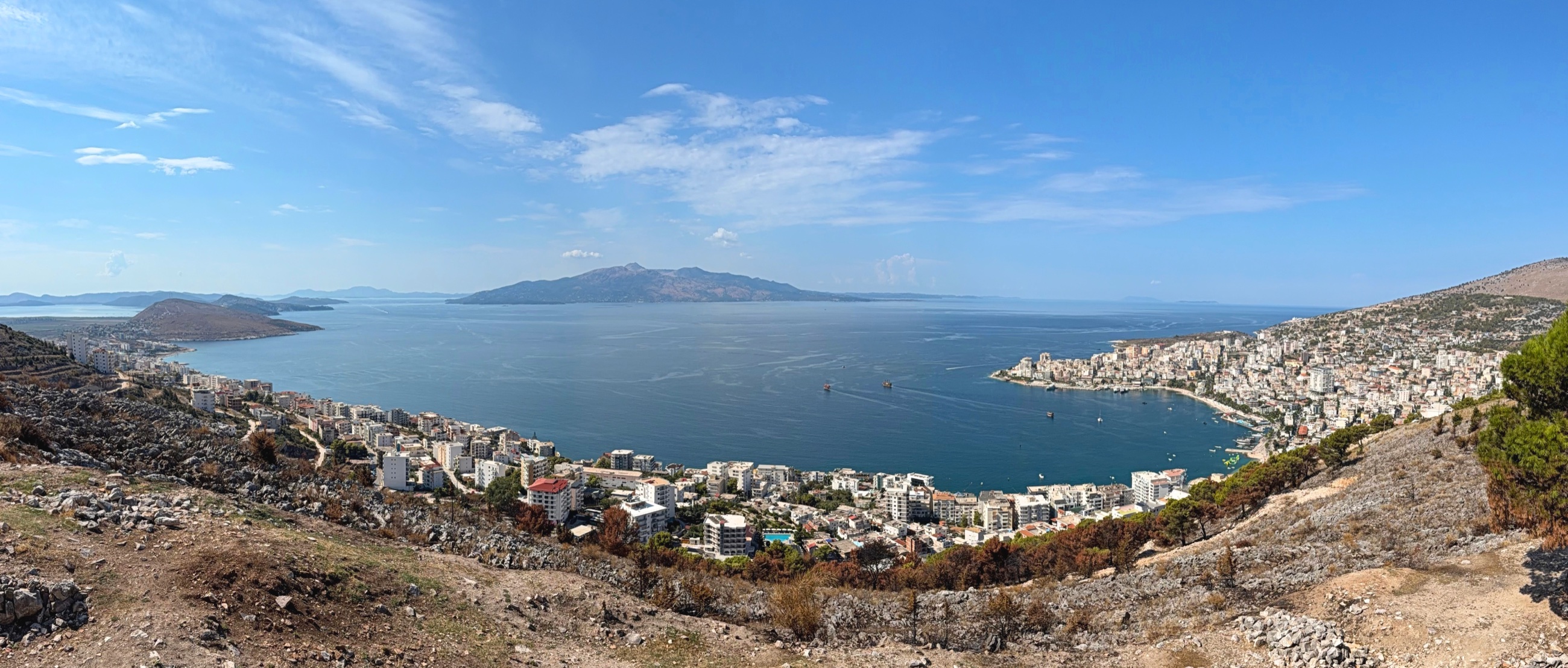 From the monastery ridge, the panorama stretches south toward Ksamil and Butrint, across the channel to Corfu, and around Sarandë Bay to the city below.
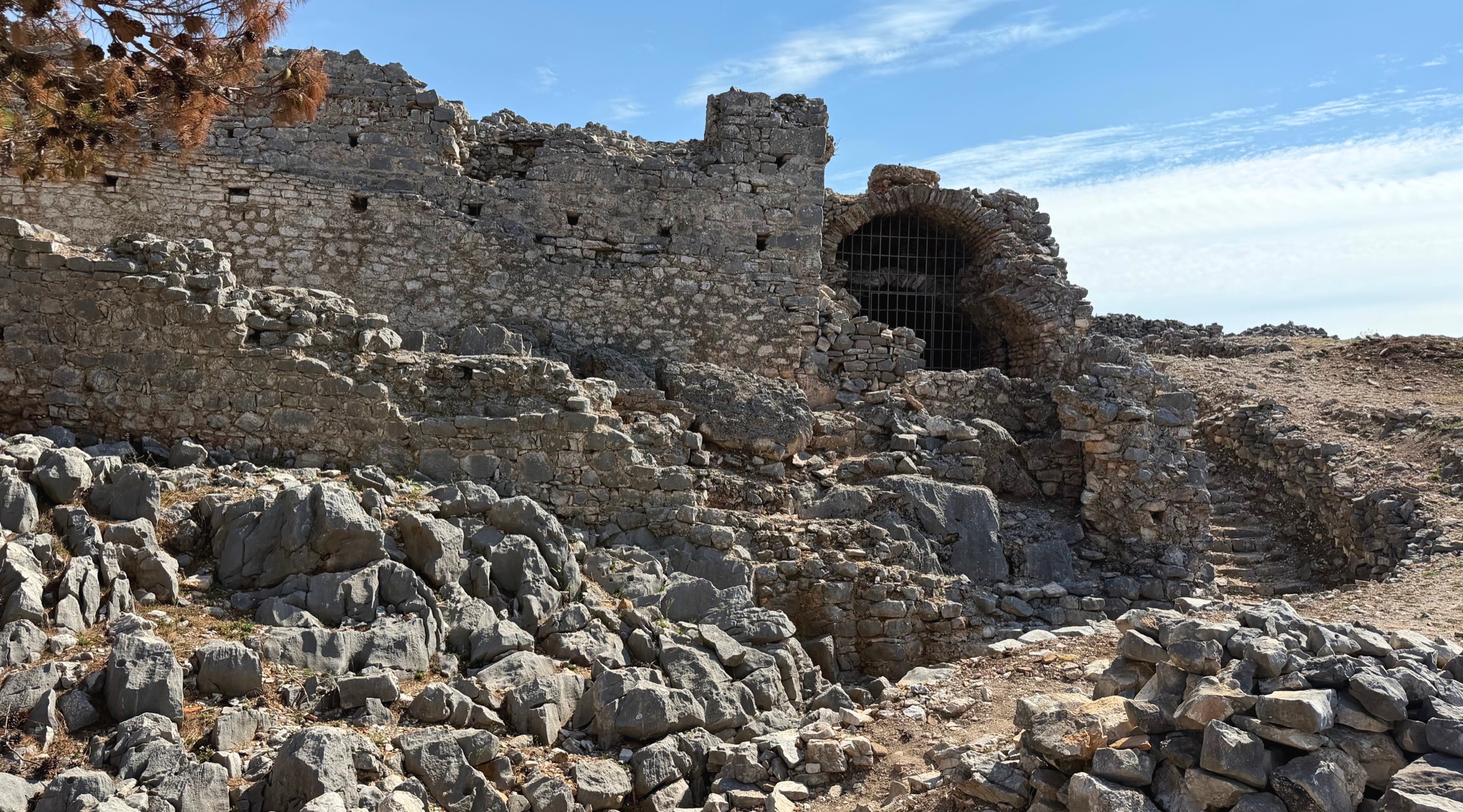 Inside the ruined monastery complex, centuries of collapsed masonry surround the remaining walls and chambers.
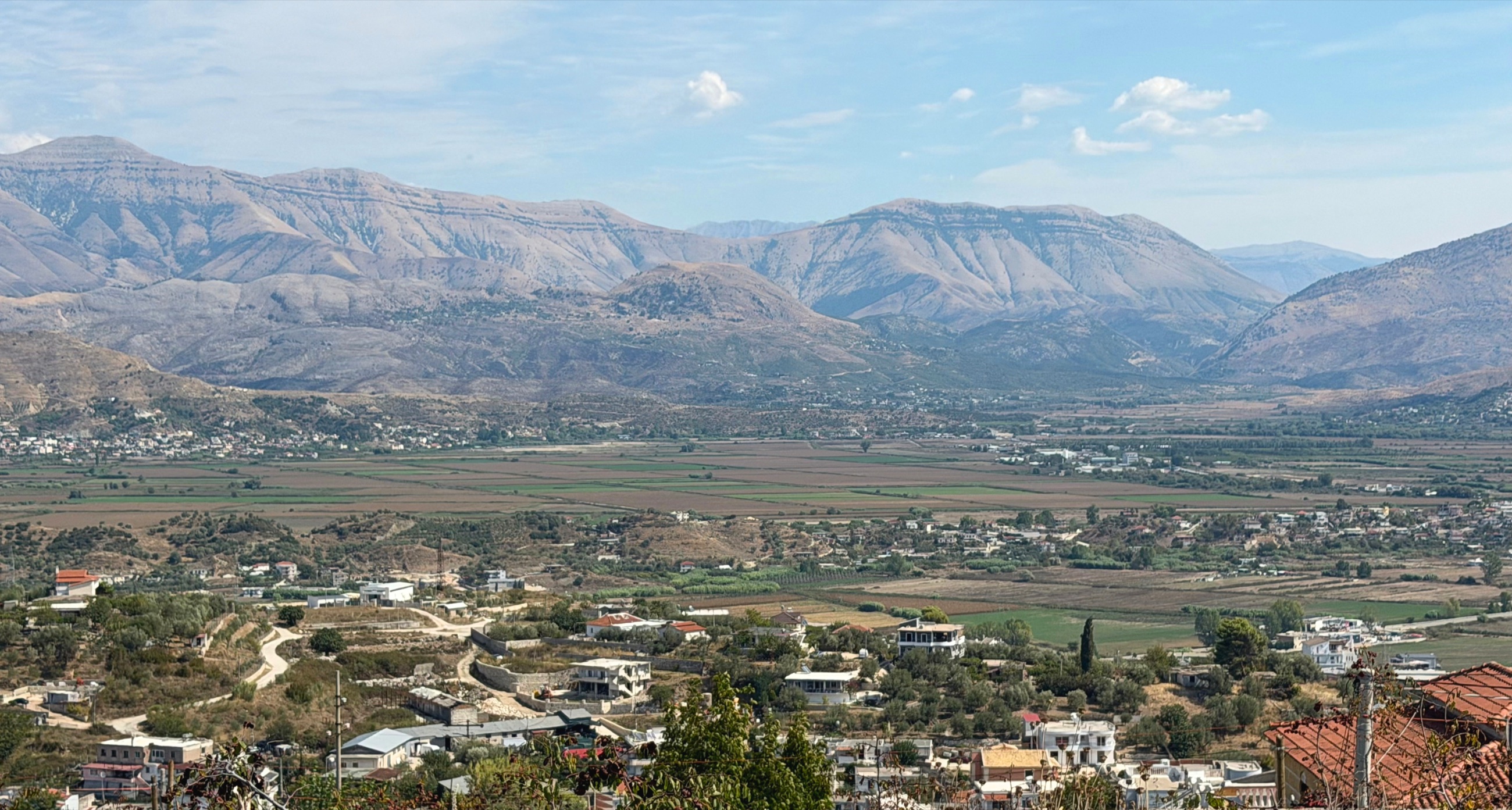 On the inland side of the ridge, the land falls away into the Gjashtë valley and the mountains beyond.
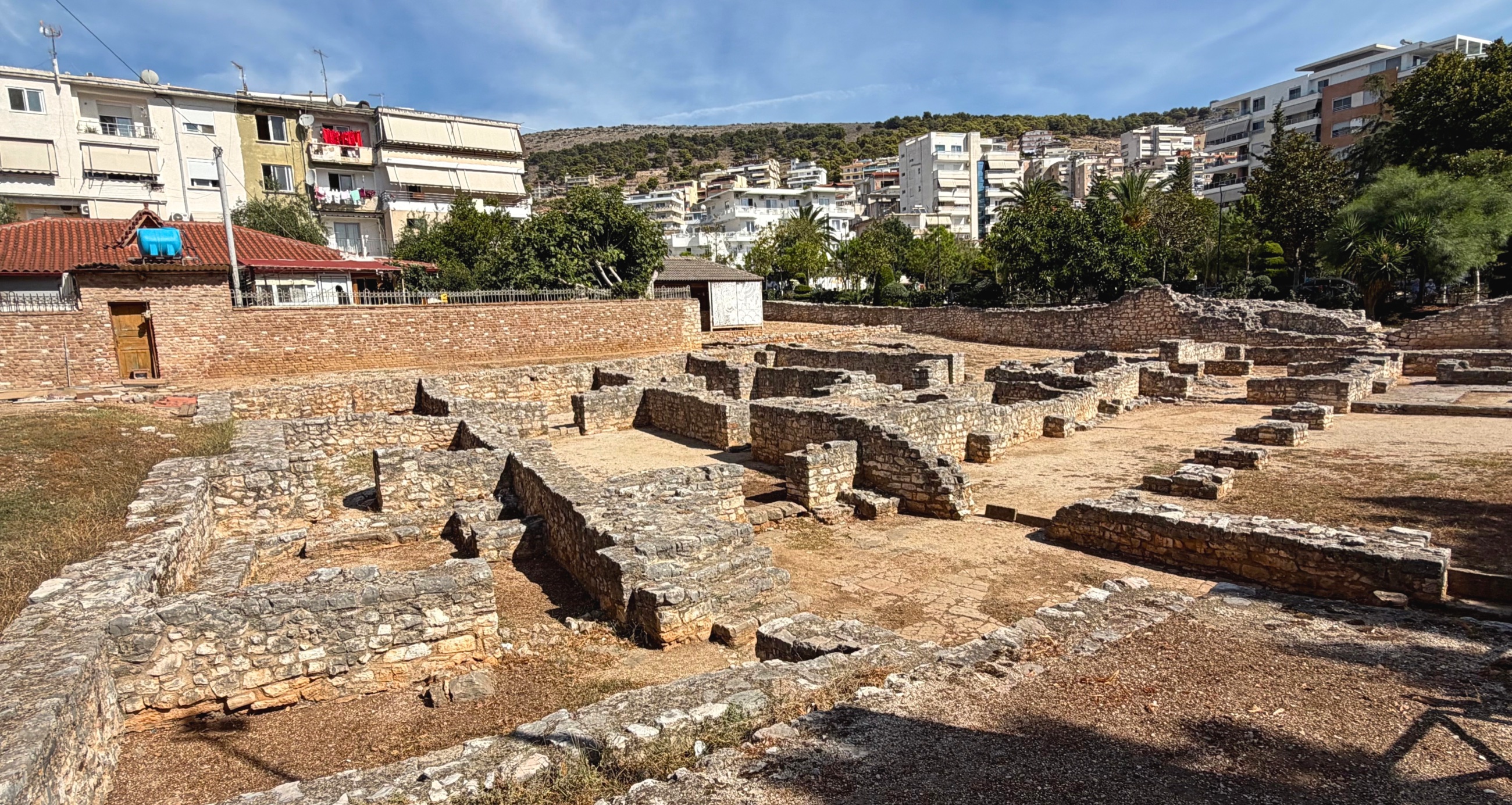 The synagogue-basilica site preserves its footprint in the center of Sarandë.
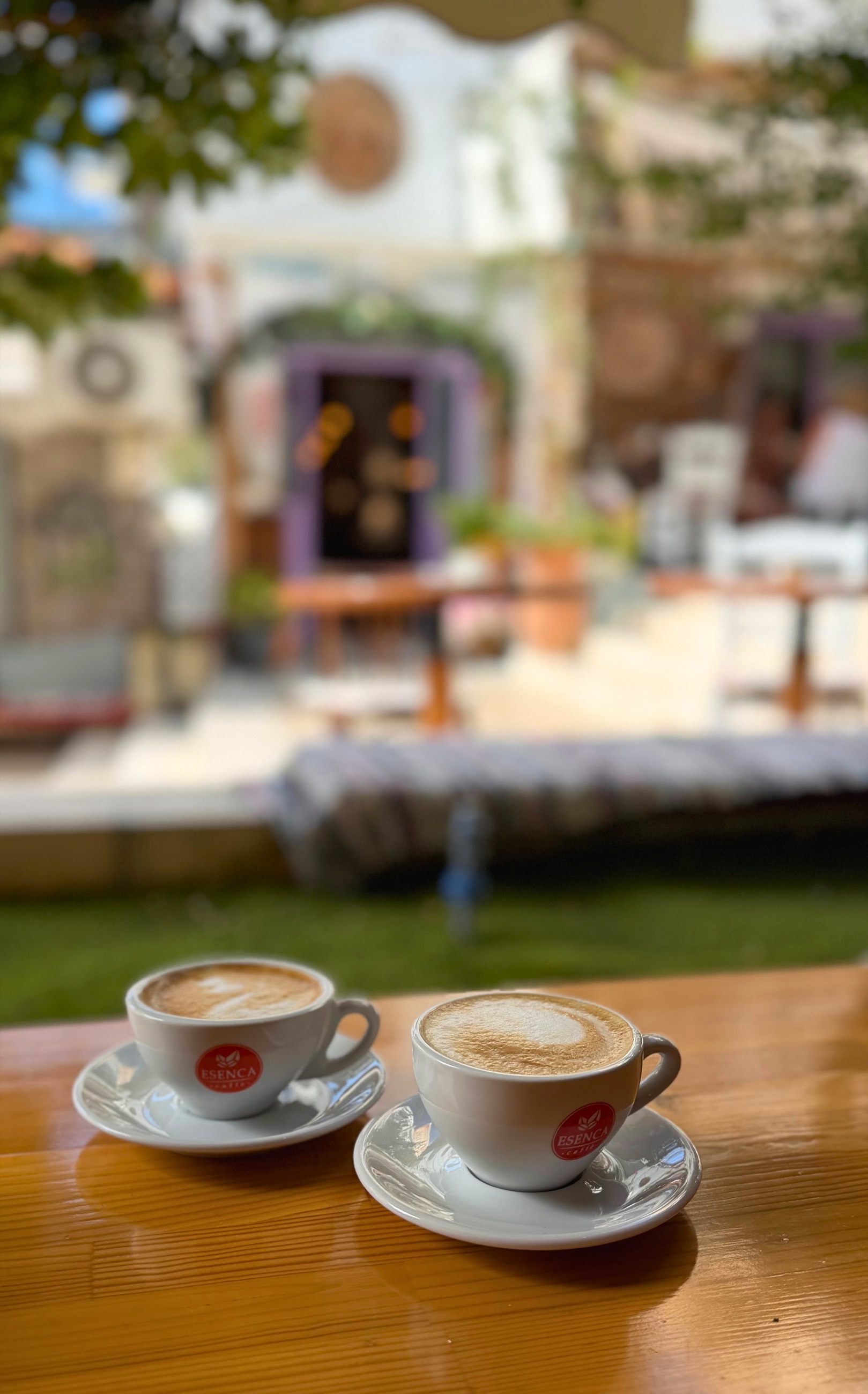 Coffee in Sarandë, a simple daily ritual.
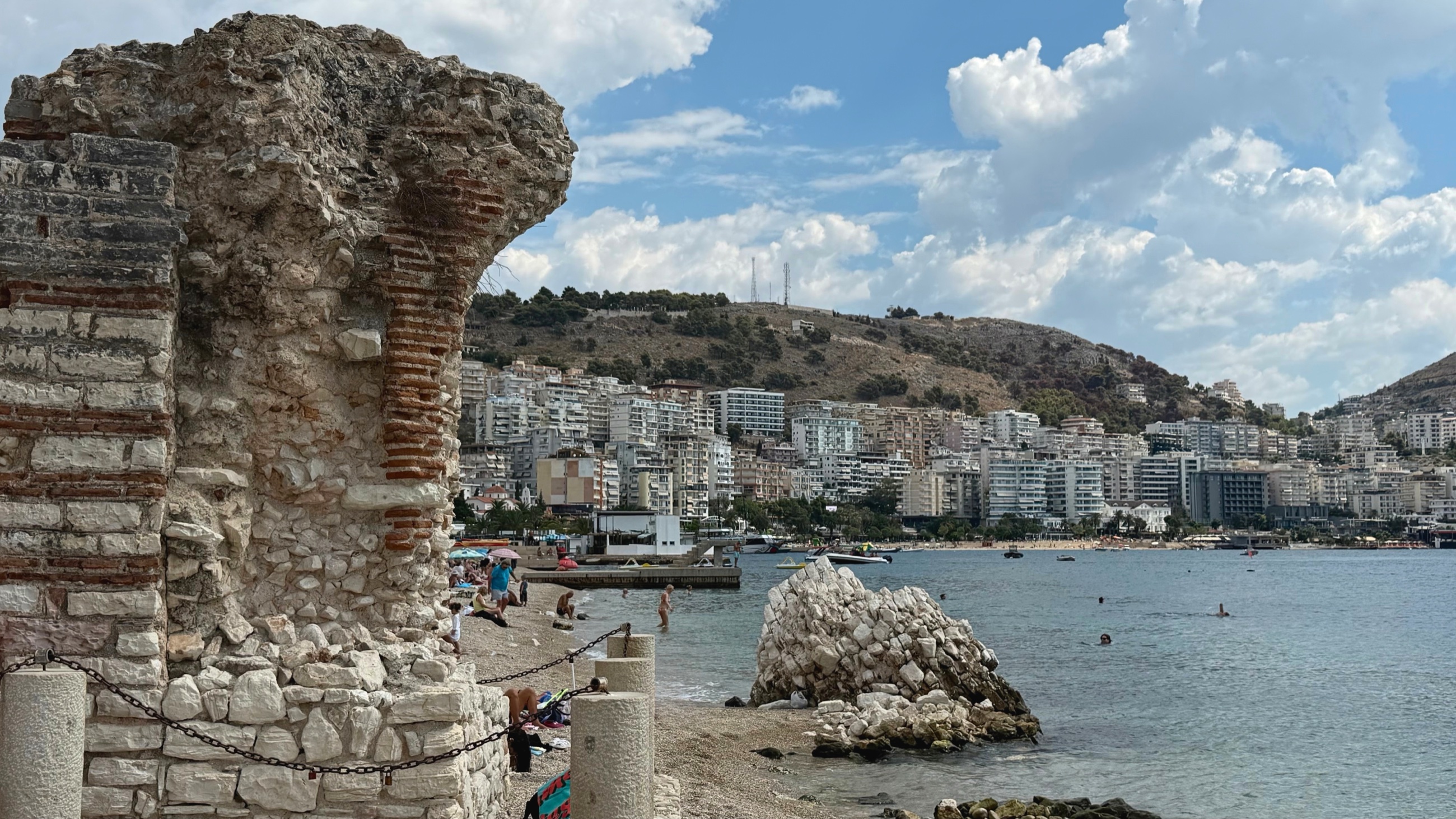 At Sarandë Public Beach, ancient brick and stonework remain at the water’s edge, layered into the everyday life of the shoreline.
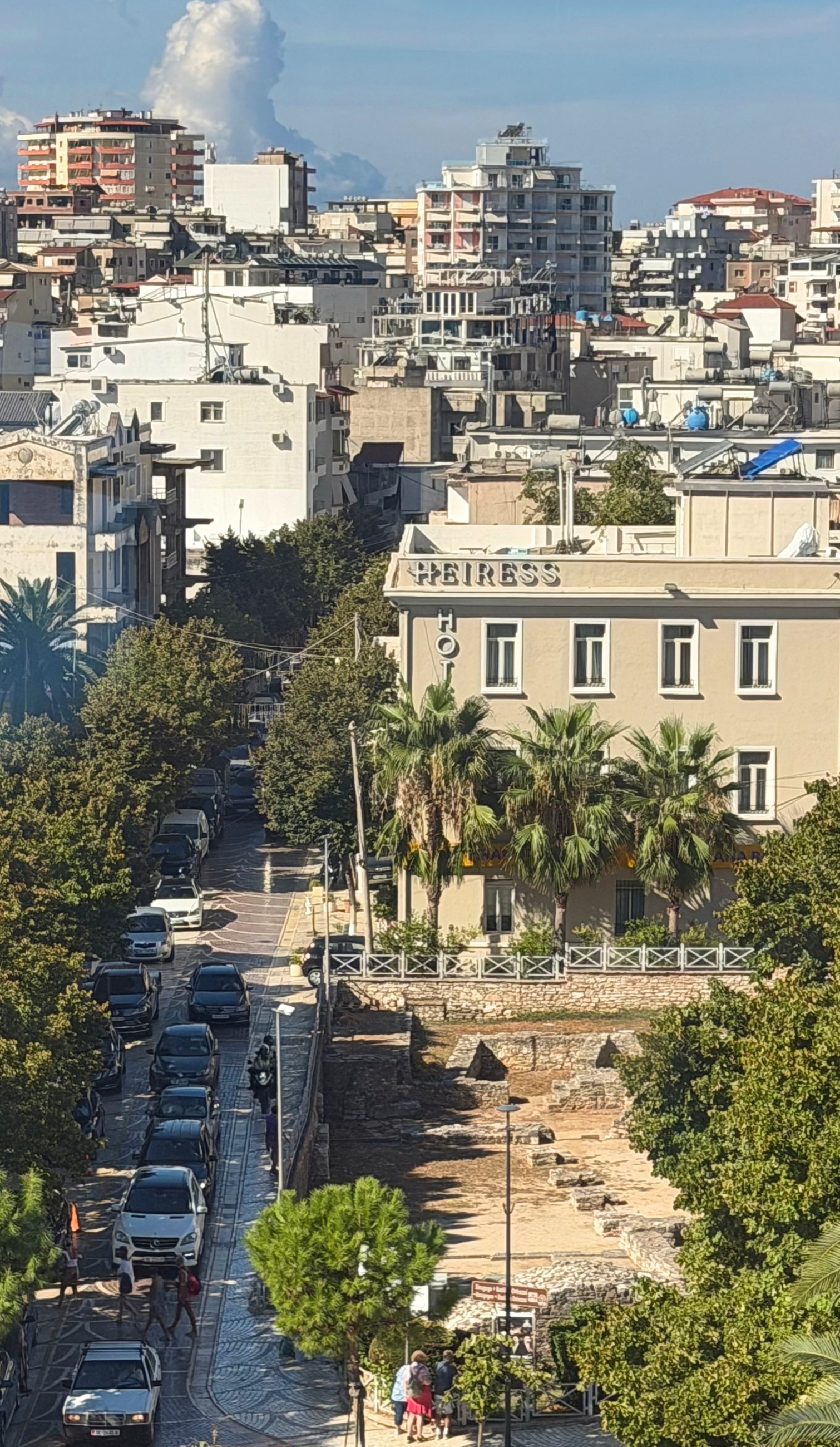 From above, the synagogue-basilica foundations are hemmed in by the streets, buildings, and everyday traffic surrounding them.
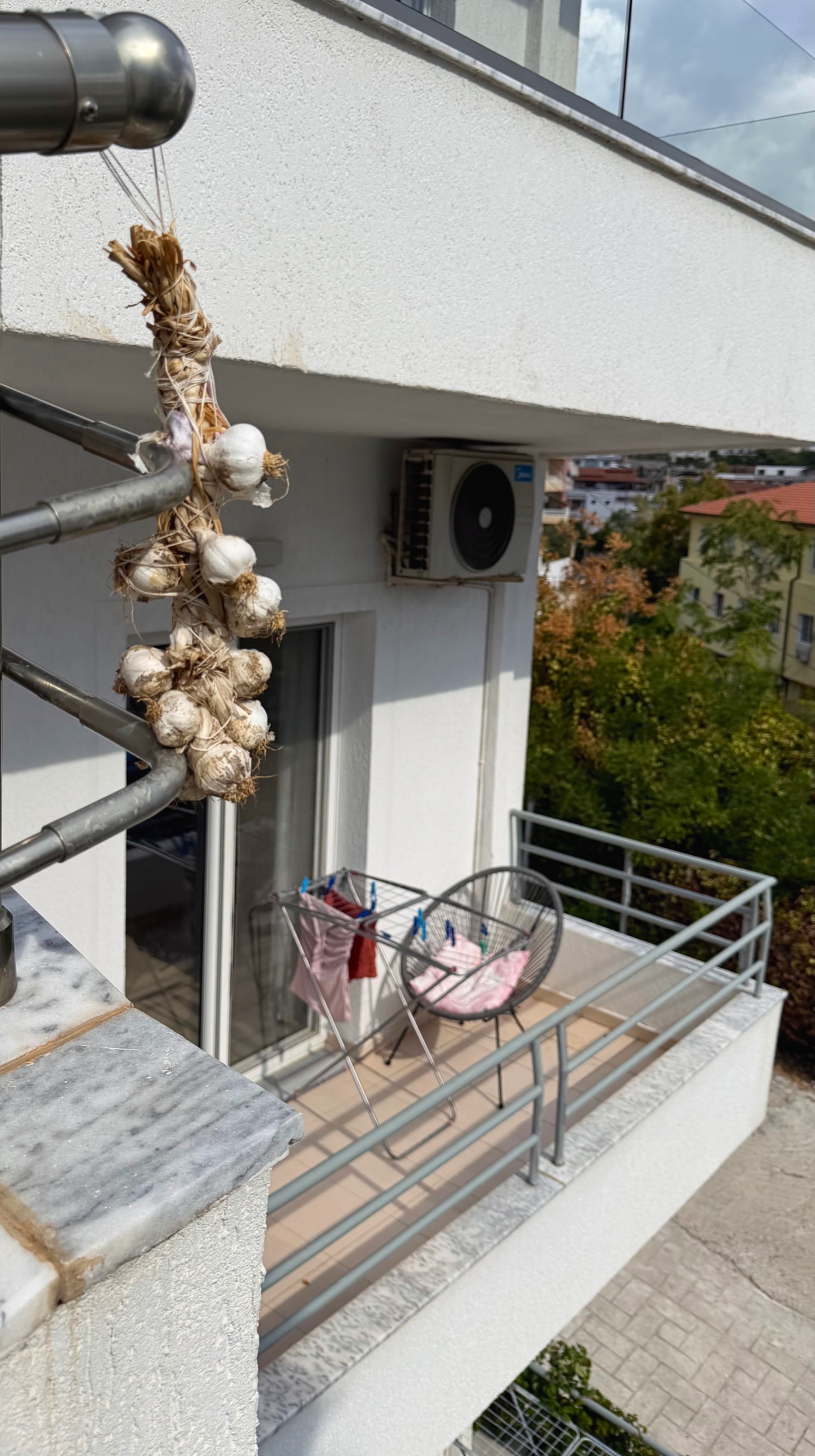 Braided garlic hangs from an external staircase near our balcony, a common expression of the Albanian tradition of protection against the evil eye.
🎯 Next Week Preview
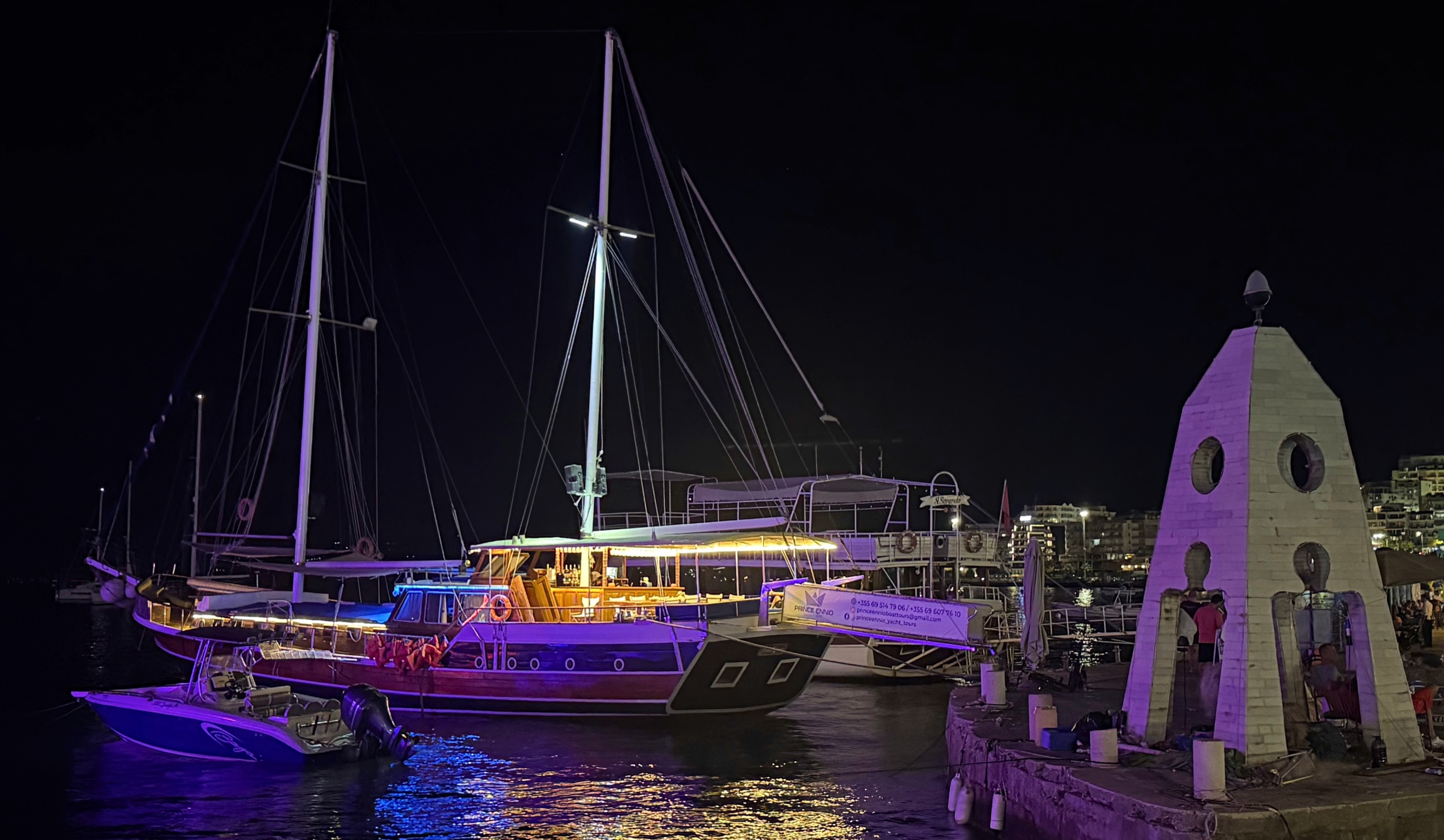 Prince Ennio moored in Sarandë before our planned trip north along the Albanian Riviera.
The last full week on the Albanian Riviera belongs to the water. Weather permitting, we plan to travel north along the coast aboard Prince Ennio, a 25-meter traditional wooden excursion boat, with swimming stops at Kakome, Krorëz, and Ushtari. After a month of looking out over the bay from above, the trip should show us the cliffs and coves north of town from below.
We also hope to fit in Mirror Beach in Ksamil while September still feels like late summer, even as the calendar slips into autumn, and to climb back to the monastery for sunset over the Ionian.
Then we close the month. Our final Sarandë issue will look back across four weeks: what worked for a longer stay, what became difficult, what surprised us, and how the city changed once the first impressions wore off. After that, we cross into Greece for Thessaloniki.
💌 Personal Connection
The places easiest to remember are usually the ones built to be noticed. A cathedral holds a square. A fortress commands a harbor. Sarandë has plenty of that. Most of what we learned this week sat somewhere less obvious: in a fenced lot beside a bus stop, in a lonely column of Roman bricks on a public beach, above a doorway in a strand of garlic.
None of it moved. Last week, Butrint came arranged for visitors. The fragments in town came without explanation, and it took three weeks of walking past them to look more closely.
Now, when we look up at the ridge from our apartment, the monastery is a place we know: the climb, the rough road, the stones underfoot, and the view back over the bay.
There is a particular satisfaction in that. We have swum often in the Ionian, walked enough of the town to learn its steep streets, eaten well, spent time with family, and worked with the bay outside the window. We have had enough time to learn what was already around us. And there is still a week left.
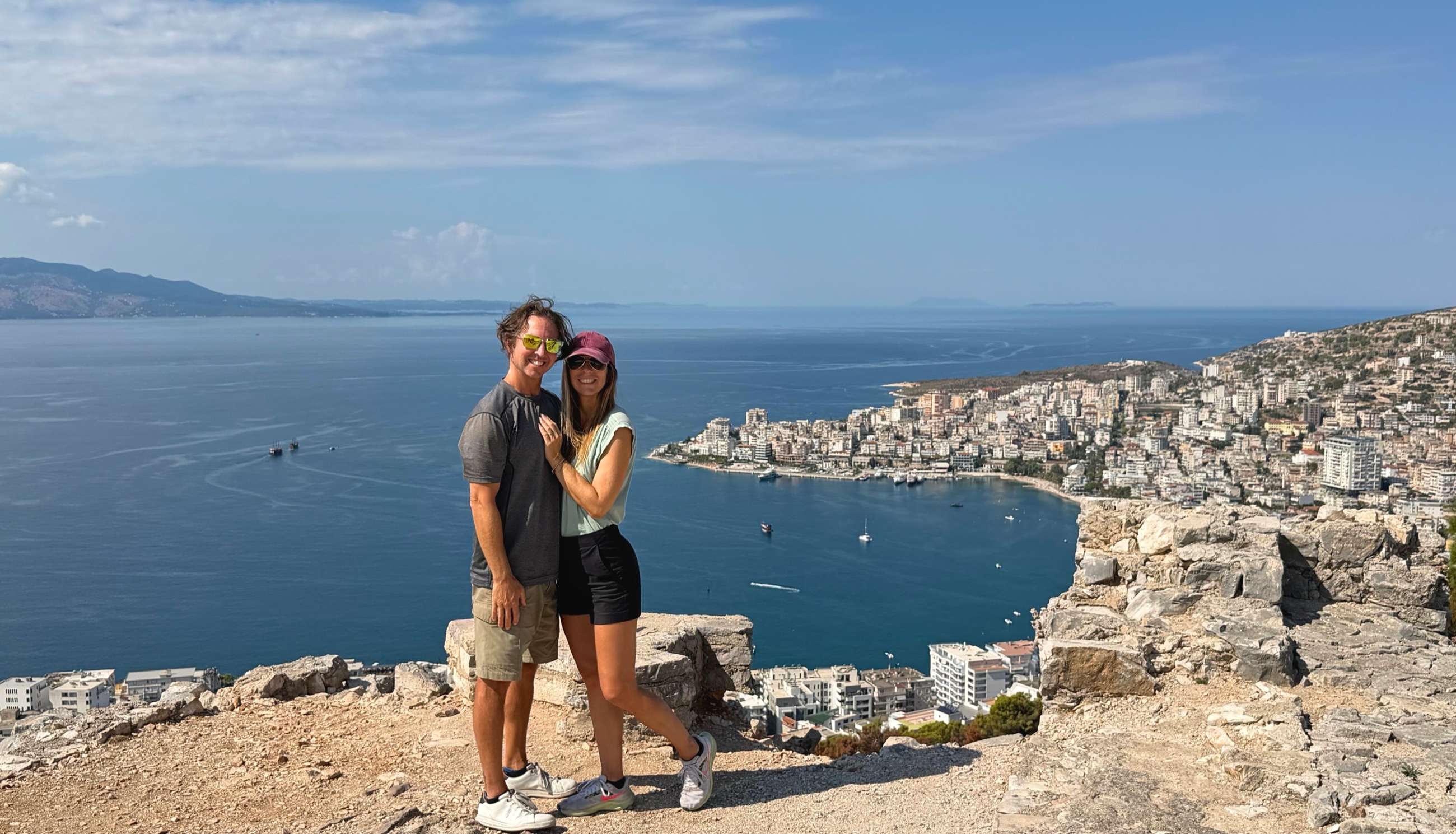 At the Monastery of the Forty Saints, with Sarandë and the Ionian below.
Until next week,
S&S
Some Great Place · Living Local in a Global World · somegreatplace.com