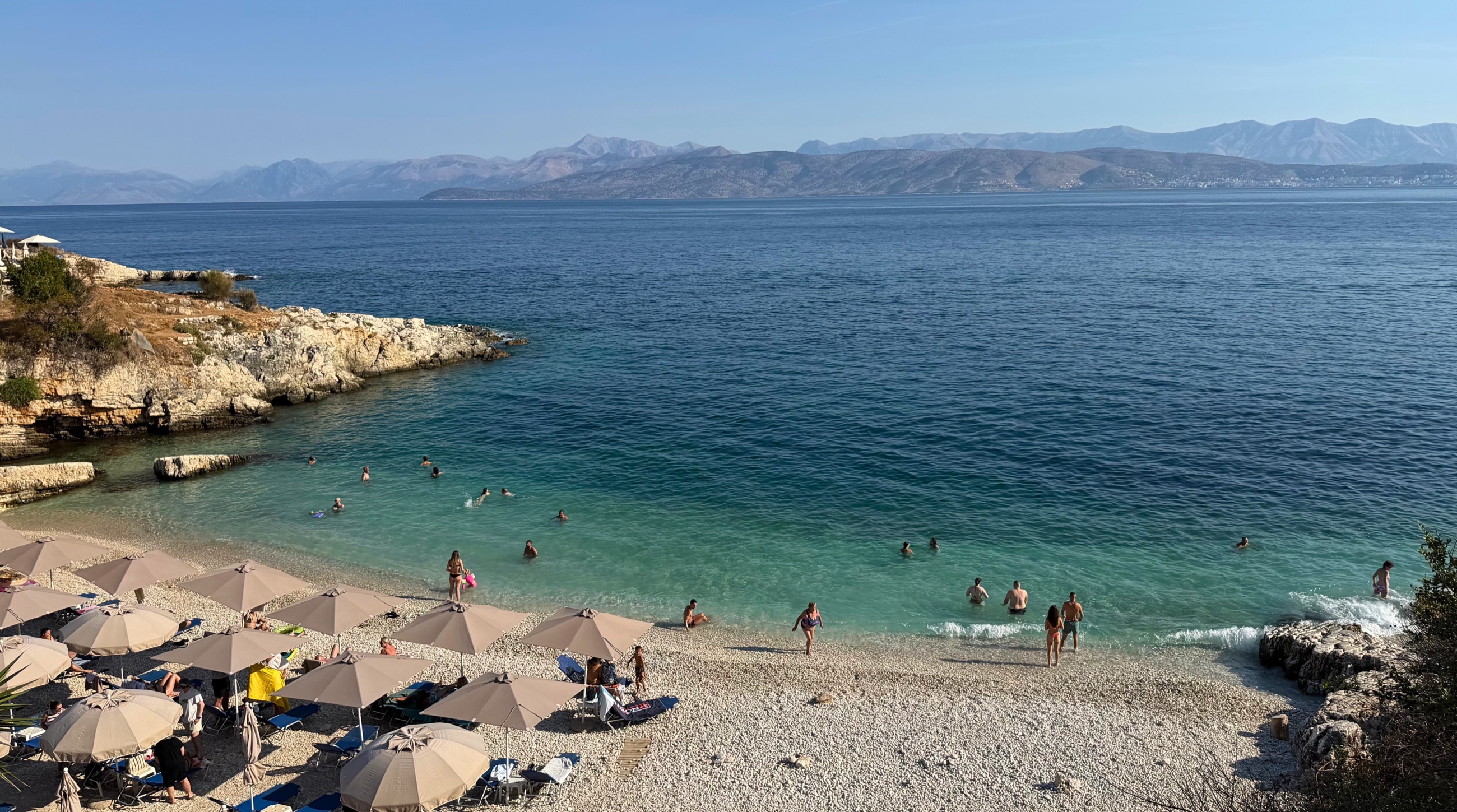
 Bataria Beach in Kassiopi, Greece, with the Albanian coast across the Corfu Channel.
Most weeks of long-term travel eventually settle around routine. This one was built around family.
Our daughter, Bailey, had planned a beach trip with two friends to close out the summer and mark her own birthday, and timed it to land during our first days in Sarandë. She and her friends met us at the Tirana bus terminal the same morning we left the capital after thirty-four nights, and together the five of us boarded the coach south, trading Tirana’s inland basin for the mountains, valleys, and eventually the Ionian coast.
So instead of immediately finding the grocery store, joining the gym, and settling behind our laptops in a new month-long home, we gave ourselves a few days off. Corfu sat across the water, and September still offered the kind of weather that makes the Ionian Sea difficult to ignore.
Our introduction to southern Albania became a small family holiday spanning two countries: dinner in Sarandë, a ferry to Corfu, an overnight in the fishing village of Kassiopi, long hours in the sea, a birthday at Ksamil, and then a final evening together along the Sarandë promenade. There will be time to learn the town properly. This week, we crossed the channel.
📍 This Week in Sarandë
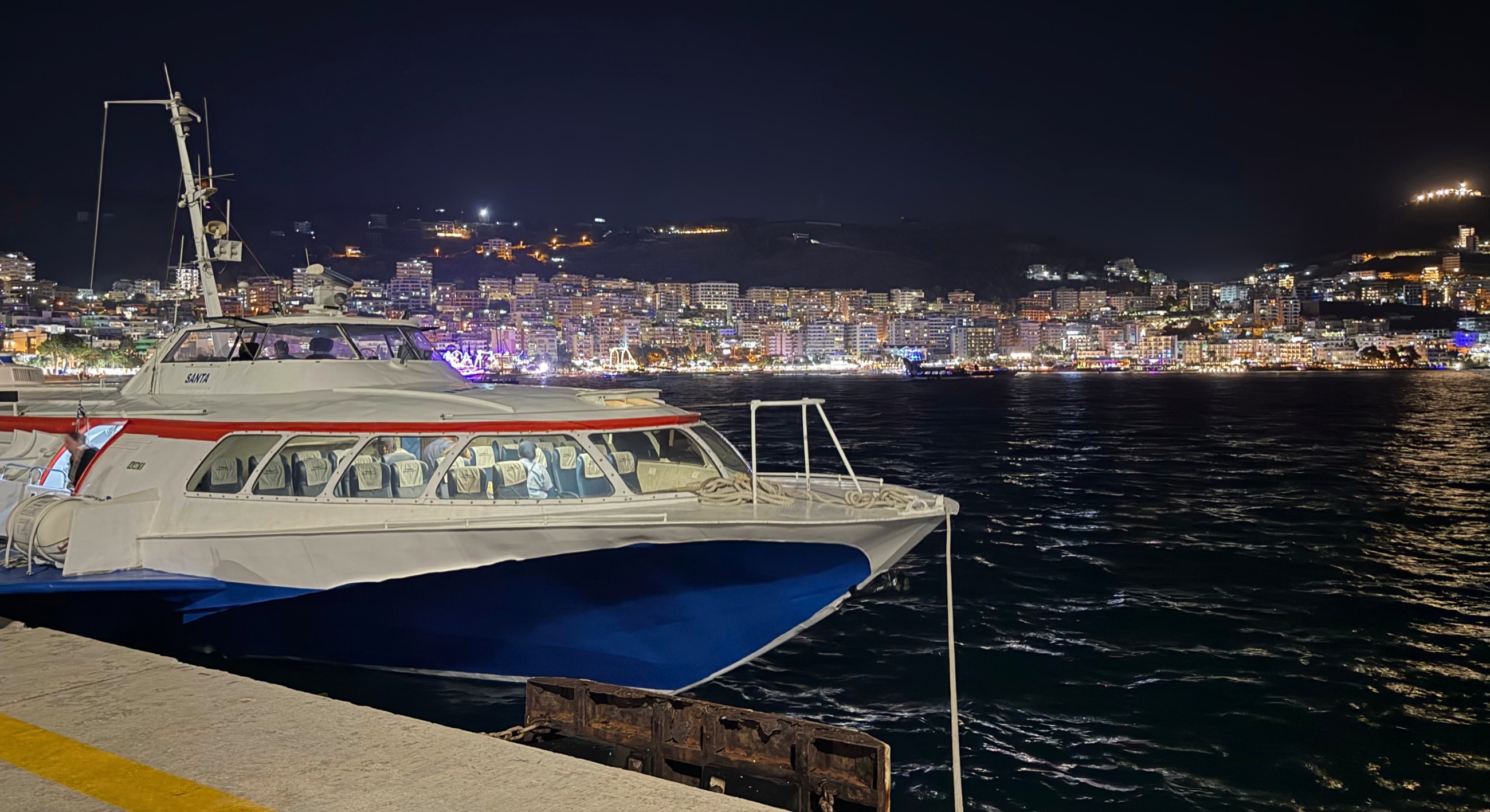 The Sarandë–Corfu hydrofoil docked along Sarandë’s waterfront, with the city illuminated across the bay.
Our first dinner in our new city came at Traditional Table, a family-run restaurant where the evening unfolded over fresh fish, moussaka, grilled vegetables, Greek salad, and house wine.
It was an appropriate first meal for a place where the cultural geography is more complicated than the national border suggests. Sarandë sits on the Albanian coast, but Corfu is plainly visible across the water. Greek language, food, religion, family connections, trade, and centuries of overlapping history remain part of the wider landscape on both shores. Less than forty-eight hours after arriving in Sarandë, we were heading to this Greek island.
Our high-speed ferry left Sarandë at 9:00 in the morning. For roughly forty-five minutes, we traveled south and west through the channel, running between stretches of the Albanian and Corfiot coasts before turning toward Corfu Town. The first surprise came before we had even stepped ashore: four cruise ships sat offshore.
September is commonly described as shoulder season around the Mediterranean, but that term now needs qualification. The worst summer heat had eased and European school holidays were largely over, yet Corfu Town was hardly empty. For many travelers, September has become desirable precisely because it promises warm water and slightly softer temperatures without the intensity of July and August.
Once away from the port, however, the town quickly became more interesting than the crowds. We wandered without much of a plan through the narrow streets of the Old Town, stopping inside churches, looking upward at balconies and façades, and repeatedly catching glimpses of fortifications between buildings. We found Saita, a small café tucked into the old streets, and ordered freddo cappuccinos before continuing on foot.
Later came lunch at Nino’s Taverna, where the cooking happening behind the counter better resembled a busy family kitchen than a polished visitor attraction. Then we walked toward the waterfront, through Spianada Square and along the Liston promenade, before stepping inside the Church of Saint Spyridon.
By mid-afternoon, we had seen enough of Corfu Town to understand that the island deserved more than its entry point, so we went north. For roughly €4 per person, an intercity coach carried us about ninety minutes up Corfu’s eastern coast toward Kassiopi. The bus was slower than a car, but the route supplied something a faster transfer might have missed: long views down into coves, glimpses of villages pressed between steep hills and water, and, across the channel, the mountains of Albania from which we had come that morning. By early evening, we were standing on another beach.
🏠 Behind the Nomad Curtain
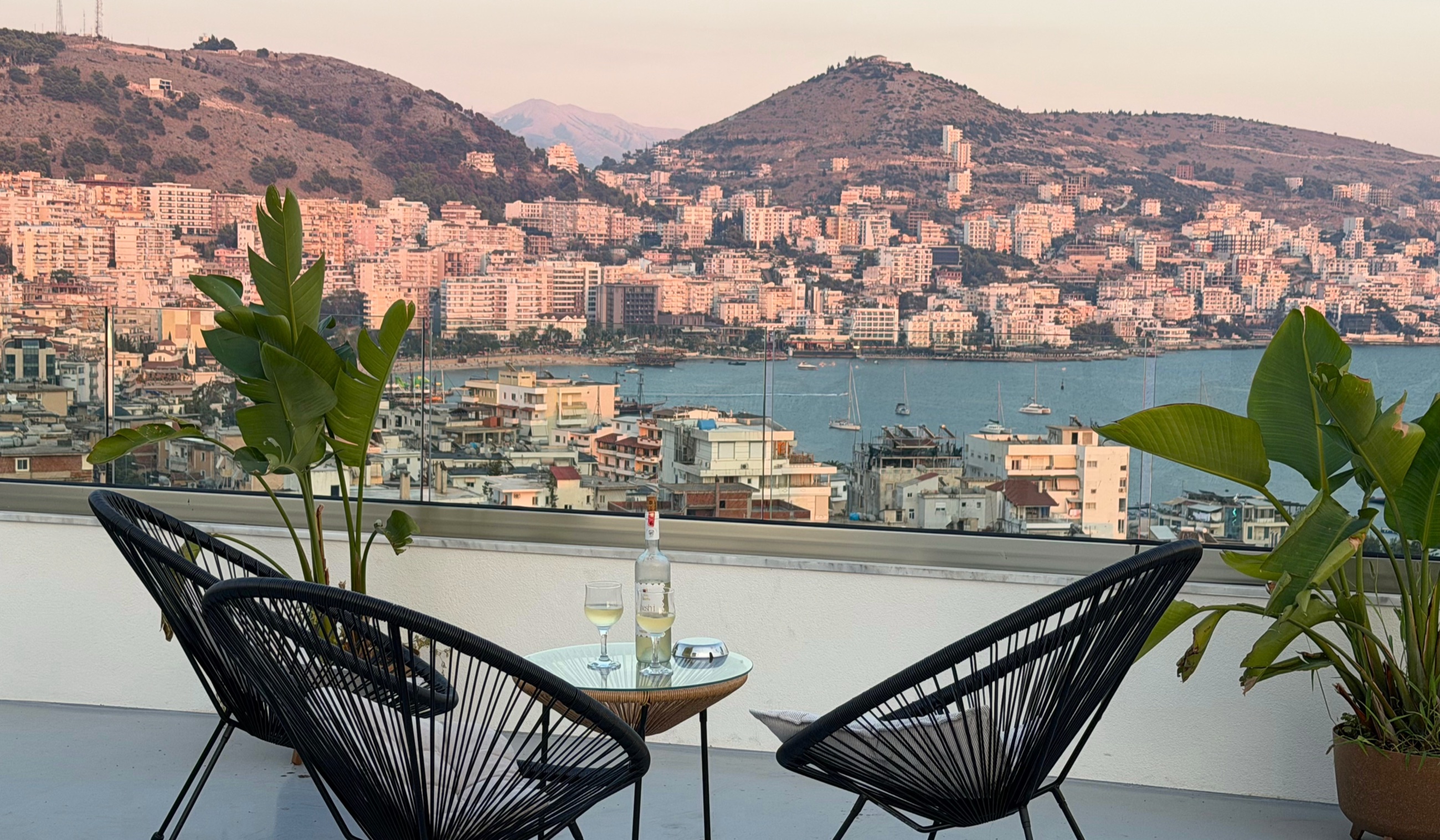 Wine on our rooftop terrace as Sarandë began to feel less like a stop and more like home for the month.
For several days, we did something surprisingly difficult for people living on the road: we acted like we were on vacation.
There were no serious work sessions, and honestly, no interest in spending Bailey’s visit working through the administrative checklist that accompanies every new month-long stay. A new gym still needed choosing, the refrigerator and pantry still needed stocking, the neighborhood around the apartment was still unfamiliar. None of it mattered yet. We had our daughter for a few days, and that settled the question before it was even asked.
One of the enduring lessons of long-term travel has been learning that living abroad and vacationing abroad are different activities, even when they take place in the same setting. Most of our life now resembles the former. We buy groceries, exercise, work, handle finances, do laundry, edit photographs, research transportation and lodging, cook dinner, and spend long stretches inside apartments that happen to be in interesting places. That ordinary structure is precisely what makes thirteen months abroad possible.
But family arriving changes the calendar. For a few continuous days, we could swim until we were tired, eat somewhere because it looked good, stay overnight on an island, celebrate a birthday, and leave the laptop closed longer than usual.
Now daily life is quiet again. The refrigerator is stocked, the gym is chosen, and Sarandë is about to become home rather than holiday.
🎨 Cultural Deep Dive
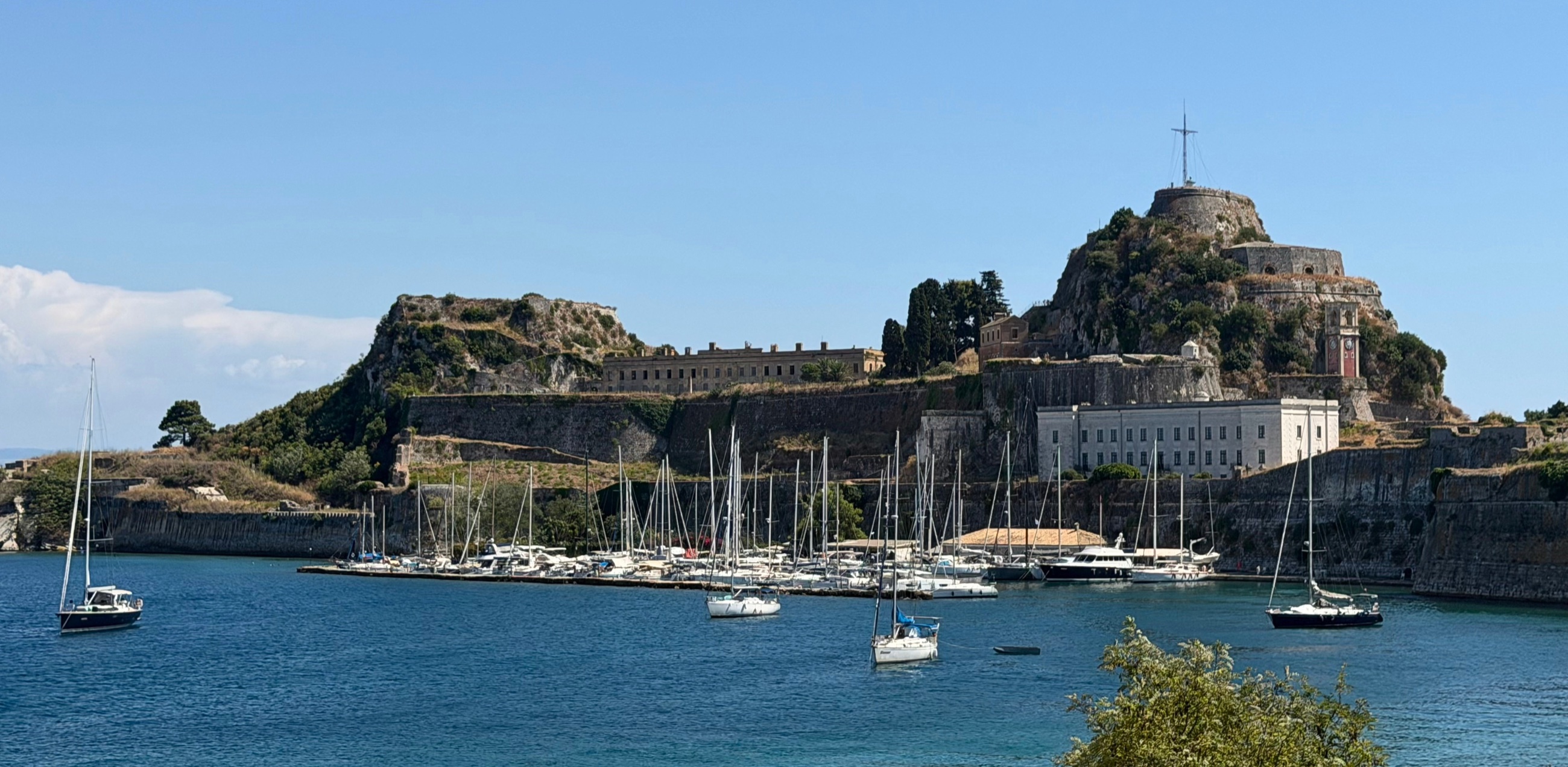 Corfu’s Old Fortress, with Byzantine origins and largely shaped by Venetian fortification works in the 15th and 16th centuries.
Corfu Town makes considerably more sense when viewed as a fortified frontier. The Old Town occupies a strategic position near the entrance to the Adriatic, facing the coast of what is now Albania. Its history reaches back to antiquity and Byzantium, but the physical character most visible today was shaped heavily during roughly four centuries of Venetian control.
That location mattered because Venice depended on maritime routes linking the Adriatic with its eastern Mediterranean possessions and trading network. Corfu became one of the fortified points protecting those routes, repeatedly confronting Ottoman pressure while much of the surrounding region came under Ottoman rule. The island itself remained outside direct Ottoman control.
That distinction helps explain the architectural contrast visible after months of traveling through the Balkans. Ottoman traces are central to cities across Albania, North Macedonia, Montenegro, Bosnia, Serbia, Greece, and Türkiye. Corfu developed along a different political path, first under centuries of Venetian administration and later through periods of French and British rule before joining the modern Greek state in 1864.
The fortresses tell much of that story. The Old Fortress grew from Byzantine defenses and was extensively reshaped under the Venetians as military engineering evolved. It guarded the eastern approach and once provided refuge for the population during major attacks.
The New Fortress, rising above the western side of the Old Town, followed later as the settlement expanded beyond the older defensive system. Together, the fortifications turned Corfu into one of the Mediterranean’s significant fortified ports. UNESCO added the Old Town to the World Heritage List in 2007, citing the combination of its urban fabric and defensive architecture.
The later layers are just as visible. The Liston, with its arcaded façades facing the Spianada, reflects the French period. The broad Spianada Square itself became one of Corfu’s principal civic spaces, and the British left another curious inheritance nearby: cricket. Matches are still played on a field surrounded by Mediterranean architecture, Orthodox churches, café tables, and Venetian fortifications.
Then there is Saint Spyridon. The church dedicated to Corfu’s patron saint was built in 1589 and remains central to the island’s religious life. His relics are kept inside, and the tall bell tower rises above the close-packed streets as one of the Old Town’s most recognizable landmarks.
Standing there after a month in Tirana produced an interesting geographical reversal. From Albania, Corfu had been the island across the water. From Corfu’s old fortifications, Albania became the mountainous mainland across the channel. For centuries, people on both sides were watching the same narrow stretch of sea for very different reasons. We were simply fortunate enough to cross it in forty-five minutes.
💰 Nomad Real Talk
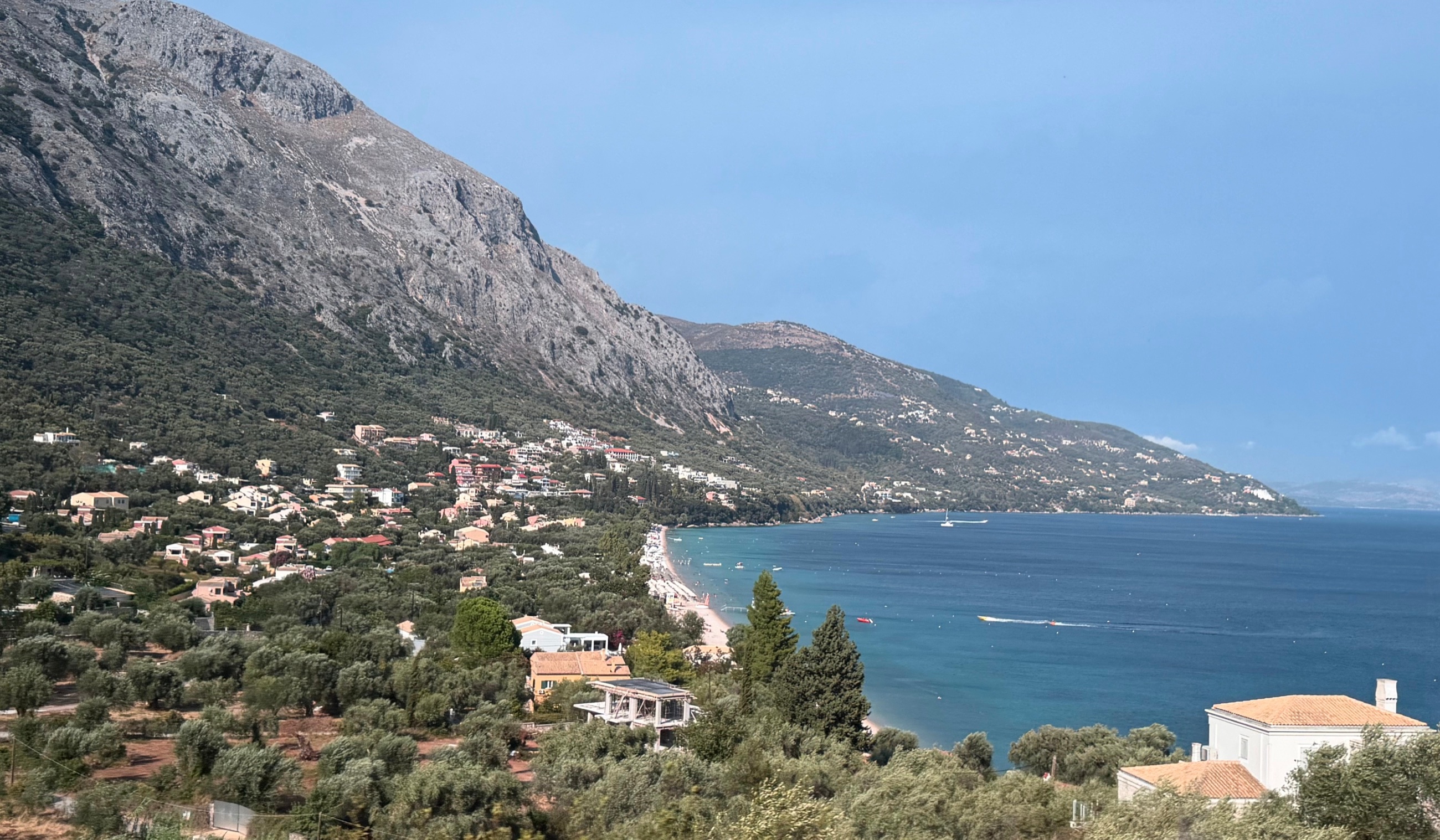 The road north toward Kassiopi follows Corfu’s steep eastern coast, helping explain why a 36-kilometer bus trip takes roughly ninety minutes.
The Sarandë-Corfu combination works remarkably well for travelers willing to use local transportation. Our experience required no rental car and very little complicated planning.
The high-speed ferry between Sarandë and Corfu Town cost €40 per person round-trip and took approximately 45 minutes. From Corfu Town, the intercity bus to Kassiopi cost about €4 per person and took roughly 90 minutes along the eastern side of the island. That cost and travel time is worth considering.
Kassiopi is only about 36 kilometers from Corfu Town, but the island’s roads follow the coastline and settlements rather than behaving like an express route. A ninety-minute bus ride therefore should not be treated as a minor transfer, particularly if trying to visit Kassiopi as a rushed day trip.
For us, staying overnight changed the calculation. We arrived with enough time for an evening swim at Bataria Beach, dinner overlooking the harbor, a walk through the village, and most of the following day back at the beach before returning to Corfu Town for dinner and our 8:30 p.m. ferry to Sarandë. It felt complete without requiring much time away from our month-long apartment.
The same principle applies on the Albanian side. From Sarandë, a local bus carried us south to Ksamil in about thirty minutes. That made it easy to spend Bailey’s birthday at the beach without paying for a taxi, renting a car, or creating another overnight stay.
Ksamil’s reputation brings its own complication: people. The combination of white-pebble and sandy shoreline, exceptionally clear blue-green water, and small offshore islands has made it one of Albania’s most heavily promoted coastal destinations. Even in September, no one should arrive expecting isolation.
Still, once we were in the water, the appeal was obvious. We spent much of the day at Ksamil 7 Beach, using an overwater platform as our base, swimming around it and eventually crossing to one of the nearby islets. For a group interested primarily in swimming and lounging rather than beach-club theatrics, the water itself justified the trip.
Two practical conclusions emerged from these few days. First, Sarandë is an unusually useful base for exploring this section of the Ionian coast without a car. Ferries and intercity coaches put a surprising amount within reach. Second, September can no longer be assumed to mean empty Mediterranean destinations. The temperatures may be better and the largest summer crowds may have receded, but popular places remain popular.
That is not necessarily a reason to avoid them. It is simply better to arrive knowing what month it actually is, rather than what the phrase “shoulder season” suggests it ought to be.
🍽️ Local Flavor
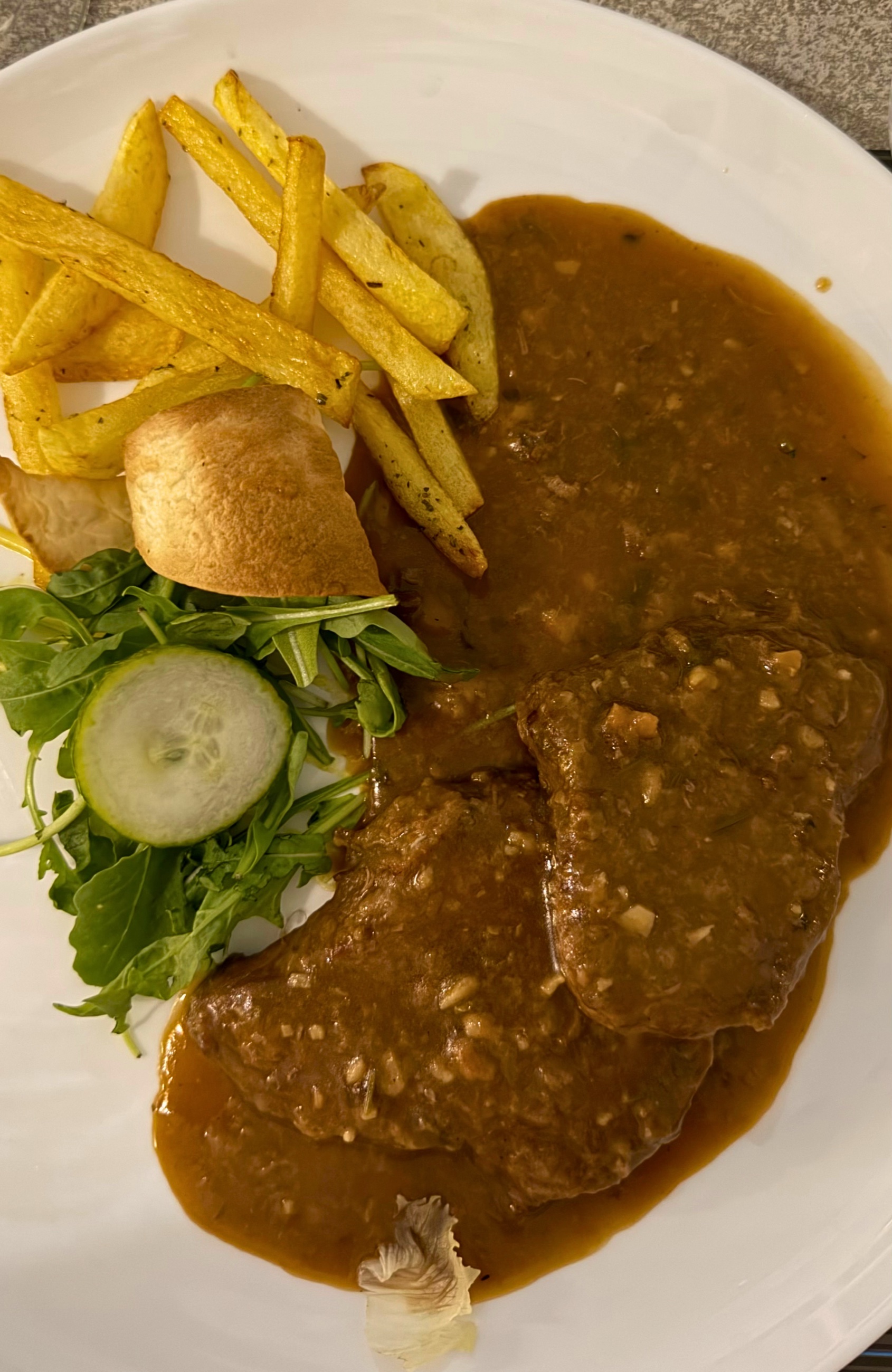 Corfiot sofrito at Kima in Kassiopi, slow-cooked veal with garlic and a wine-based sauce, reflecting the island’s Venetian culinary inheritance.
Corfu’s political history also survives on the plate. The Ionian Islands developed a culinary tradition distinct from much of Greece, with Italian and especially Venetian influences layered onto Greek ingredients and cooking habits. Even the names of some of Corfu’s better-known dishes reveal that inheritance.
We encountered the most famous example in Kassiopi. After checking into our Airbnb, swimming at nearby Bataria Beach, and cleaning up for dinner, we took a table overlooking the harbor at Kima Restaurant Café.
The meal included shrimp moussaka, Greek salad, and sofrito, one of Corfu’s defining dishes. Despite the name’s resemblance to Spanish and Latin American cooking terms, Corfiot sofrito is its own preparation: slow roasted pieces of veal or beef cooked with garlic and a wine or vinegar sauce, often with parsley, depending on the kitchen.
It tasted appropriate to the setting: Greek in its ingredients and place, European in its historical lineage, and difficult to separate neatly into the categories national cuisines sometimes imply. That pattern continued the following day.
After another long session in the water at Bataria Beach, we returned by bus to Corfu Town and ate our final meal at Margherita Pizza Artigianale, tucked into one of the Old Town’s narrow lanes. The pizza was distinctly Neapolitan in style, paired with red wine and eaten in surroundings that could easily remind a first-time visitor of southern Italy.
Earlier that morning we had been swimming beneath the ruins of a Byzantine castle. By dinner, we were eating Italian pizza inside a Greek town shaped for centuries by Venice. Corfu compresses a good deal of Mediterranean history into a small space.
Back in Sarandë, the eating became simpler again. For Bailey’s birthday evening, after another full day in the sea, we found a busy Italian pizza restaurant and settled around the table with wood-fired pizza, Greek salad, cold beer, conversation, and no particular reason to hurry. After several days of very good meals, that one may be the easiest to remember.
📸 Photo Story
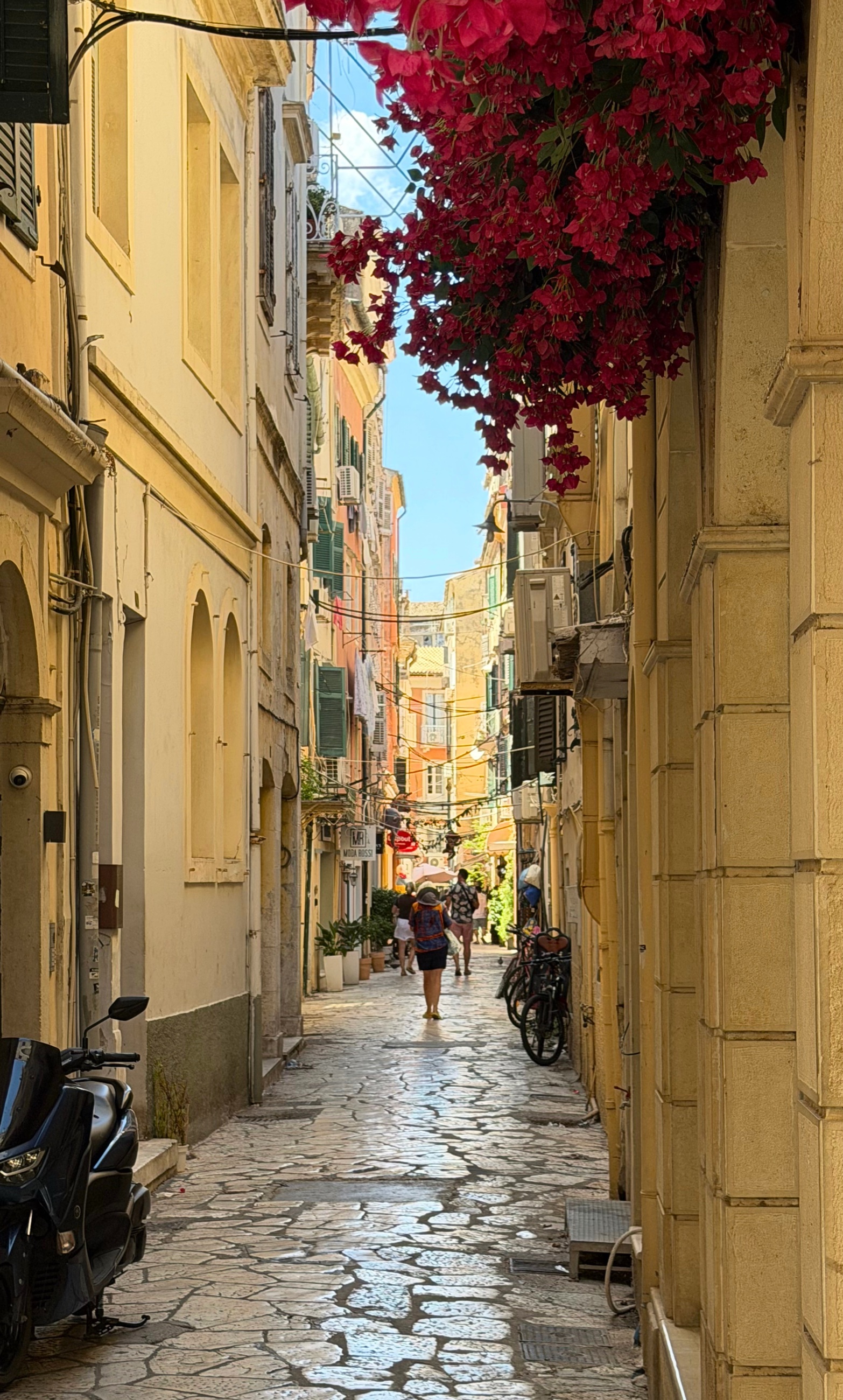 A quiet lane in Corfu Old Town, lined with worn stone, shuttered windows, and bougainvillea.
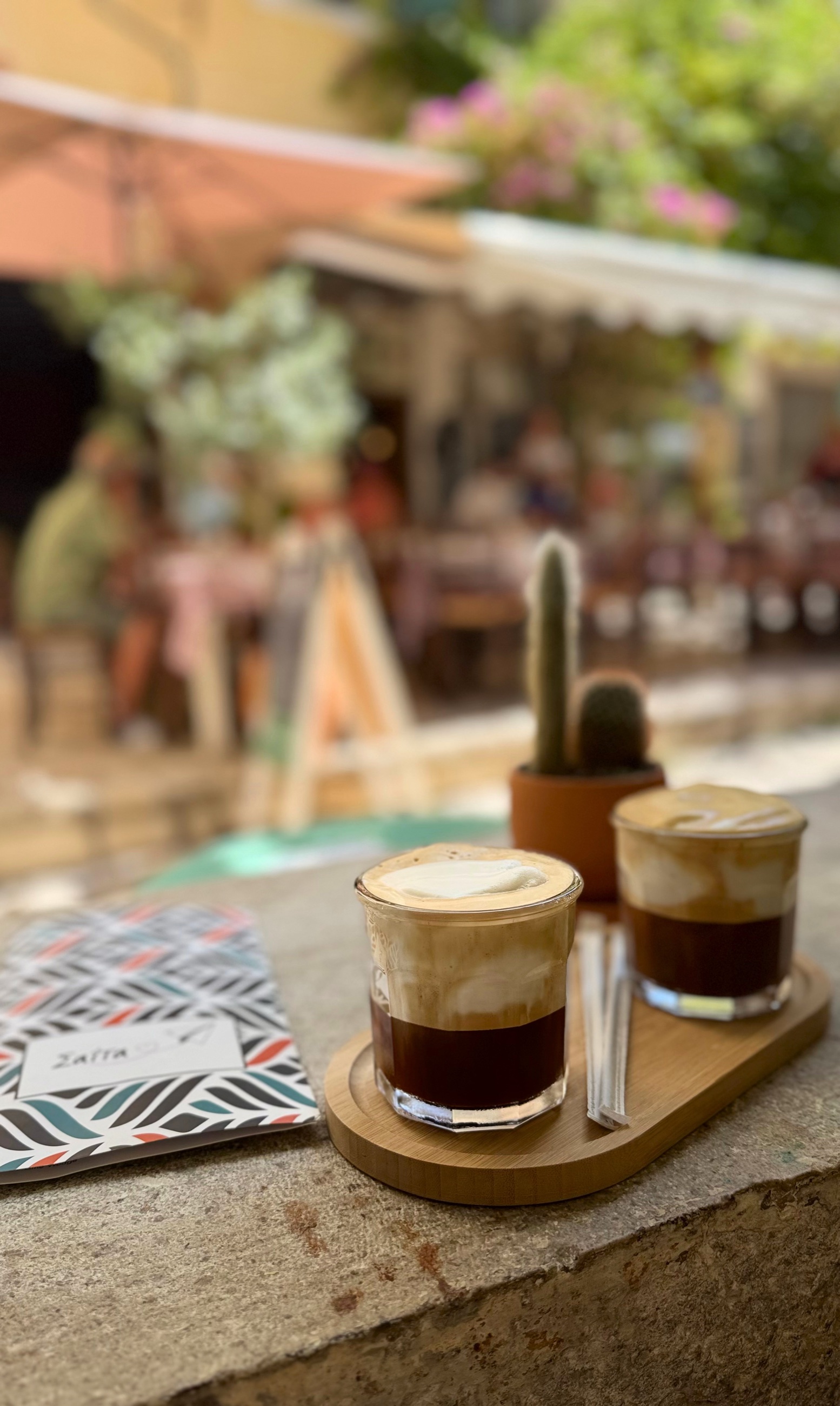 Freddo cappuccinos at Saita, tucked into the narrow streets of Corfu Old Town.
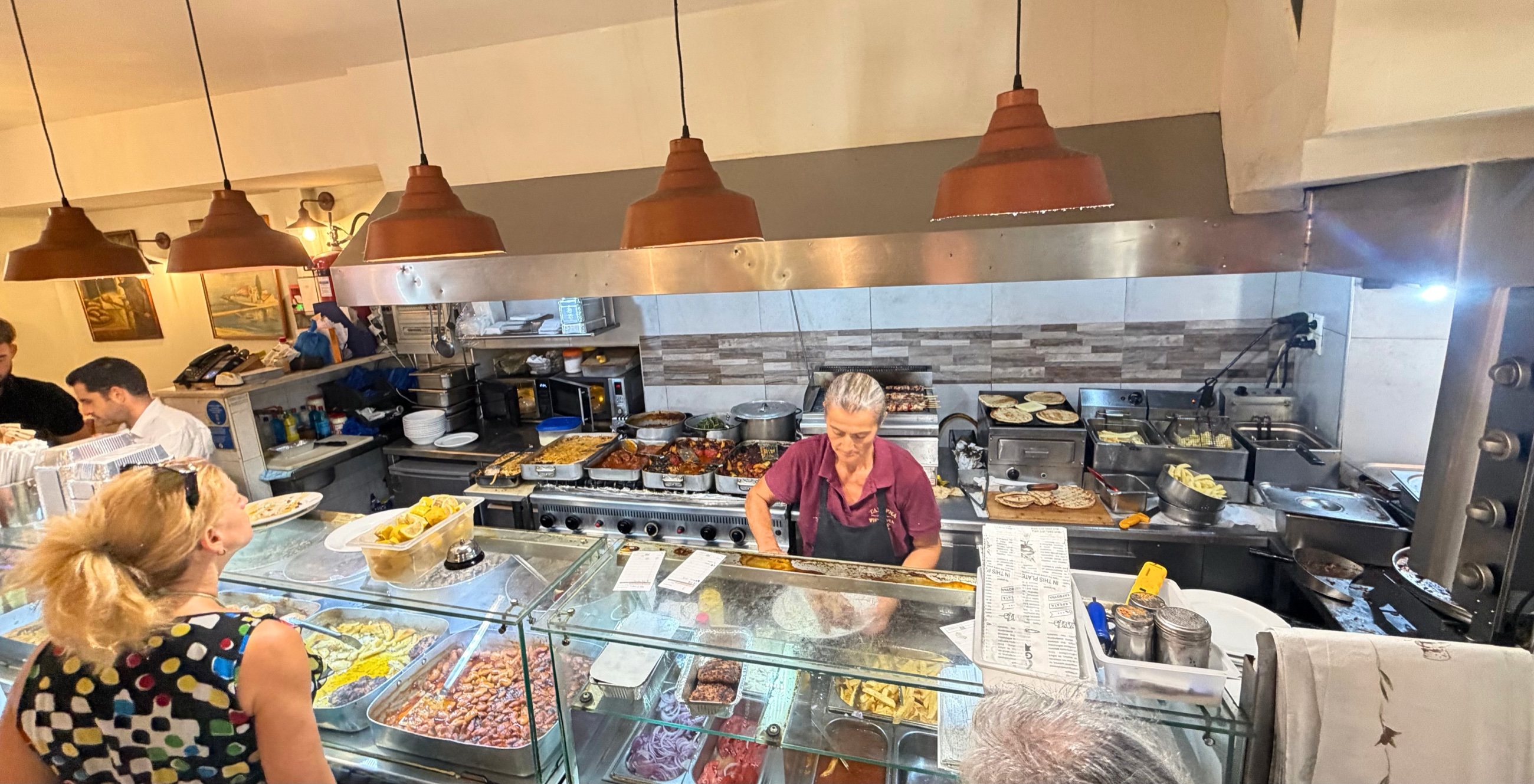 Lunch at Nino’s Taverna, with grandma running the kitchen.
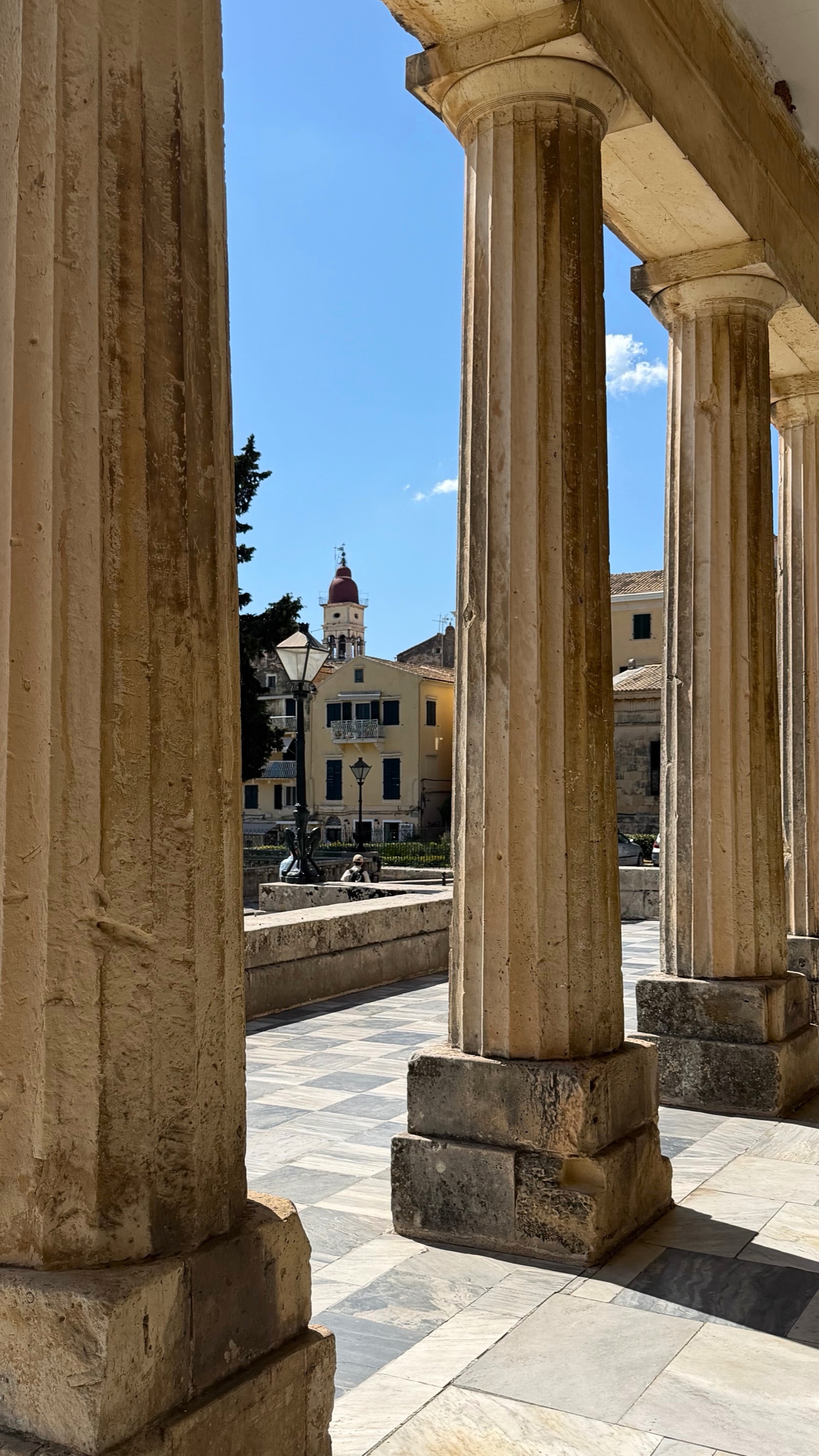 Through the colonnade of the Palace of St. Michael and St. George, a Corfu bell tower rises beyond.
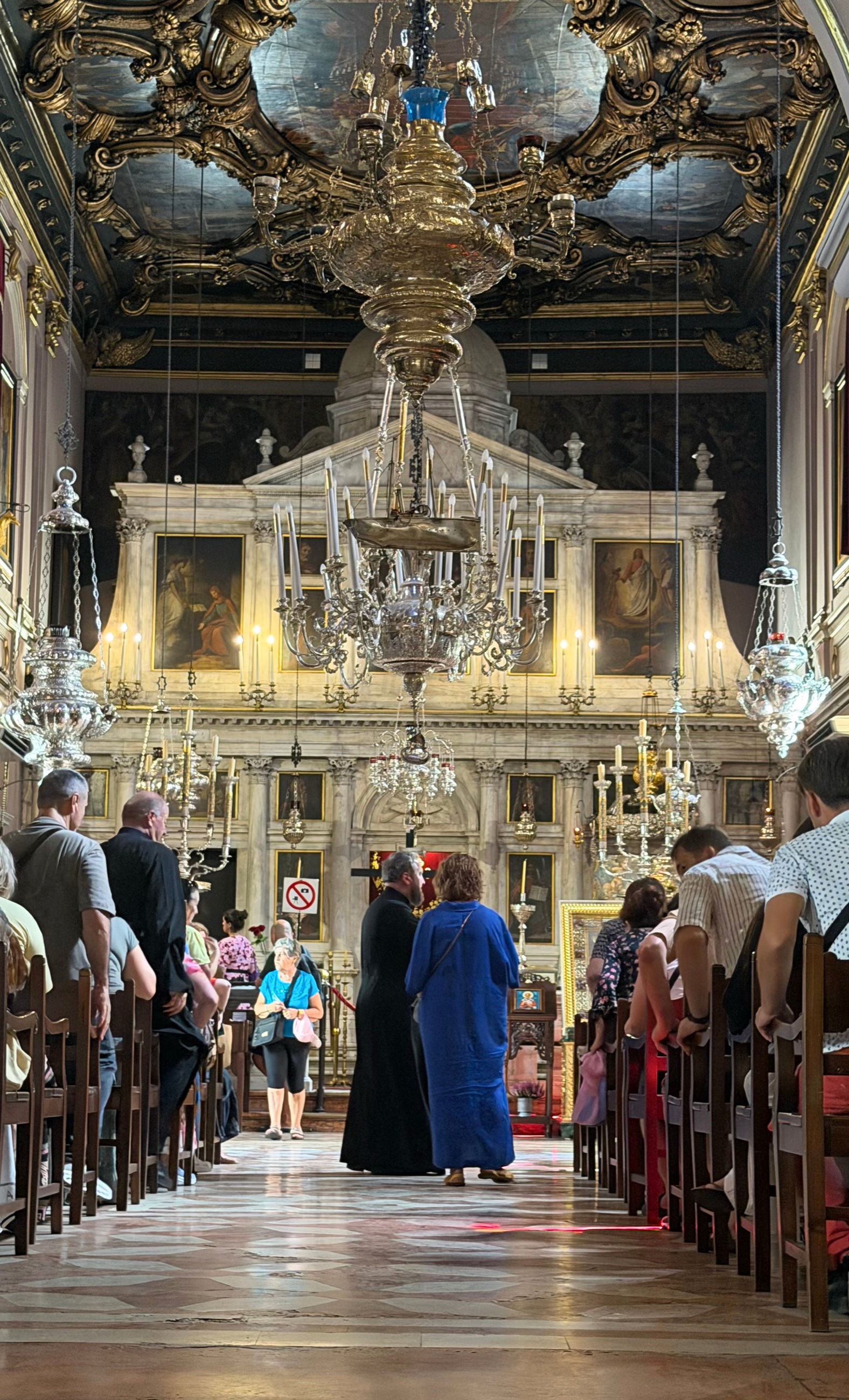 Inside Saint Spyridon Church, the spiritual heart of Corfu and home to the island’s patron saint.
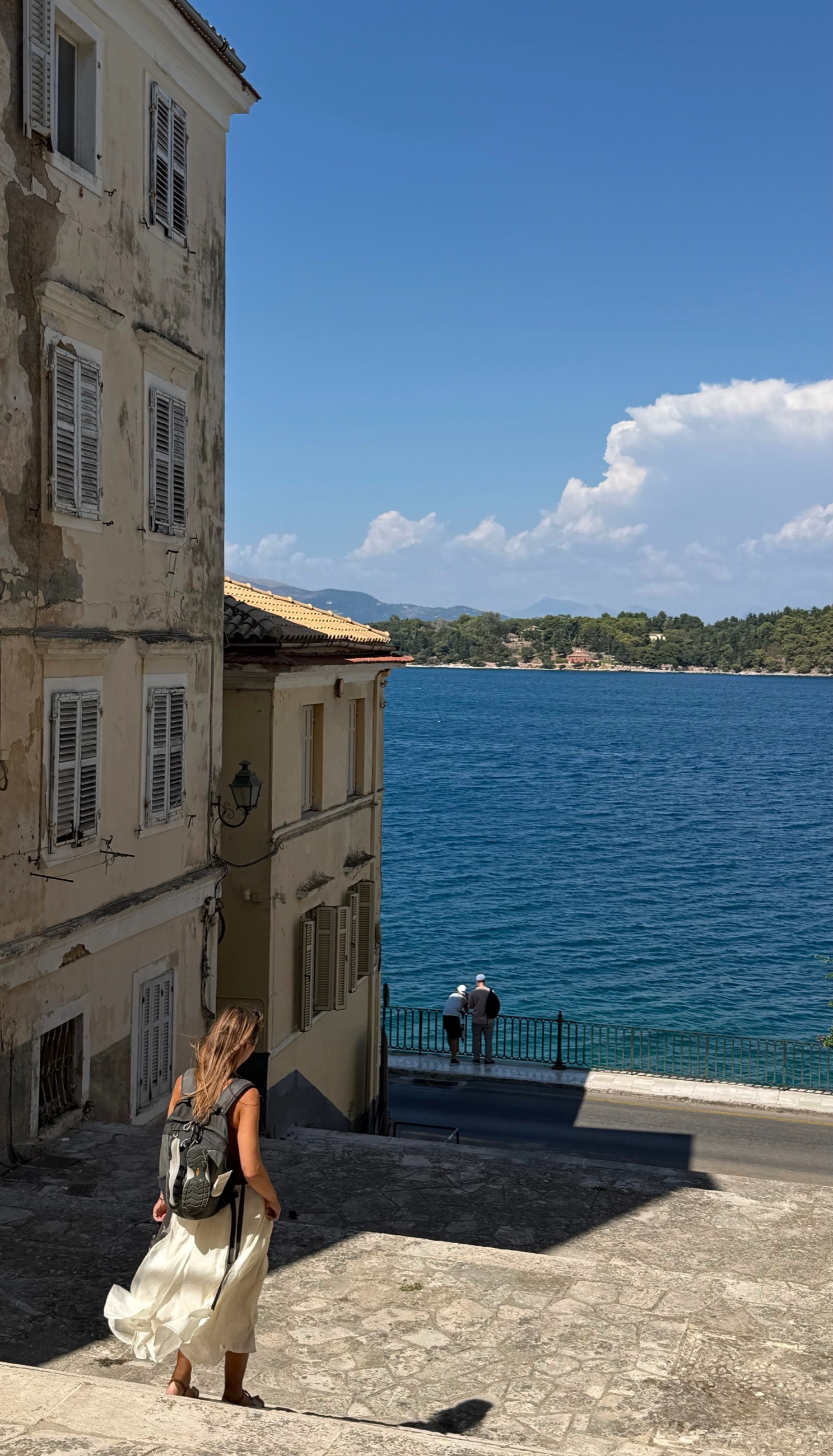 A walk downhill through Corfu Town ends with the Ionian Sea opening into view.
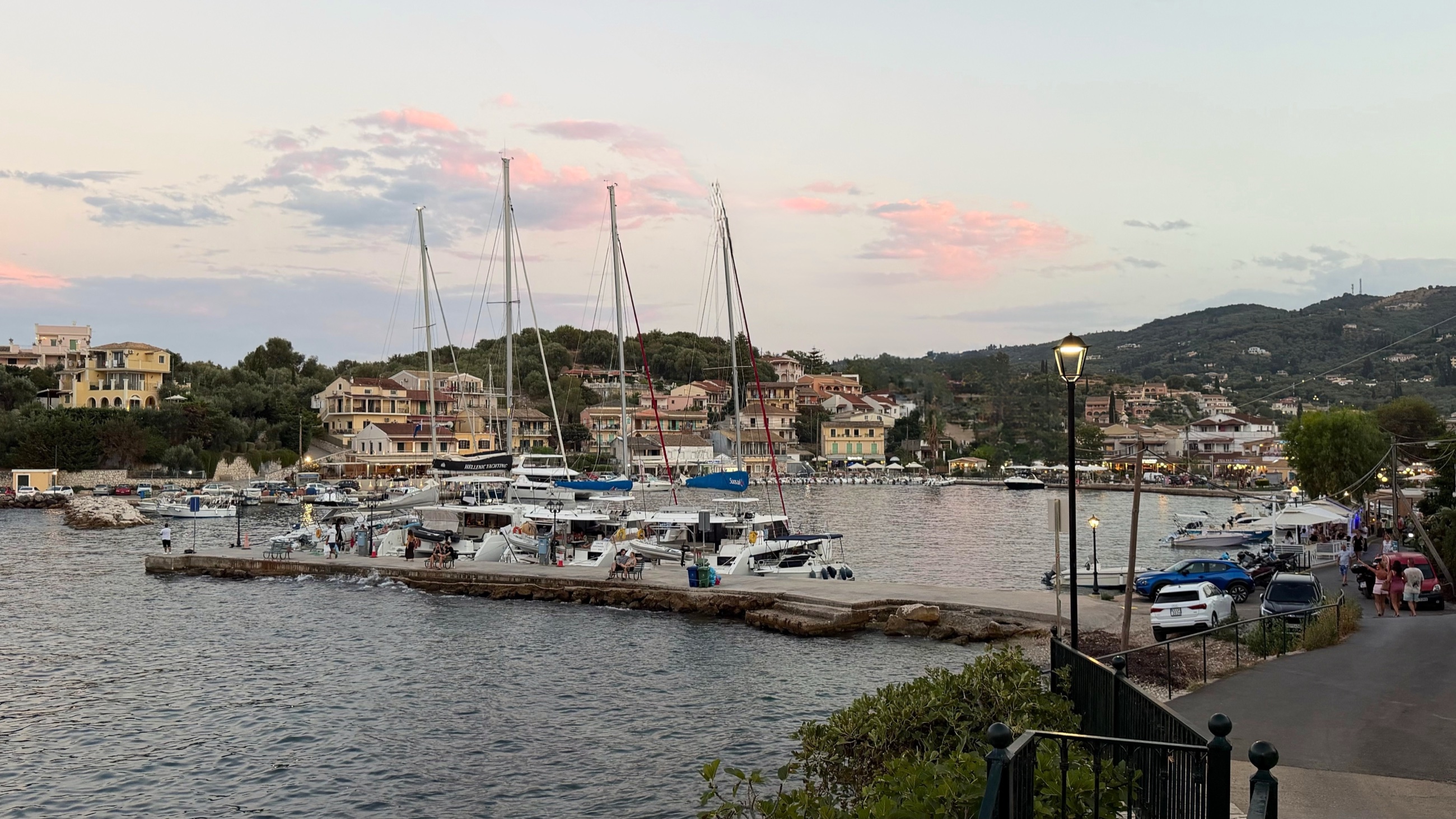 Evening settles over Kassiopi harbor, with sailboats moored beneath the village waterfront.
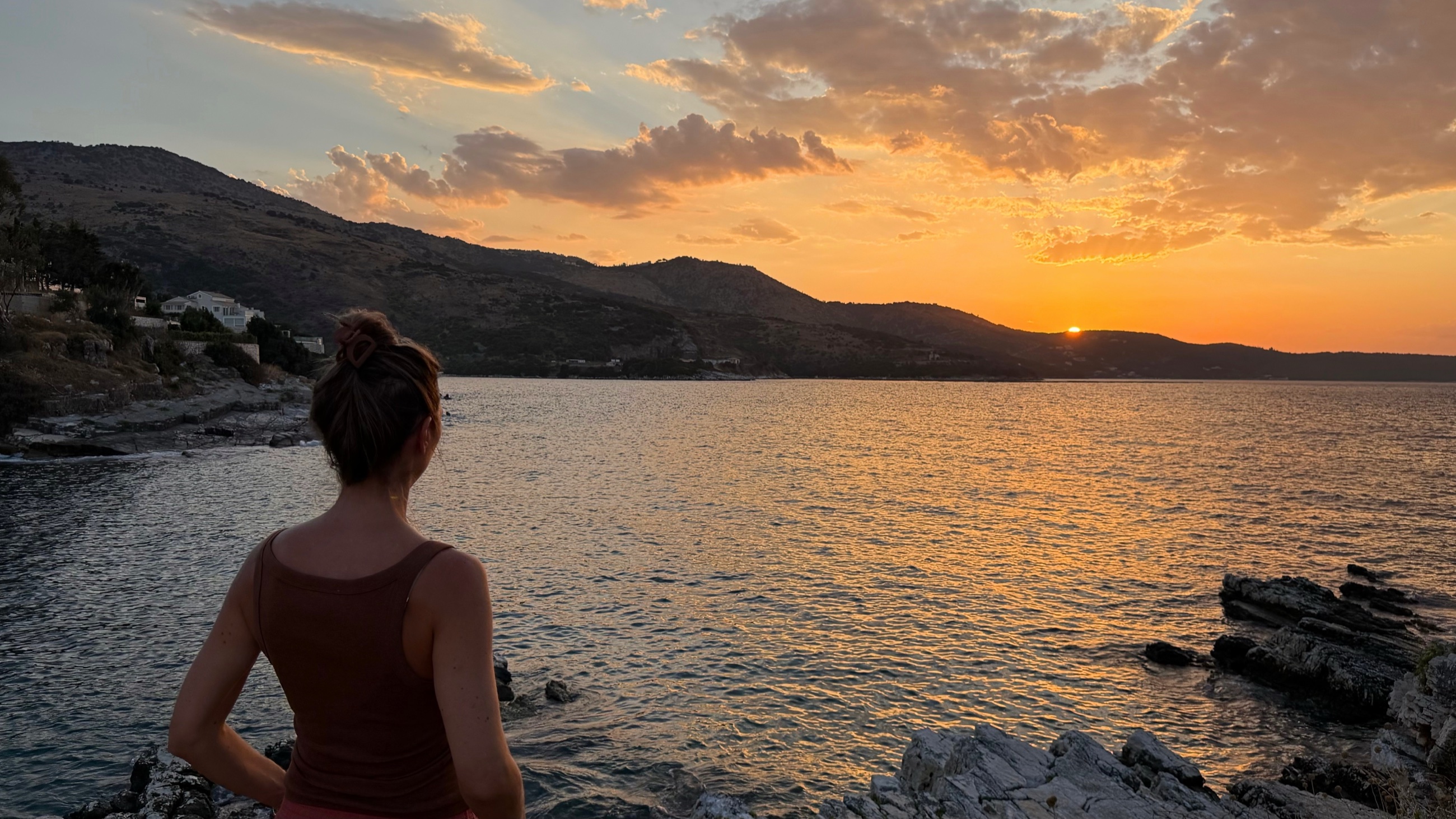 Watching the sun drop over Kassiopi.
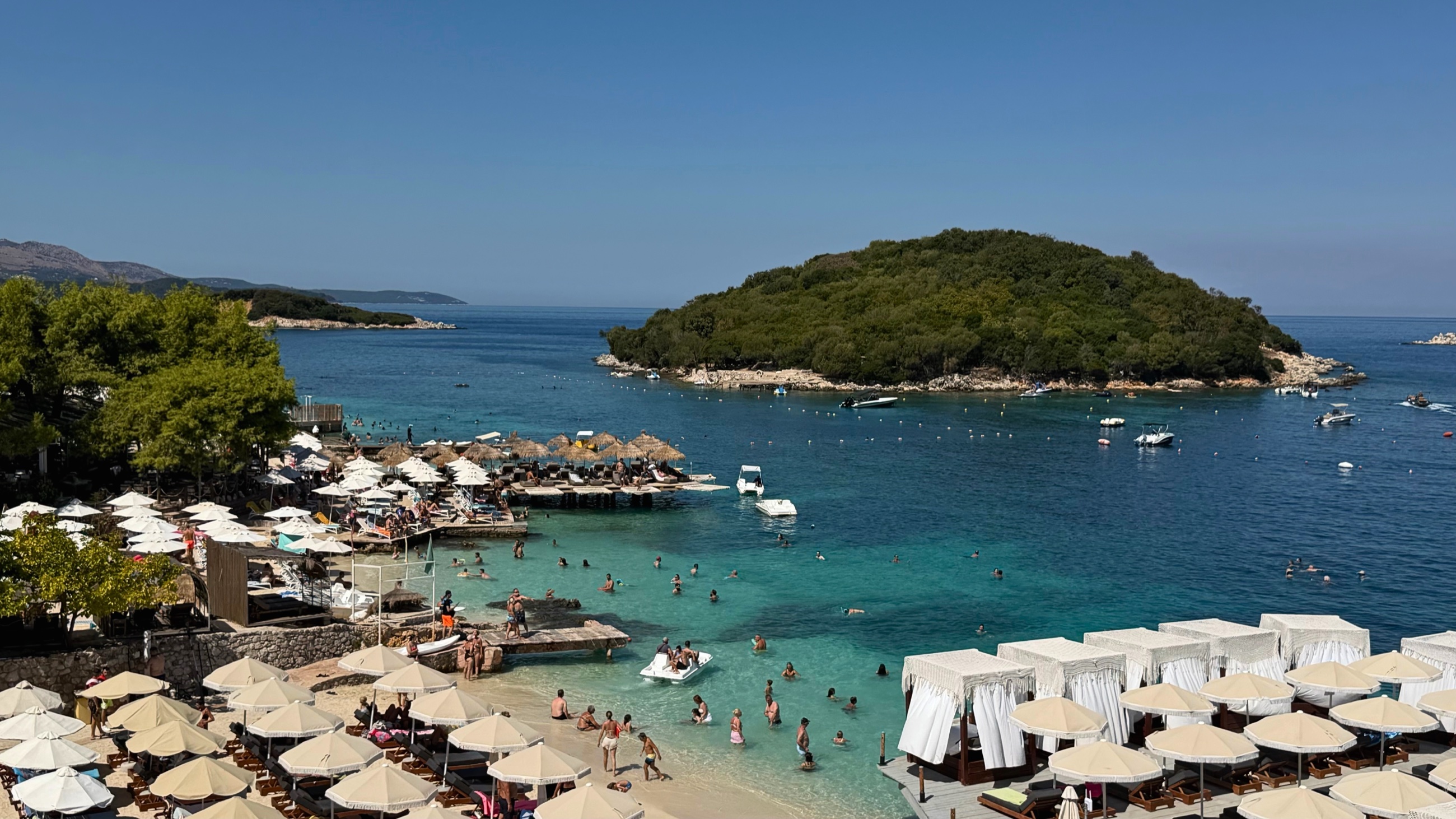 Ksamil at its most vivid: turquoise water, swimmers, loungers, and a sheltered bay filled with summer activity.
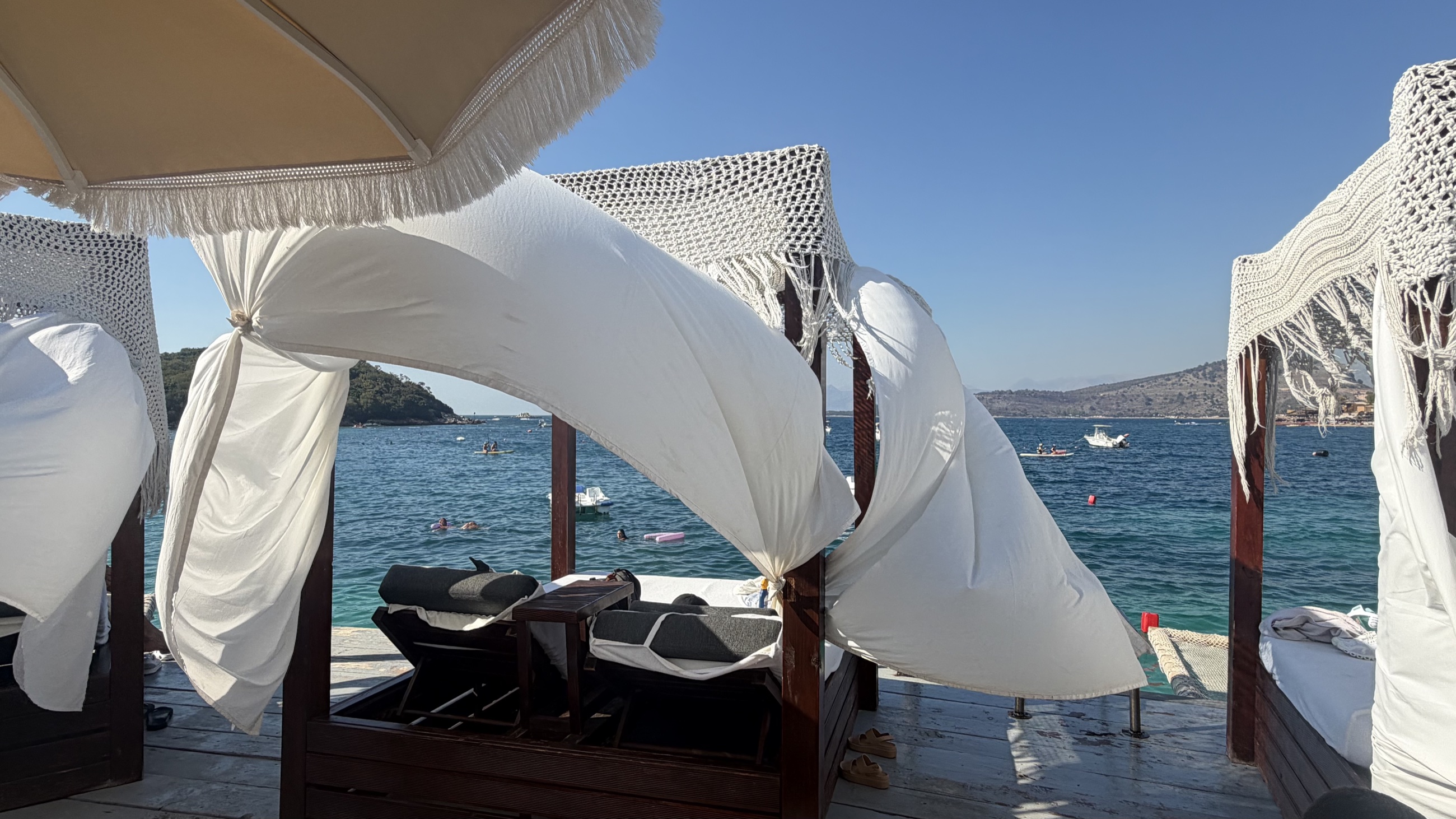 Our breezy cabana on the Ksamil waterfront, looking out across the Corfu Channel.
🎯 Next Week Preview
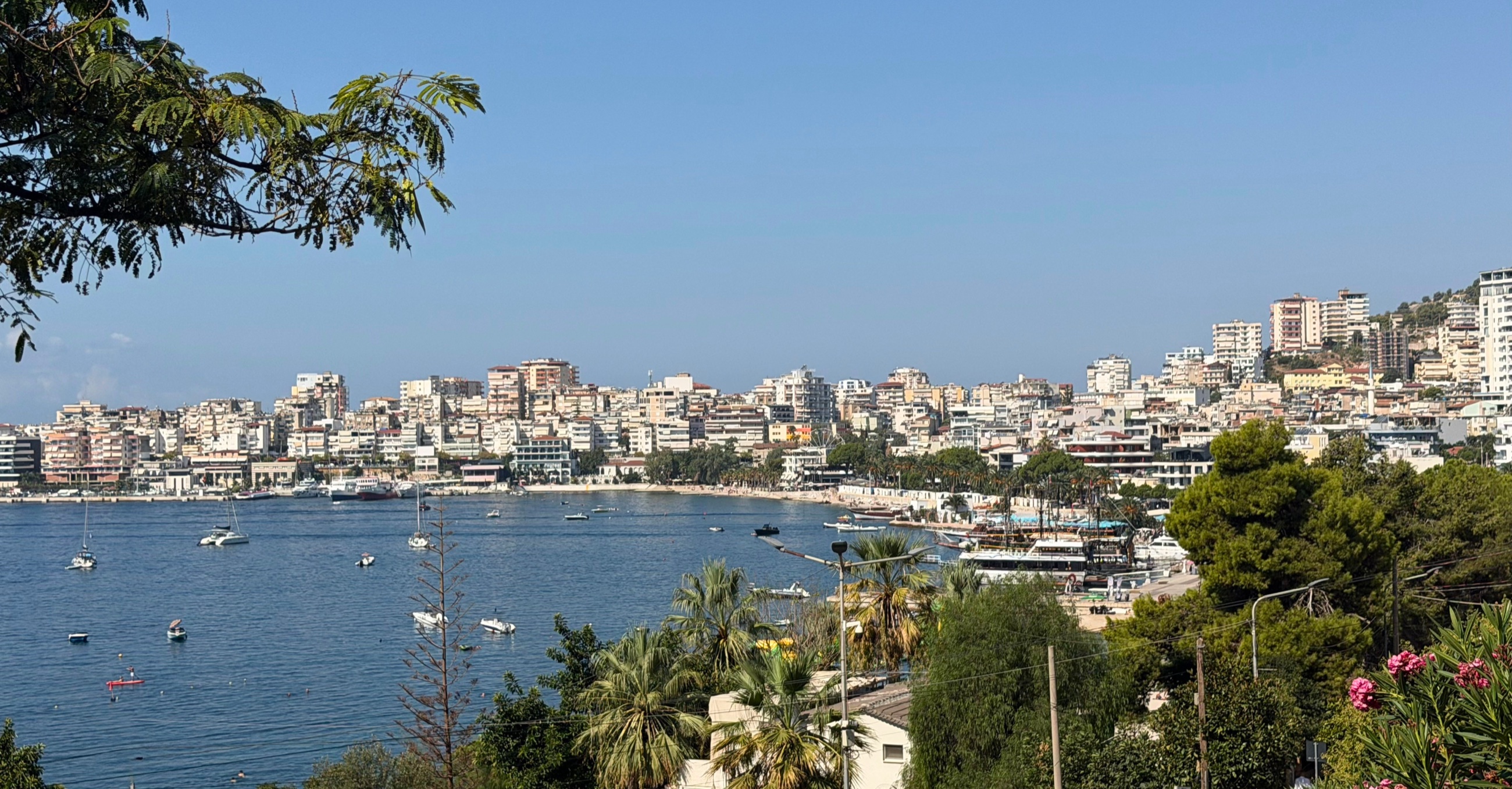 Sarandë’s waterfront and hillside neighborhoods, where the coming week will establish the rhythms of daily life.
With our family visit over, the coming week will finally belong to Sarandë itself. Work resumes, along with the less photogenic business of finalizing transportation and lodging for the months ahead.
More importantly, we can begin seeing Sarandë at the pace of slow travel. The beaches and promenade are the obvious introduction. What interests us now is what sits behind them: where people shop, where we want coffee, what the streets feel like away from the waterfront, how the town functions outside the busiest visitor hours, and what daily life looks like once a resort destination becomes a place to live for a month.
Corfu was the big excursion. Now we begin Sarandë.
💌 Personal Connection
We had been to Greece before: an anniversary trip through Athens, Crete, and the Cyclades several years earlier, one of the best trips of our marriage. We love this country, and Corfu only confirmed it. Thessaloniki, our next stop after Sarandë, will confirm it again.
There are certain family gatherings planned years in advance, and others that come together only once the shape of a life on the road makes them possible. Celebrating Bailey’s birthday between Sarandë, Corfu, Kassiopi, and Ksamil belongs to the second kind.
A year ago, none of us would have predicted that we would swim in the Ionian Sea off a Greek island, then celebrate her birthday by doing the same off the Albanian coast the next day.
For several days, our strange traveling life intersected with ordinary family life again. We ate together, shared an apartment, caught buses, waited for ferries, swam until everyone was tired, laughed over dinner, and spent enough uninterrupted time together for the destinations to become the setting instead of the point.
On her final evening, we walked the Sarandë promenade after dinner before eventually reaching the moment every family visit reaches: hugs, goodbyes, separate directions. Then Stephanie and I walked home.
The next morning there was still nearly a month ahead of us in Sarandë: work to resume, routines to settle back into, and a resort town that still had to become, in the ordinary sense, a place we lived rather than visited. For a few days, though, we were simply grateful that this particular corner of the world could be shared.
Happy birthday, Bailey. We love you very much.
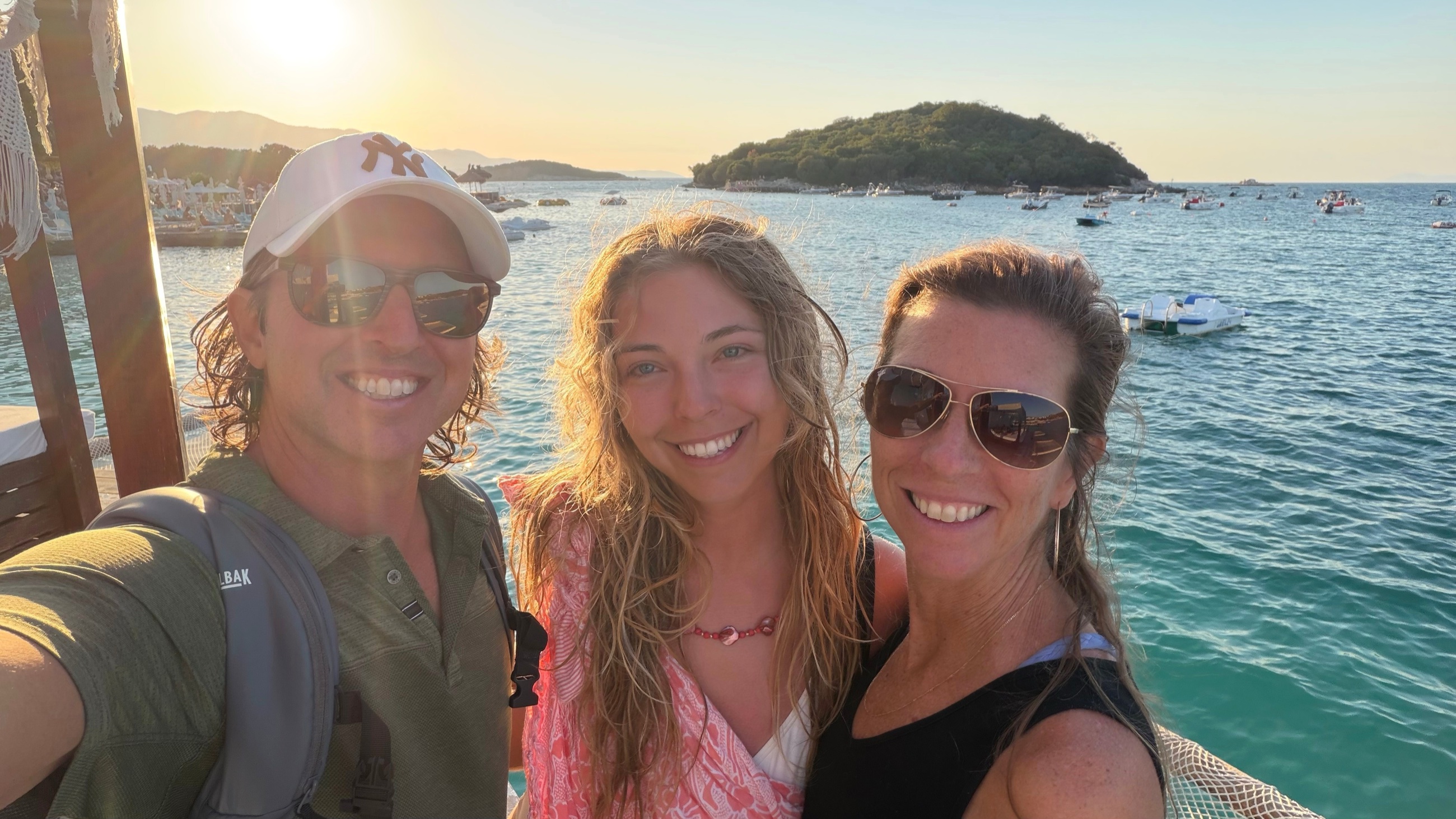 Celebrating Bailey’s birthday in Ksamil, with one last beach day together before another goodbye, for now.
Until next week,
S&S
Some Great Place · Living Local in a Global World · somegreatplace.com