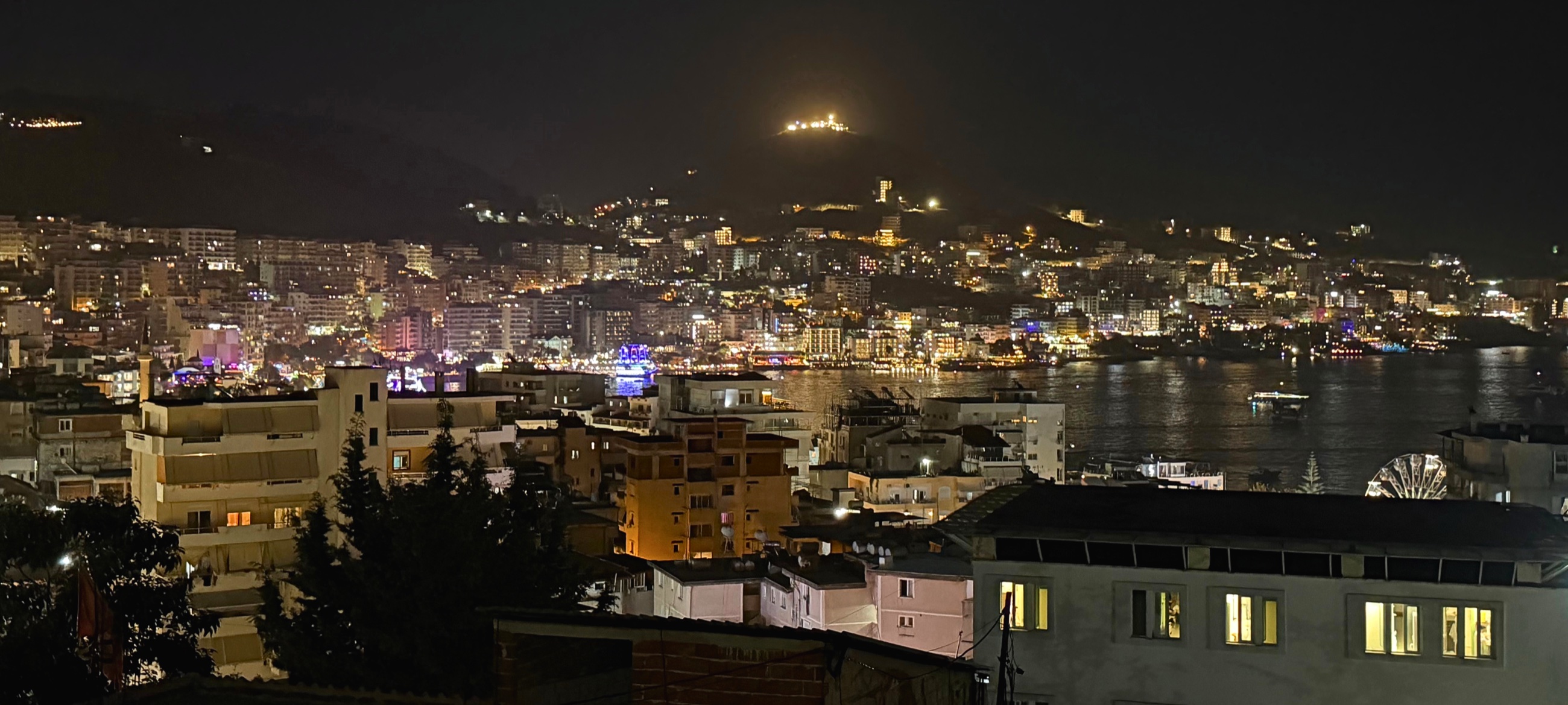
 Night settles over Sarandë, seen from our apartment above the Ionian.
Last week ended with the refrigerator stocked, the gym chosen, and Sarandë about to become home rather than holiday. This week, it did.
That is a more settled kind of week than the ones before it, and it says something about why we choose a month in a place instead of three days. Then, in the middle of it, you can find yourself standing in a Hellenistic theatre.
📍 This Week in Sarandë
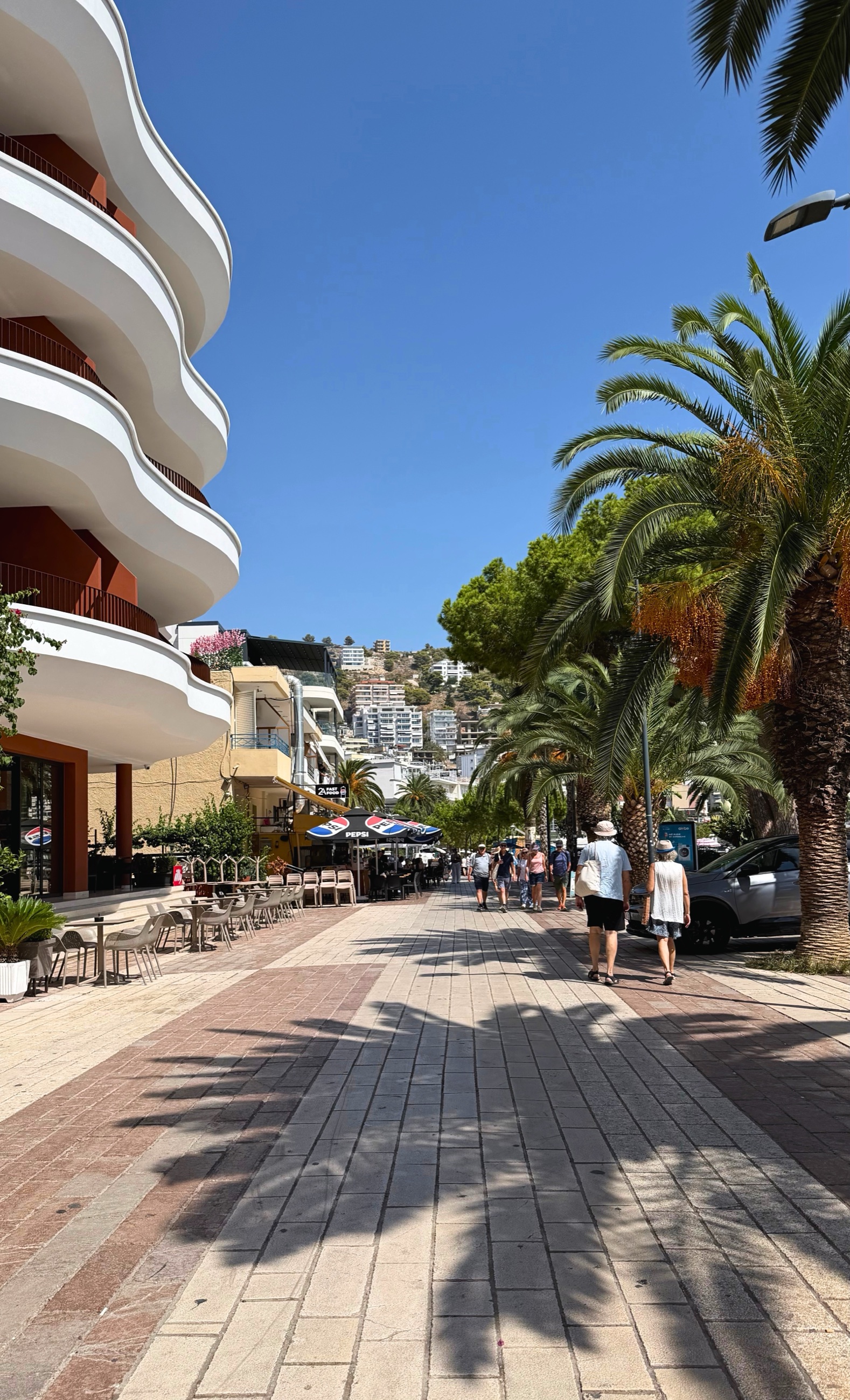 The Sarandë promenade, part of the rhythm of everyday life.
Our gym routine travels with us. The variable is finding the right place in each new city; this week the Sarandë gym was back in full rotation. We have a favorite coffee shop now, though hardly the only one we’ll walk into. Restocking supplies has stopped being one stop: a bakery, a meat and cheese shop we’ve come to prefer, the farmers market for fresh produce, and a regular grocery store for whatever else we need. We’ve learned where to go for what. We walked stretches of Sarandë we hadn’t gotten to yet, mostly because the town no longer feels like something that needs to be explored on purpose, and returned to Ksamil twice, drawn back by some of the clearest, most inviting water we have found anywhere on this journey.
The one real excursion of the week pulled us south toward Butrint, opposite Corfu across the channel. We caught the local bus to Butrint National Park, one of Albania’s most significant archaeological sites, and by mid-afternoon were back on the same route, stepping off early to swim at Ksamil before returning to Sarandë for pizza on a hillside veranda above the bay.
🎨 Cultural Deep Dive
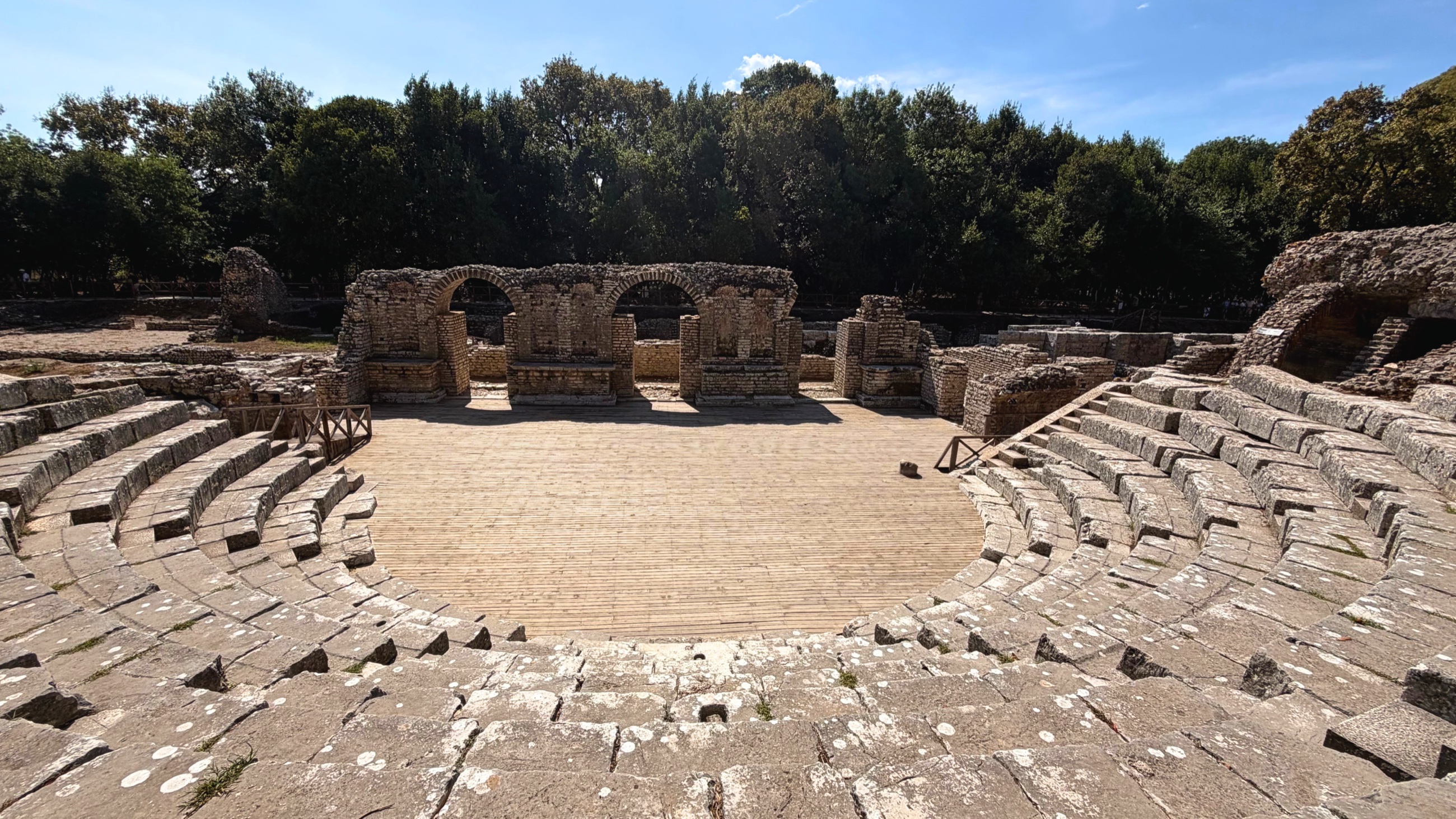 The Hellenistic theater at Butrint, built in the third century BC and later expanded by the Romans.
A Little Troy: More Than Two Millennia at Butrint
Long before Butrint became one of Albania’s most important archaeological sites, it appeared in one of the foundational works of Western literature.
In Book III of Virgil’s Aeneid, Aeneas arrives at Buthrotum and encounters Andromache and Helenus, survivors of Troy who have recreated pieces of their lost homeland along the Ionian coast. Virgil describes the settlement as parva Troia, a “little Troy.”
Nearly two thousand years after Virgil wrote those lines, getting there from Sarandë requires little drama. We boarded the local bus, paid 300 LEK, about €3, per person, and arrived roughly forty-five minutes later.
The contrast becomes apparent almost immediately. Butrint sits on a wooded peninsula between Lake Butrint and the Vivari Channel, so its ruins appear gradually through trees and wetlands rather than against the streets of a modern city. Human occupation in the wider landscape reaches far into early history, while the ancient settlement developed strong connections with the Greek world and became an important center of the Chaonians of Epirus.
One of the first major monuments along the route is the theatre, built around the middle of the third century BC beside the Sanctuary of Asclepius, the god associated with medicine and healing. Inscriptions carved into the complex record the freeing of enslaved people, small pieces of individual lives preserved alongside the architecture. Roman additions later enlarged and altered the theatre while retaining much of the older Greek setting.
Rome changed Butrint more extensively after the city became a Roman colony in the first century BC. Aqueducts, baths, villas, fountains, and new construction expanded the urban center beyond its earlier footprint.
Christianity then added another layer. By the fifth century, Butrint had become an episcopal center. The sixth-century baptistery remains one of its most important monuments, with a mosaic floor arranged in concentric bands of animals, birds, plants, geometric forms, and Christian symbolism. The mosaics are usually covered with protective sand to limit damage from weather and erosion, as they were during our visit, although photographs inside the museum show what lies underneath.
Nearby, the Great Basilica makes the scale of Butrint’s Christian period more tangible. Portions of its walls, arches, nave, and apse still rise among the trees rather than surviving only as outlines at ground level.
The Lion Gate tells a different story. Its stone relief depicts a lion attacking a bull, an older carved block reused when the gateway was reconstructed and narrowed during the medieval period. It is a small architectural detail with a larger implication. Successive generations at Butrint continually built with pieces of what had come before them.
Byzantine, Angevin, Venetian, and Ottoman influence followed. At the top of the acropolis, the castle now houses the Butrint Museum and looks across the Vivari Channel and surrounding wetlands. From there, the entire setting becomes clear: city, water, marsh, defenses, trade routes, and geography occupying the same compact landscape.
Admission is 1,000 LEK, about €10, and includes the museum. The walk around the peninsula and up to the castle at the top of the acropolis comes to just under two miles, with little elevation beyond the roughly hundred-foot climb to the castle itself. Including the museum and a picnic lunch, our full visit took about three hours. Two to three hours covers the principal monuments comfortably. The site rewards a slower pace if the schedule allows it, particularly around the theatre, the baptistery mosaics, and the museum exhibits.
What stayed with us was the accumulation. Greek sanctuary, Roman colony, Christian bishopric, Byzantine settlement, Venetian defenses, and eventual abandonment occupy essentially the same ground. The history is encountered in sequence simply by walking through it.
🍽️ Local Flavor
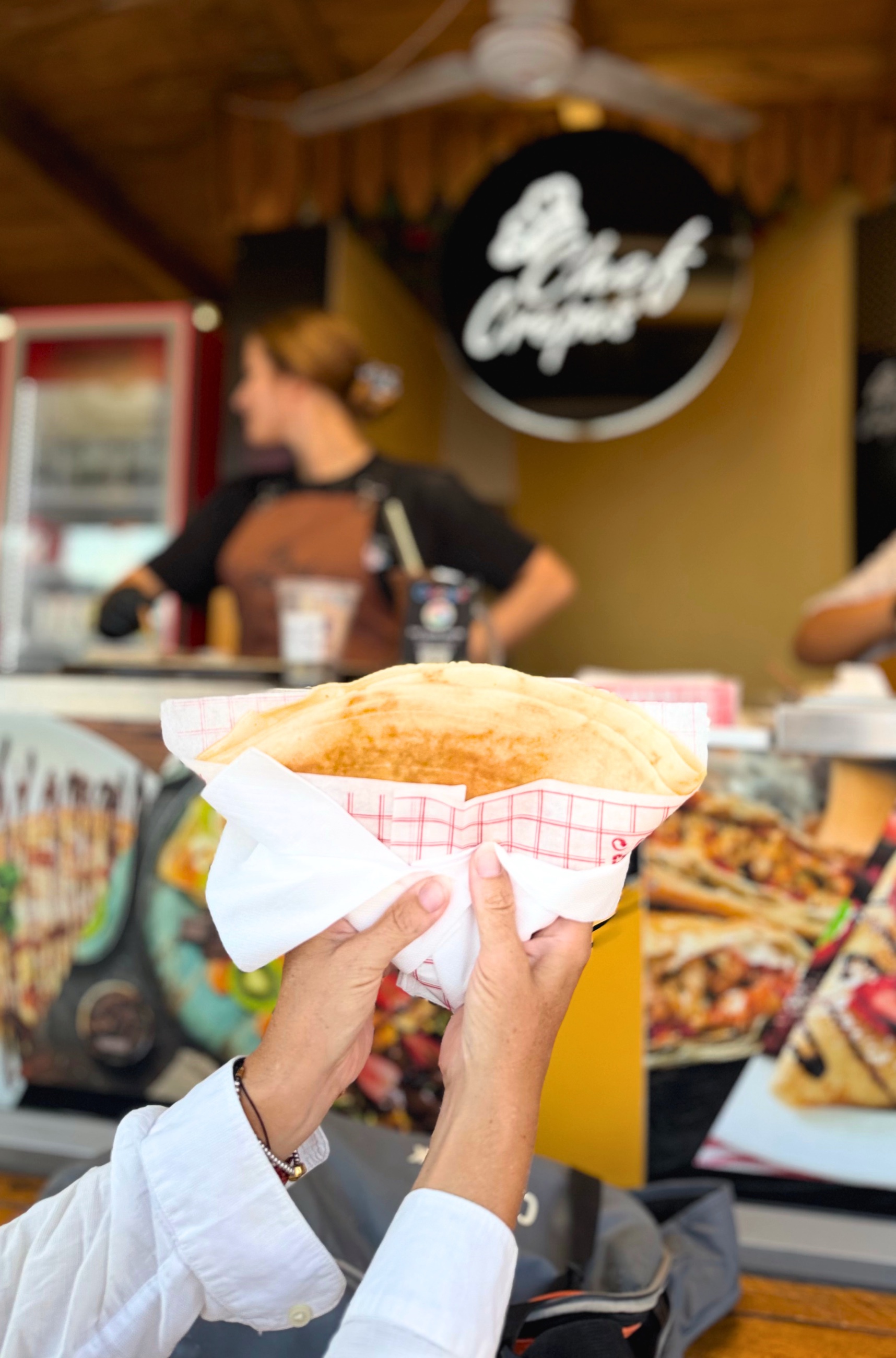 Savory crepes along the Sarandë promenade.
Our favorite meal this week never left the apartment.
We stopped at our regular meat and cheese shop and assembled a simple board with kaçkavall and Gouda, Italian prosciutto, two kinds of salami, bread from the bakery, olives from the farmers market, and fresh grapes. We opened a bottle of Albanian Shesh i Zi, a dark-skinned local grape we have been wanting to taste, and carried everything out to our balcony.
Dinner unfolded while the light changed across Sarandë and the bay below. The entire spread, including the wine, cost about €15.
There is no photograph of it. We started eating and never thought to take one.
That probably says more about the meal than another carefully arranged food picture would. After months of restaurants, markets, regional specialties, and meals chosen partly because we are curious about the place, some of the most satisfying evenings still involve buying what looks good nearby and eating at home.
The photographic honors therefore go to the runner-up: savory crepes from Chef Crepes along the Sarandë promenade. They were considerably less elaborate than our balcony dinner and still quite satisfying after another long walk through town.
Local flavor this week also means something smaller and more repetitive than a single dinner: coffee.
The Coffee Trail
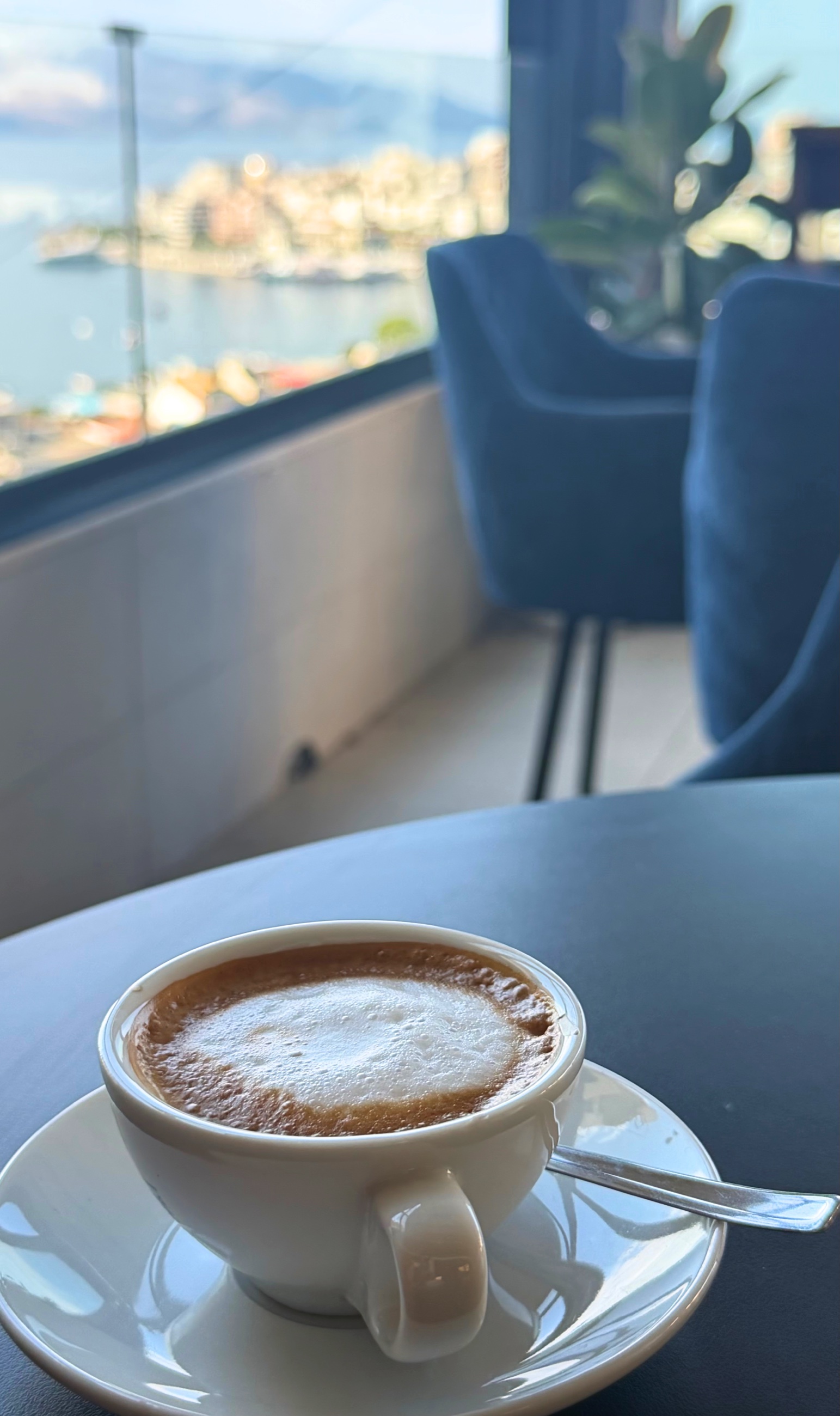 An espresso macchiato with Sarandë in the background, a daily ritual in Albania.
Coffee is one of our accidental ways of measuring daily life from country to country. The drink itself changes only slightly. The habits around it reveal considerably more.
Familiar orders such as Americanos, cappuccinos, and lattes appear almost everywhere we travel, but we have gradually stopped trying to reproduce the coffee we might order at home. The more reliable approach has been to watch what people around us are drinking and start there.
In Spain, that gave us the cortado and café con leche. Istanbul shifted our attention toward small glasses of strong Türk çayı, poured throughout the day and often lingering on café tables long after the first glass. North Macedonia brought us back to the broader Ottoman coffee tradition, with thick, unfiltered coffee alongside the more contemporary Macedonian macchiato.
Along the Adriatic, the differences narrowed. In Croatia, kava sa mlijekom became our dependable order, essentially espresso with warm milk. Montenegro introduced us to dojč kafa, an extended espresso with milk and foam whose unusual name is commonly connected to the period when the German Deutsche Mark circulated there.
Albania has given us the espresso macchiato. It is short, strong, marked with a small amount of milk, inexpensive, and available nearly everywhere. After more than six weeks in the country, the small white cup sitting on a café table has become as recognizable a feature of daily Albania as the produce stands, bakeries, and evening promenades.
We have a regular place for ours in Sarandë now. That fact would have meant nothing during our first two days here. By the second week, it is one of the small fixed points the rest of the day gets arranged around.
The survey will continue soon. Thessaloniki gave the world the Greek frappé in 1957, and the modern freddo espresso is now ubiquitous across Greece. Belgrade will bring another deeply rooted café culture, including domaća kafa, Serbia’s thick, unfiltered preparation in the wider Ottoman tradition.
On paper, the differences are small: more water, less milk, filtered or unfiltered, hot or cold. Around the table, they become another way of seeing how an everyday ritual travels across borders while remaining distinctly local.
💰 Nomad Real Talk
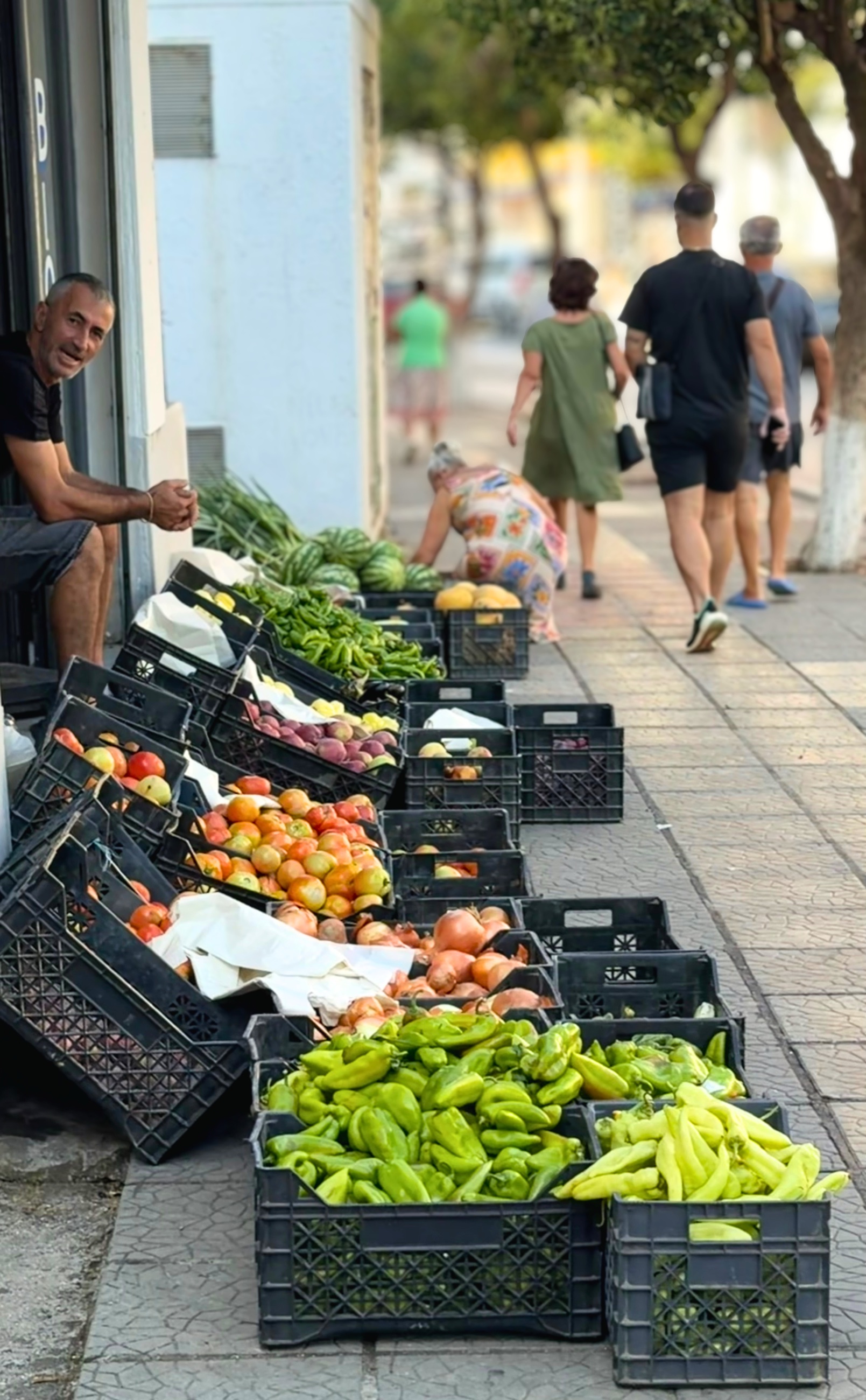 Local produce remains one of the best values in Sarandë; imported goods are another story.
Restocking supplies seems straightforward until the items you want have to cross an international border.
Albania continues to offer very good value for daily life, particularly when we buy what is grown or produced here. Seasonal fruit and vegetables can be remarkably inexpensive, and neighborhood produce markets remain one of the easiest places to see the difference between local and imported food.
Imported products are another matter. Albania’s standard VAT rate is 20 percent, and imported goods also absorb transportation, distribution, and, depending on the product and origin, customs costs. The premium becomes visible quickly in a grocery store. Avocados, mangoes, specialty packaged foods, and other products traveling farther to reach Albania can cost disproportionately more than local produce.
For a month-long traveler, the more complicated category is specialized health and personal-care products. Vitamins, supplements, specific brands, and temperature-sensitive products such as probiotics are not always easy or economical to replace locally.
Shipping replacements into Albania carries its own limitations. The current duty-free threshold for online purchases arriving by post is €22. Qualifying non-commercial gifts sent from one individual abroad to another individual in Albania have a €45 threshold. Above those amounts, customs declaration and import charges can apply.
The practical lesson after months on the road has become fairly simple: buy local versions of everyday products whenever possible, and carry enough of the genuinely specialized items to last through a longer stay.
There is a broader cost-of-living point here too. Comparing countries only through apartment prices, restaurant bills, and grocery baskets misses some of the friction of living abroad. Replacing a particular supplement, shipping a hard-to-find item, or paying a premium for an imported product rarely changes the monthly budget dramatically on its own. Over time, those small complications become part of the true cost and logistics of staying somewhere.
🏠 Behind the Nomad Curtain
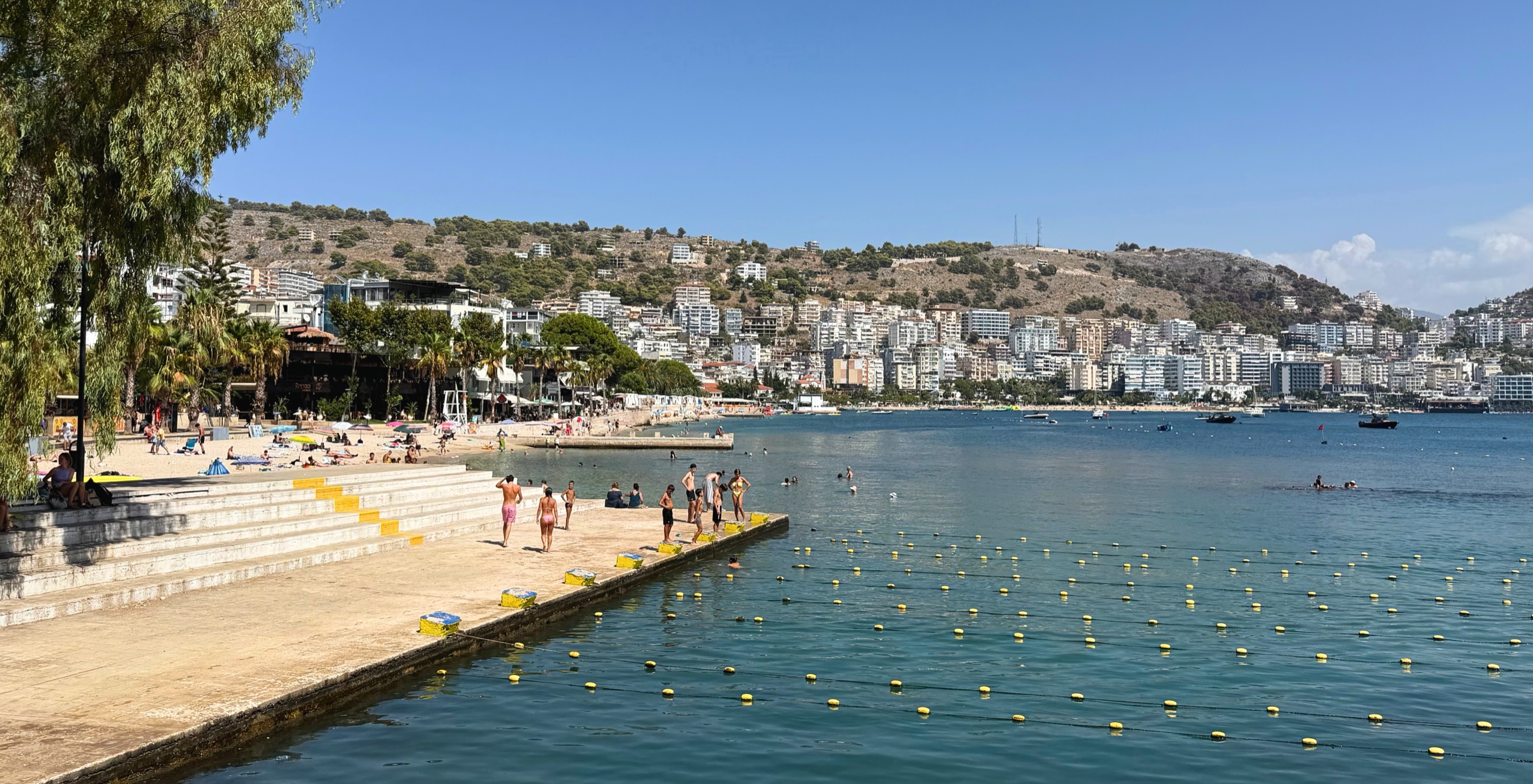 With the months ahead settled, there’s more time to simply focus on where we are now, along the Sarandë shoreline.
A less visible part of this week happened behind laptop screens. Our accommodations and flights through the end of the year are now booked.
Sarandë will carry us through October 1. From here, we spend twelve nights in Thessaloniki, thirty-one in Belgrade, twenty-eight in Bologna, and twenty-eight in Seville. During the Bologna stay, we will make a short trip to Venice for Stephanie’s birthday. Seville will then become home for Christmas and New Year’s, with Bailey and Preston planning to join us for part of the stay.
There is substantial administrative work hidden inside a slow-travel itinerary. Longer stays reduce how often we move, but each move still requires choosing neighborhoods, comparing apartments, checking transportation, studying arrival logistics, monitoring Schengen days, and making sure the next city works for day-to-day life as well as exploration.
Having the next four months substantially settled removes much of that work from the weekly calendar. It also lets us do what the entire structure is designed to support: pay attention to where we are instead of continually planning where we are going.
We still have about two weeks left in Sarandë, and we’re content to let the days unfold at their own pace.
📸 Photo Story
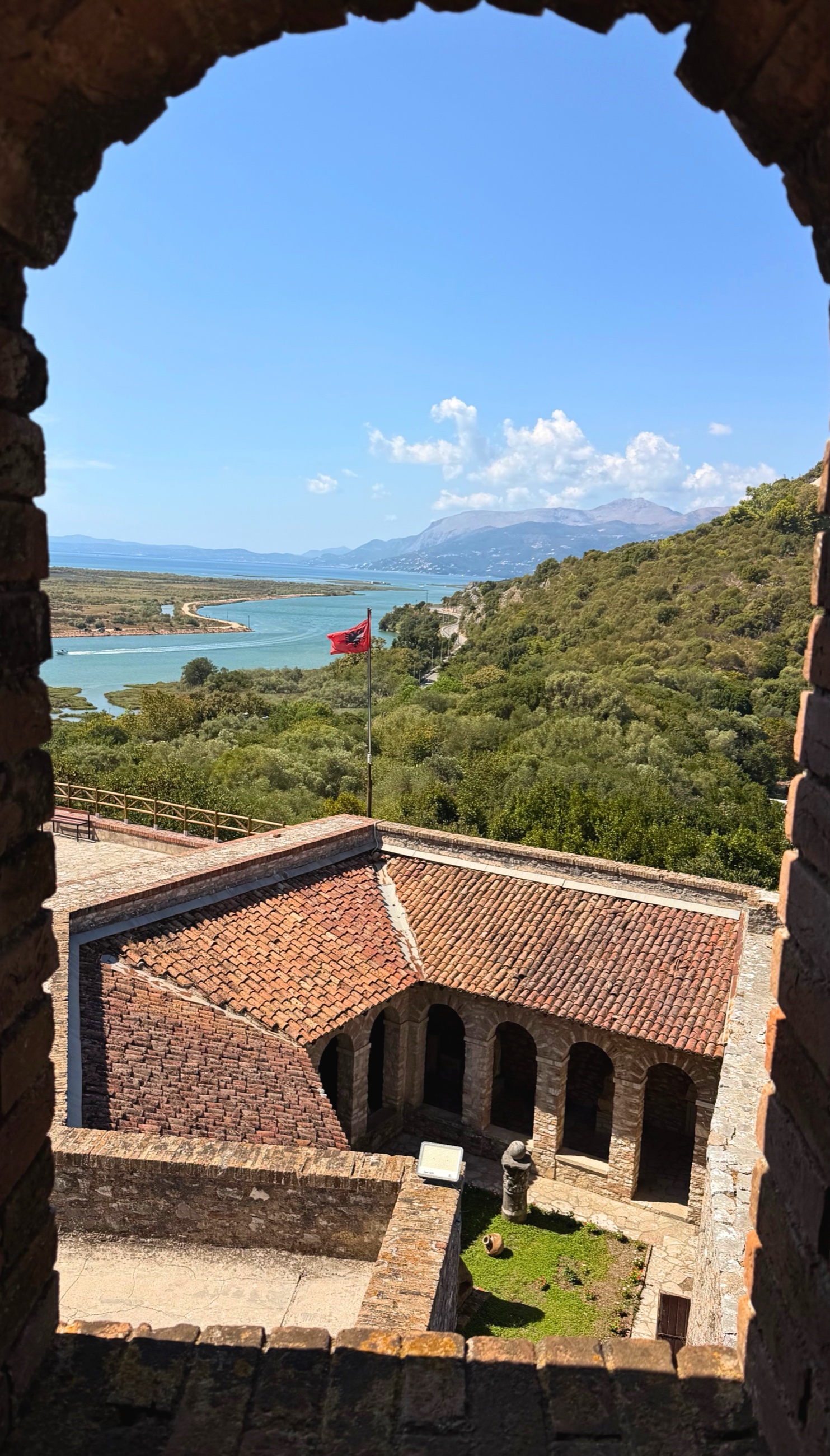 From the Venetian castle atop Butrint’s acropolis, the Vivari Channel winds through the wetlands below.
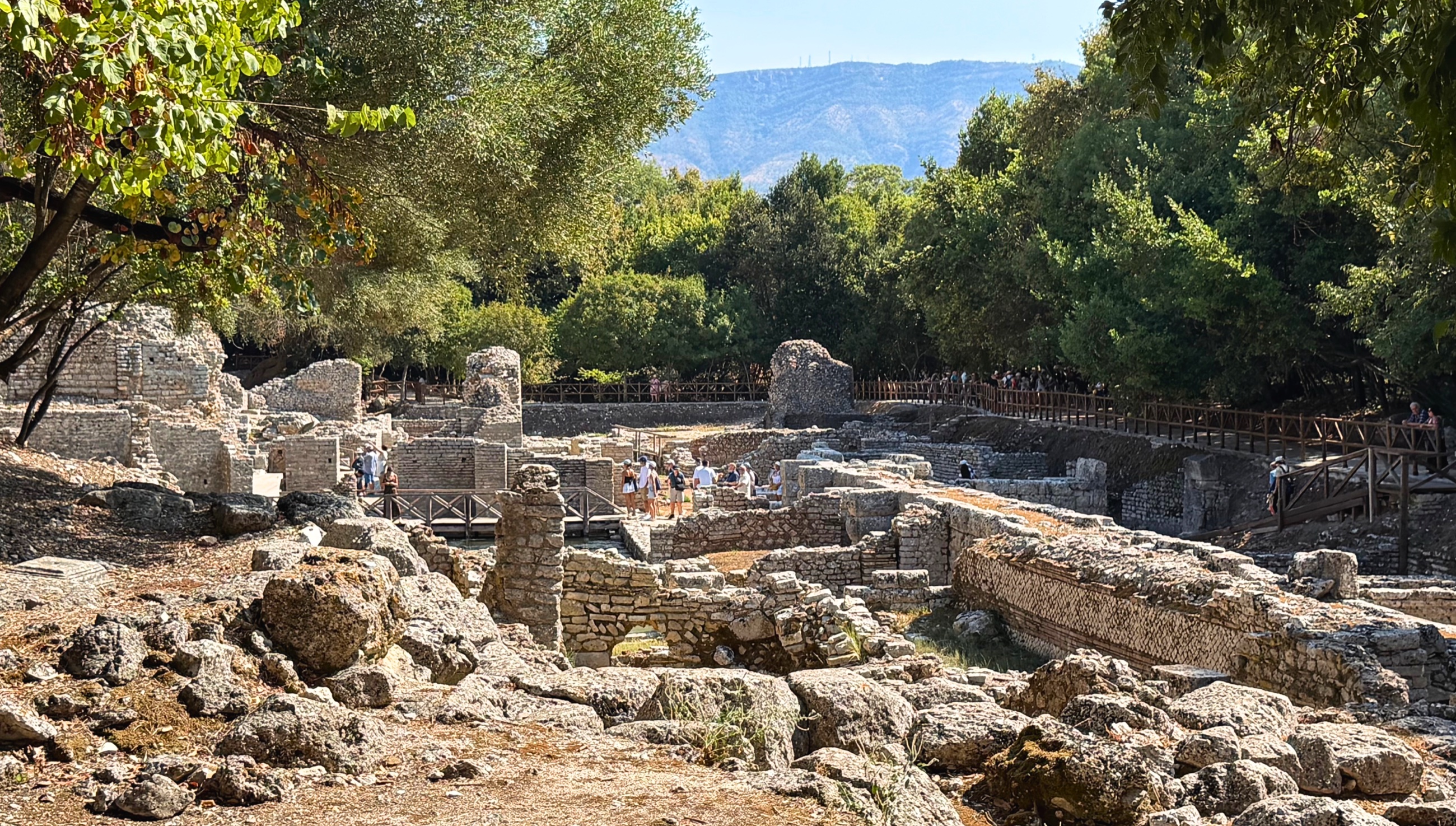 A wider look across Butrint’s lower city, where centuries of construction overlap among the ruins and trees.
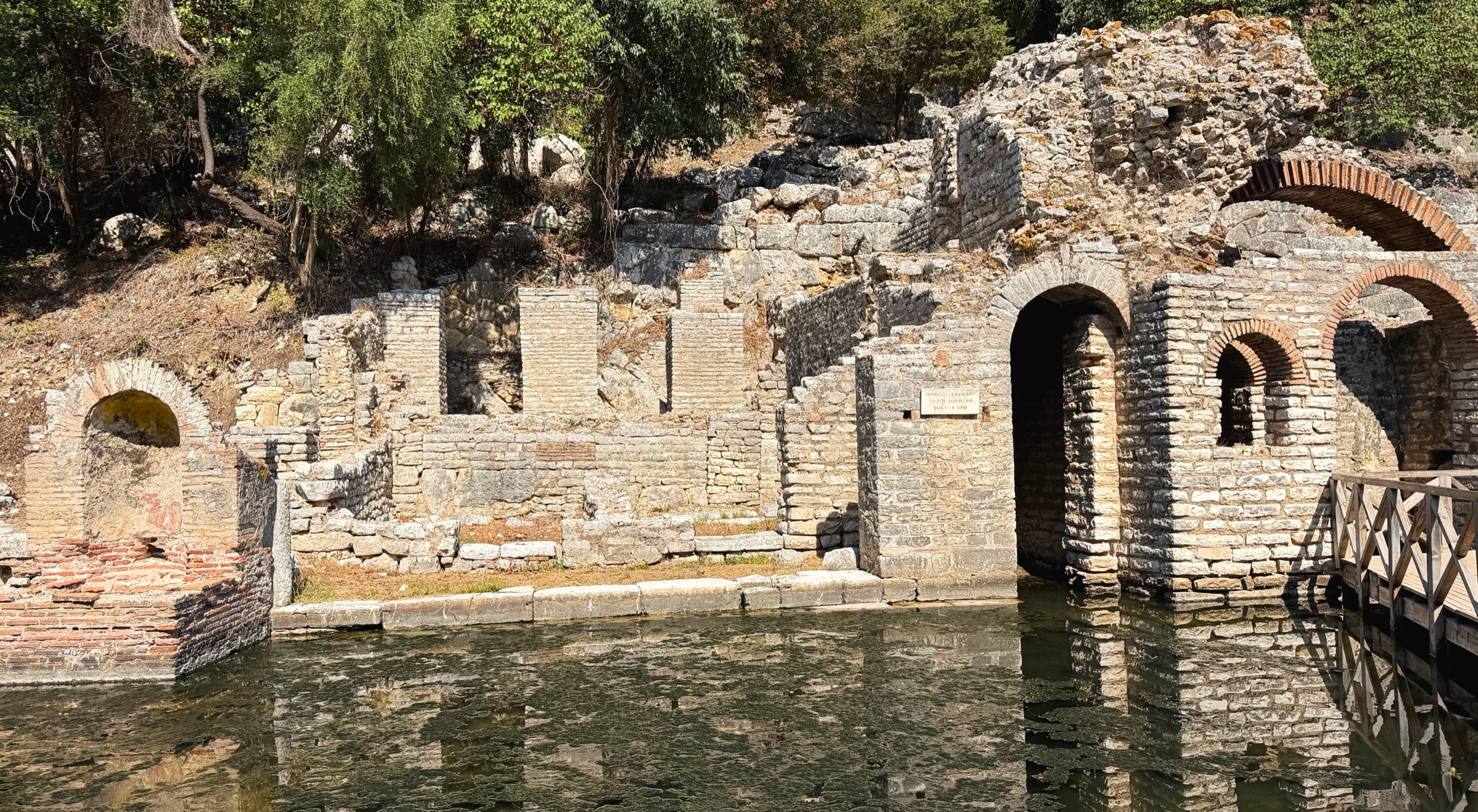 Butrint’s Roman baths, built during the Roman colony and extensively remodeled in the second century AD.
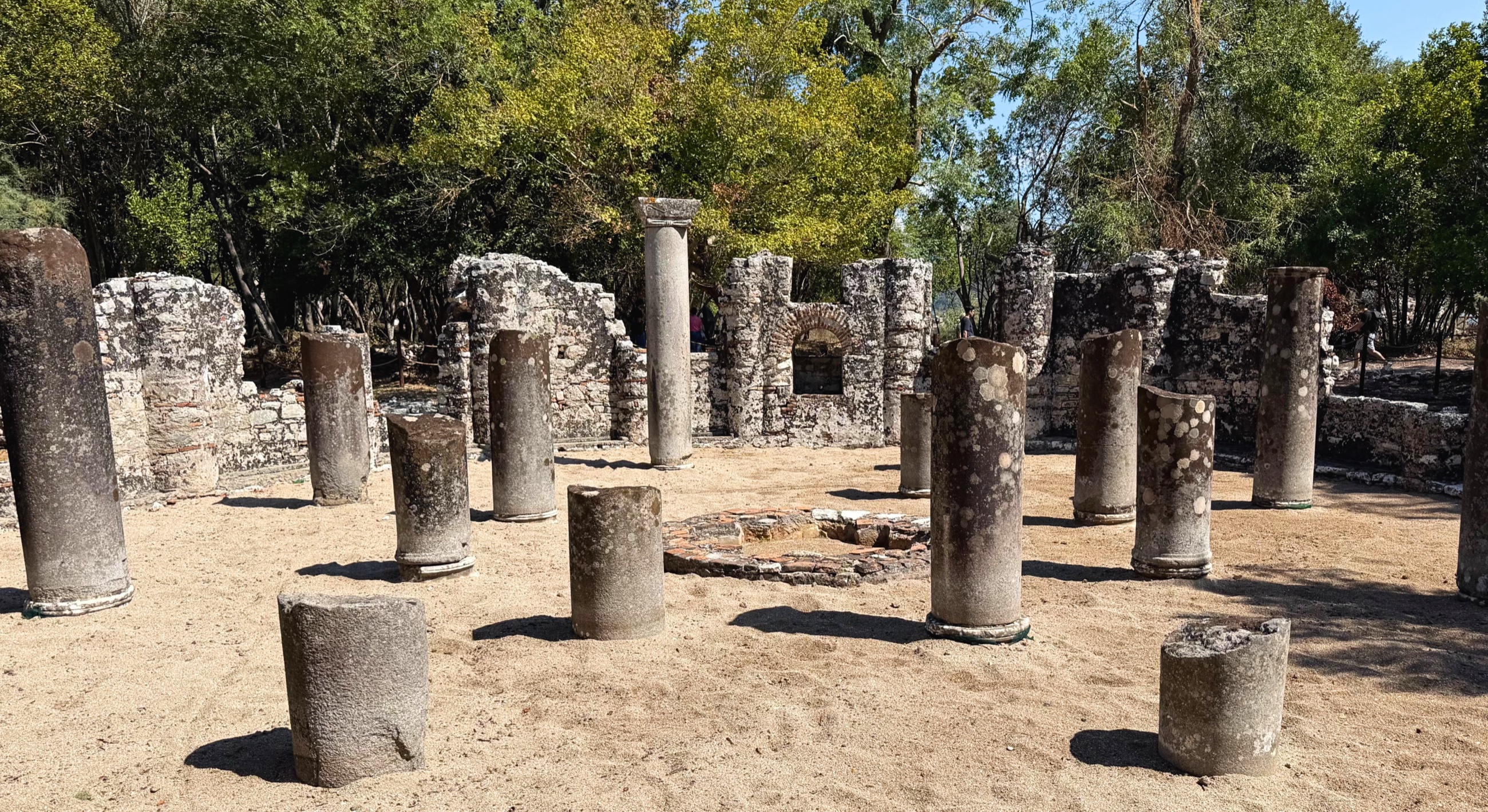 The sixth-century Baptistery, its celebrated mosaic floor protected beneath the sand between the surviving columns.
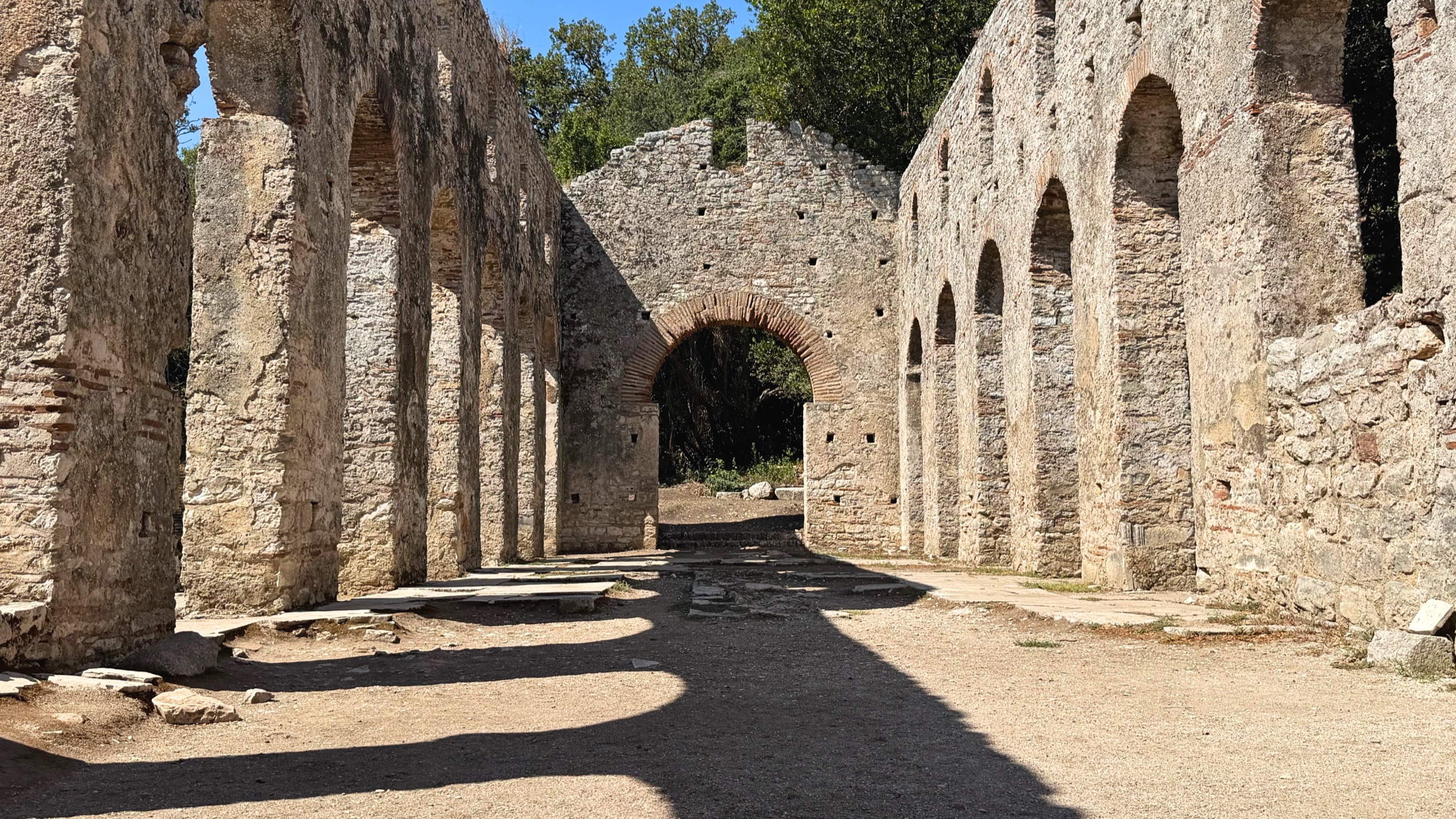 Inside the Great Basilica, built around the turn of the sixth century as Butrint emerged as an important Christian center.
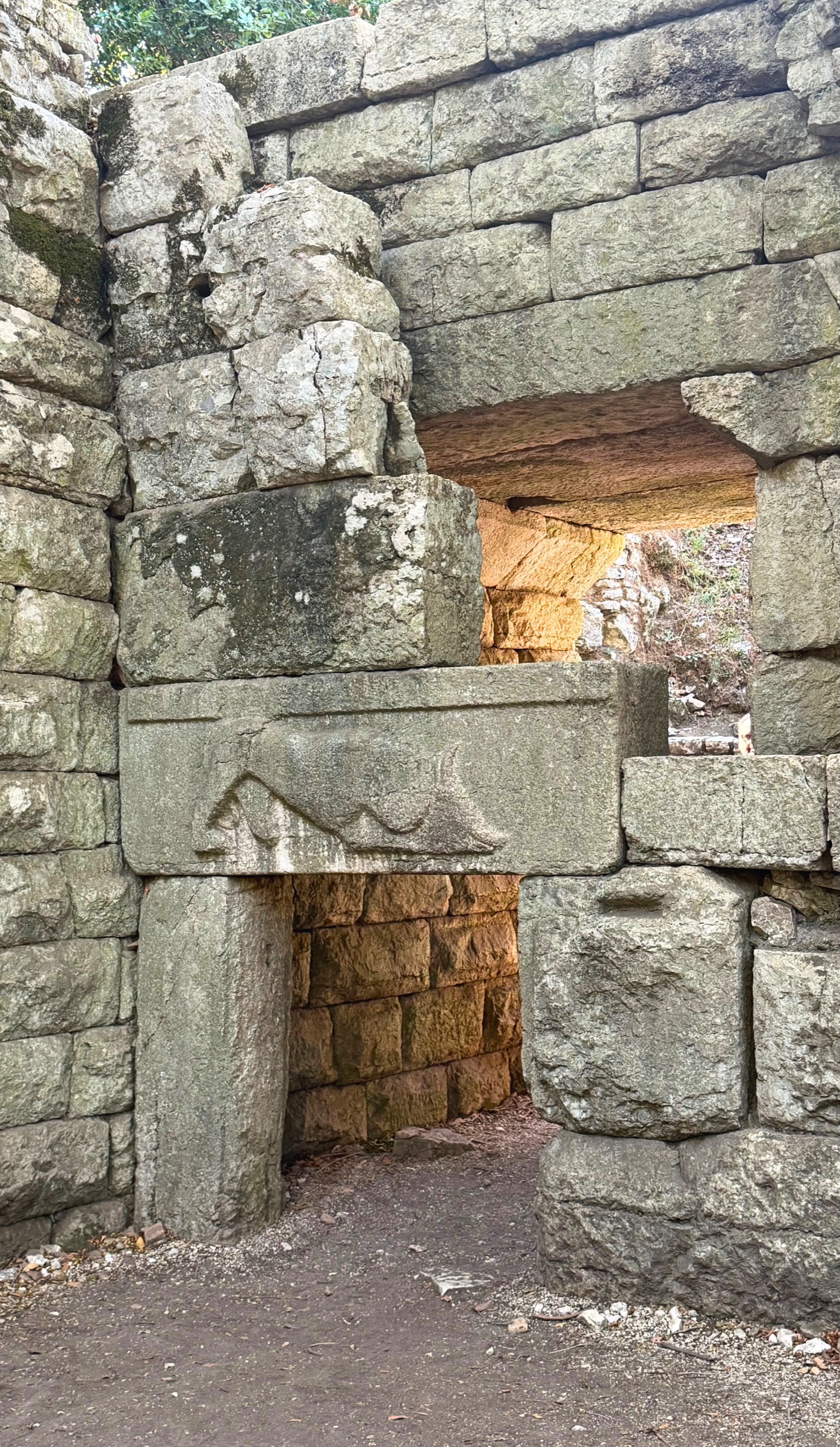 The Lion Gate, where an older relief of a lion attacking a bull was reused above the narrowed entrance.
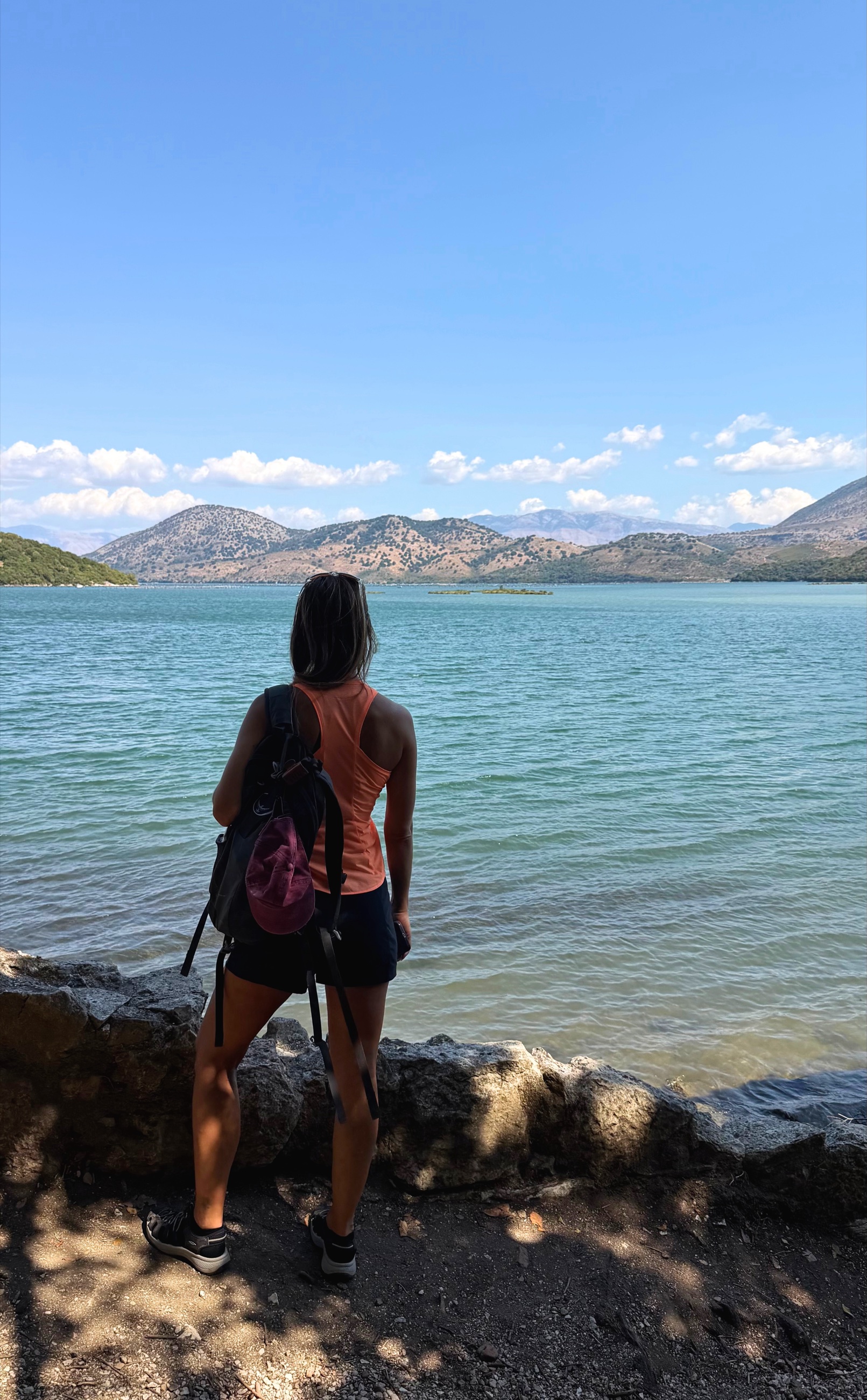 Stephanie pauses along Lake Butrint, with the mountains of southern Albania beyond the water.
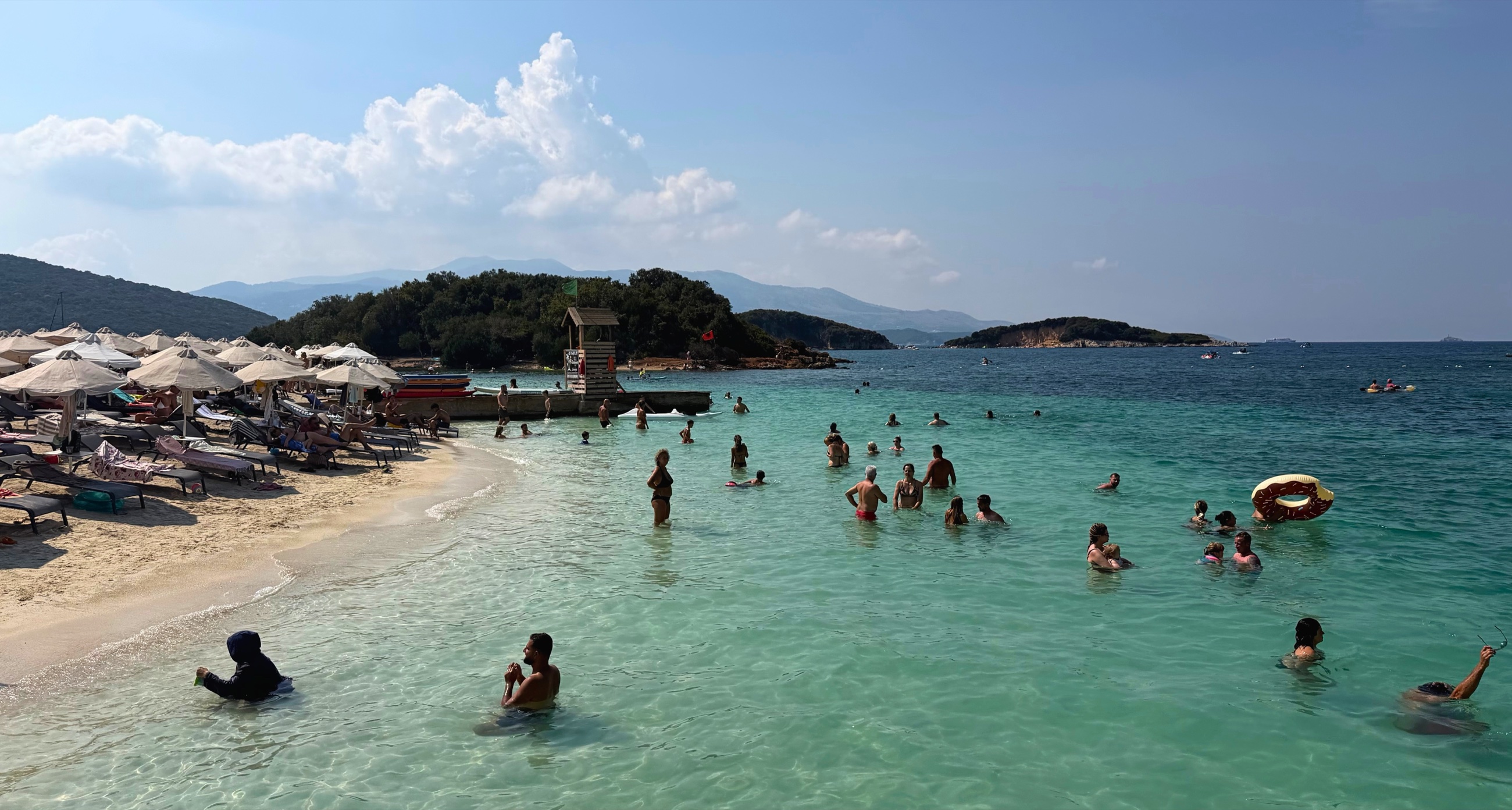 Back in Ksamil, another afternoon spent swimming in the clear turquoise water that keeps drawing us back.
🎯 Next Week Preview
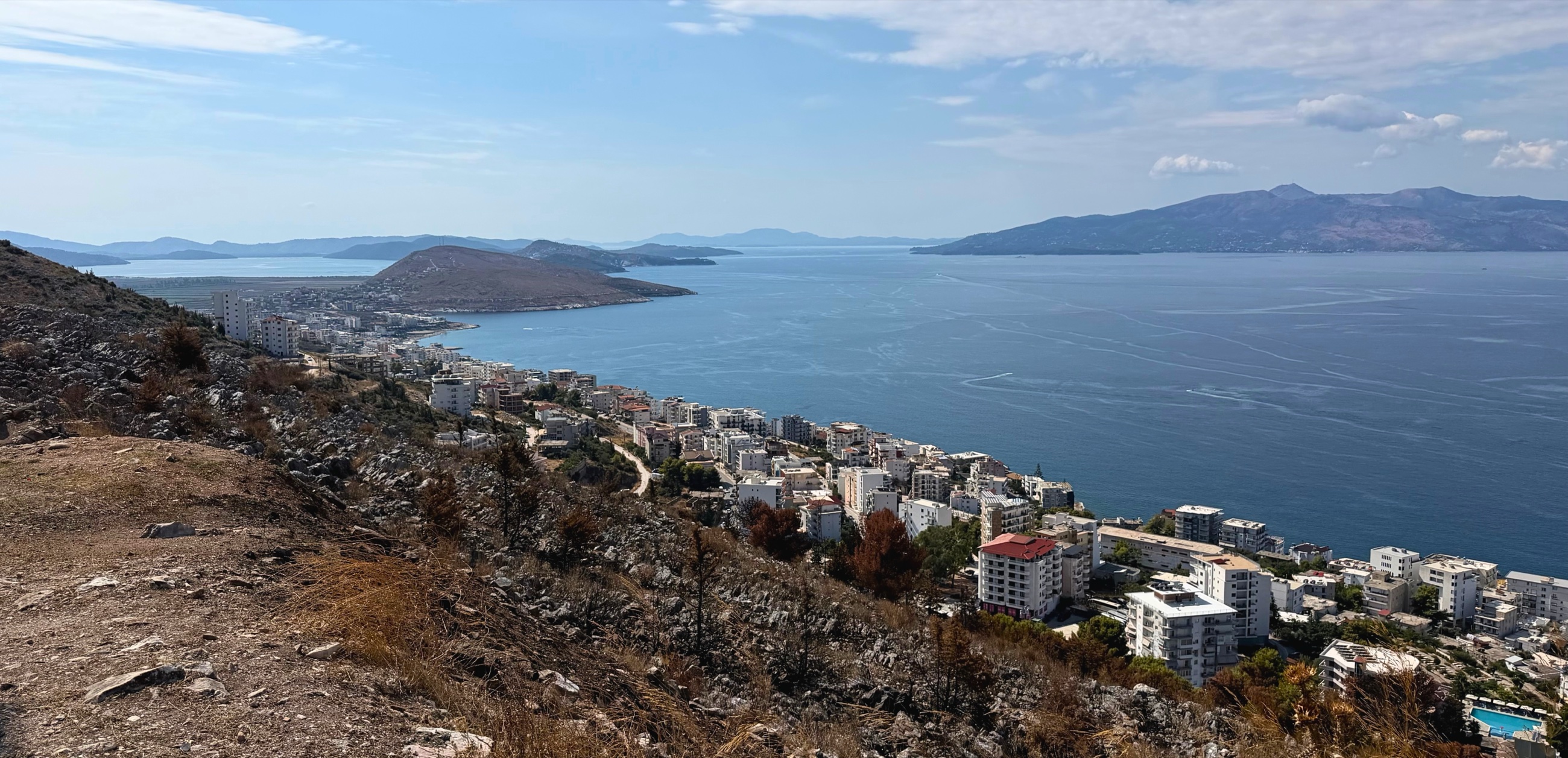 Looking south from the hills above Sarandë toward the Butrint landscape and the Ionian coast.
After seventeen days in Sarandë, we have already covered the principal excursions we hoped to make from here. Corfu and Butrint are behind us, Ksamil has already become a repeat destination, and we have walked enough of Sarandë itself that the city no longer feels unfamiliar.
That leaves the second half of the month wide open, and we like it that way. We’ll follow whatever catches our attention next.
While the September weather cooperates, we plan to keep swimming along our local shore and possibly return to Ksamil again if the water stays this good. We’ll also make the climb up to the Monastery of the Forty Saints, the ruins on the hillside above town, for sweeping views over Sarandë and the Ionian, with Corfu across the strait and the Butrint landscape stretching south. Otherwise, we’ll spend more of our time settling into the familiar rhythms of daily life here.
Work continues in between all of it.
Much of this could fit into a three-day visit. What changes over a month is the repetition, familiarity, and accumulated sense of place. That is becoming one of the parts of slow travel we value most.
💌 Personal Connection
By the second or third week in a place, orientation begins to give way to discernment. We know which grocery stores are better for produce, which carry the products we use most, and which are worth the extra walk. We have tried enough bakeries to have a favorite, while still stopping somewhere else when it makes sense. The same is true of coffee: there are places we prefer, but familiarity gives us choices rather than a single routine.
Sarandë has reached that point for us. We move around the city with a better sense of where to go for what, our gym is back in full rotation, and the local bus system is familiar enough that a morning at a UNESCO archaeological site and an afternoon swimming at Ksamil no longer require much logistical thought.
That familiarity does not make the place less interesting. It changes the way we experience it. We are spending less time figuring out how Sarandë works and more time simply living within it.
For us, living local means allowing that kind of repetition to develop while remaining aware that a month never gives us the perspective of someone who has spent a lifetime here. It simply lets us see farther beyond the arrival experience.
Sarandë feels different to us now than it did two weeks ago. The view from our apartment has not changed. The Ionian is the same color. Corfu still sits across the water. What has changed is our relationship to the place itself: the coffee shops, grocery stores, gym, promenade, and beach, all pieces of a life we are now living here rather than visiting.
Last week was family, movement, ferries, birthdays, and beaches. This week included gym days, coffee, grocery shopping, work, ancient ruins, more swimming, dinner on our balcony, and evenings with nowhere in particular we needed to be.
This kind of week is every bit as much a part of why we chose to live this way.
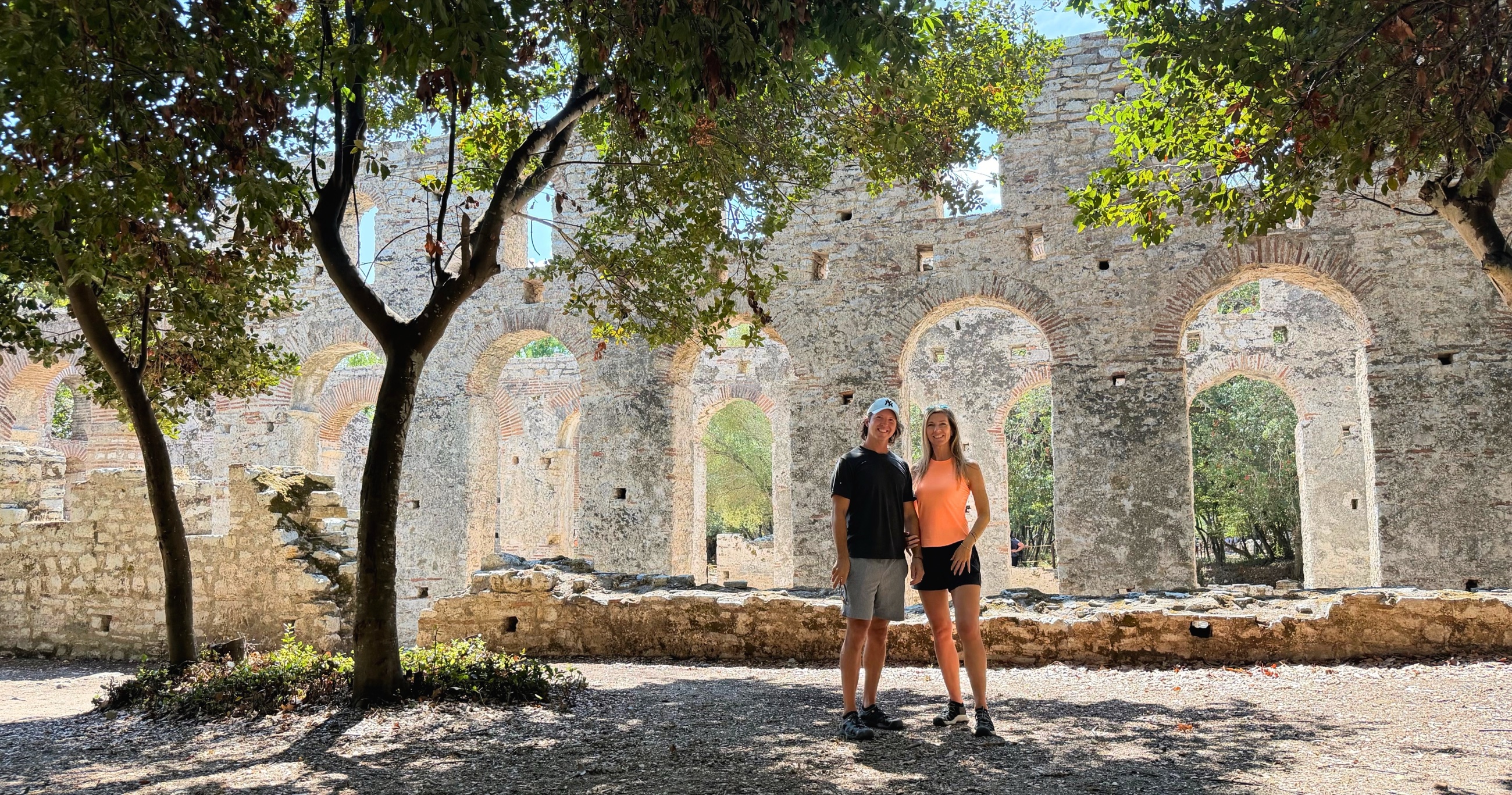 A quiet moment among the ruins of Butrint’s Great Basilica.
Until next week,
S&S
Some Great Place · Living Local in a Global World · somegreatplace.com