Some weeks settle into repetition. Others require every part of daily life to be packed, carried across a border, and rebuilt somewhere new.
This week contained both.
Our final days in Bar returned us to the coast that had organized the past month: a last day trip north, one more afternoon at Red Beach, a farewell workout, and a long goodbye coffee with Mina. Then came the border crossing, one night in Shkodër, and an afternoon arrival in Tirana.
The distance was modest. The transition was not.
After two months in Montenegro, crossing into Albania meant leaving the country where our Balkan chapter had begun to feel familiar. By the time we reached Tirana, the sea had disappeared from view, our belongings were spread across another apartment, and the work of learning a new city had started again.
📍 This Week: Bar and Tirana via Shkodër
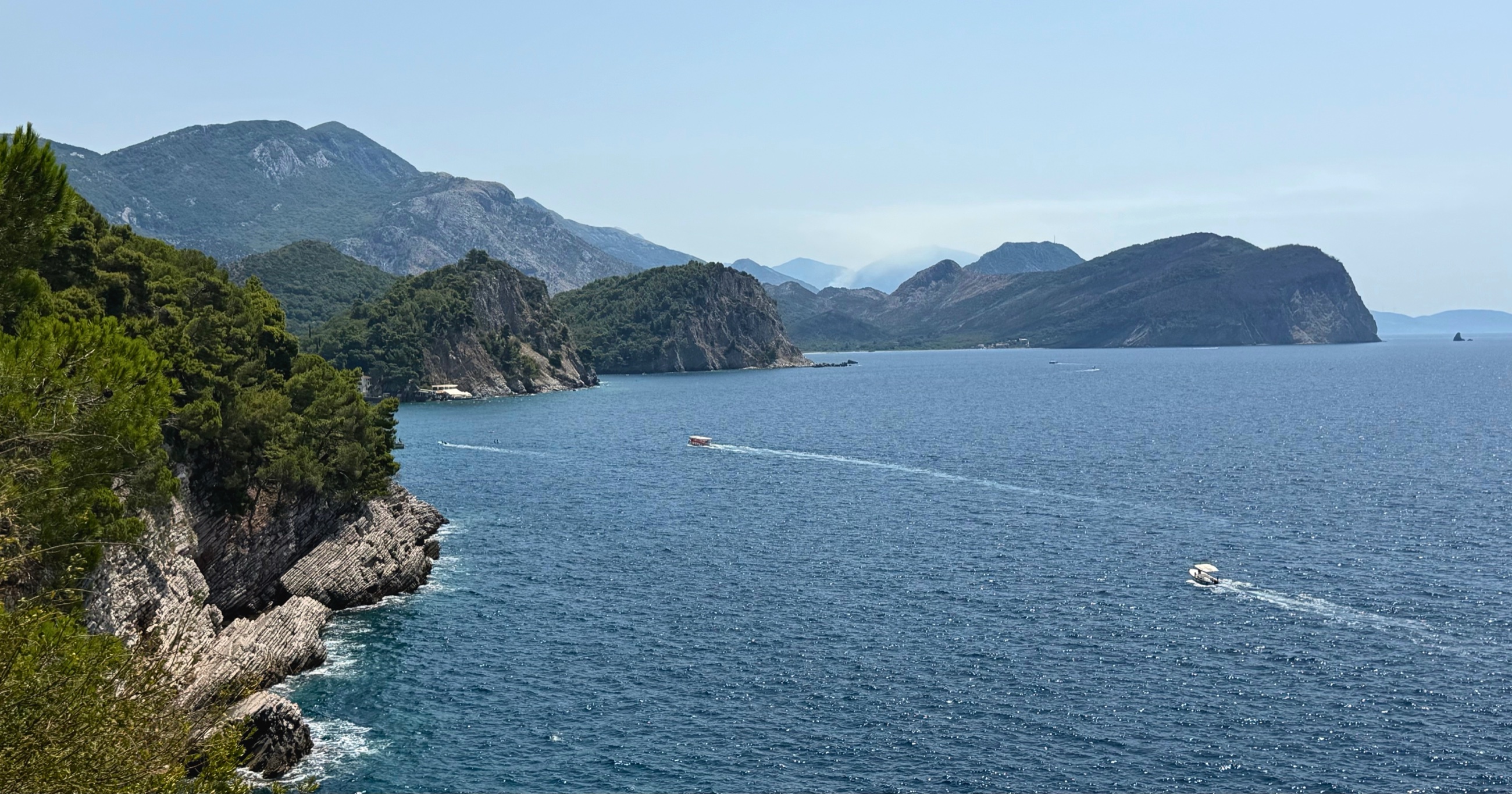 The coast north of Petrovac, where forested cliffs descend into the Adriatic.
Our last substantial day trip took us north to Petrovac, a coastal town between Bar and Budva. The intercity bus left us near the center, within walking distance of the town’s compact waterfront.
Petrovac presents a more composed version of the Montenegrin coast than Bar. Its bay is lined with cafés and umbrella loungers, while pine trees soften the developed shoreline. Offshore, the small islands of Katić and Sveta Nedjelja rise from the Adriatic, the latter crowned by a small church.
We began with coffee beside the beach, looking across the water toward the islands. From there, the coastline offered two appealing directions: Lučice Beach to the south, or a walking path known as the Health Trail, following the cliffs north toward Perazića Do. We chose the trail.
The path runs just under a mile (1.5 km) along the edge of the limestone coast. Pine trees surround much of the route, filling the warm air with a resinous scent that remained one of the clearest impressions of the walk.
Three pedestrian tunnels carry the trail through the rock. They alternate between extended sections of darkness and sudden openings toward the sea. At several points, the tunnel entrances framed the Adriatic and the offshore islands with striking precision: raw cliff, engineered passage, then a broad field of turquoise water.
The route was originally built to connect Petrovac with Hotel AS, once one of the more ambitious resorts on the Yugoslav coast, and that history becomes visible as soon as the final tunnel ends. A vast concrete structure rises above Perazića Do Beach, embedded into the cliff like the unfinished hull of a ship. The original Hotel AS, designed by the Yugoslav architect Stojan Kovačev, began construction in 1973 as a flagship luxury destination of the Yugoslav era. Decades later, a 2002 privatization deal meant to expand it into a five-star resort collapsed amid financial and legal disputes.
Construction stopped. The building remained.
Its exposed floors, weathered concrete, and rusting cranes now dominate one end of an otherwise beautiful bay. Below is clear emerald water, a narrow shoreline, and steep green slopes. Above stands one of the coast’s most conspicuous unfinished development projects.
The stalled hotel may also have had an unintended effect. With the largest site in the bay tied up for years, Perazića Do escaped some of the dense commercial development found elsewhere along the Budva Riviera.
There were a couple of beach bars and organized loungers near the main entrance. We continued along the rocks until we found a smaller cove, spread out our towels, and stayed for the afternoon.
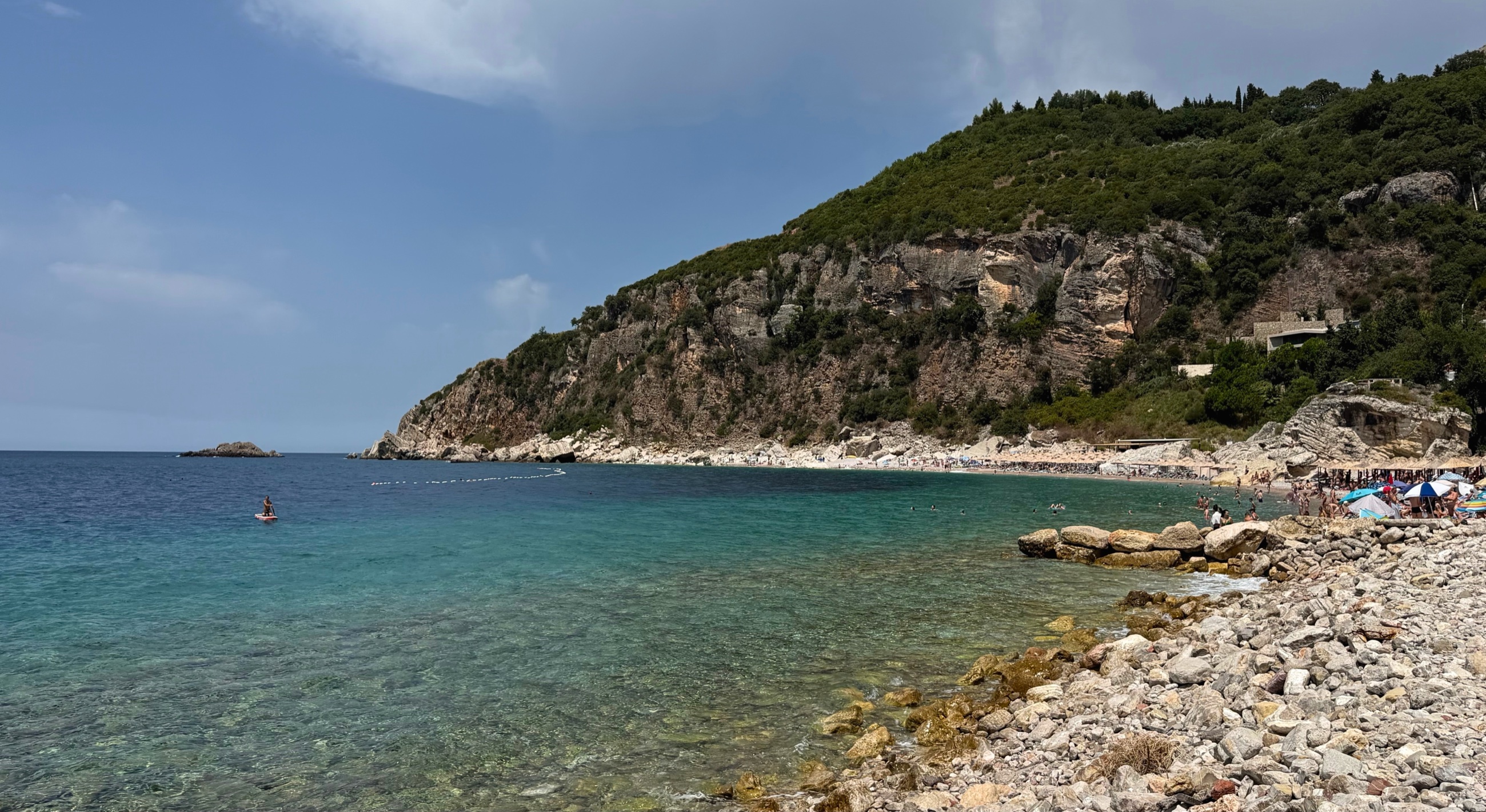 Perazića Do Beach, where clear water meets a narrow shoreline beneath the unfinished Hotel AS.
The water was cold, clear, and deepened quickly beyond the shore. On a hot day, it invited repeated swims.
From our apartment, we could travel north toward Čanj, Petrovac, Budva, and Kotor, or south toward Ulcinj and the Albanian border. We could spend several hours at a beach that looked entirely different from the one near home, then return to the apartment and resume work. Petrovac was one more confirmation of how much Bar’s value depended on what sat within reach of it.
Our closing weekend also brought us back to Red Beach, a small cove about thirty minutes from our apartment in lower Šušanj. Reaching it requires a walk that includes a long stretch beside the coastal road, which is not especially pleasant in July heat. The reward is a reddish pebble shoreline and some of the clearest water we found near Bar.
The water was cool, even on a hot afternoon, and the rocky edges made the cove feel more enclosed than the town beaches. It had become our favorite place to swim in the immediate area.
Returning for one more afternoon required no planning. We knew the road, where to leave our things, where the shoreline made entering the water easiest, and how long the walk home would feel afterward.
A beach stops being an excursion and becomes a place you know how to use. That is one of the rewards of staying for a month.
Our last full day was more domestic. We made one more visit to the gym, housed in another substantial Yugoslav-era building near central Bar. Afterward, we met Mina for coffee in a part of town where Russian migrants have congregated.
We sat for nearly two hours. Mina is Serbian, and much of the conversation turned toward her home country and Belgrade. She told us about the city, its neighborhoods, and the places that might help us understand it beyond the most obvious visitor circuit. Belgrade has remained on our longer itinerary as a possible future base. By the end of coffee, it felt less theoretical.
Then we returned to the apartment and packed. The following morning, Mina drove us to meet our transfer. We loaded the car, said our goodbyes, and our month in Bar was over.
The drive took about two and a half hours door to door, slowed by traffic and the border crossing, but smooth enough that we reached Shkodër in time for lunch. The Adriatic remained beside us for part of the route south. Then the road turned inland, the border formalities were completed, and Montenegro gave way to northern Albania.
🎨 Cultural Deep Dive
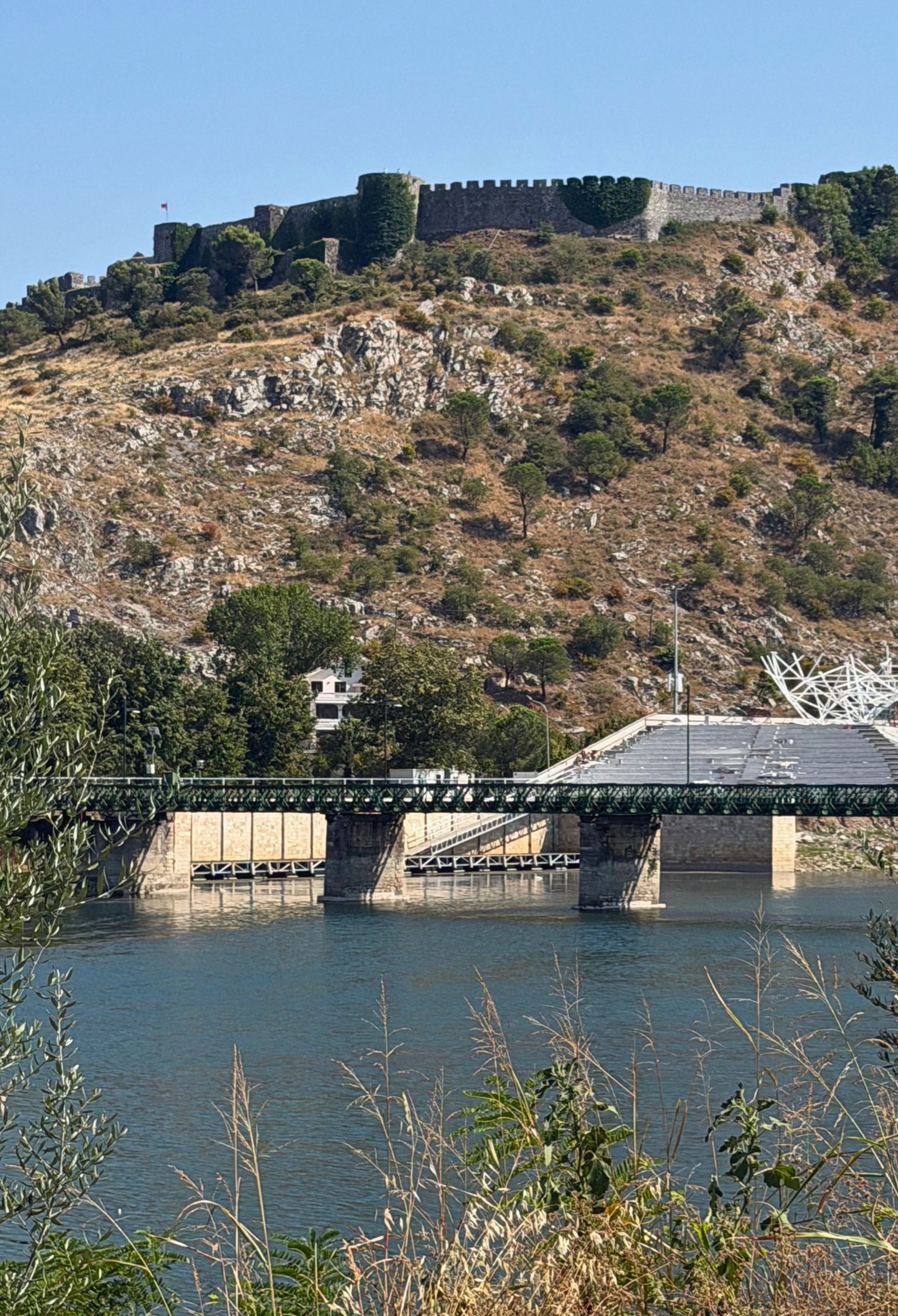 Rozafa Castle above the Buna River, occupying the hill that has guarded Shkodër for centuries.
Shkodër occupies a distinctive place in Albania. It stands near Lake Shkodër and the Buna and Drin river systems, where the coastal plain begins to rise toward the Albanian Alps. That geography made it a natural center of trade, defense, and movement between the Adriatic, the western Balkans, and the mountainous north.
The city’s history extends back to the Illyrian settlement of Scodra. Roman, Byzantine, medieval Serbian, Venetian, and Ottoman powers later held or contested the region. Each period added another layer to a city already positioned along important commercial and military routes.
Rozafa Castle remains the clearest physical expression of that history. The fortress rises on a rocky hill above the rivers at the southern entrance to the city. The site contains Illyrian foundations, with later Roman, Byzantine, Venetian, and Ottoman construction incorporated into its walls. From above, the landscape explains why the location mattered. Rivers, lake, plains, and roads converge beneath it.
The castle is also associated with one of Albania’s best-known legends. Three brothers attempt to build a fortress, but the walls collapse each night. They are told the structure will stand only if one brother’s wife is sacrificed within it. The brothers agree not to warn their wives, though two break the promise. Rozafa, the wife of the youngest brother, arrives the next day carrying food for the workers. When told what must happen, she accepts her fate but asks that part of her body remain uncovered so she can continue feeding, holding, and caring for her infant son.
The legend is severe, and its meaning has been interpreted in different ways. At its center is the idea that something enduring demands a human cost, with that cost borne by a woman whose obligations continue even as she is enclosed within the walls.
We did not make the climb to see any of this up close. Bicycles rented through our hotel carried us along the base of the hill instead, then onto a wooden-slat bridge crossing the Buna as it wound toward the lake. We followed the water out to Shiroka, a small lakeside village, and stopped in the shade to cool off before turning back. It came to roughly ten miles (16 km) round trip, more ground than the afternoon heat would have allowed on foot, and enough to trade a close look at the fortress for a wider sense of the geography holding the city together: the river, the lake, and the hill above them, all visible from a bicycle seat in a single afternoon.
Shkodër’s cultural identity reaches beyond the castle. The city became an important center of Catholic life in northern Albania while also developing under centuries of Ottoman Muslim rule. Mosques and churches remain close enough to share the same streetscape, evidence of religious traditions that survived conflict, political change, and state repression.
During Albania’s communist period, religion was subjected to increasingly severe restrictions. In 1967, the government declared Albania an atheist state, closed or repurposed religious institutions, and criminalized many forms of worship. Shkodër’s Catholic clergy and communities were among those subjected to imprisonment and persecution. Religion returned publicly after the communist system collapsed, restoring visible institutions that had shaped the city for generations.
Shkodër also holds a special place in Albanian photography. The Marubi photographic collection began with Pietro Marubi, an Italian who settled in the city during the nineteenth century and opened a studio there. The work continued through several generations, producing an archive of portraits, public events, political figures, family life, clothing, architecture, and social change.
Those images record Albania from the final decades of Ottoman rule through independence, monarchy, war, and communism. They preserve prominent faces, but also show how people dressed, worked, assembled, celebrated, and presented themselves to the camera. That tradition gives Shkodër an unusually rich visual record of its own transformation.
The city changed after dark. The day’s heat eased, and Kolë Idromeno, the pedestrian street through the old town, filled for the xhiro, the evening walk that structures social life across Albania. By ten o’clock, the avenue was as full as at any point that day: people strolling in both directions, nearly every café and restaurant table occupied, and conversation carrying the length of the street. Our stay was brief, so this was an introduction rather than a complete account. Even so, Shkodër served as more than a convenient overnight stop. It introduced Albania through a northern city with its own religious, intellectual, and commercial history before we continued toward the political and economic gravity of Tirana. Often called Albania’s cultural capital, it left us wanting a longer return, time enough to see more of the city than one bicycle ride and one overnight allowed.
🍽️ Local Flavor
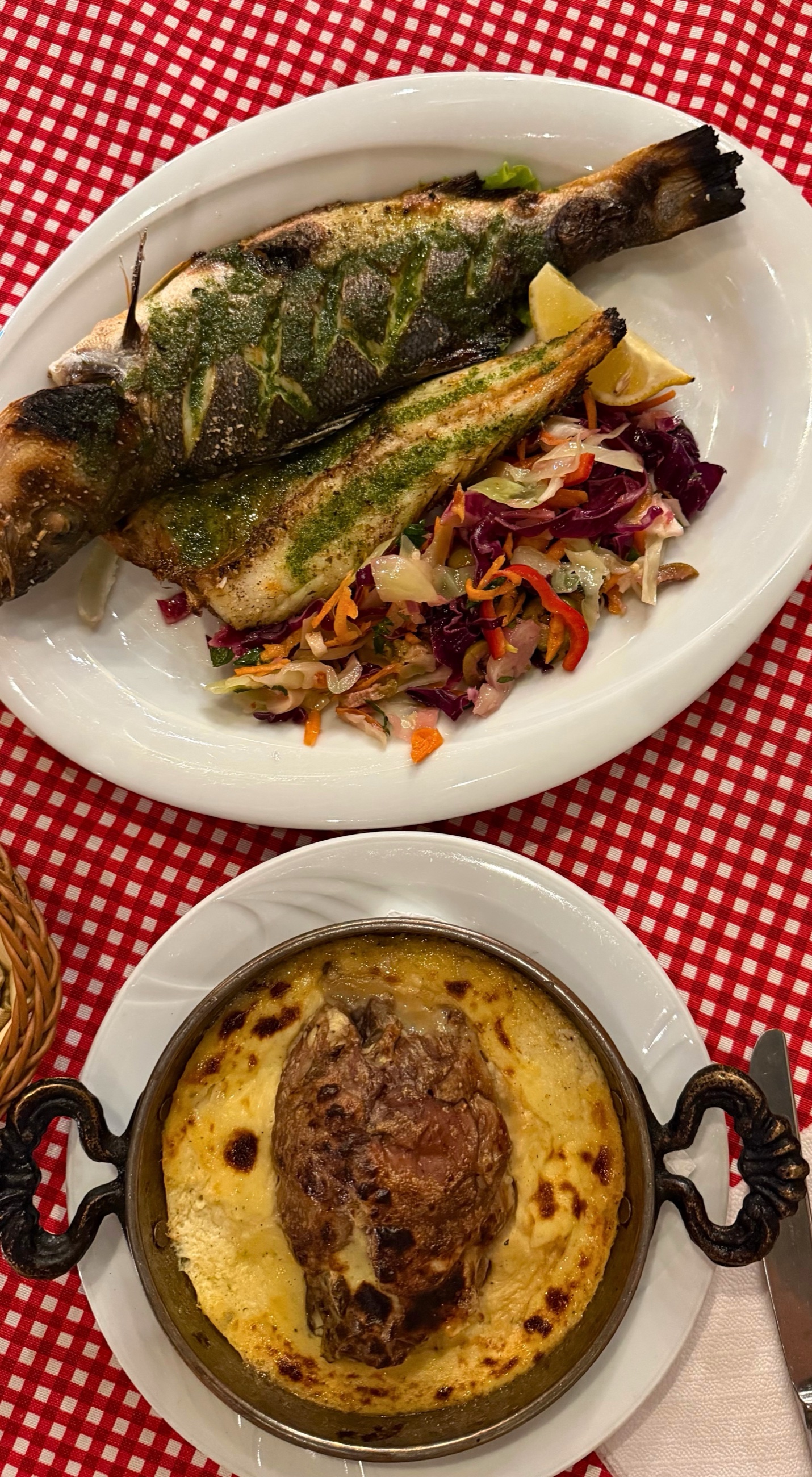 Tavë kosi and grilled fish from the lake at Vila Bekteshi, our first traditional Albanian dinner.
A transition issue does not provide enough evidence for sweeping conclusions about Albanian food.
It provides meals.
We reached Shkodër in time for an early check-in, dropped our bags, and walked a block to the pedestrian streets. Lunch was chicken pesto wraps made from scratch at a small spot on a side street, followed later by iced coffee and homemade cookies at a specialty coffee shop nearby.
Dinner was more deliberate. We went to Vila Bekteshi, where a courtyard strung with lights and fans held off the evening heat. The meal was tavë kosi, a baked lamb and yogurt casserole often named among Albania’s national dishes, alongside grilled fish from the lake, a Greek salad, and a bottle of house white wine.
The next morning brought a full breakfast at our hotel: savory crepes, eggs, toast, fruit, yogurt, and cappuccinos in the garden courtyard before we packed up for Tirana. A single day of meals does not explain a national cuisine, but it does not need repetition to matter. Some meals earn their place through routine; others earn it in one sitting, and Vila Bekteshi was the second kind: an excellent dinner in its own right, not just an early impression. A considered judgment on Albanian food will still take market visits, grocery shopping, home cooking, and enough repeated meals to see what belongs to daily life, what is reserved for special occasions, and what is built for visitors.
Shkodër gave us a strong start.
Tirana will provide the longer education.
💰 Nomad Real Talk
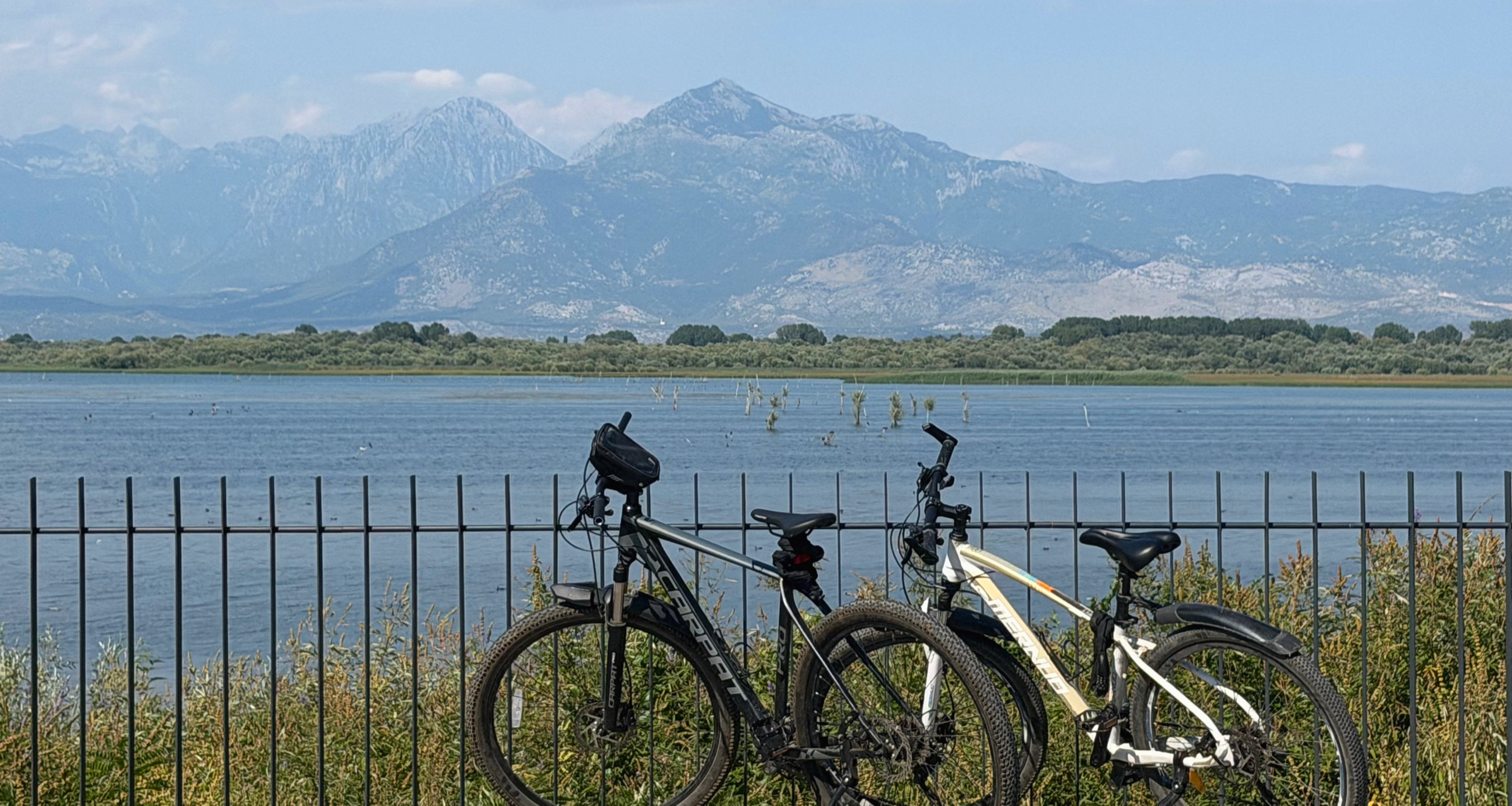 Rental bicycles beside Lake Shkodër, part of a ten-mile ride from the city to Shiroka and back.
Bar and Shkodër sit close together on the map, but the public transportation between them is not straightforward.
There is one direct bus from Bar to Shkodër each day, but it leaves at approximately 5:00 p.m. That timing would have placed us in Shkodër late in the evening, after an international border crossing, with little margin for delays. It was not a practical option for us.
A second route involved taking a bus from Bar to Ulcinj, waiting several hours, and then boarding a Shkodër-bound bus from a stop separate from Ulcinj’s main station. It was possible, but slow and unnecessarily complicated with several large bags.
The better public transportation option was to take the train from Bar to Podgorica, walk to the neighboring bus station, and continue by bus to Shkodër. The train and bus stations in Podgorica sit beside one another, making the transfer manageable.
Even so, the route still required two vehicles, repeated handling of the luggage, a coordinated connection, and a border crossing by bus. The estimated total for both of us was about €60.
We chose the direct option instead. A private driver collected us near our apartment in Bar and delivered us to our hotel in Shkodër for €120. That was twice the price of the train-and-bus route, but it removed nearly every difficult part of the transfer: no trip to the station, no connection in Podgorica, no repeated loading and unloading, no uncertainty around departure times, and no need to arrange transportation after arriving in Shkodër.
The calculation would have been different with just a couple of backpacks. We are traveling with the belongings required to live and work abroad for an extended period across multiple seasons, making each transfer more difficult.
The additional €60 did more than remove friction. It bought us time: we reached Shkodër in the early afternoon instead of the evening, with hours still ahead of us rather than behind us. It was not the cheapest choice. For our circumstances, it was the better value.
The following day required no such calculation.
Standard public buses run directly from Shkodër to Tirana throughout the day, generally about once an hour. Tickets cost €6 per person for the two-and-a-half-hour trip. Premium shuttles and tourist-oriented services can cost close to twice that amount, but the standard public bus is the better value for a straightforward domestic journey with no border crossing or transfer. After paying for the private transfer from Bar, we were content to use the less expensive public option for the final leg to Tirana.
A short taxi from the Tirana bus stop to our new apartment added another €15. Door to door, the full two-day move from Bar to Tirana came to €147 for both of us: €120 for the private transfer, €12 for the bus, and €15 for the taxi.
Breaking the move into two days added the expense of a hotel night and required us to open our bags for less than twenty-four hours. It also gave us time to see part of Shkodër and prevented the entire Montenegro-to-Tirana journey from becoming one long and fragile chain of transportation.
For long-term travelers, efficiency is not always measured by the lowest fare. Sometimes it is measured by how many points of failure a more expensive option removes.
Separately, a day of exploring Shkodër by bicycle cost €5 per person, rented directly through our hotel. It gave us exercise, transportation, and access to the lake for €10 total, a particularly good value during a short stay.
🏠 Behind the Nomad Curtain
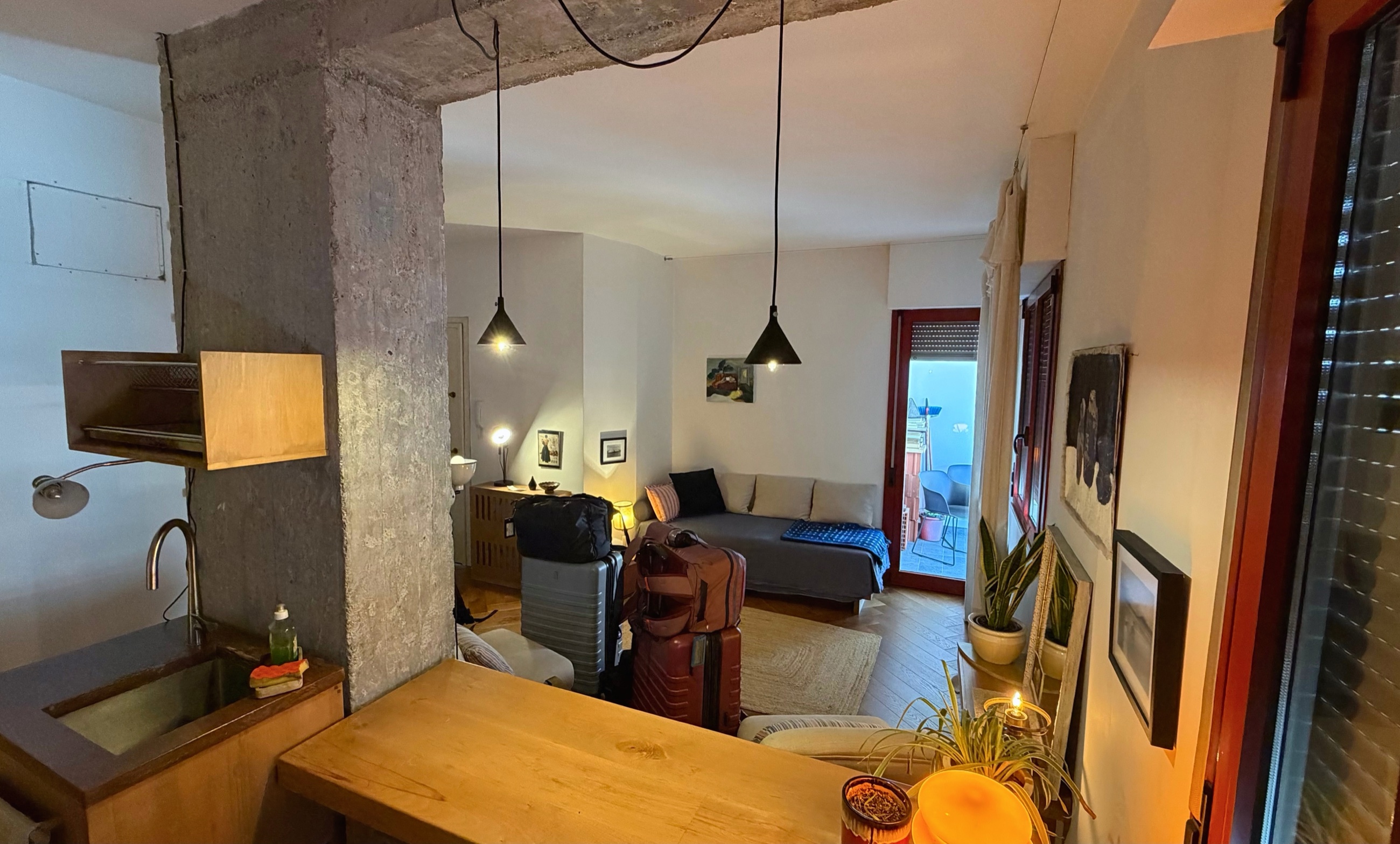 Arriving in Tirana with the luggage still gathered in the living room and another month waiting to be unpacked.
Packing after a month follows a sequence we now recognize. First come the belongings that never fully leave their travel cases: documents, backup cables, spare toiletries, and clothing unsuitable for the current weather.
Then come the things absorbed into the apartment: food in cabinets, laundry on drying racks, chargers behind furniture, shoes near the door, and bathroom items arranged as though they have always belonged there.
The final stage is compression. Everything that made the apartment functional has to return to the same finite collection of luggage.
A one-night stop is packed differently from a month-long arrival.
In Shkodër, we kept the next day’s clothes and essential toiletries accessible while leaving most of the bags closed. We needed a bed, a few meals, and a reliable departure point.
Tirana required the full process.
We arrived in the early afternoon, spent the first couple of hours unpacking and settling into the apartment, then returned to work for the rest of the day. The first tasks were practical: set up the router and confirm the internet, locate a market nearby, inspect the kitchen and laundry setup, establish a workable desk, and learn the space well enough to function easily.
A small market near the apartment carried us through the first twenty-four hours: enough for that evening and the next morning, but not a full shop. The real grocery run, and the first real look at the surrounding streets, waited until the following morning.
These errands reveal very little about Tirana as a city. They show how we begin living here.
By the end of the first day, the bags were unpacked and the computers were connected. Understanding the neighborhood will take longer.
📸 Photo Story
The last days in Montenegro moved from familiarity to departure. Red Beach gave us one last afternoon in the water near home. Petrovac extended the coast northward, from its orderly waterfront through the pine-scented tunnels of the Health Trail. Perazića Do offered clear water beneath the unfinished mass of Hotel AS, an accidental refuge below a failed development.
The visual story then became more practical: a parting coffee, bags gathered in the apartment, the road south, and the border.
Shkodër added a day of its own: bicycles at the base of Rozafa Castle, the wooden bridge over the Buna, the lake road to Shiroka, and a lantern-lit courtyard dinner before the bus to Tirana.
Tirana arrived last.
At this stage, the strongest photographs are the opening fragments: the apartment, the surrounding street, the first view from the window, and the evidence of a household beginning again.
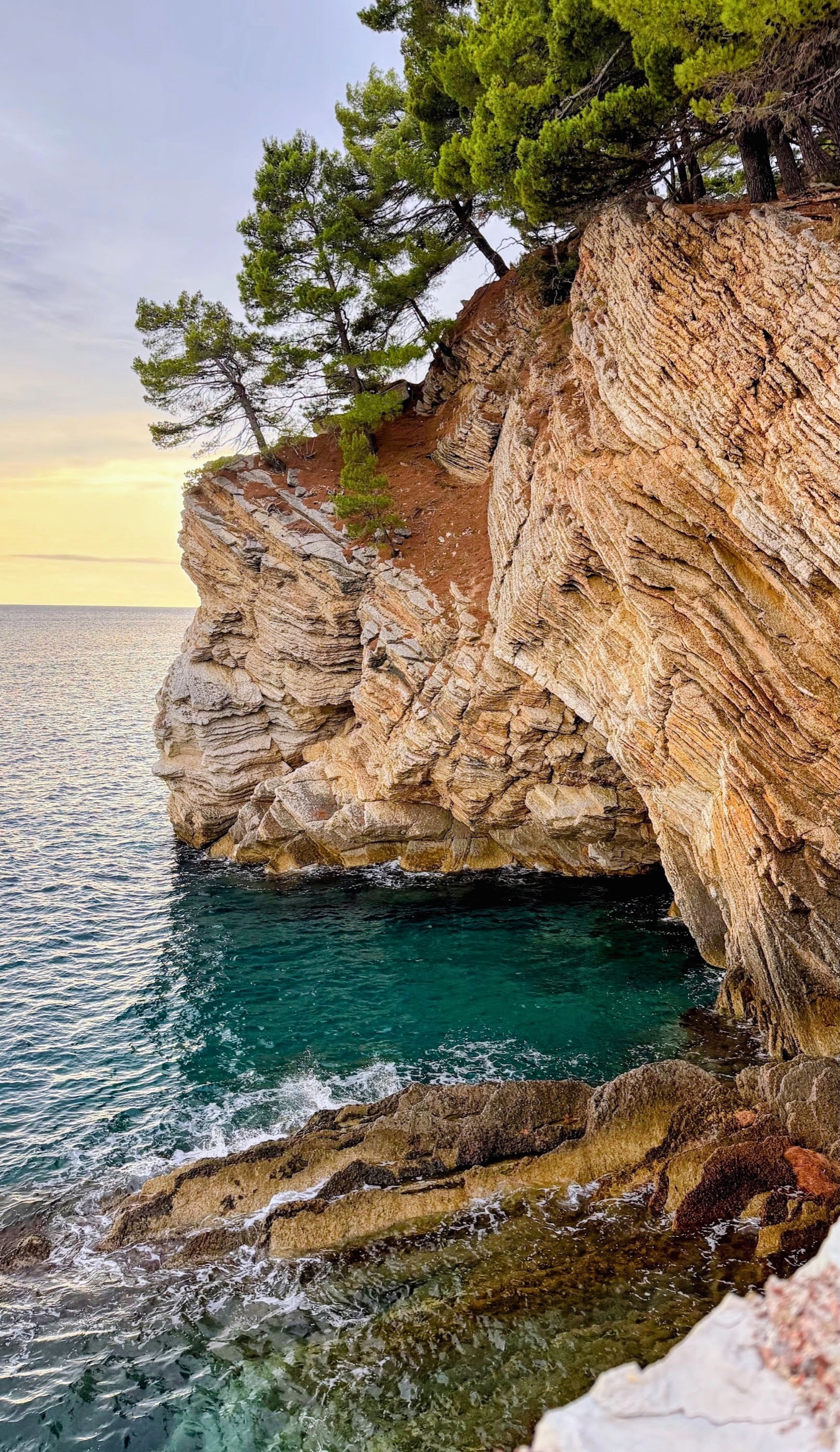 Folded limestone cliffs enclosing a small cove along the Health Trail north of Petrovac.
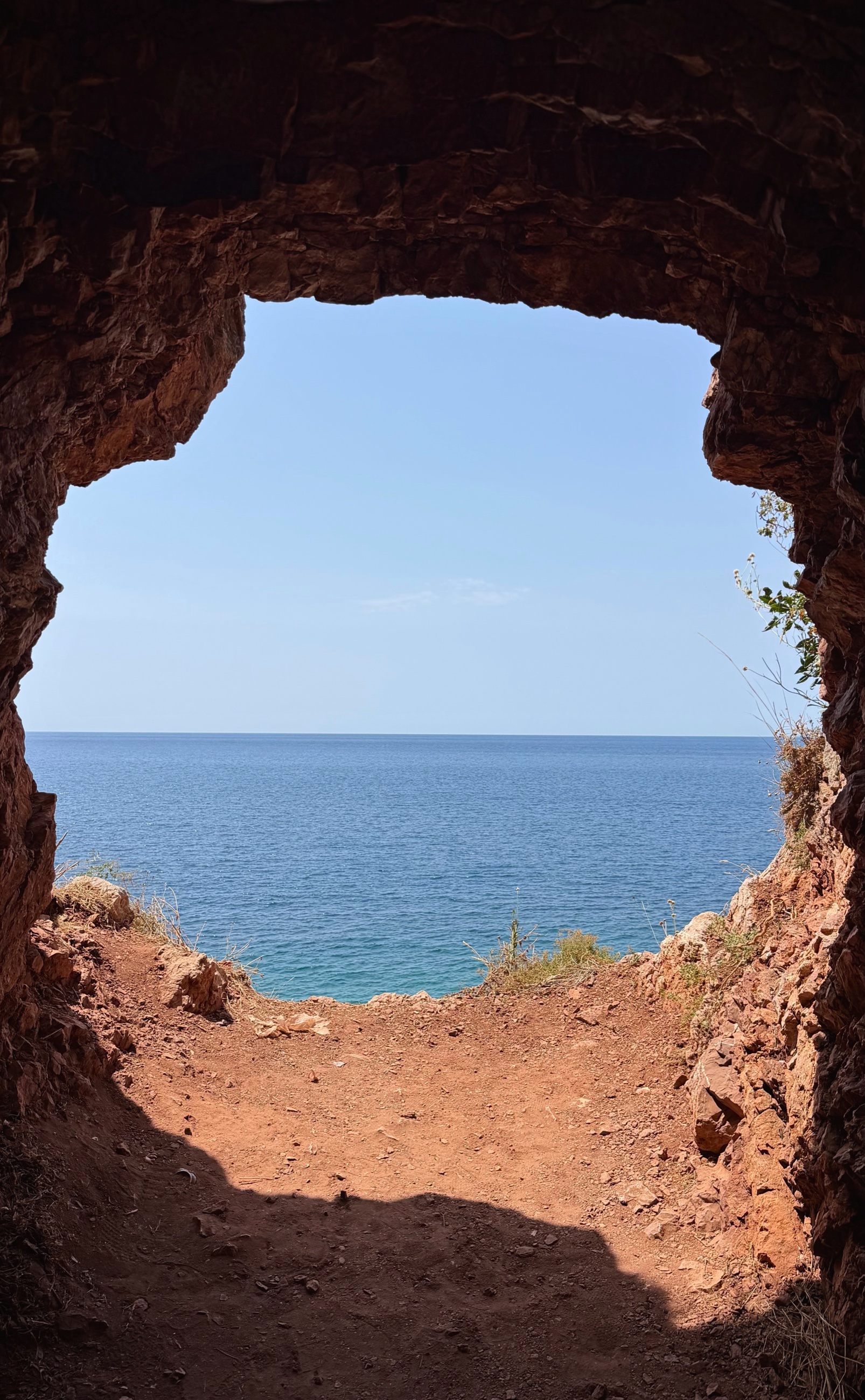 One of the Health Trail tunnels opening suddenly onto the Adriatic between Petrovac and Perazića Do.
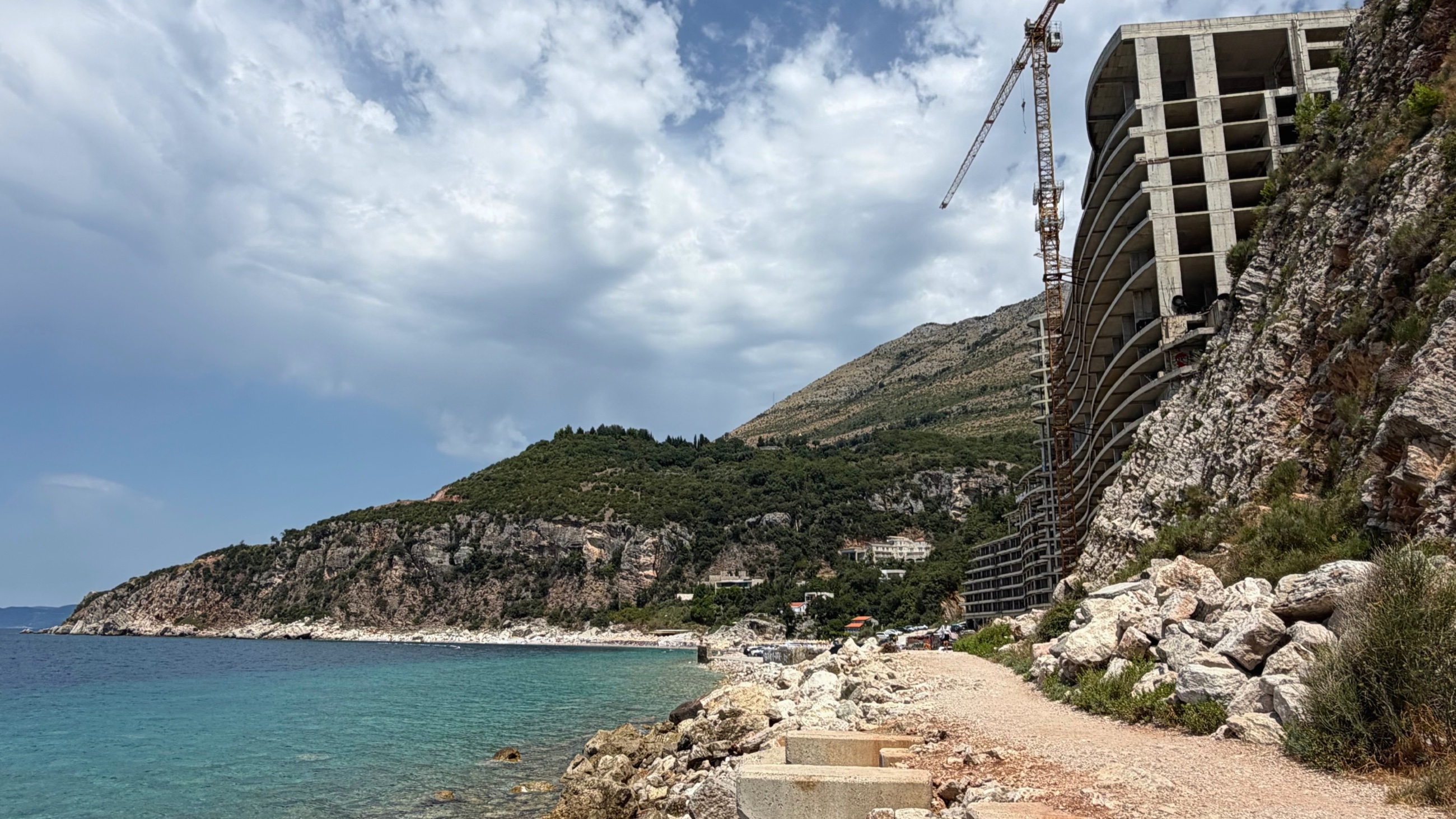 The unfinished Hotel AS above Perazića Do Beach, a conspicuous remnant of decades of stalled development.
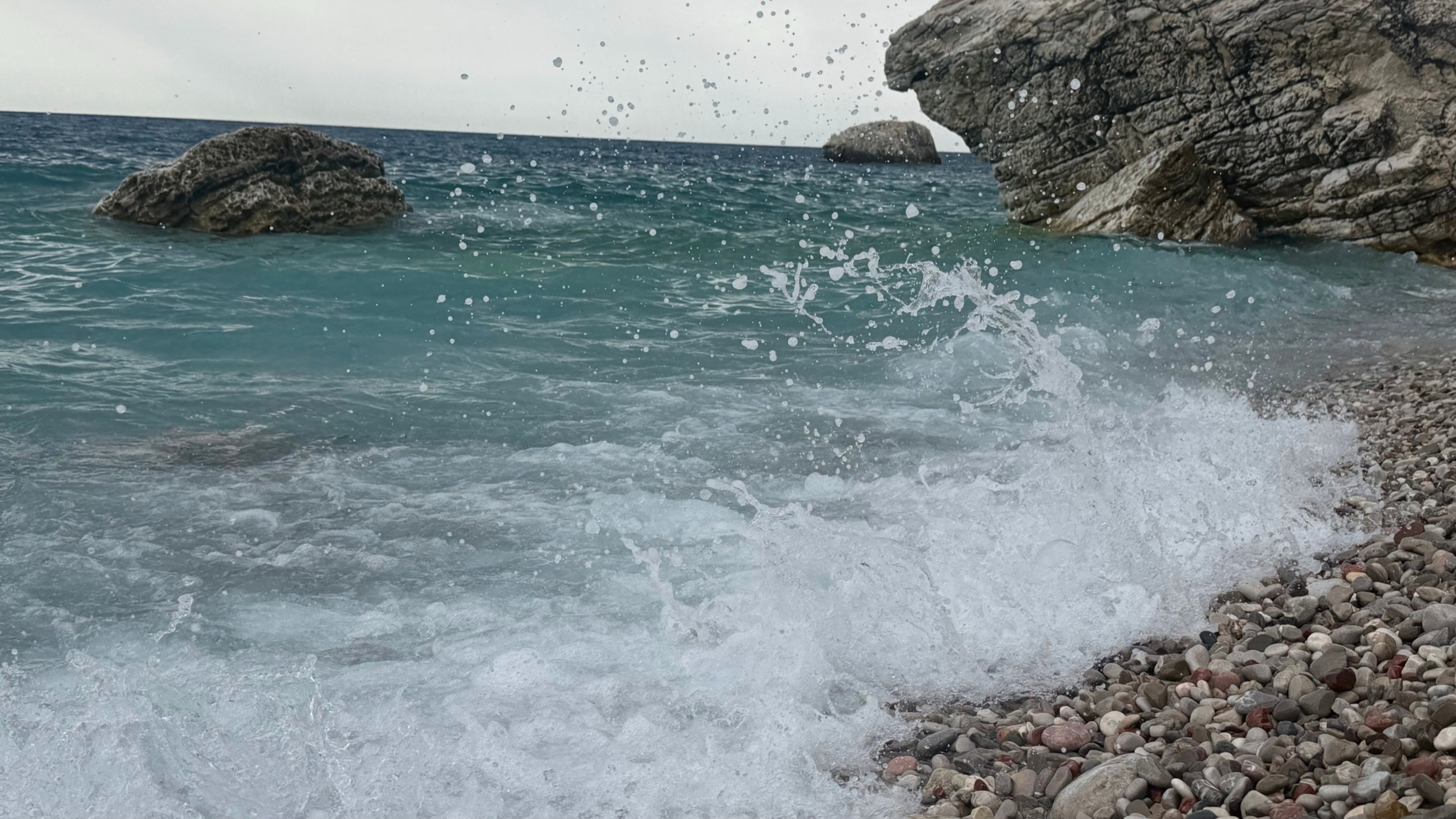 Waves breaking against the stones at Perazića Do, just beyond the narrow shoreline.
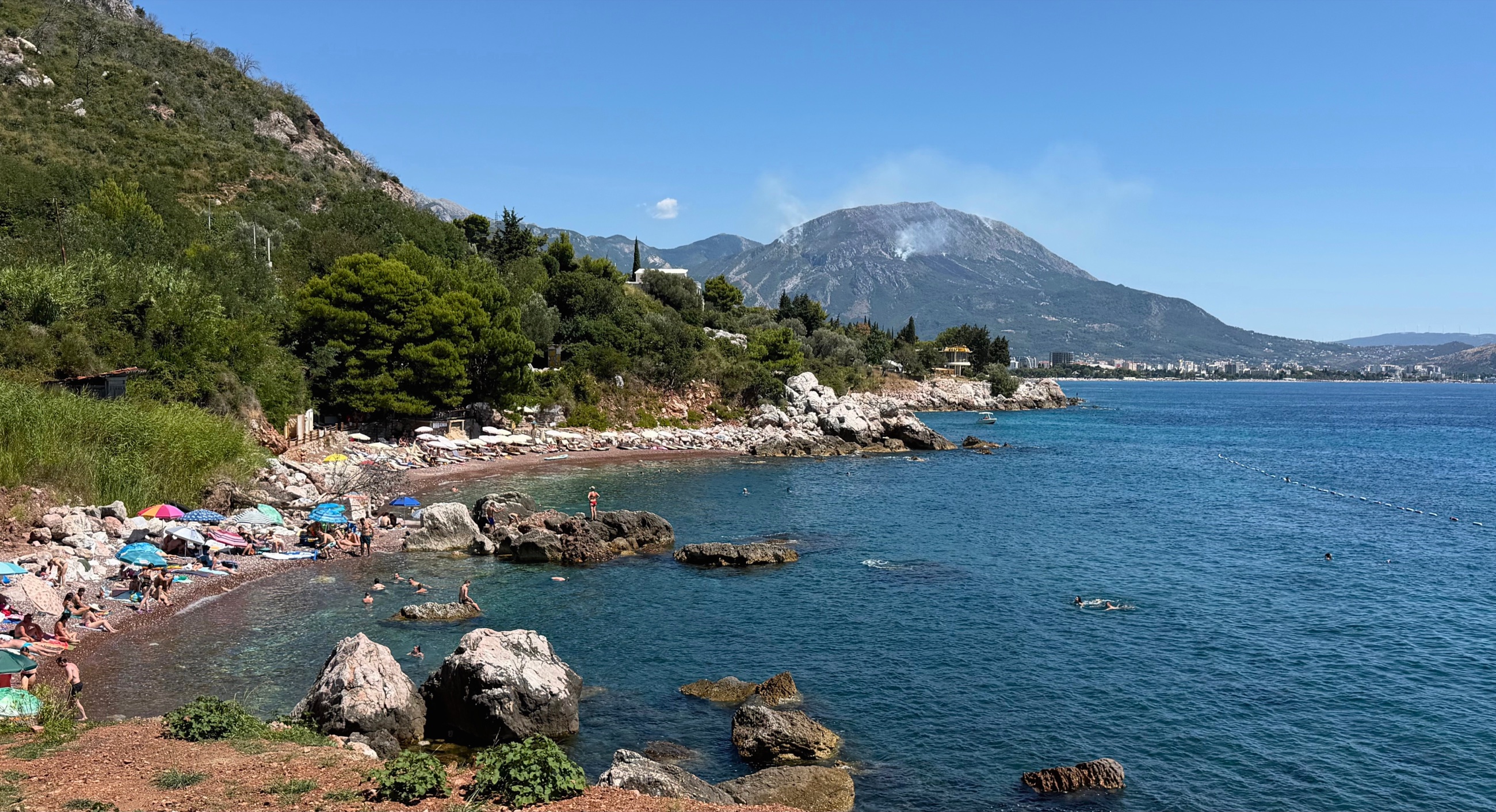 Red Beach near Šušanj, with reddish pebbles, pine-covered rocks, and some of the clearest water we found near Bar.
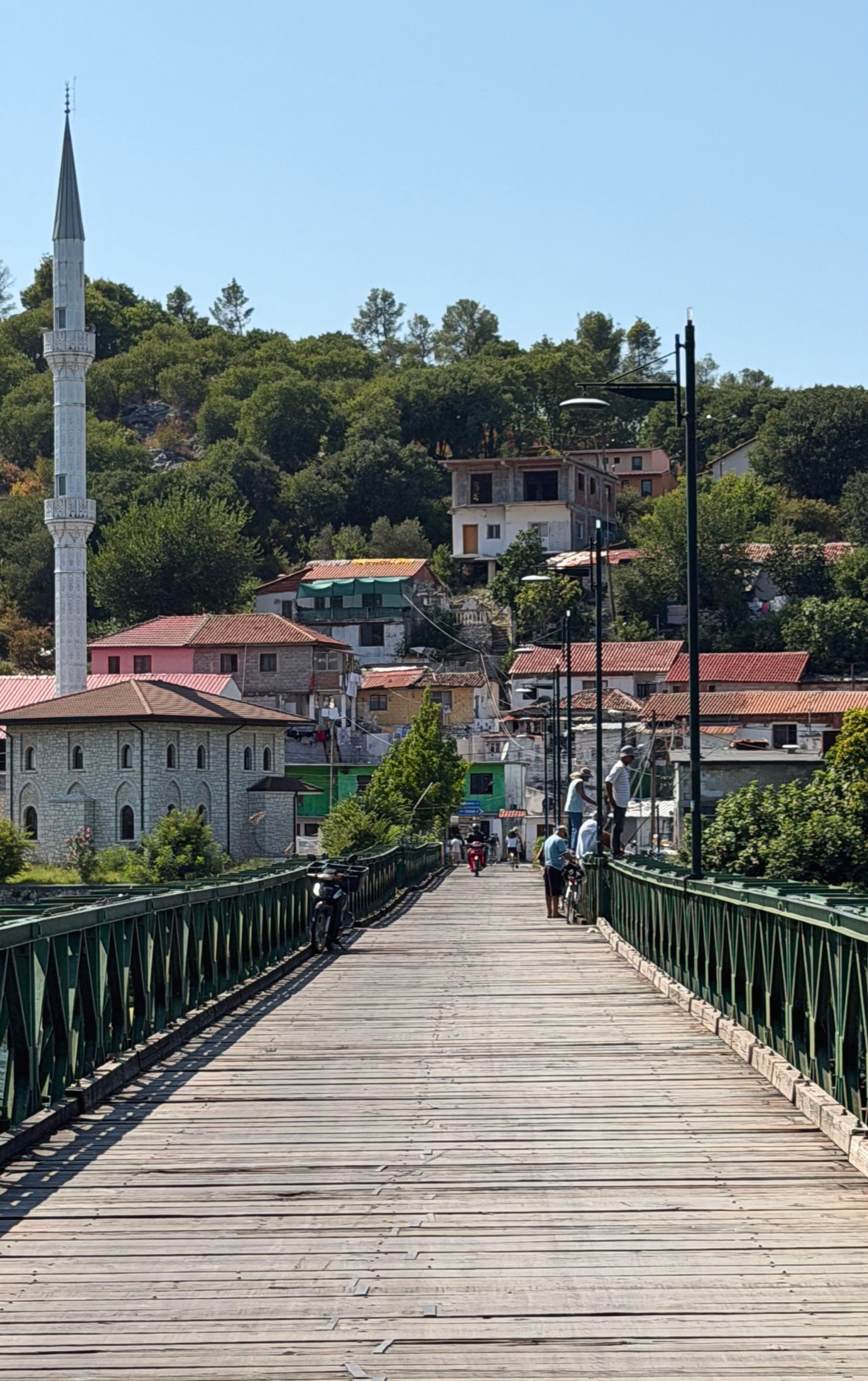 The wooden bridge across the Buna River on our bicycle route toward Shiroka and Lake Shkodër.
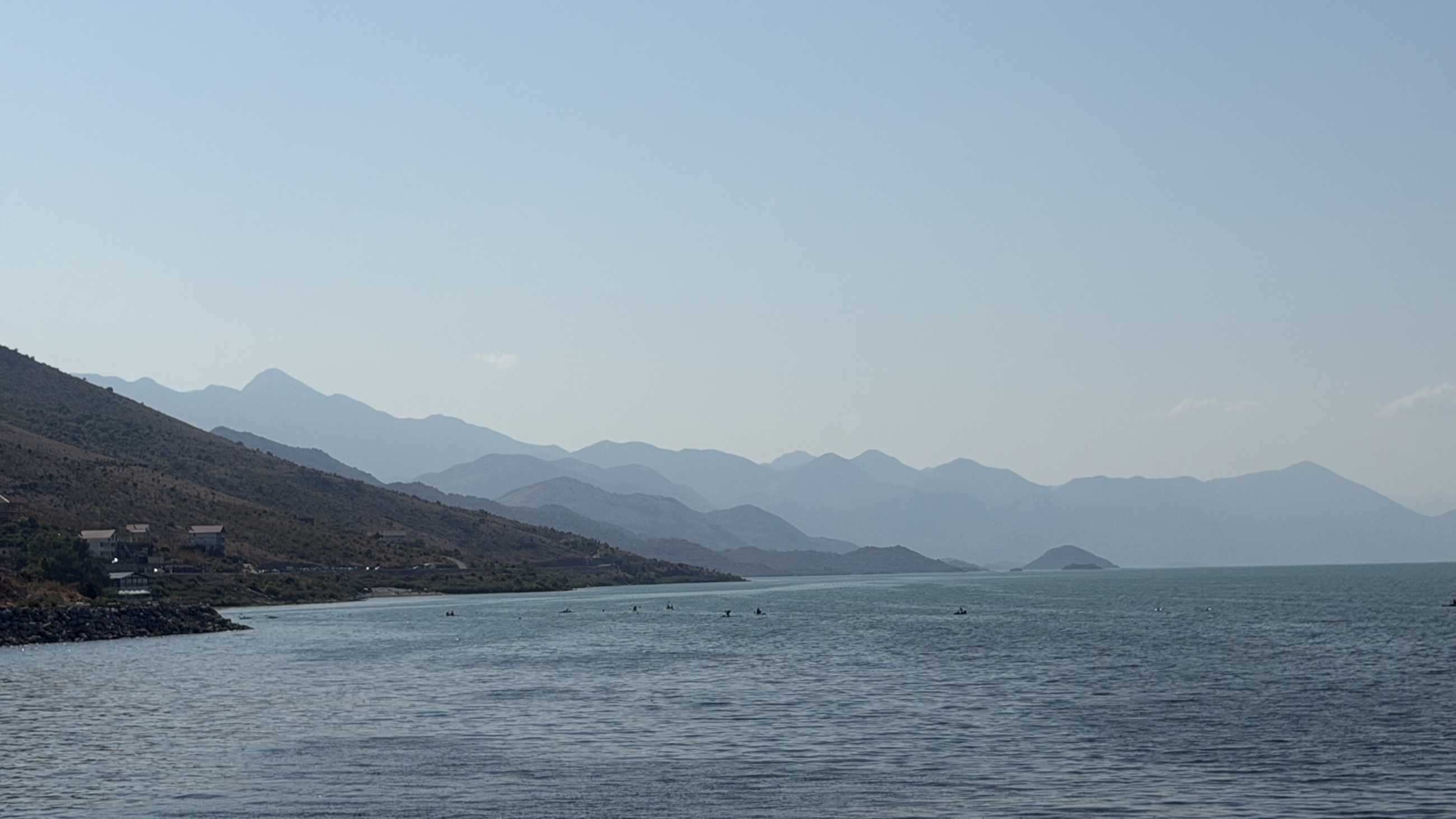 Lake Shkodër stretching toward the Albanian Alps from the road to Shiroka.
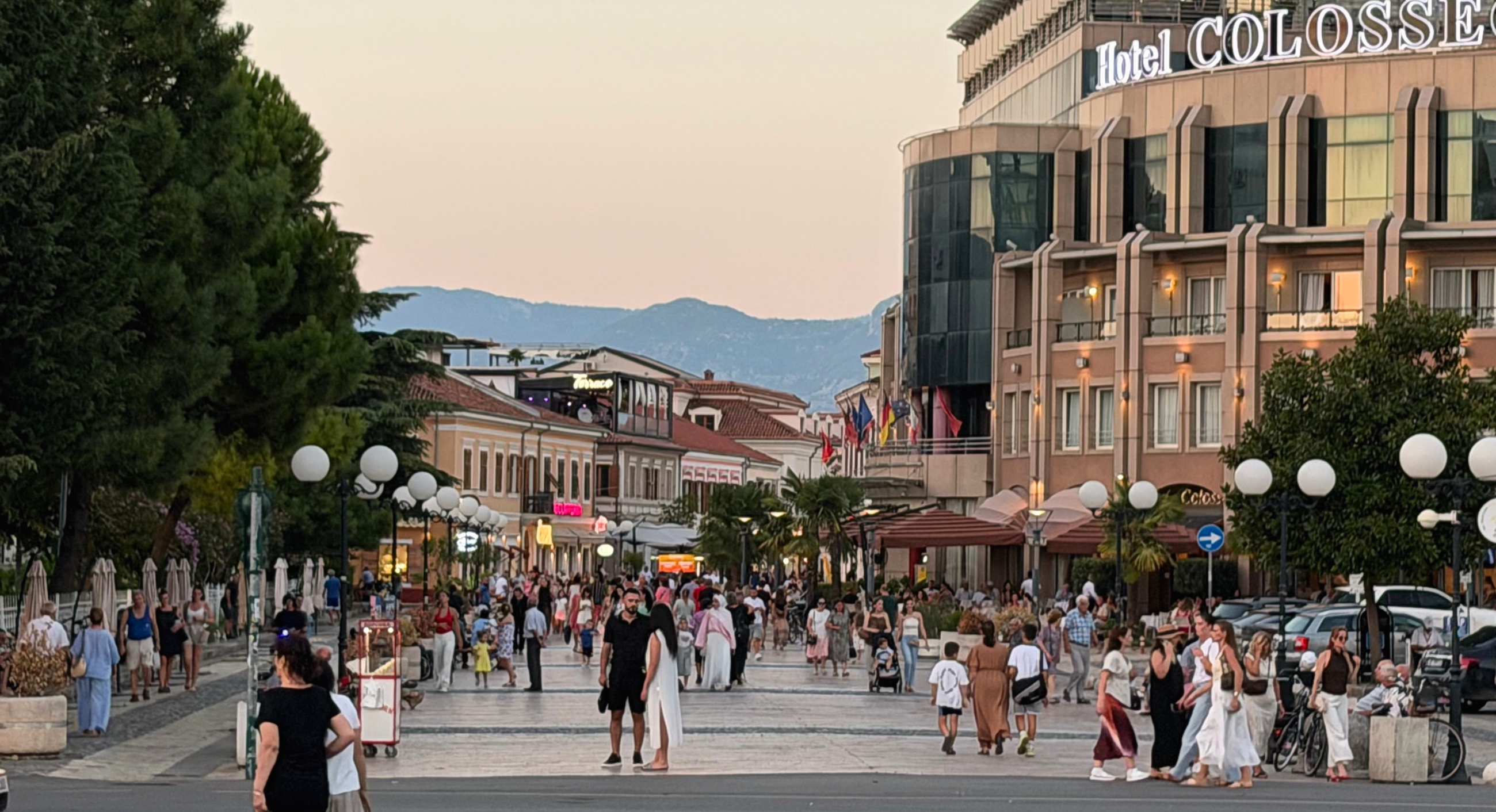 Kolë Idromeno during the evening xhiro, as families and groups filled the pedestrian avenue after the day’s heat eased.
🎯 Next Week Preview
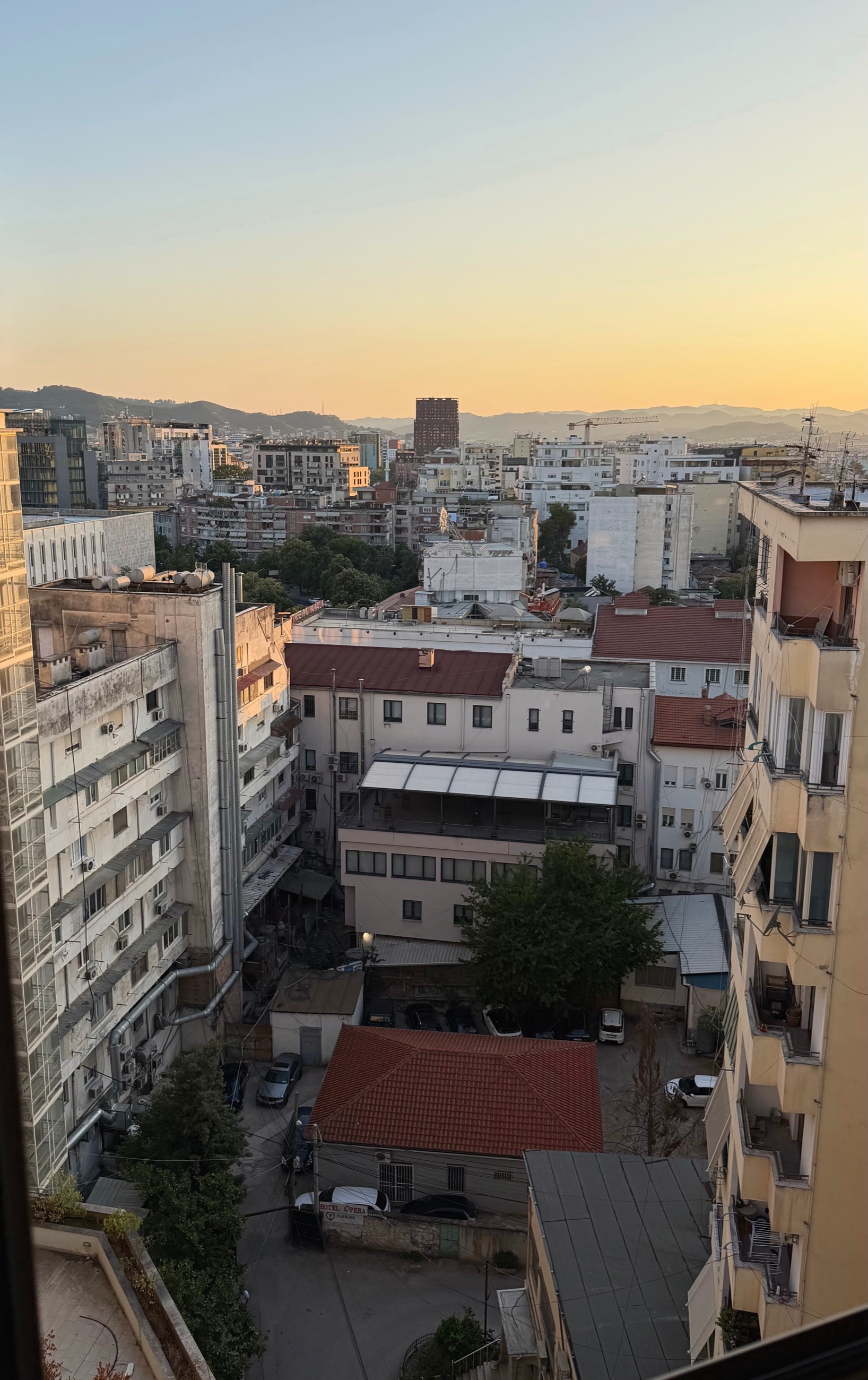 The first view from our Tirana apartment, across a capital we had only begun to understand.
Next week will be our first substantive report from Tirana. We will begin with the part of the city that has to sustain daily life: the streets surrounding our apartment, grocery stores, cafés, markets, a gym, public transportation, and the routes we begin walking repeatedly.
From there, we will turn toward the civic center around Skanderbeg Square and the history that shaped modern Tirana. Albania spent much of the twentieth century under one of Europe’s most isolated communist governments. Since the collapse of that system, Tirana has expanded rapidly, absorbed large-scale migration from other parts of the country, and remade much of its central landscape.
The traces of those periods sit close together: Ottoman-era landmarks, Italian planning, communist monuments and apartment blocks, contemporary towers, painted façades, mosques, churches, and a public square rebuilt more than once to express a changing national identity.
We have been here for too little time to decide how those elements fit together.
Next week, we will begin trying.
💌 Personal Connection
Two months in Montenegro began with a bus ride from Split to Kotor.
We arrived in late May carrying the uncertainty that accompanies every new country. We did not know the local buses, the grocery stores, the etiquette of the beaches, the shape of the coast, or how the Bay of Kotor would look after the cruise ships departed each day.
A month later, we moved south to Bar.
The second month gave us a different Montenegro. Kotor offered preserved walls, steep mountains, maritime history, and a bay whose physical scale shaped nearly every view. Bar offered beaches, modern avenues, trains, an industrial port, inexpensive buses, and a less polished form of coastal life.
Together, they became more complete than either would have been alone.
We saw Montenegro from medieval lanes and waterfront promenades, from railway windows and bus stations, from mountain paths and city gyms, from cold coves and crowded summer beaches. We learned the practical differences between towns separated by less than two hours: where tourism concentrates, where daily life remains more visible, and how the same coast changes as it approaches Albania.
The country also became personal through people. There were friends met in Kotor, and conversations that expanded beyond the exchange required by a rental or café.
In Bar, Mina began as the person who handed us the apartment keys. She became the neighbor who brought over her family’s rakija, talked with us about Serbia, and came to see us off when it was time to leave.
That progression cannot be scheduled. It requires repeated encounters, enough time for conversation to move beyond logistics, and the willingness to remain present after the transaction is complete.
When we left the apartment, we stood beside the same bags we had carried into Montenegro two months earlier.
The bags were largely unchanged, but Montenegro no longer felt unfamiliar.
Crossing into Albania did not feel like abandoning one chapter for an unrelated destination. The transition had been visible for weeks in the geography, history, languages, food, and religious traditions of the southern Adriatic. Ulcinj had already shown how the cultural lines between the two countries overlap. Shkodër continued the story from the other side of the border.
Now we are in Tirana, surrounded by an unfamiliar capital and another month that has not yet acquired a shape.
One more shift is ahead. Our daughter will be joining us here for three weeks, and we are looking forward to sharing an extended stretch of this chapter with her rather than compressing a visit into a handful of days.
For the moment, that is enough.
The bags are unpacked. The computers are connected. There are groceries in the kitchen. Outside, a city we do not yet understand is continuing without us.
Tomorrow, we begin walking.
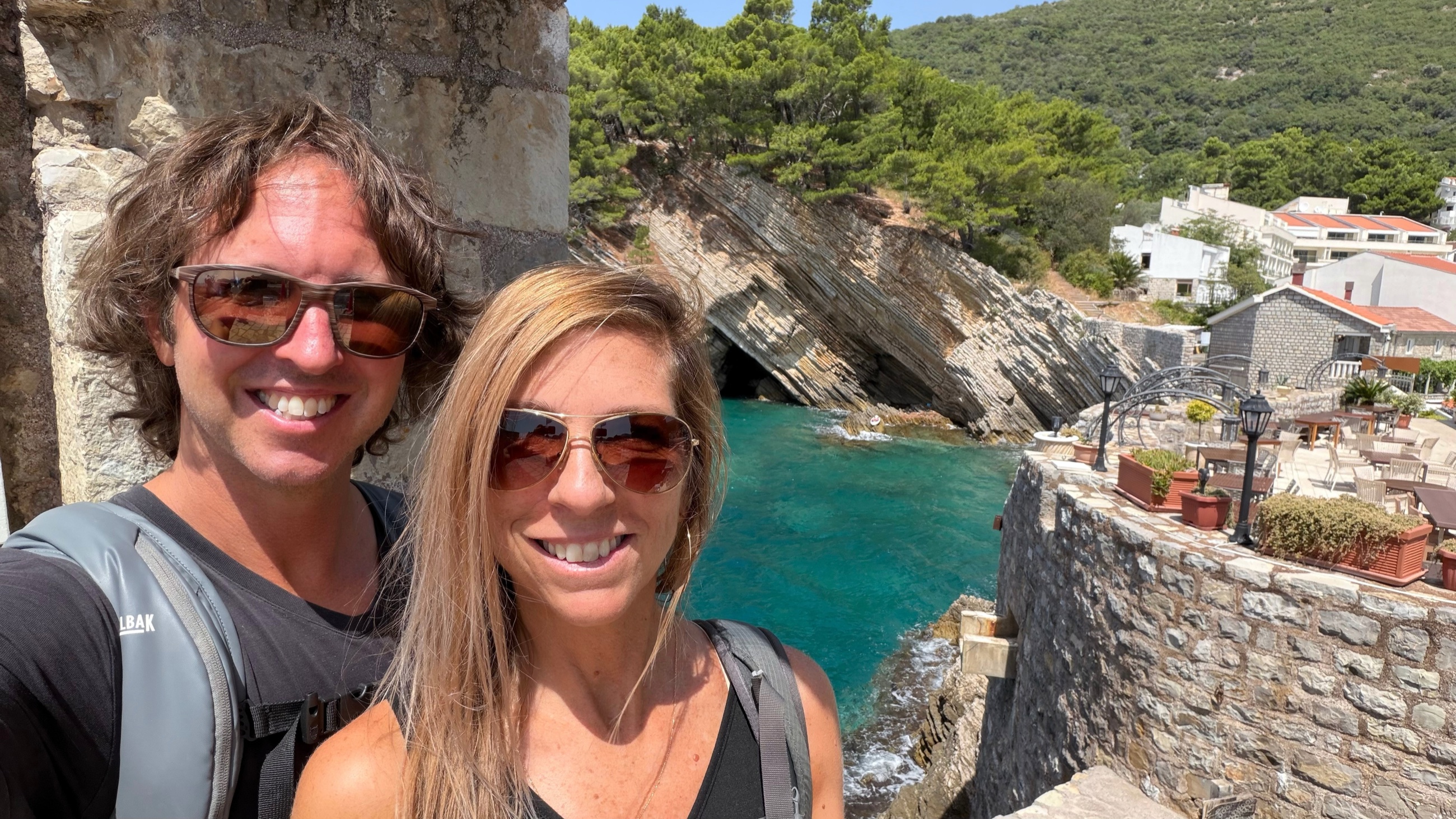 Together in Petrovac during our final days in Montenegro.
Until next week,
S&S
Some Great Place · Living Local in a Global World · somegreatplace.com