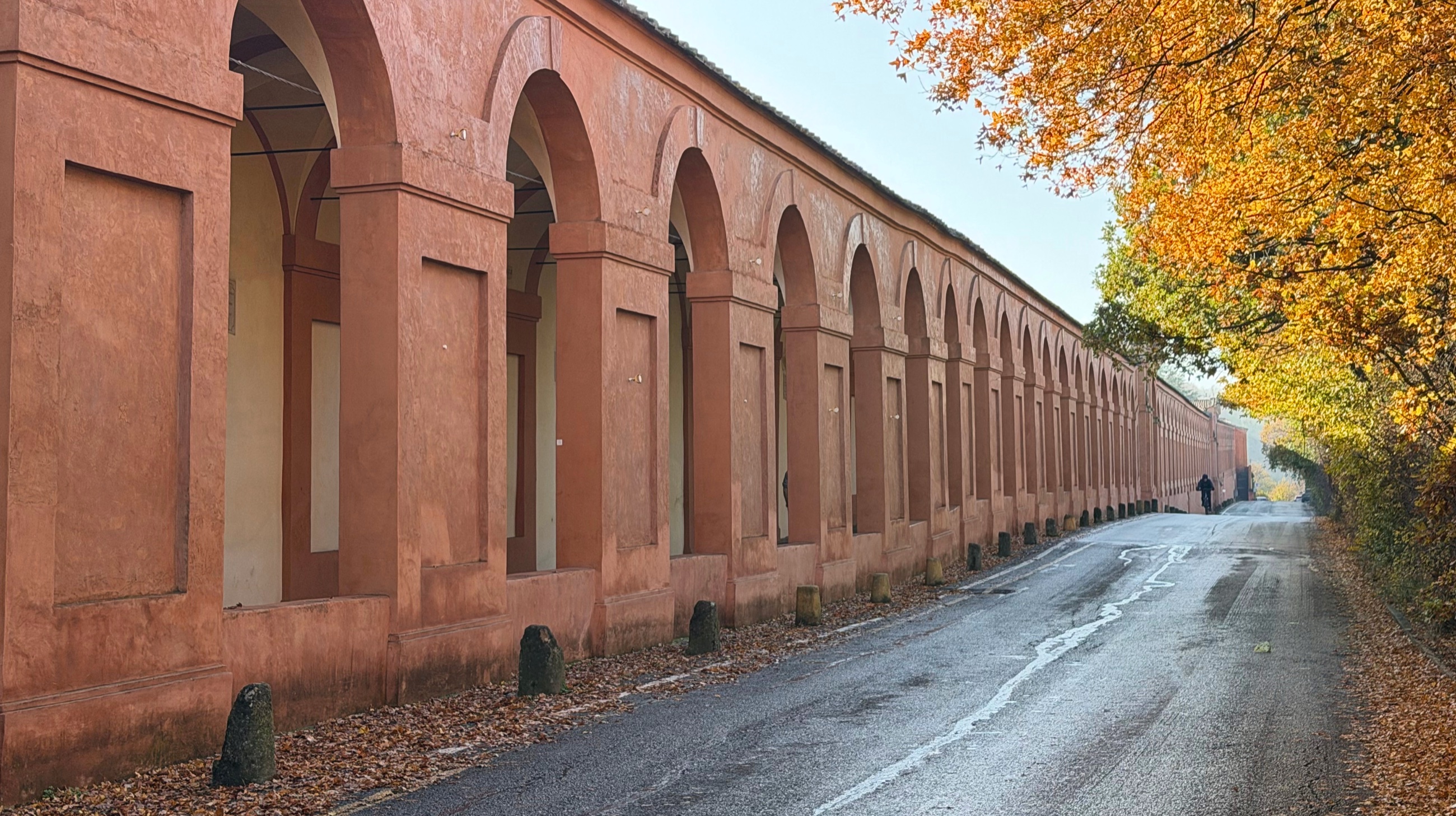
 The terracotta arches of Bologna’s Portico di San Luca lead to the hilltop Sanctuary of the Madonna di San Luca.
Bologna is a city you can cross in the rain without opening an umbrella. Arches cover most of the sidewalks in its old center, and for more than seven centuries they have shaped how people here live, shop, and study. One covered walkway runs all the way out of town and up a wooded hill to the sanctuary that watches over the city.
We spent our first week here walking under them, then followed the Via Emilia, the Roman road that ties this region together, west to Parma and Modena, through the countryside that gives the world Parmigiano Reggiano, Prosciutto di Parma, and balsamic vinegar. This issue covers the porticoes and the walk to San Luca, two day trips, a new kind of housing for us, and, since this letter arrives on Thanksgiving, what is on our table this year.
📍 This Week in Bologna
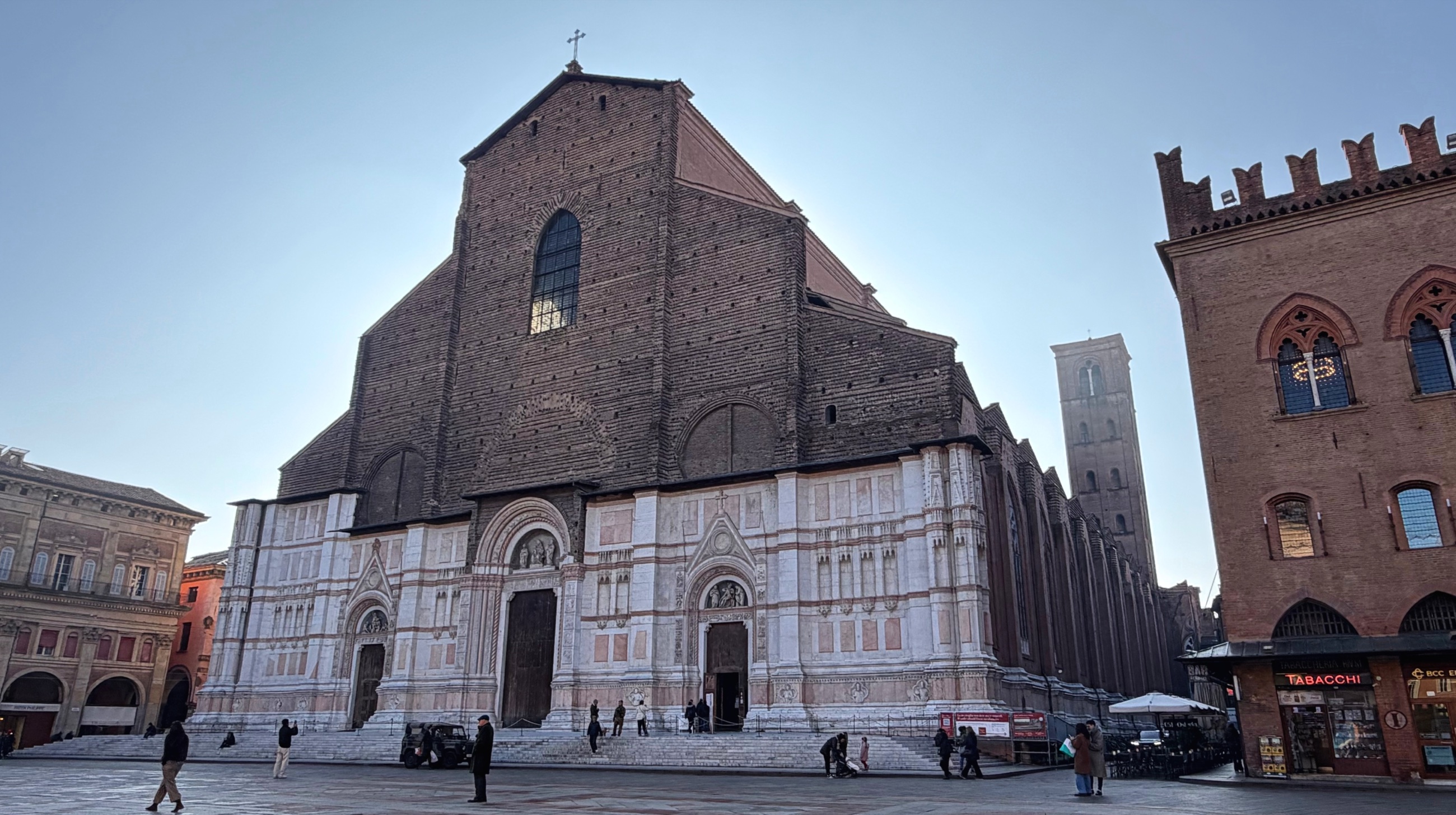 The unfinished façade of the Basilica of San Petronio faces Bologna’s Piazza Maggiore, with exposed brick above the pink and white marble.
We came back to Bologna from Venice on an afternoon train, collected the bags we had left behind, and unpacked into a room we will keep for nearly a month. The first days went to settling in: a round of grocery stores, a first session at the gym downstairs, a bakery for our bread, macchiatos at the counter, and our first mortadella sandwiches. With the basics in place, we turned to the city itself.
Bologna has three traditional nicknames, and the first is easiest to understand on foot. La rossa (“the red”) is visible in the brick, plaster, and terracotta of the historic center, where the colors range from ochre to rust to deep red. The other two are la grassa (“the fat one”), an affectionate name for a city famous for its cooking, and la dotta (“the learned”), for its university, whose founding is traditionally dated to 1088.
Our first walks took us down Via dell’Indipendenza to Piazza Maggiore, the square at the center of the old city, framed by the Basilica of San Petronio, the city’s largest church, whose brick façade was never finished, and by the medieval town hall. In the smaller square beside it stands the bronze Fountain of Neptune, made in the 1560s by the Flemish-born sculptor Giambologna.
Then, one morning, we set out to see how far we could walk under a single roof. The answer was nearly two and a half miles, from Porta Saragozza, one of the old city gates, to the Sanctuary of the Madonna di San Luca. We went the whole length, with a stop for coffee before the ascent, and were back in the center by lunchtime. The walk is this week’s Cultural Deep Dive.
Parma
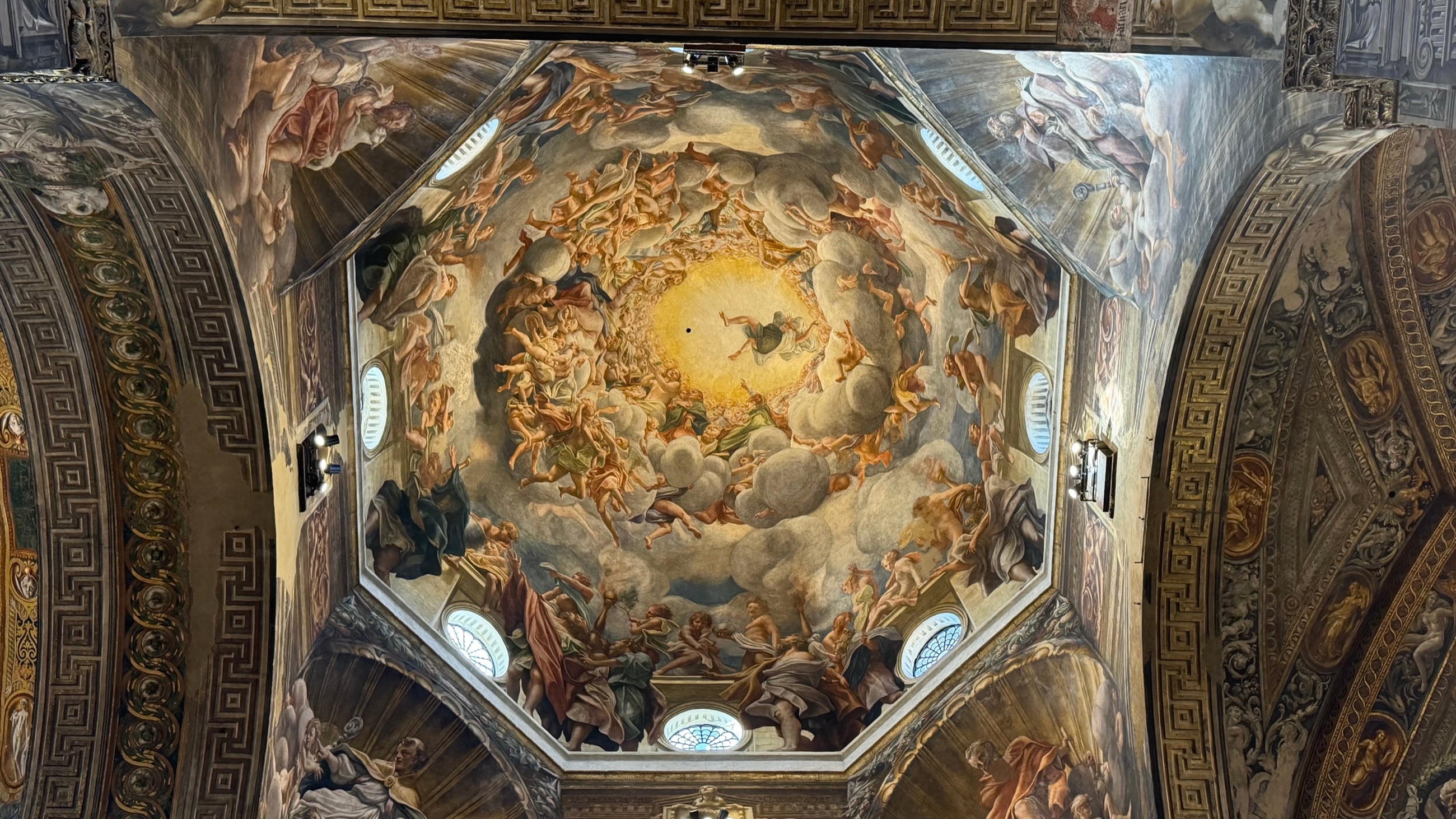 In The Assumption of the Virgin (1526-1530), Correggio made the dome of Parma Cathedral appear to open onto heaven, an illusion that later Baroque painters would take up across Europe.
On Saturday we went west to Parma. Rail work on the line meant a 45-minute train to Reggio Emilia and a 30-minute bus the rest of the way. We saw little of Reggio beyond its station and bus terminal, but the city is worth a sentence: it gives Parmigiano Reggiano the second half of its name, and it is the home of erbazzone, a savory pie of chard, herbs, and cheese that we had already eaten for breakfast in Bologna.
We had come partly to buy cheese and prosciutto to bring home, but our first stop was Piazza Duomo. Inside the Romanesque cathedral, consecrated in 1106, nearly every wall and vault is covered in sixteenth-century fresco. We took a seat in the pews and looked up. In the dome overhead, the Renaissance painter known as Correggio after his hometown near Reggio Emilia painted the Assumption of the Virgin between 1526 and 1530 as a gathering of figures rising through banks of cloud toward an opening of light. From below, it is remarkably difficult to tell where the dome ends and the sky he painted begins. The technique of painting a ceiling as if it opened onto heaven would occupy Baroque painters for the next century and a half. Not everyone has been won over. “Frog leg stew,” grumbled Girolamo Tiraboschi, a priest at the cathedral in the late eighteenth century, at the tangle of limbs seen from below. Titian is supposed to have answered the skeptics more generously, saying the dome deserved to be filled with gold and handed to Correggio, a story that is probably too good to be entirely true.
Outside, we walked around the octagonal baptistery, begun in 1196 by a medieval sculptor who also carved much of its decoration, and built of pink Verona marble. We skipped the interior ticket and followed instead the band of 75 carved panels that wraps around its base, a frieze of real and imagined creatures that includes centaurs, unicorns, and signs of the zodiac. A full circle of the building, past its three sculpted portals, costs nothing and repays the time.
Behind the cathedral stands the Benedictine monastery of San Giovanni Evangelista, which can be seen only on a guided tour, so we came back that afternoon. The tour was in Italian; an English brochure did much of the explaining, and the rooms did the rest.
Founded in 980 and rebuilt between 1490 and 1519, the monastery has been emptied three times, under Napoleon, the Bourbon dukes, and the new Kingdom of Italy, and each time the monks came back. A monk or two passed us in the cloisters, and our guide greeted each one with “Buona sera, padre.” The largest cloister leads to the great refectory, where a Last Supper painted in 1562 still hangs above the room where the monks ate. When the monastery served as a barracks, soldiers used the refectory as a gymnasium.
Then came the library, which neither of us was prepared for. Every surface of its eighteen vaults is painted, covered in 1574 and 1575 with grotesque ornament of foliage, masks, and hybrid creatures, a style named for the buried rooms of Nero’s palace in Rome, set around maps of the Holy Land and inscriptions in Latin, Hebrew, Greek, and Syriac. None of it is idle decoration. The abbot who planned the room meant each of the eighteen bays as a meditation on wisdom and the human search for truth, drawing classical, biblical, and worldly learning together for the monks who came here to study. Display cases below hold illuminated manuscripts from the monastery’s own scriptorium and volumes that set scripture in several languages side by side; the maps and images overhead were copied from one such book, a polyglot Bible printed in Antwerp in 1572. The effect is overwhelming and a little strange, like a set waiting for a Dan Brown hero with a flashlight and a theory. The documented history is less sinister, though it has intrigue of its own. The Antwerp Bible had the pope’s blessing, yet a rival scholar denounced its editor to the Inquisition for making too liberal use of rabbinical sources, and he was not cleared until 1580, five years after the paint in Parma was dry.
The adjoining church gave us a second Correggio dome in a single day, The Vision of Saint John on Patmos, with Christ descending in light among the apostles. One detail is easy to miss: Saint John himself is tucked under the rim of the dome, invisible from the nave and visible only to the monks. The congregation saw Christ; only the monks saw John seeing him.
From there we walked through the rest of Parma, which for three centuries before Italian unification was the capital of its own duchy. San Francesco del Prato, a Gothic church built by Franciscan friars in the thirteenth century, had an unusual second life. After Napoleon’s administrators expelled the friars, the church became the city prison, and it remained one until the 1990s. Restoration has since removed the cell walls and uncovered fifteenth-century frescoes beneath them.
A short walk west, Piazzale della Pace is a broad lawn framed by the Palazzo della Pilotta, the vast brick palace of the Farnese dukes who ruled Parma from the sixteenth century, and now home to the National Gallery. Facing it is a monument to Giuseppe Verdi, the composer of the operas Aida, La Traviata, and Rigoletto, who was born in a village in the province of Parma. The monument incorporates sculpted reliefs salvaged from a larger memorial damaged by bombing in the Second World War.
Next door stands the Teatro Regio, Parma’s opera house, opened in 1829 by Marie Louise of Austria. She was Napoleon’s second wife, and after his fall the Congress of Vienna gave her Parma to rule. We had a brief look inside the red-and-gold auditorium. Verdi is a point of local pride here, and the regulars in the upper gallery are known as some of the most demanding audiences in Italy, quick to boo a singer who falls short.
We crossed the river toward the Parco Ducale, the gardens laid out for the Farnese dukes in the sixteenth century, then looped back to Piazza Garibaldi, named for the general who led the campaign to unify Italy, a civic square that sits over the old Roman forum.
Just off the square, on Strada della Repubblica, the city’s stretch of the old Via Emilia, we stepped into the church of San Vitale after dark. It is one of the oldest churches in Parma, recorded by the tenth century; tradition credits its founding to King Pepin of Italy, a son of Charlemagne, and the present building dates from 1651. We found it empty, its single Baroque nave lit low enough that the gilded side altars and the painted ceiling seemed to come forward slowly as our eyes adjusted. We ended the day walking Strada Farini and Via Cavour, two of the main shopping streets, under lamps strung across the street, then caught the bus and train home.
Modena
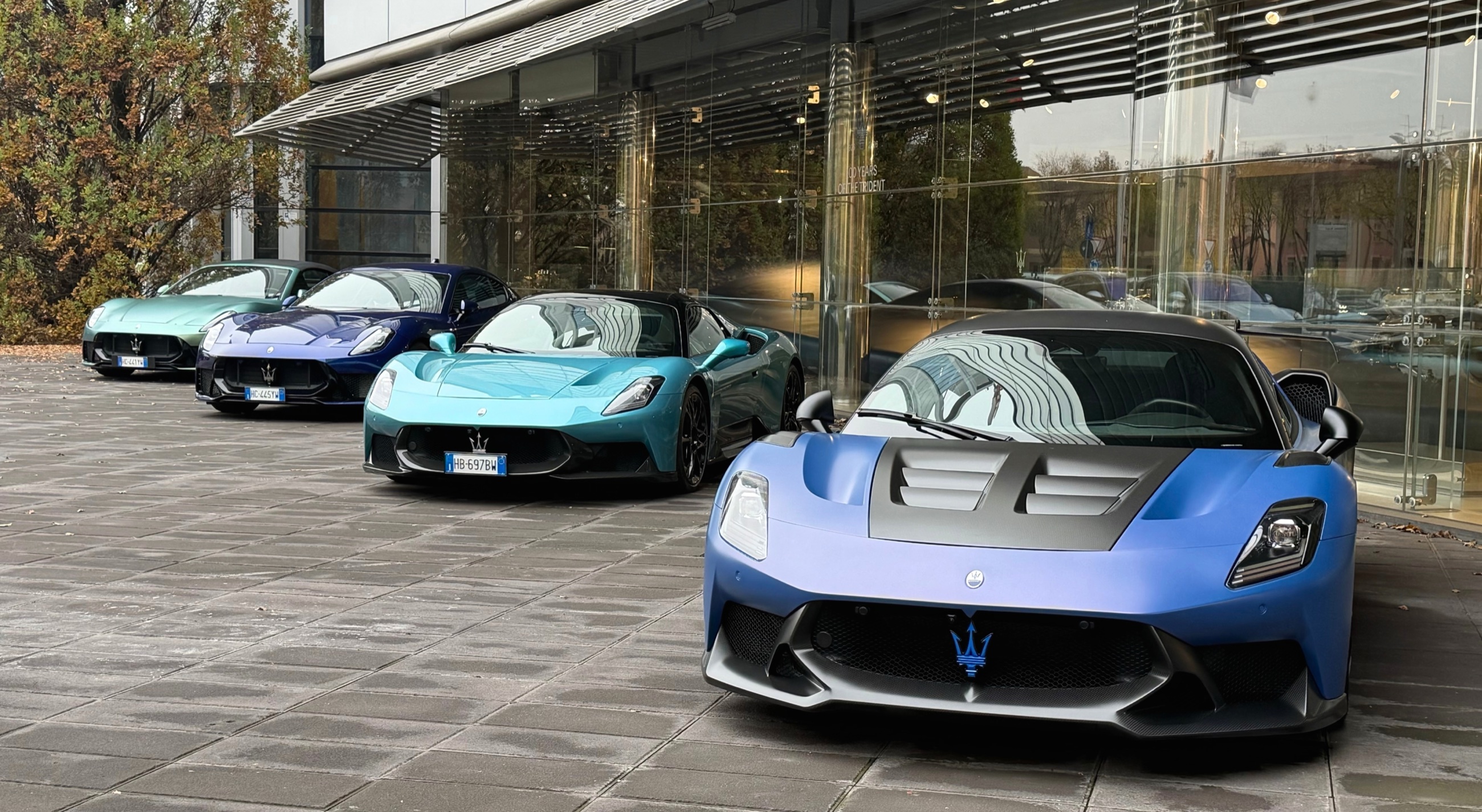 Outside Maserati’s headquarters in Modena, the trident on the grille points back to Bologna’s bronze Neptune.
On Tuesday we took the regional train 30 minutes west to Modena, €4.50 ($5) each way, and spent the day on a loop through the old town that took in sports cars, churches, Roman stone, and an eclectic market lunch without a single museum ticket. Modena lives with two reputations: as the heart of Emilia-Romagna’s Motor Valley, where Maserati, Ferrari, and Lamborghini are built, and as a city of Romanesque stone. Our route began and ended with the engines.
From the station we walked to the Maserati headquarters on Viale Ciro Menotti, the company’s home for more than 80 years, to photograph its brick façade and the cars lined up out front. Maserati began in Bologna, and its trident emblem is generally credited to Mario Maserati, the one artist among the engineering brothers who founded the company, who took it from the Fountain of Neptune we had passed in Bologna’s Piazza Maggiore.
In the old town, the Baroque Palazzo Ducale fills one side of Piazza Roma. It was built for the Este dukes, the family that had ruled Ferrara for three centuries until the papacy took the city in 1598 and the court moved here, and it now houses Italy’s military academy. Across the square, the church of San Domenico holds Christ in the House of Martha and Mary, a group of terracotta figures modeled in 1544 by Antonio Begarelli. Modena’s two great Renaissance sculptors, Begarelli and Guido Mazzoni, worked in clay rather than marble, and Michelangelo is said to have remarked of Begarelli’s figures that if this clay were to become marble, woe to the ancient statues.
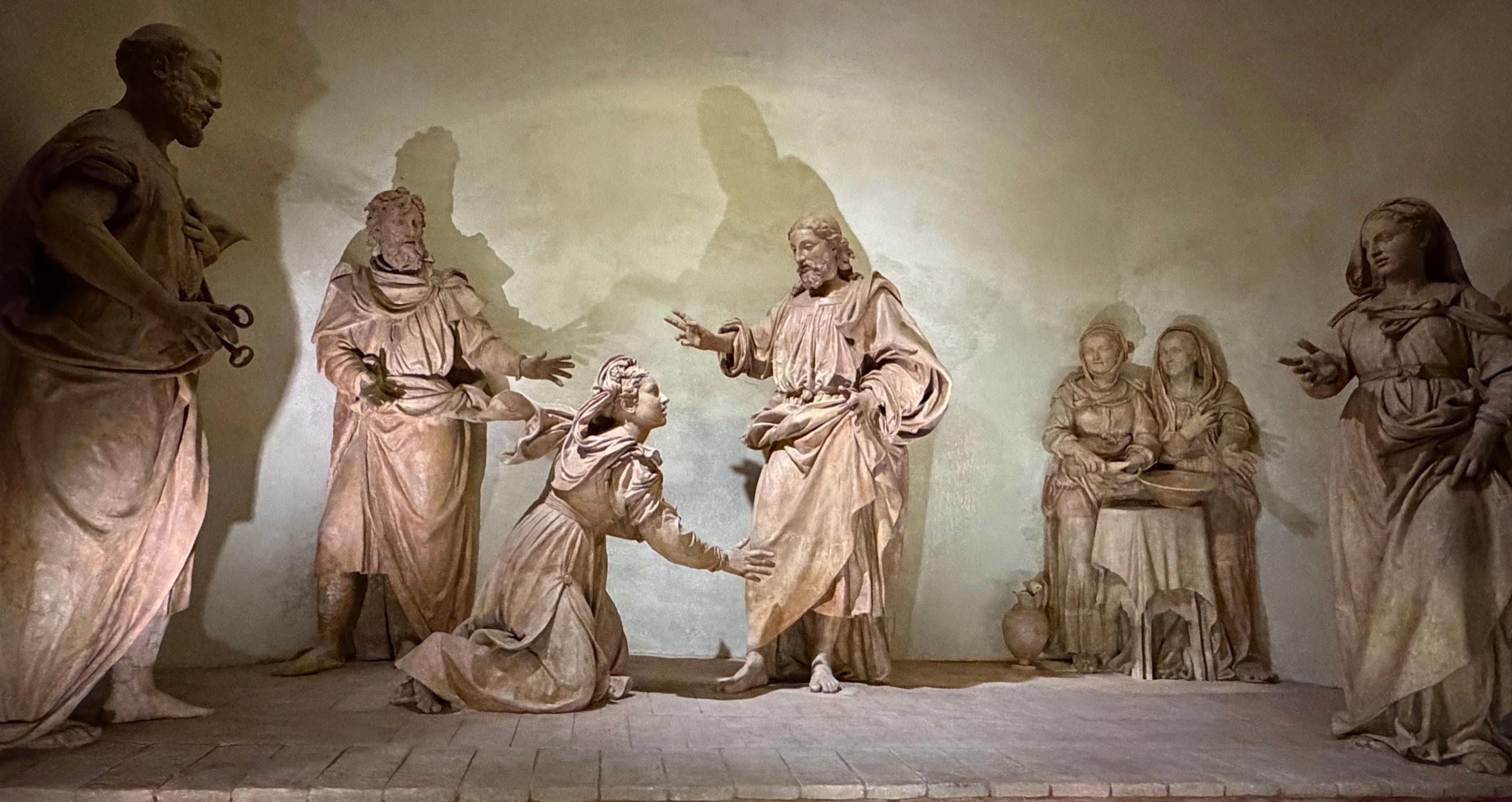 Mary kneels before Christ in Antonio Begarelli’s terracotta group, Christ in the House of Martha and Mary (1544), in Modena’s church of San Domenico.
A short walk brought us to Piazza Grande, the city’s civic center since the Middle Ages, where Modena’s Romanesque cathedral fills one side of the square. The cathedral was begun in 1099 and consecrated in 1184, over the tomb of Saint Geminianus, Modena’s fourth-century bishop and patron saint. Its brick walls are faced with stone salvaged from Roman Modena, and across the façade run carved scenes from Genesis by the sculptor Wiligelmo, who worked alongside the cathedral’s architect. On the north side, the arch over the Porta della Pescheria, the old fish-market door, shows mounted knights riding toward a castle, identified by carved names that include Artus de Bretani, King Arthur. Carved in the early twelfth century, it is possibly the earliest monumental sculpture of the Arthurian legend. Together, the cathedral, its Ghirlandina bell tower, and the square have been a UNESCO World Heritage Site since 1997.
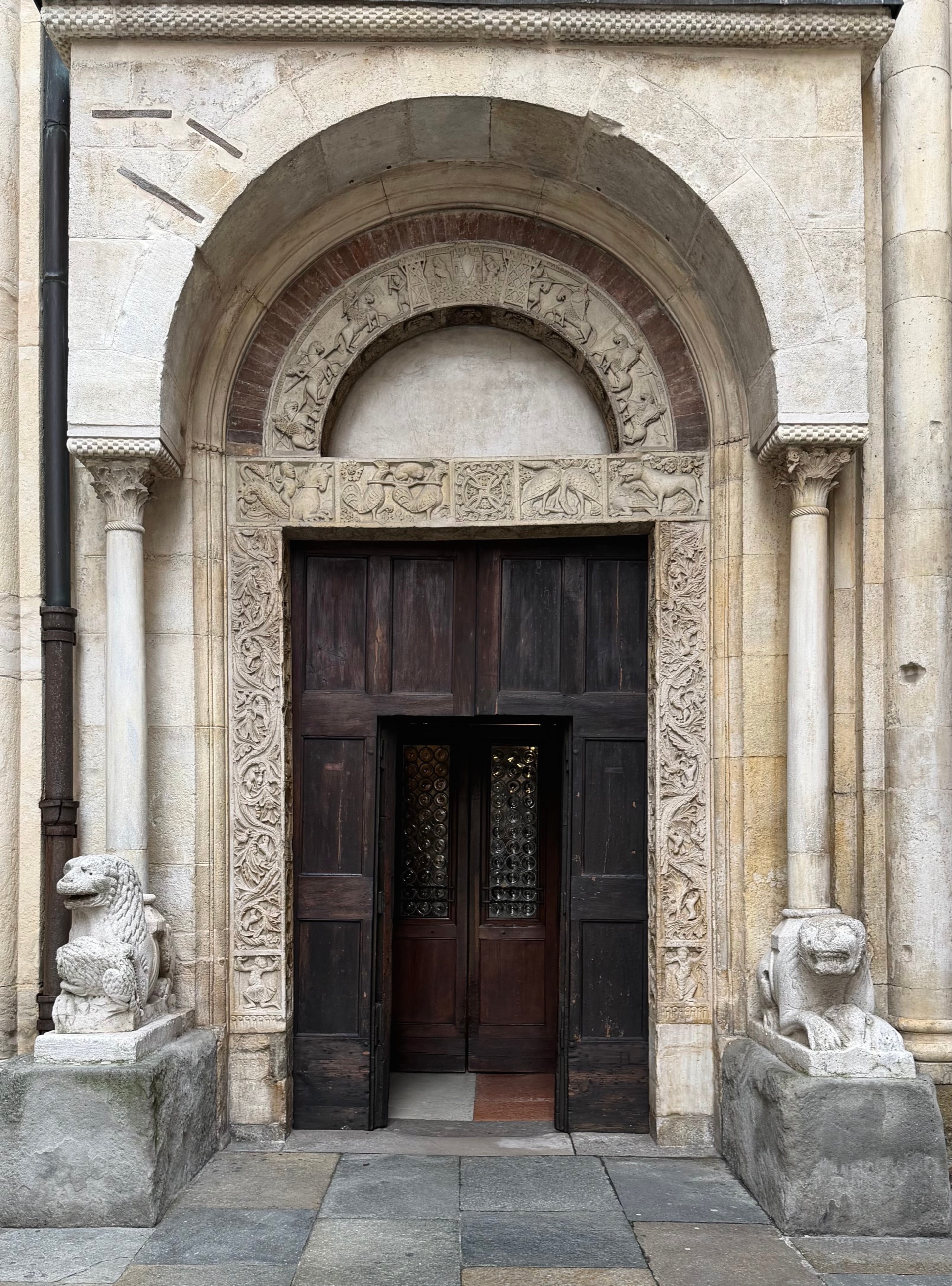 On the curved stone arch above Modena Cathedral’s north door, mounted knights ride toward a castle carved at the crown of the arch. An inscription identifies one rider as Artus de Bretani, King Arthur of Britain.
We went in through that north door. The interior is bare red brick, and a marble screen carved with scenes of the Passion, a Last Supper among them, lifts the altar above the nave. Beneath it, in the crypt, clusters of columns surround the tomb of Saint Geminianus, and nearby stands Guido Mazzoni’s painted terracotta Nativity of the early 1480s, known as the Madonna della Pappa for the servant who blows on a spoonful of porridge to cool it for the Christ child.
After lunch at the market (more on that below), we walked west across the old town. We stepped briefly into the Paradisino, a small church from 1596 that now serves a Ukrainian Catholic parish worshipping in the Byzantine rite, a liturgy we came to know farther east. Beyond the former ducal gardens, an open-air site called Novi Ark preserves a stretch of Roman road and stone monuments from Mutina, the Roman town beneath Modena, and the courtyard of the Palazzo dei Musei, free to enter, holds the Lapidario Estense, a collection of Roman inscriptions, funerary monuments, and medieval sarcophagi. Like Parma and Bologna, Modena began as a Roman town on the Via Emilia.
Our last stop, on the walk back toward the station, was the Enzo Ferrari Museum, where a yellow aluminum roof shaped like a car’s hood curves beside the brick house where Enzo Ferrari was born in 1898 and his father ran a mechanical workshop. Along the courtyard wall, the museum tells the rest in a single line: Ferrari sold the house at twenty to buy his first race car, “the beginning of the Legend.” We peeked in from the lobby, then caught the afternoon train back to Bologna.
🎨 Cultural Deep Dive
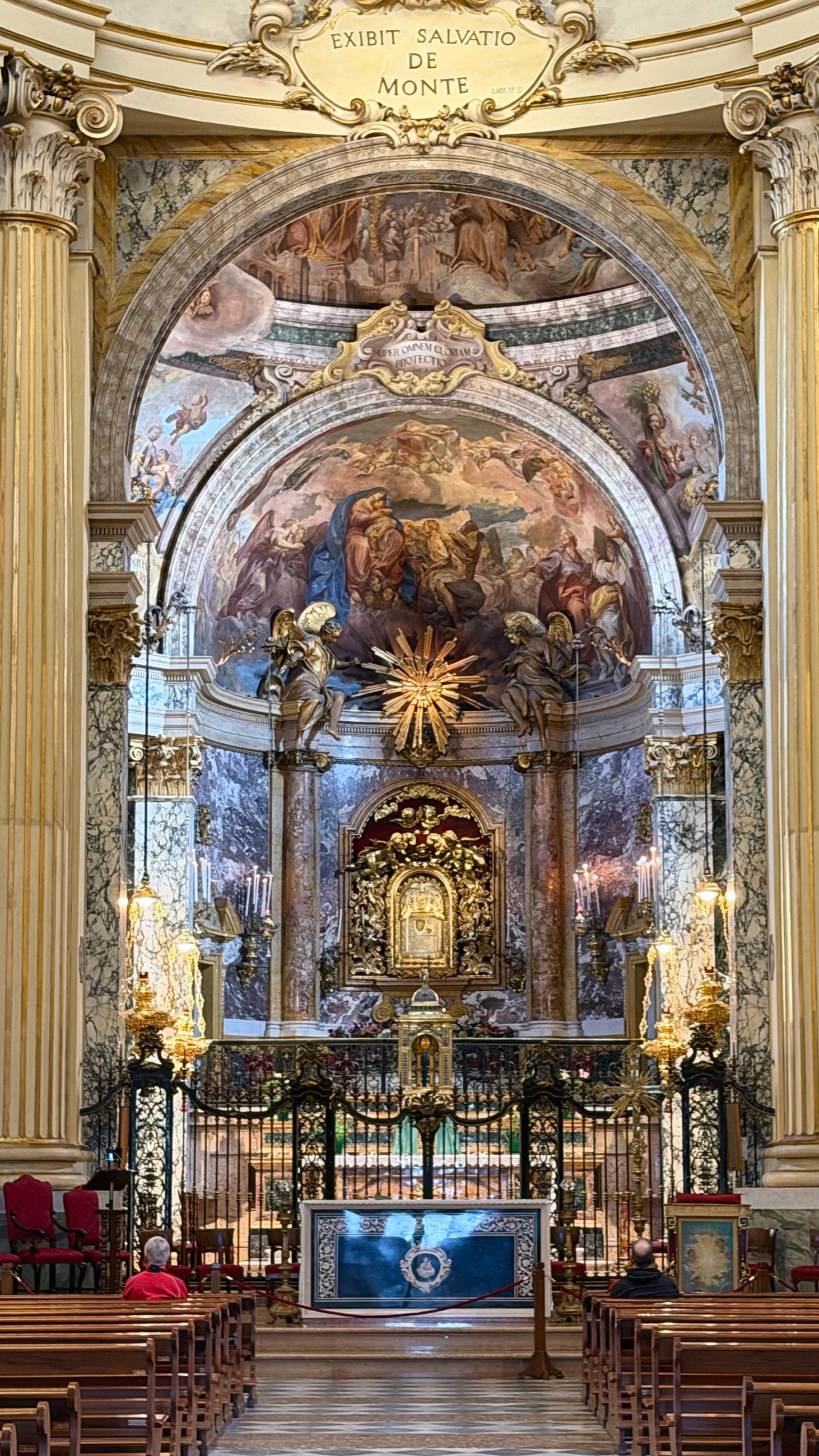 At the end of Bologna’s covered walk, the icon of the Madonna and Child rests in the gilded frame beneath the sunburst, above the high altar of the Sanctuary of the Madonna di San Luca.
Why Bologna built under arches
Bologna’s porticoes began with a practical problem. By the eleventh century the city was growing faster than its walls, and students were arriving from across Europe to study law, all of them needing somewhere to sleep. Households found room by extending their upper floors out over the street on wooden beams. The extension added living space upstairs and left a sheltered passage beneath it. What began as improvised and often unlicensed building became public policy in 1288, when a city statute required that existing porticoes be maintained and that every new house be built with one. The statute set a minimum height of seven Bolognese feet, about 8 feet 9 inches, enough for a rider on horseback to pass beneath.
The arrangement still defines Bologna at street level. A shopkeeper can open a door, a customer can stop at a window, and someone on the way to class can pass them both under the same roof. Today the city has about 38 miles of porticoes, roughly 26 of them inside the historic center. In 2021, UNESCO inscribed twelve representative stretches on the World Heritage List, from medieval wooden porticoes to twentieth-century concrete ones. They are working architecture rather than a preserved set piece. In late November, the stalls of the Antica Fiera di Santa Lucia, the city’s oldest Christmas market, fill the broad portico of Santa Maria dei Servi on Strada Maggiore, and every morning students cross the university quarter beneath the arches of Via Zamboni, the university’s main street. We will come back to the university before we leave.
The longest portico in the world
The covered walk to San Luca belongs to a different category. In town, a portico takes you past a succession of addresses. From Porta Saragozza, the arches lead to a single destination. Built largely between 1674 and 1721, with contributions from Bolognese families, guilds, and parishes of every class, the San Luca portico runs 2.36 miles from the old city gate to the sanctuary on the Colle della Guardia. It is the longest continuous portico in the world, with 15 small chapels, 489 steps, and 666 arches by the traditional count. That last number comes with a story. Because 666 is the number of the beast in the Book of Revelation, the winding portico is said to represent the serpent, its head crushed beneath the sanctuary of the Virgin at the top of the hill, an echo of the familiar Catholic image of Mary with the serpent under her foot. It is a story the Bolognese tell rather than one the builders recorded, but it is hard to forget once you have walked all the way up.
The route falls into two parts. The first stretch, just under a mile, follows Via Saragozza on fairly level ground past apartment buildings, shops, and bus stops. We stopped at a bar along the way and drank our macchiatos standing at the counter, €1.50 ($1.65) each, the Italian way of resting without sitting down. At the Arco del Meloncello, designed by the Bolognese architect Carlo Francesco Dotti, the walkway crosses the road in a single curving span and turns onto the hillside, beginning the sustained climb of about a mile and a half.
What we noticed as we gained height was how the openings between the columns changed. Down below, they framed the street. Farther up, they framed red-tiled roofs, then the tops of trees, then the plain below. The sound of traffic gave way to footsteps on the covered path.
The icon on the hill
At the top stands the sanctuary itself, rebuilt by Dotti between 1723 and 1757 and visible from much of the city at nearly 1,000 feet above sea level. Inside are paintings by Bolognese artists, among them Guido Reni, the most celebrated painter the city produced in the seventeenth century. Above the altar is the reason for the whole undertaking: a Byzantine icon of the Madonna and Child, painted around the tenth or eleventh century and venerated on this hill since the late twelfth. According to tradition, a pilgrim hermit brought it from Hagia Sophia in Constantinople, with an inscription identifying it as the work of Saint Luke, which explains the sanctuary’s name.
In 1433, after months of rain threatened the harvest, the city carried the icon down into Bologna to pray for relief. The rain stopped, the story goes, as the image entered the city. The procession has been repeated every year since, in the days before the Ascension, when the icon is carried to the Cathedral of San Pietro and stays there for a week before returning to the hill. The portico was built to shelter that procession, and by long local tradition the icon’s descent still brings rain, an irony the Bolognese seem to enjoy.
We made the return trip aboard the small tourist train, €8 ($8.80) each and valid for the day, and were soon back among the streets we had been looking at through the columns.
🍽️ Local Flavor
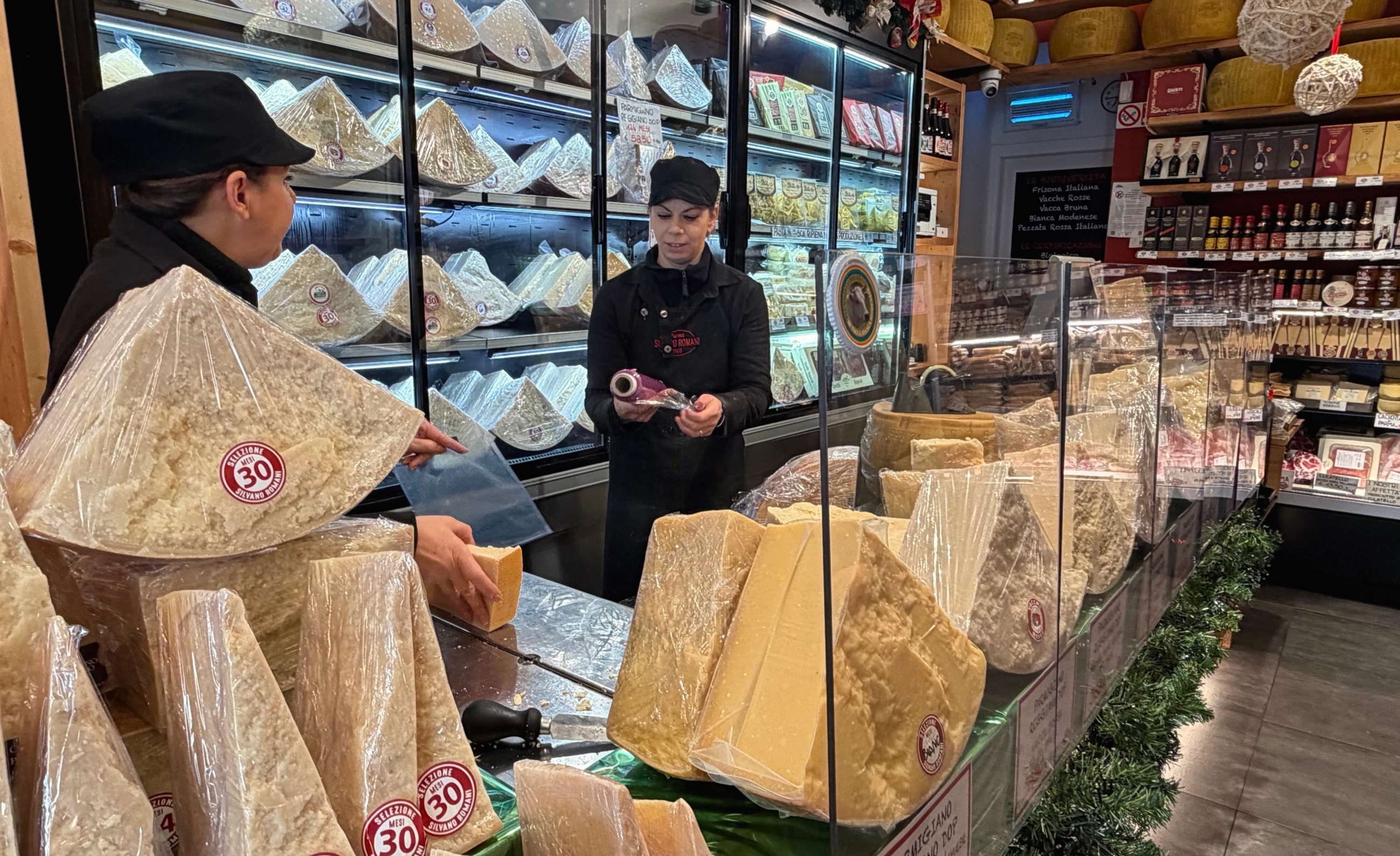 At the counter in Parma, the wedges in the foreground bear a red 30 mesi seal. We tasted that Parmigiano Reggiano alongside one aged ten months longer and took the 40-month cheese home.
One road, three tables
The cities of this region are strung along a single Roman road. The Via Emilia, laid out in 187 BC by the consul Marcus Aemilius Lepidus, runs in a nearly straight line from Rimini on the Adriatic Sea to Piacenza on the Po River, passing through Bologna, Modena, Reggio Emilia, and Parma on the way. The region takes its name from it. Much as the Via Egnatia, the Roman road from the Adriatic to Constantinople, linked several of the cities we lived in across the Balkans, the Via Emilia links a chain of cities whose kitchens are related but distinct: mortadella and ragù in Bologna, balsamic vinegar in Modena, cheese in Reggio and Parma, and cured ham in the hills just south of Parma.
Bologna: ragù, two ways
After San Luca we sat down in the center to two dishes that use ragù quite differently. The first was gramigna, short curled tubes of pasta tossed with sausage ragù, a homely dish rarely seen outside the region. The second was lasagne verdi, thin sheets of spinach pasta layered with ragù and béchamel, which is how Bologna makes lasagna and has for generations. With bread, sparkling water, and a half-liter of house red, lunch came to €44 ($48) for the two of us, including the €2 ($2.20) coperto, the per-person cover charge that appears on most Italian restaurant bills.
At home, we have been cooking from the markets, where the fresh pasta case is a lesson in itself: tortellini, small enough to be served in broth; larger tortelloni; ribbons of tagliatelle; and green balanzoni, filled with ricotta and named for Dottor Balanzone, the pompous Bolognese scholar of Italian comic theater. We have made our own ragù, simmered slowly with garlic and wine, and on other nights dressed fresh pasta with olive oil, garlic, lemon, and basil. The most ambitious dinner so far has been a saffron risotto made from scratch on our two-burner stove, with Arborio rice bought here in Bologna, Parmigiano Reggiano we carried home from Parma, and saffron purchased in Marrakesh. Add caprese salads, vegetables from the market, and local wines, and we have eaten nearly as well at home as anywhere in town.
Parma: cheese, ham, and what the label means
In Parma, the most instructive tasting of the day was at Casa del Parmigiano Reggiano. We tried cheese aged 30 months and 40 months. The younger was sharp and clean, the one we would grate over pasta. The 40-month cheese broke into craggy pieces with small, crunchy crystals and had a sweet, nutty flavor we preferred on its own. We bought the minimum cut, a little over a pound, for about €18.40 ($20), from dairy number 320. We added a solid portion of Prosciutto di Parma from La Prosciutteria. Both shops vacuum-packed our purchases, and a bottle of local red wine and a jar of fig preserves rounded out what we carried home. With limited space in our luggage, these are the souvenirs that suit us: things we can enjoy down to the last taste and leave nothing to pack.
Both products carry the red-and-yellow D.O.P. seal, for Denominazione di Origine Protetta, or Protected Designation of Origin. The seal guarantees that a product is made in a defined area by regulated methods; anything that falls short cannot use the name. For Parmigiano Reggiano, that means raw cow’s milk, salt, and rennet and nothing else, from cows fed on local forage rather than fermented silage, in a zone that includes Parma, Reggio Emilia, and parts of Modena, Bologna, and Mantua. Each wheel ages at least 12 months and is inspected before it receives its fire-branded mark, along with the dairy number we saw on our wedge. As it ages toward 30 or 40 months, the cheese loses moisture, the flavor concentrates, and the crystals form. Prosciutto di Parma is made from the legs of Italian-raised pigs and sea salt alone, with no nitrates or preservatives, and cured under the consortium’s current rules for at least 14 months in the hills south of the city, where producers credit the dry air coming down from the Apennines. Hams that pass the final inspection are branded with the five-pointed ducal crown of Parma.
It was at Da Mat, over lunch, that we understood just how good the prosciutto could be. We laid thin slices over warm pieces of torta fritta, puffs of fried dough served with a soft, spreadable cheese, and it was the best prosciutto either of us can remember eating. We also shared a lasagna and tortelli d’erbetta, tender pasta parcels filled with ricotta and chard, both clearly made in-house. With a glass of local red, sparkling water, and the cover charge, our meal was €46 ($51).
Modena: a market lunch and a bottle of balsamic
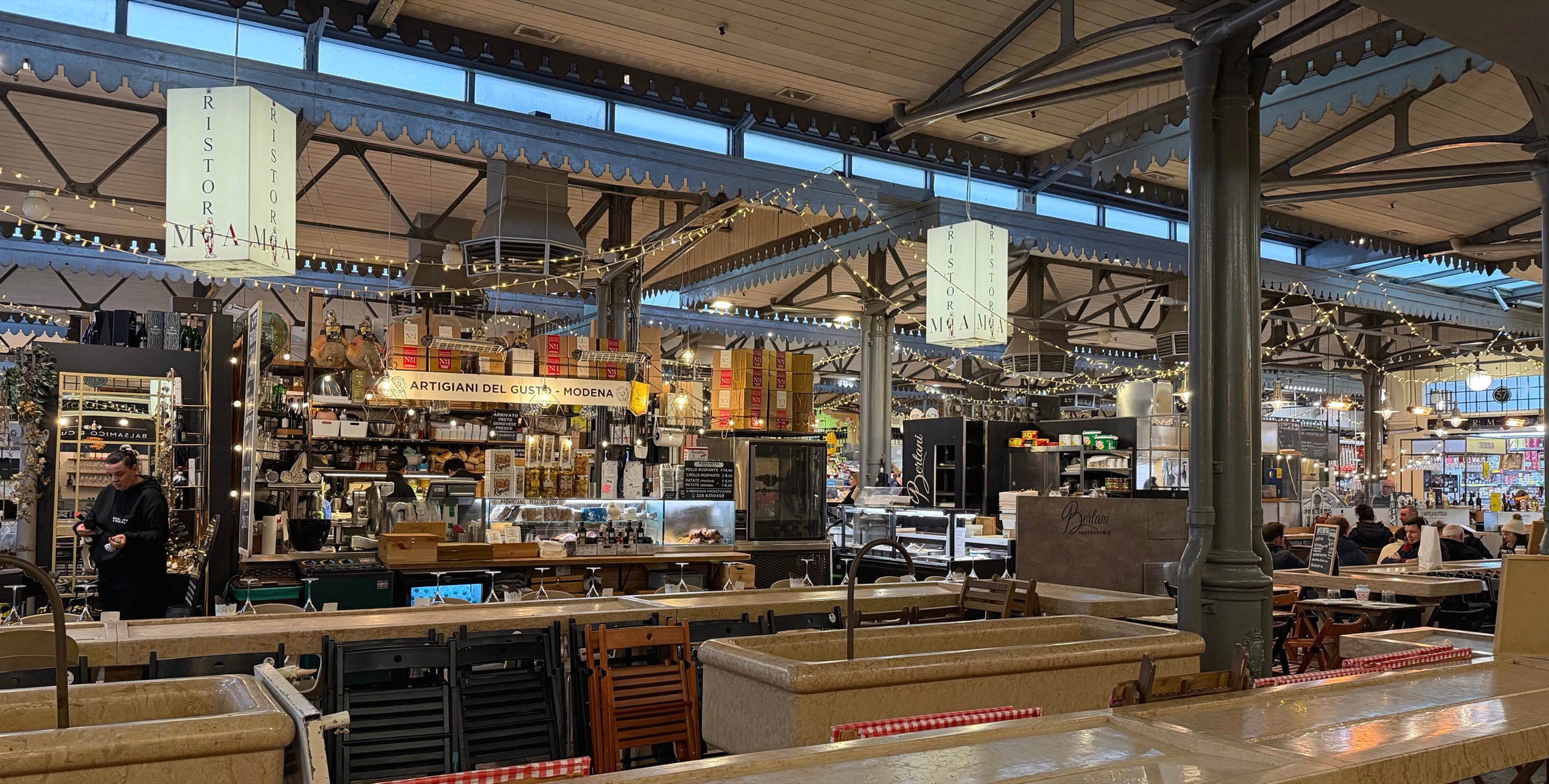 Inside Modena’s Mercato Albinelli, diners sit at long tables beside the food stalls beneath the market’s iron trusses.
In Modena, lunch was a long graze through the Mercato Albinelli, a covered market built in 1931 in the Liberty style, Italy’s version of Art Nouveau, for about €20 ($22) for the two of us. From one counter we shared ricotta and vegetable patties, a soft baked vegetable flan, and pumpkin crespelle, thin sheets of fresh egg pasta wrapped around roasted pumpkin and baked. At a salumeria we split porchetta in a toasted roll, herb-roasted pork with crisp crackling, with a glass of dry Lambrusco Grasparossa di Castelvetro, the lightly sparkling red from the hills south of Modena, whose acidity cuts straight through the fat. A chocolate-filled pastry and a square of chocolate shortbread finished the meal.
Before leaving, we tried the free balsamic tastings at the market and learned to read the labels. Aceto Balsamico Tradizionale di Modena D.O.P. is made from cooked grape must alone and aged for at least 12 years in a series of ever-smaller wooden barrels. It is sold only in a 100-milliliter (about 3.4-ounce) bottle designed in 1987 by Giorgetto Giugiaro, the car designer behind the original Volkswagen Golf and the DeLorean, and even that small bottle costs more than €50 ($55), with the 25-year versions well over €100 ($110). Following our Parma rule of souvenirs we can consume, we chose a 50-milliliter (1.7-ounce) bottle of Aceto Balsamico di Modena I.G.P. for €9 ($9.90), made by a family producer from nine parts grape must to one part wine vinegar. Its label reads Riserva 15. I.G.P. rules do not allow an age in years on the label, so the number is the producer’s own grade, referring to fifteen annual rackings from larger casks into smaller ones. It is dense and fruity, with gentle acidity, and made to be used raw, over aged Parmigiano Reggiano, prosciutto, or risotto. Whatever the price, check that mosto d’uva cotto, cooked grape must, is the first ingredient.
💰 Nomad Real Talk
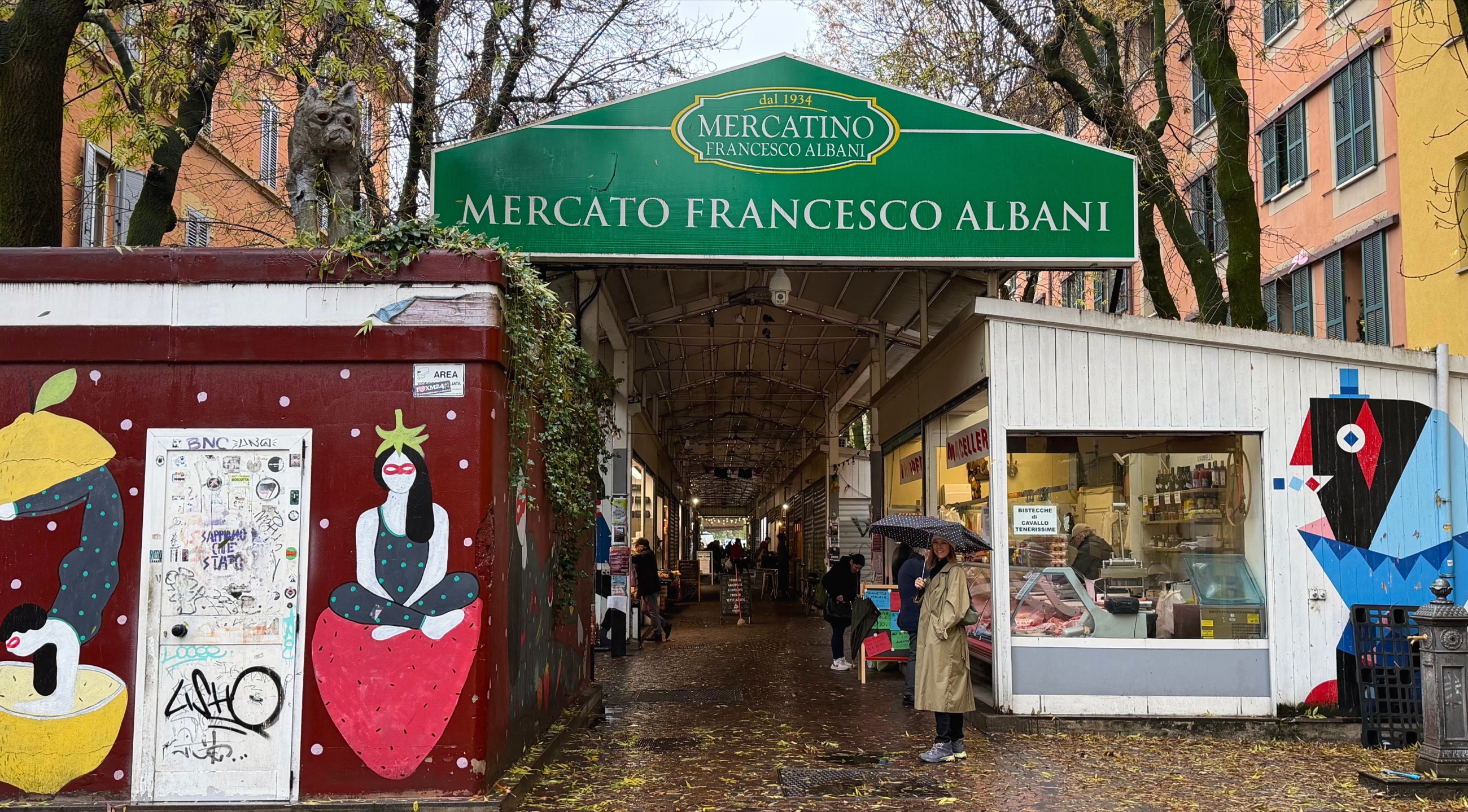 On a rainy day in Bologna, we stopped at Mercato Francesco Albani, our neighborhood market. Just inside the entrance, the butcher’s window looks out onto the covered aisle.
For our 25 nights in Bologna, we booked a studio at The Social Hub for €1,540.93 ($1,695), or €61.64 ($68) a night. It is a different model from the apartments we usually rent. The Social Hub is a Dutch hotel group that combines hotel rooms with coworking space, a gym, a restaurant and bar, lounges, and a courtyard pool that is open only in the warmer months. The building mixes long-stay guests, students, and business travelers, and it feels much like an extended-stay hotel with a campus attached.
The studio itself is one room. The bed, two desks, chairs, a television, and an open clothes rack with shelves share the space, with a private bathroom off it. The kitchenette has a two-burner stove, a half-size refrigerator, a sink, and what we need to make coffee, tea, and meals; there is no oven. Housekeeping, a front desk, and an on-site gym come with the room, which removes several of the small problems that an apartment rental can create. In exchange, we give up a separate living area and a full kitchen. The lobby and common spaces downstairs stay busy, but our room sits at the end of a long, quiet hall on the third floor, and none of that activity reaches us.
The larger choice was location. The Social Hub sits in Bolognina, a residential and increasingly multicultural district just north of the railway, a few minutes’ walk from Bologna Centrale. That matters more than it might seem. We are using Bologna as a hub, with Venice, Parma, and Modena already behind us and Ravenna and Florence still ahead, all by train. To reach most of the historic streets and sites, we cross a bridge over the tracks and walk 20 to 30 minutes. Bicycles are included in our stay, though so far the rain and chilly temperatures have kept us on foot.
The apartments we considered in the historic center cost considerably more for the same dates. For a month built around side trips, being steps from the station was worth more to us than being steps from Piazza Maggiore, and we spend some of the difference at the table.
🏠 Behind the Nomad Curtain
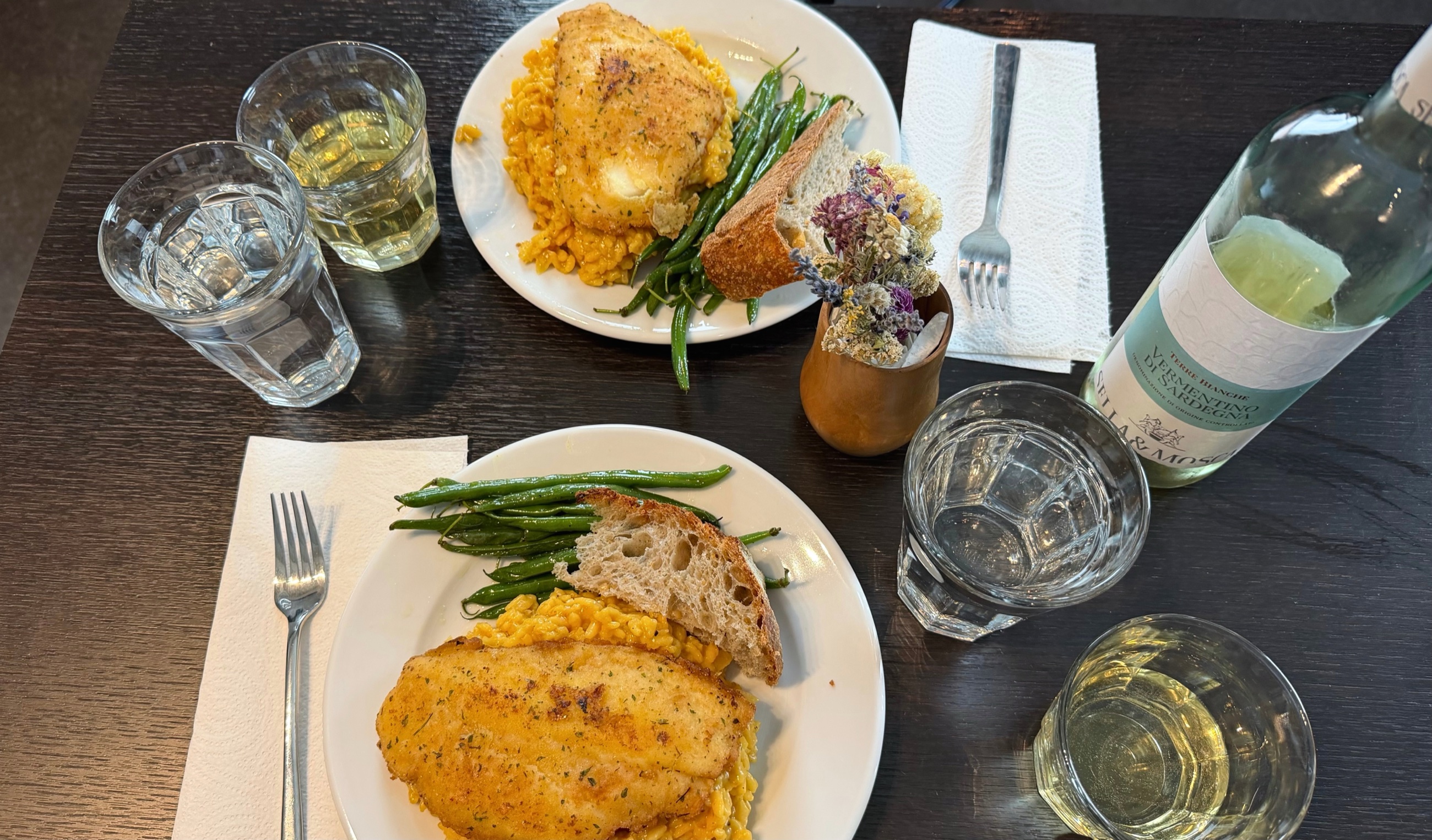 In our Bologna studio, we set the desk for two and served breaded fish over risotto, with green beans, hearty bread, and Vermentino in tumblers.
Our week has taken a familiar shape. On Monday, Wednesday, and Friday mornings we go downstairs to the gym. Tuesdays and Thursdays, and weekends, are for longer outings, which is why Parma fell on a Saturday and Modena on a Tuesday. Lunch remains the main meal of the day, and we work at our desks in the late afternoon and evening.
One of those desks doubles as our dining table, and what we put on it had something to do with how we planned the month. We scheduled the food trips early in the stay so that we would have time to enjoy what we brought back. A pound of aged Parmigiano Reggiano makes far more sense with several weeks in a room with a refrigerator ahead of us than it would the night before a flight.
Most of our shopping takes us only a few blocks: a farmers’ market nearby, a large grocery store, several places for coffee, and the bakery.
📸 Photo Story
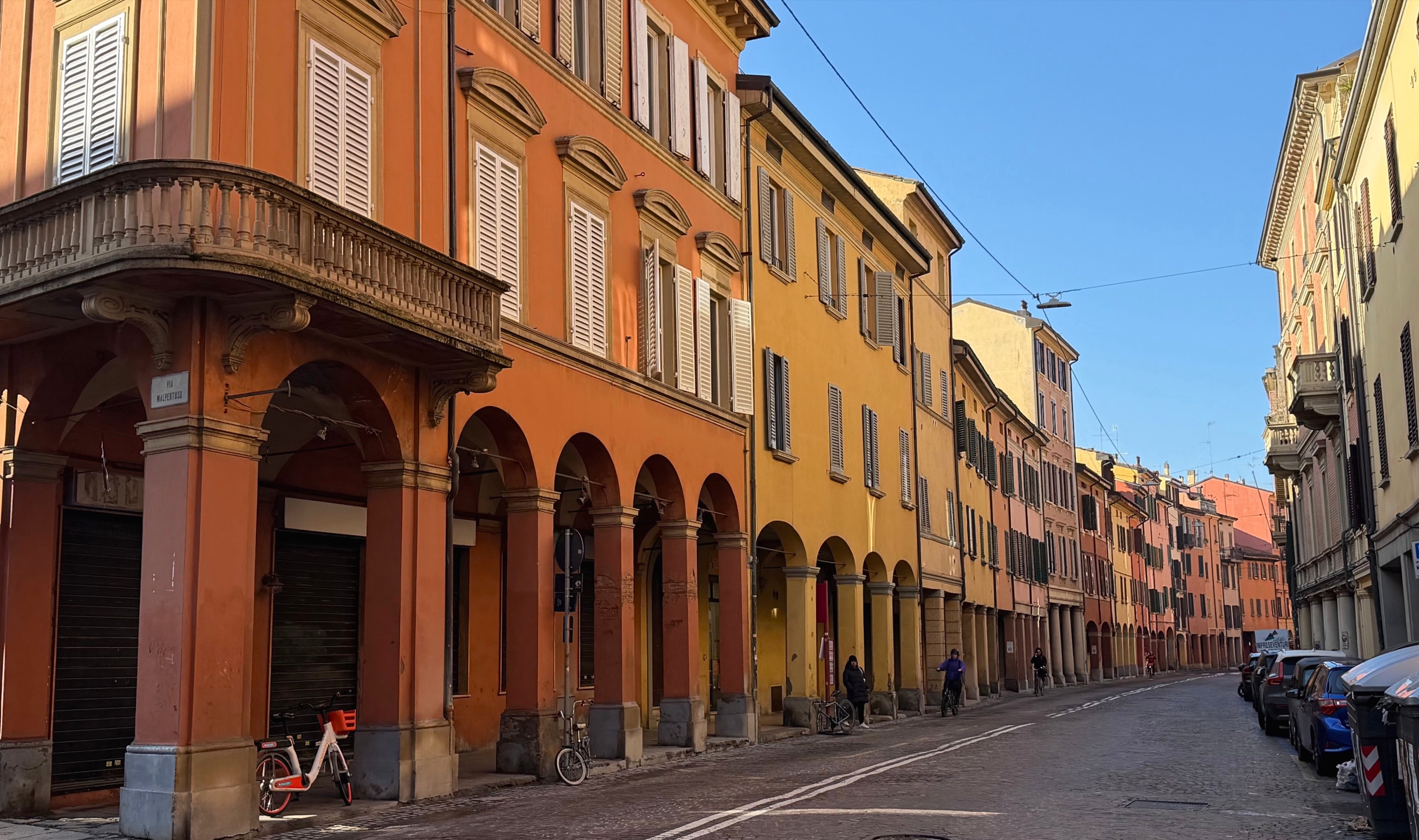 Along Via Malpertugio, Bologna’s ochre and terracotta façades follow the bend in the street. Bicycles stand in the shade beneath the porticoes.
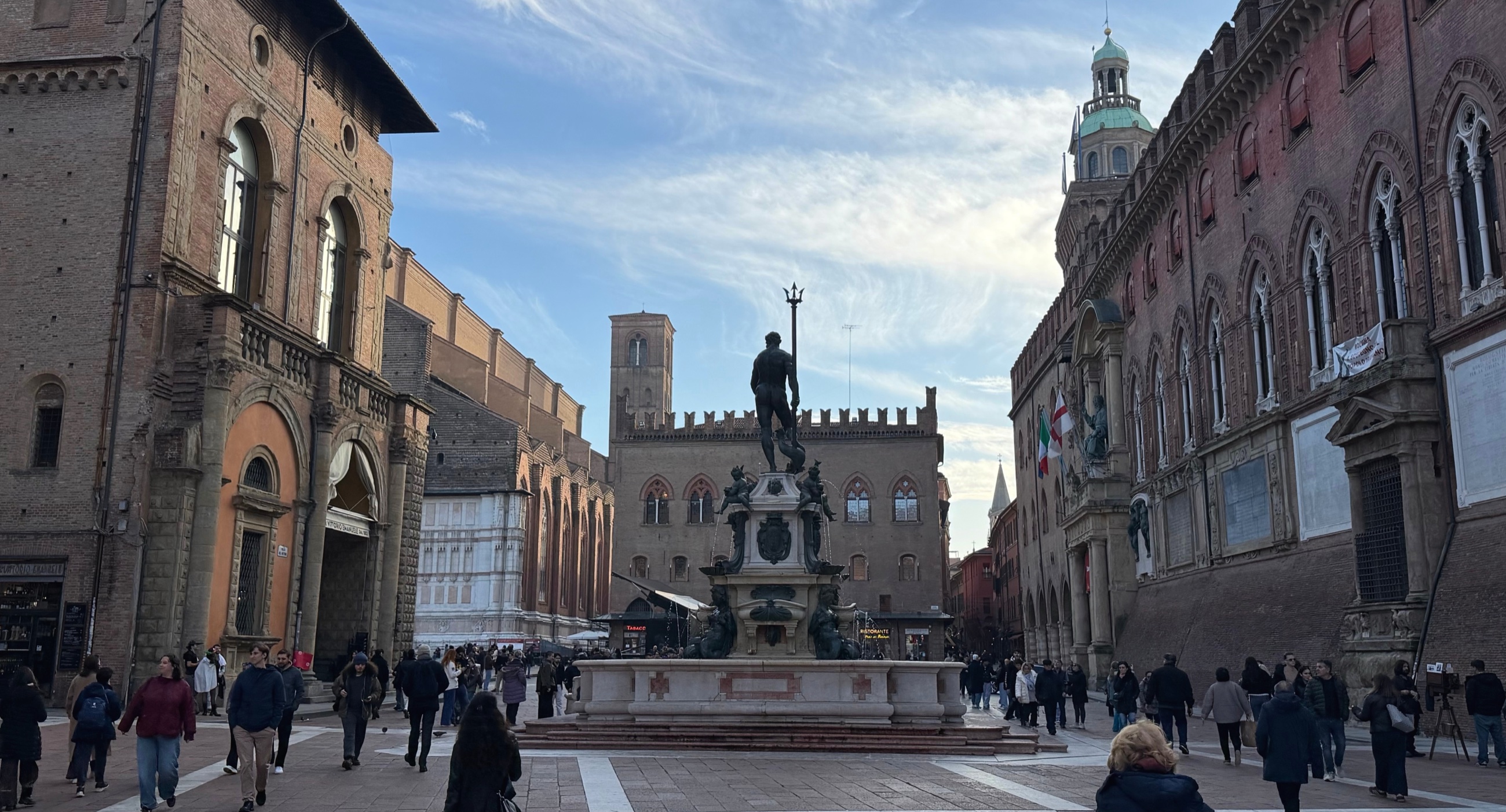 Beside Bologna’s Piazza Maggiore, Neptune raises the trident that inspired the Maserati emblem we later saw in Modena.
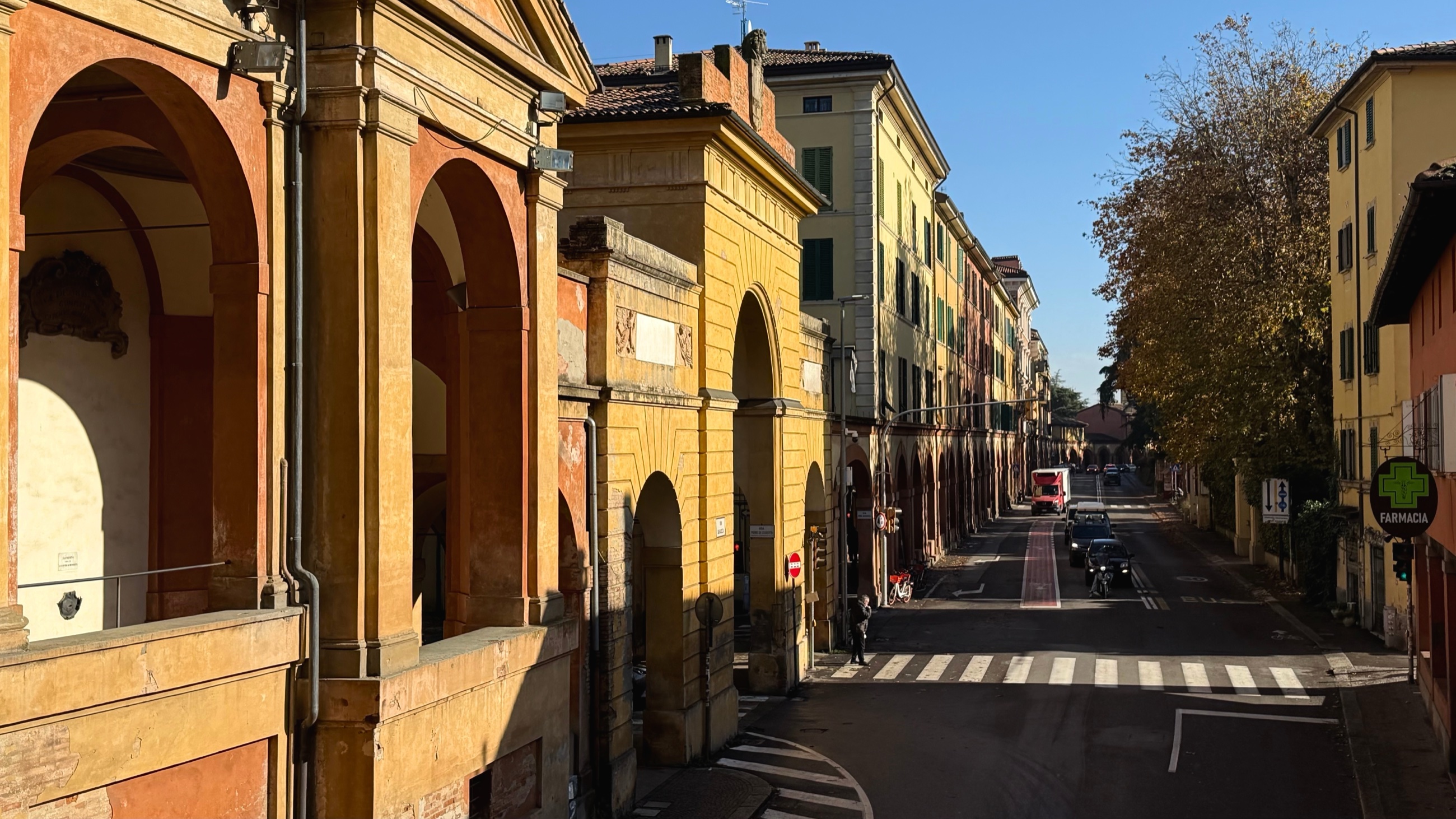 From the Arco del Meloncello, we could look back along Via Saragozza before the covered walkway turned uphill toward San Luca.
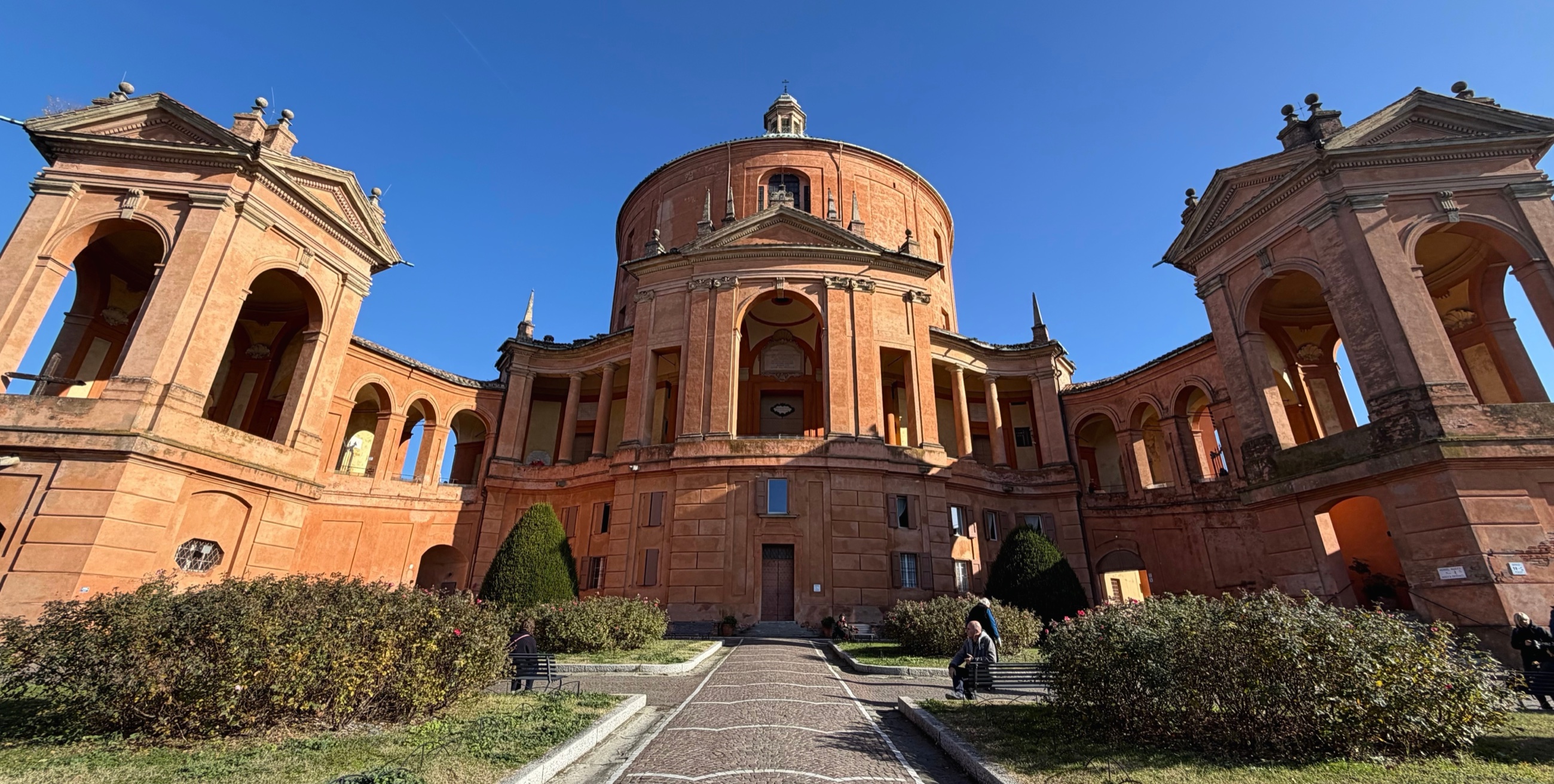 At the top of the climb, curved porticoes reach from the Sanctuary of the Madonna di San Luca to the pavilions on either side.
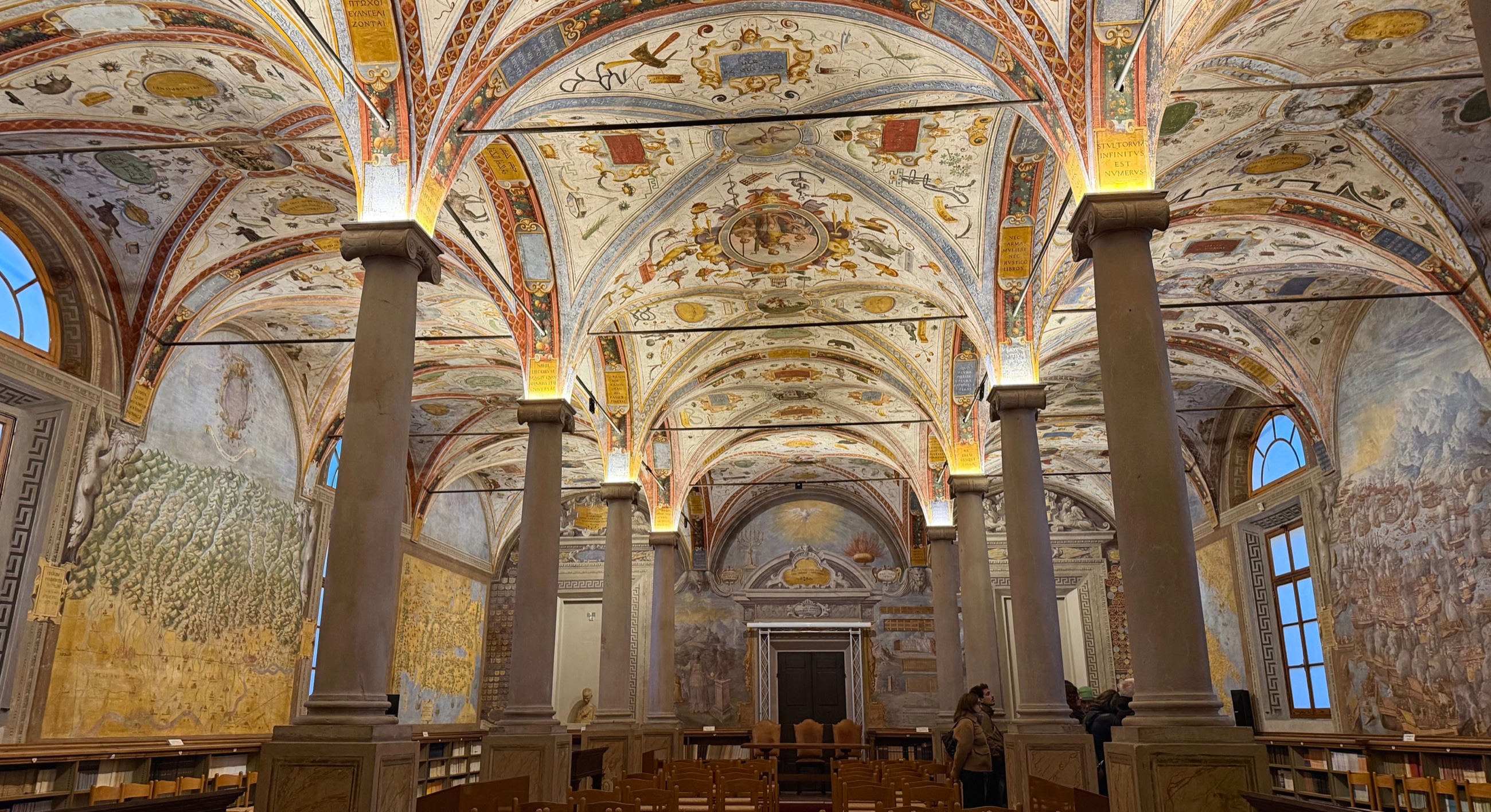 Maps of the Holy Land line the walls of the monastery library at San Giovanni Evangelista in Parma. Across its eighteen painted vaults, foliage curls around masks, birds, and imaginary creatures. Inscriptions appear in Latin, Hebrew, Greek, and Syriac.
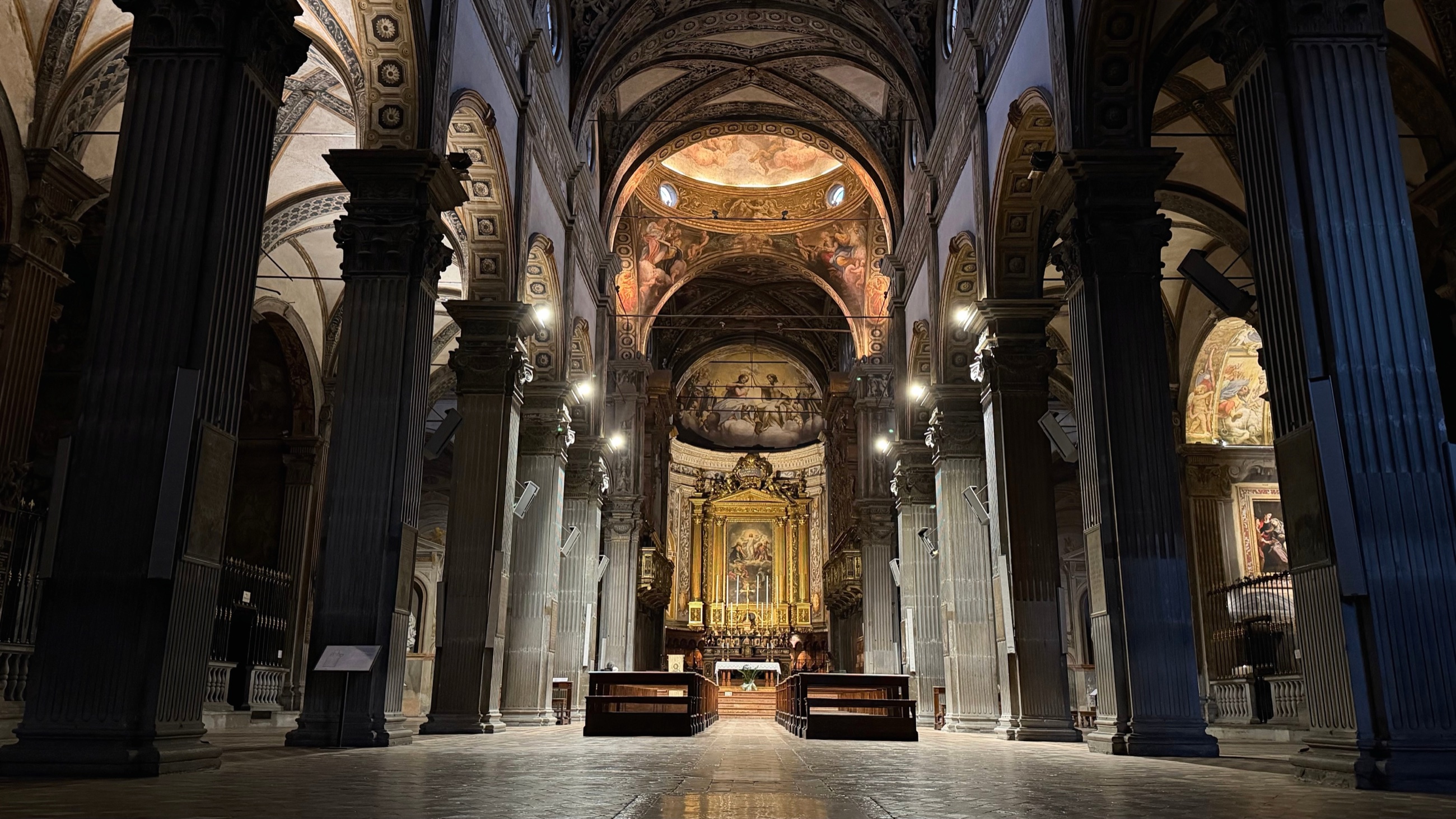 In the adjoining monastery church of San Giovanni Evangelista, fluted columns frame the view down the nave to the gilded altarpiece. Above the aisle, the lower edge of Correggio’s Vision of Saint John on Patmos is visible.
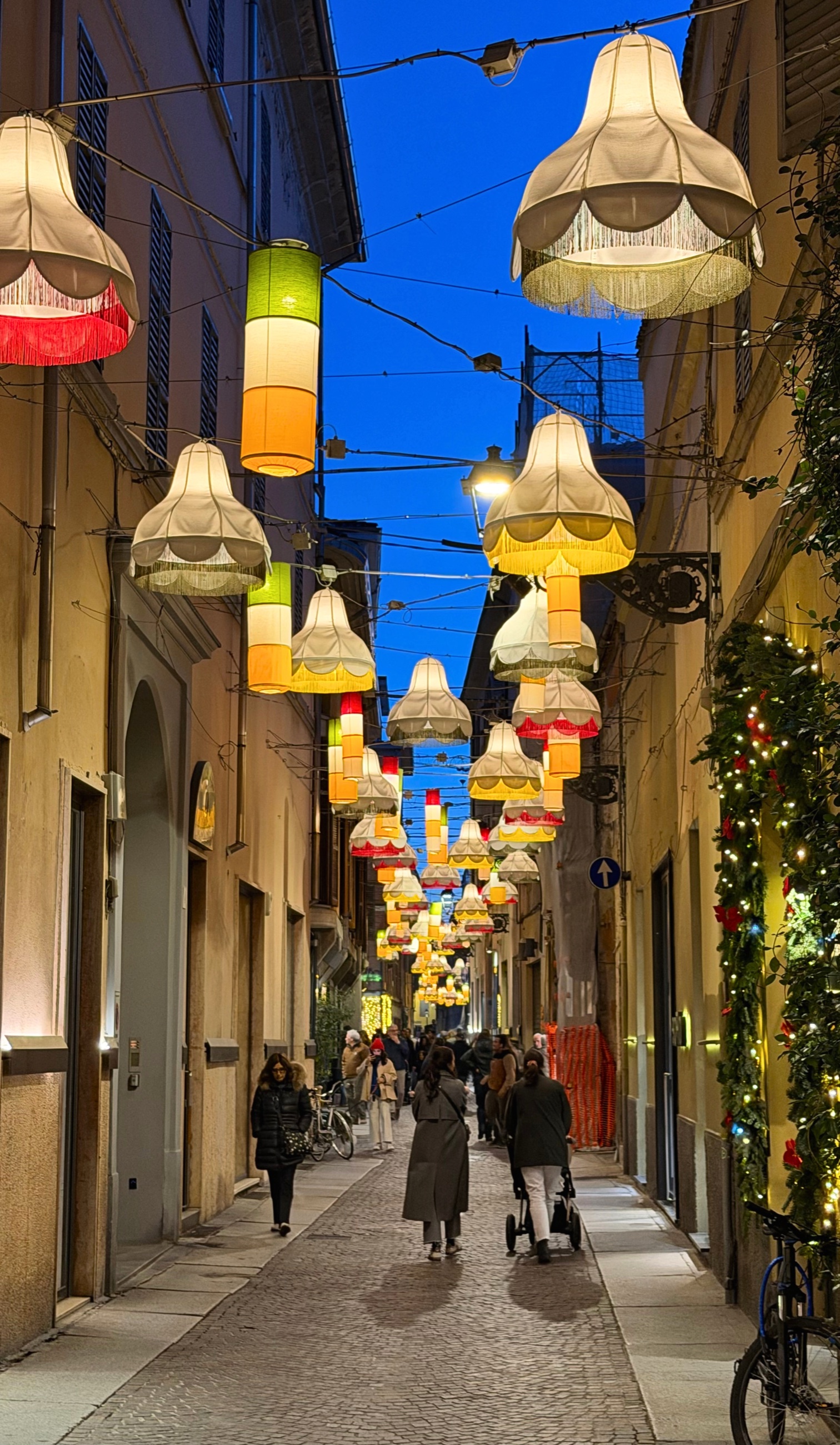 By the time we finished our walk through Parma, fringed lampshades glowed above the cobblestones and the evening sky was still blue.
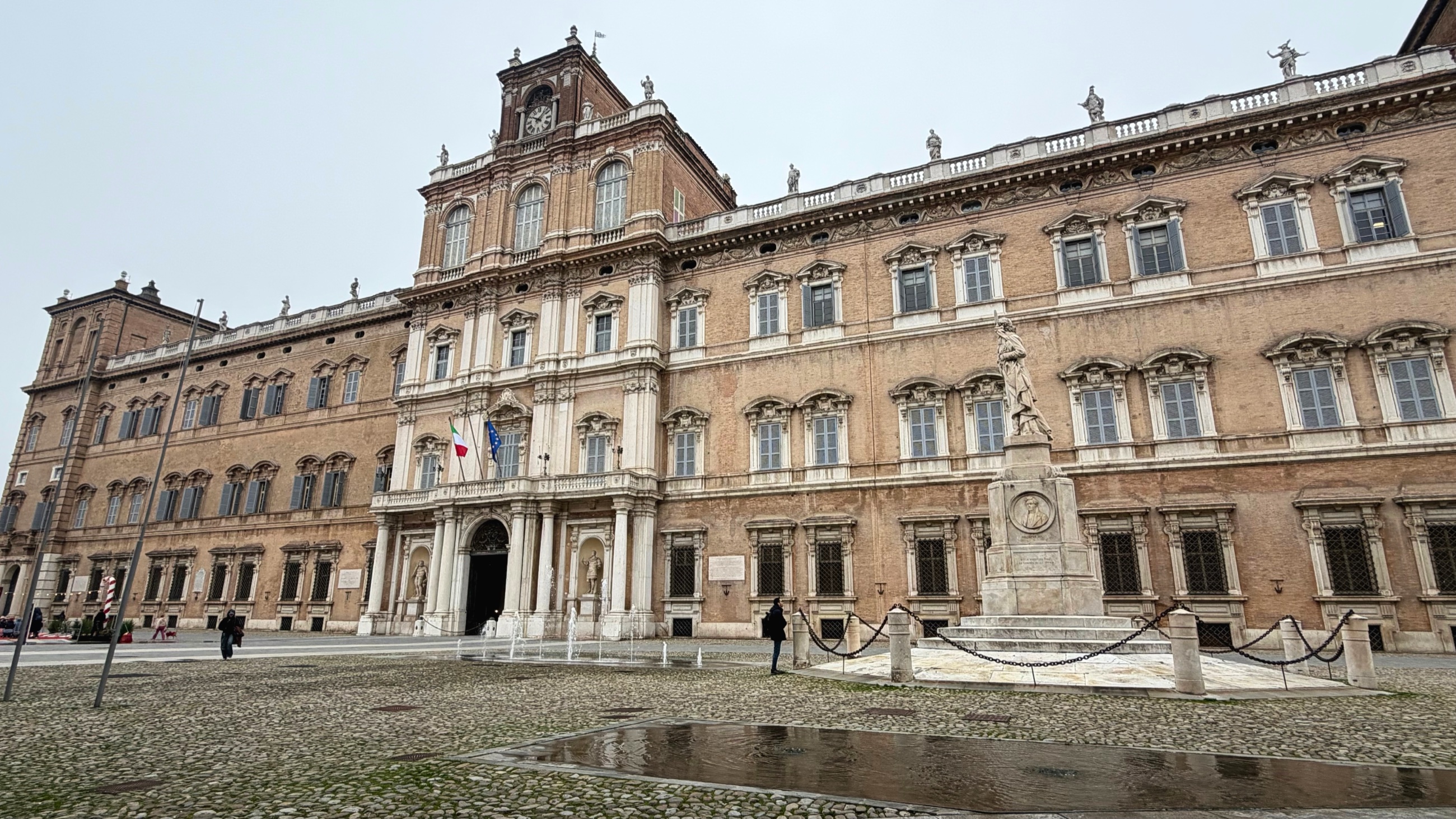 The Este dynasty had ruled Ferrara for three centuries before moving its court to Modena. The Palazzo Ducale, the dukes’ former seat of power, fills one side of Piazza Roma and now houses Italy’s military academy.
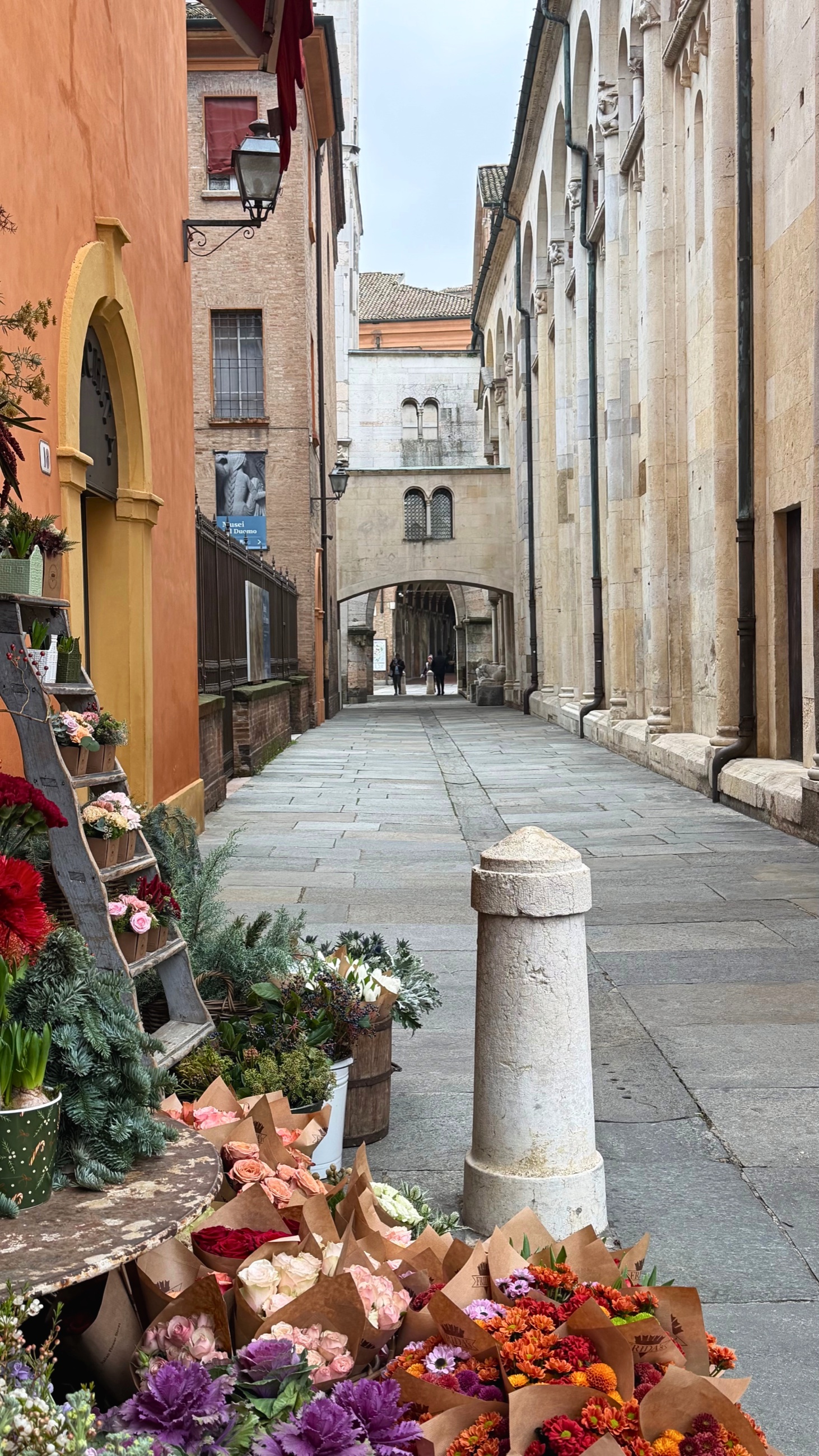 A florist displays bouquets along Via Lanfranco, the narrow lane beside Modena Cathedral. Above the lane, a windowed stone passage connects the cathedral on the right with the cathedral museums on the left.
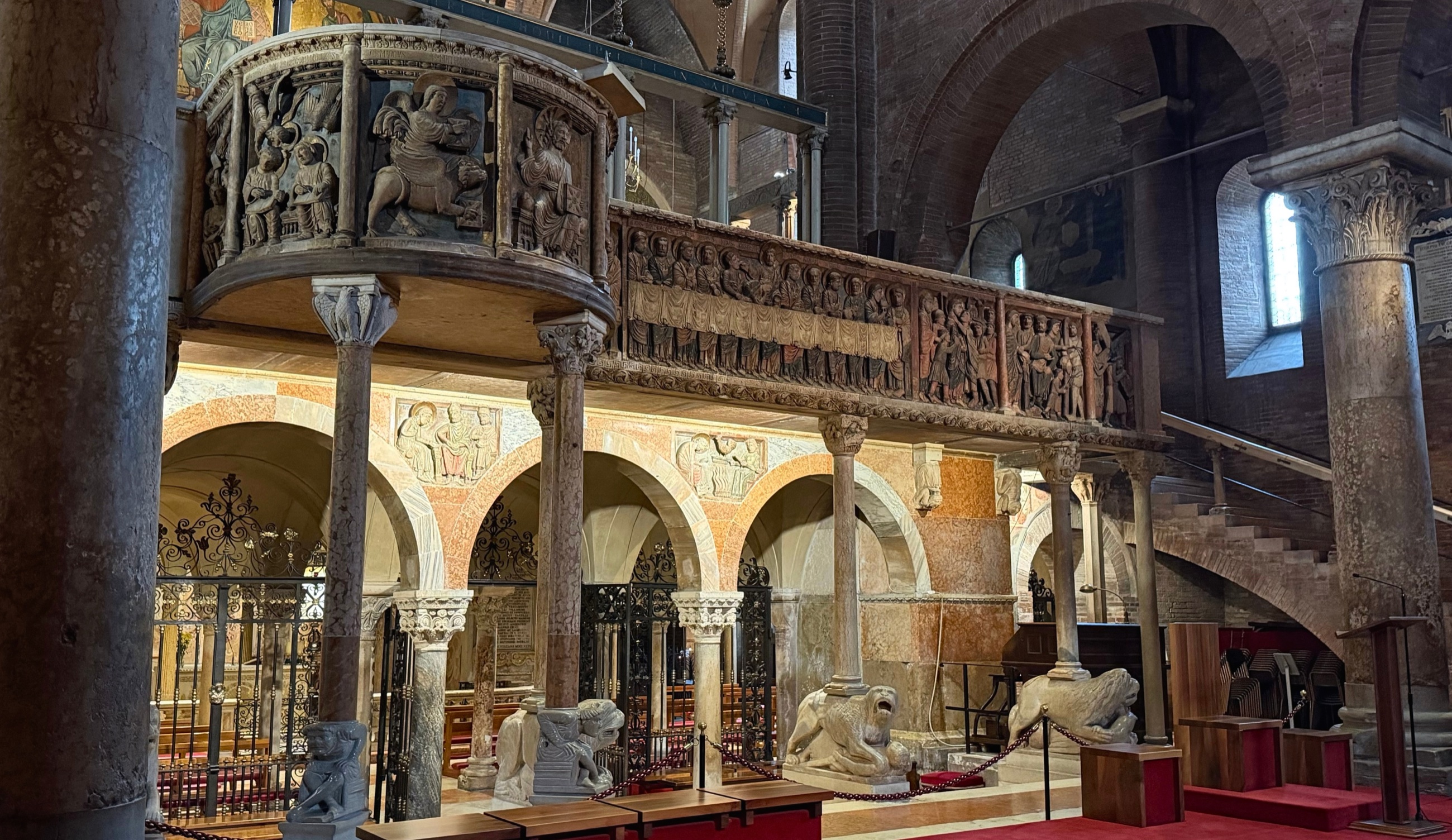 Above the crypt in Modena Cathedral, Christ and the apostles sit at a long table in a marble relief of the Last Supper. Below, carved lions support the columns.
🎯 Next Week Preview
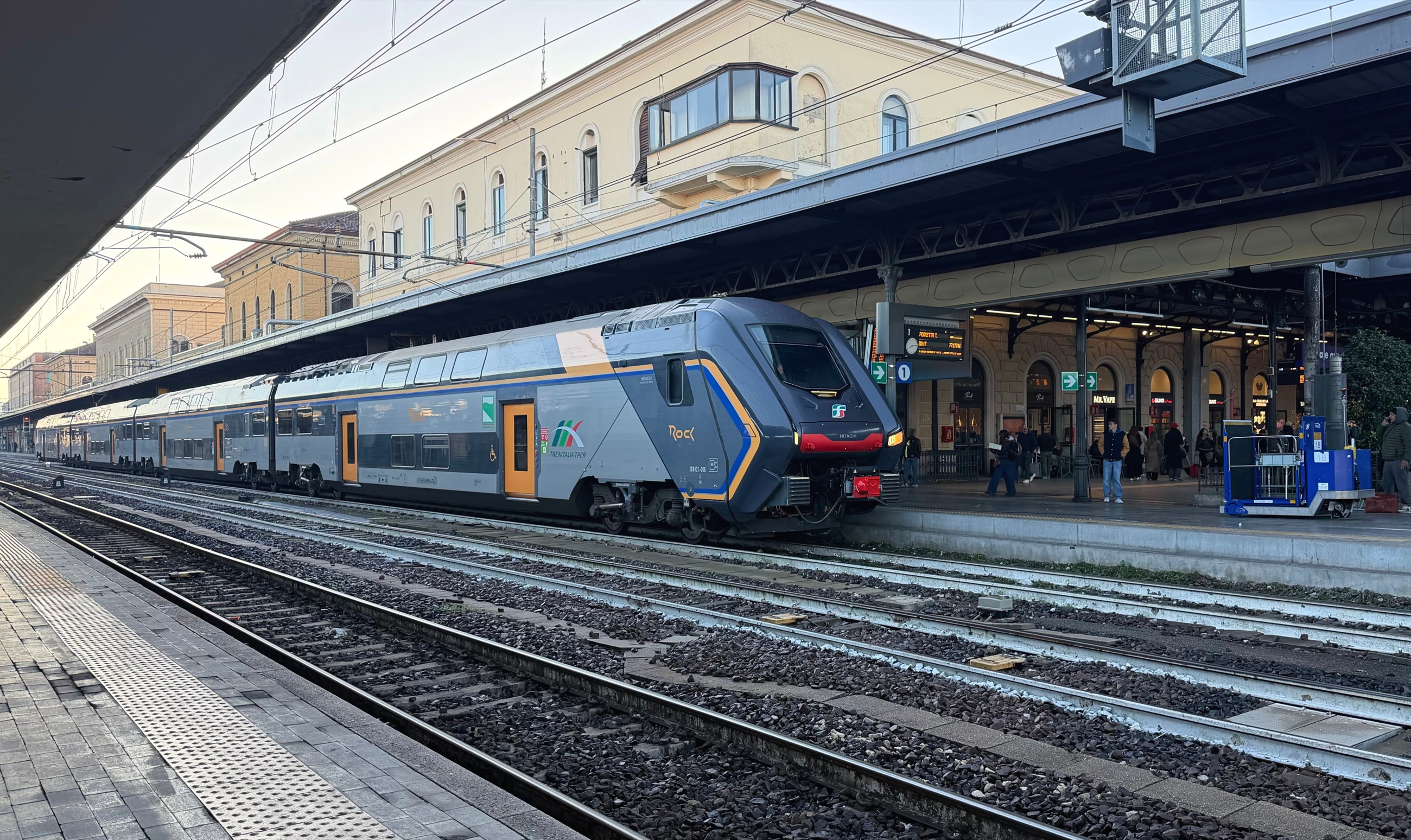 A double-decker regional train at Bologna Centrale, where we’ll catch the train to Ravenna next week to see its mosaics.
Next week we head east to Ravenna, seat of the Western Roman Empire in its last decades and later the capital of Byzantine Italy, to see its early Christian mosaics, including the portraits of the Byzantine emperor Justinian and his empress, Theodora, in the church of San Vitale. Back in Bologna, we walk from Piazza Maggiore through the old market lanes of the Quadrilatero to the Two Towers and the Santa Lucia Christmas market, as the season settles over the city.
💌 Personal Connection
To our family, friends, and readers celebrating Thanksgiving in the United States today, happy Thanksgiving from Bologna.
Here it is simply a Thursday in late November. The market stalls are open, and the porticoes are full of people on their way to work and class. This year our table is a desk in a studio in Italy, and this week it has held bread from the neighborhood bakery, prosciutto and aged Parmigiano Reggiano from Parma, a bottle of local red wine and a jar of fig preserves from the same trip, and a small bottle of balsamic from Modena, each made with care. We have much to thank God for.
We are especially grateful for the people we would gladly pull up a chair for today and miss on days like this, and for those of you who make time each week to read a letter from the two of us. Wherever your table is today, we hope it is a blessed one.
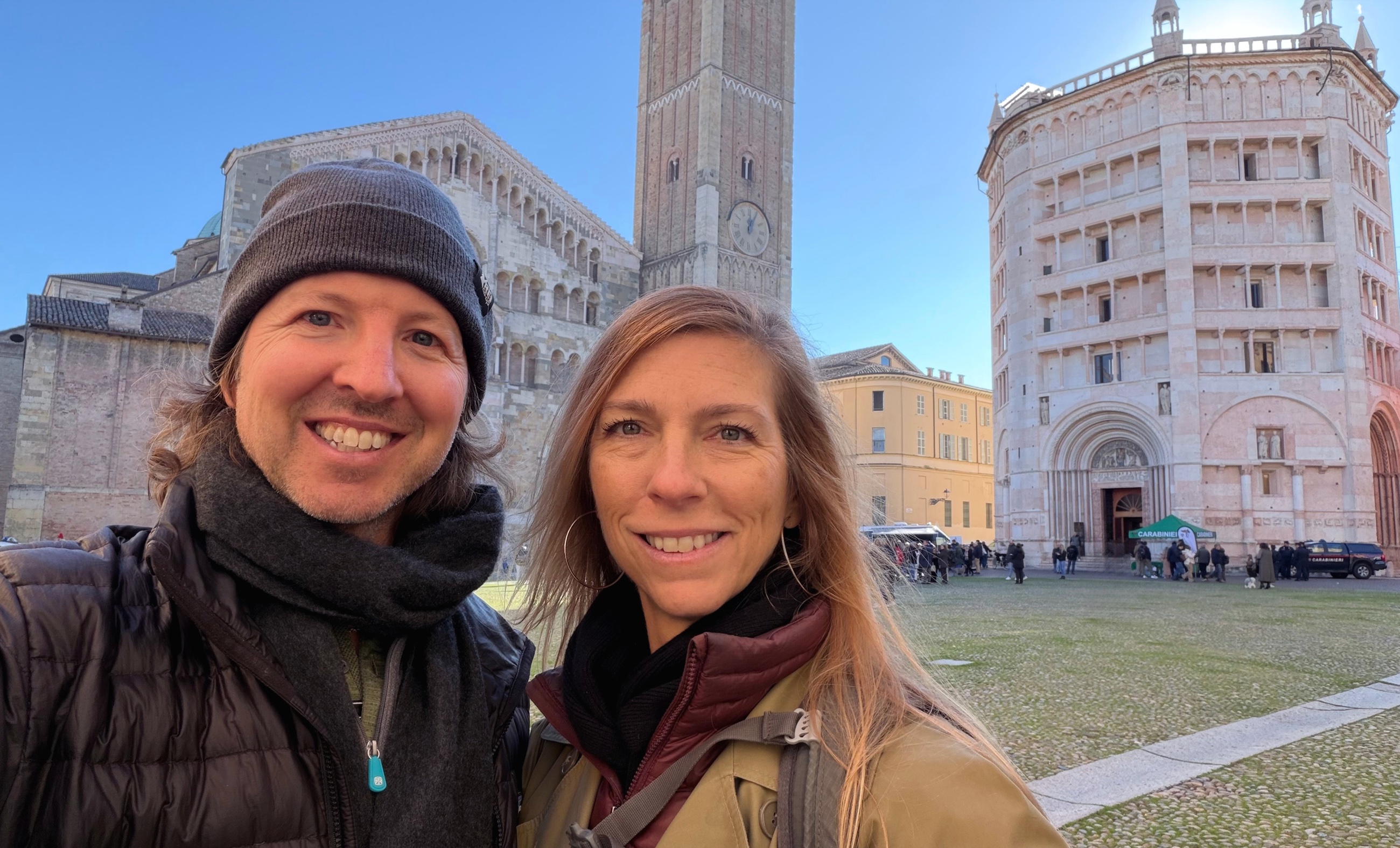 Here we are in Parma’s Piazza Duomo, with the cathedral behind us and the pink marble Baptistery to our right.
Until next week,
S&S
Some Great Place · Living Local in a Global World · somegreatplace.com