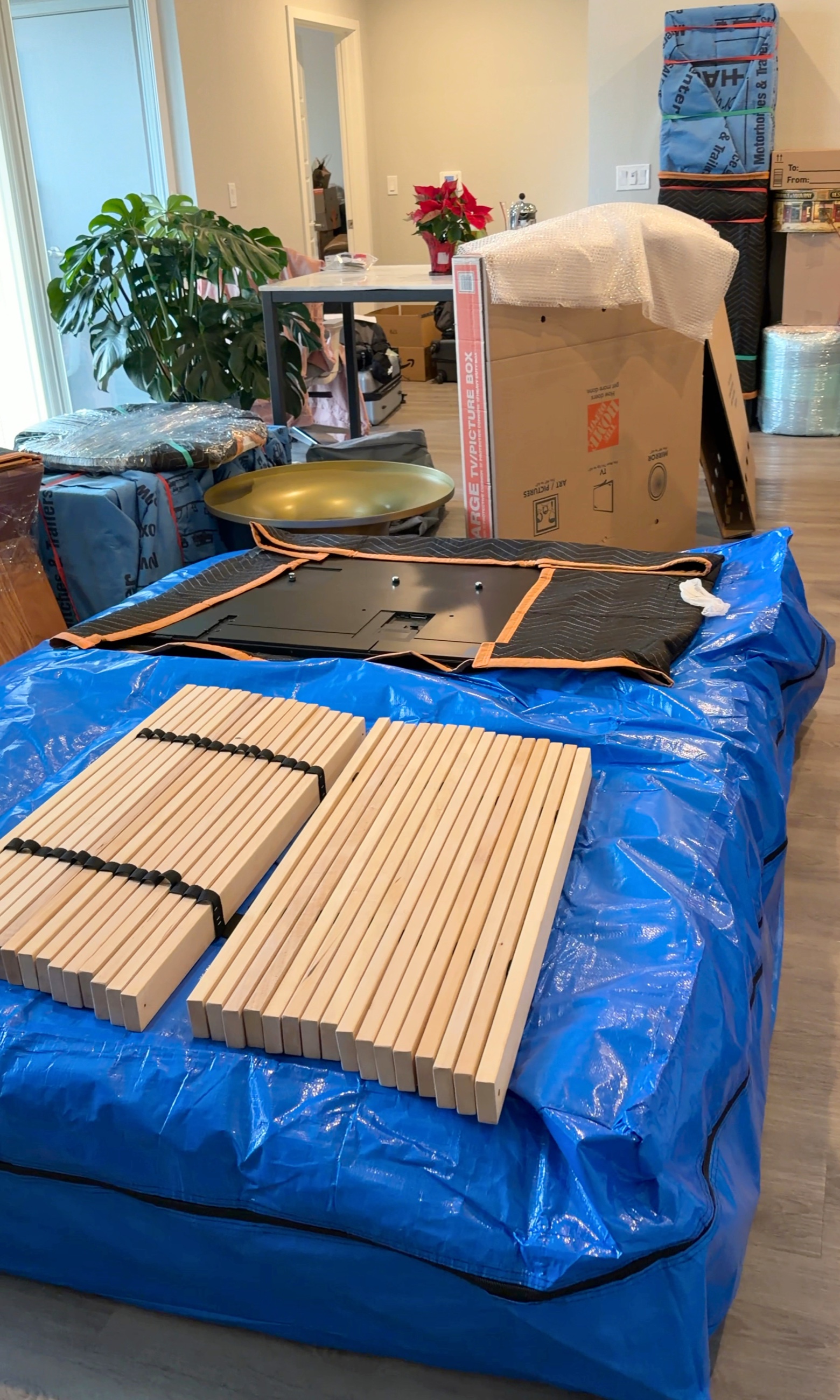
 By the final week, the apartment had become a staging area for what would be sold, stored, donated, or carried abroad.
Six days before we handed back the keys, the living room had stopped looking like a room anyone lived in. Storage bins stood along the walls. The couch remained in the center of the floor, an island surrounded by open space and the evidence of departure. Most of the smaller furniture was already gone, sold through OfferUp or Facebook Marketplace or carried out in a few donation runs to the local Catholic Charities. In the garage, bins were stacked into a labeled grid, waiting for the truck.
The apartment had been changing for weeks: a chair here, a shelf there, a table gone the following Tuesday. By December the change was total. A settled household was being divided into four destinations: sell, donate, store, or carry across an ocean. For months, the multi-year journey had existed mainly in spreadsheets, folders, and reservations. Now the work required to make it possible occupied the apartment floor.
Reducing the Physical Footprint
The reduction did not begin in these final weeks. Three years earlier, we had left a three-story house with two sheds in Seattle’s Wallingford neighborhood for a high-rise apartment in South Lake Union, backed by a large storage unit. The move to Reno required a second reduction, into a two-bedroom apartment with a small garage. This next stage would be smaller again: a 10-by-10 storage unit in Texas, a handful of items left with family, and whatever luggage could travel abroad.
Each object came down to the same six questions: Did it carry real monetary value, emotional value, or practical value? Was it heavy? Was it easy to replace? Would we actually use it within the next few years?
The bedroom set and living-room sofa justified their place. Much of the rest did not. Patio furniture, potted plants, a television, soundbars and speakers, end tables, a chair, shelving, a vacuum, a desk, a game console, books, and table lamps left the apartment one sale or donation at a time.
The list grew long because a settled life accumulates in increments. Much of what we kept had never been a real choice. It was simply already there, occupying a drawer or shelf, until moving day required a decision that most of it could not justify.
Storage introduced its own discipline. Cardboard is cheap and familiar, but it does not hold up to years in a unit and repeated handling. We replaced it with durable plastic bins from Home Depot, standing in the aisle comparing options.
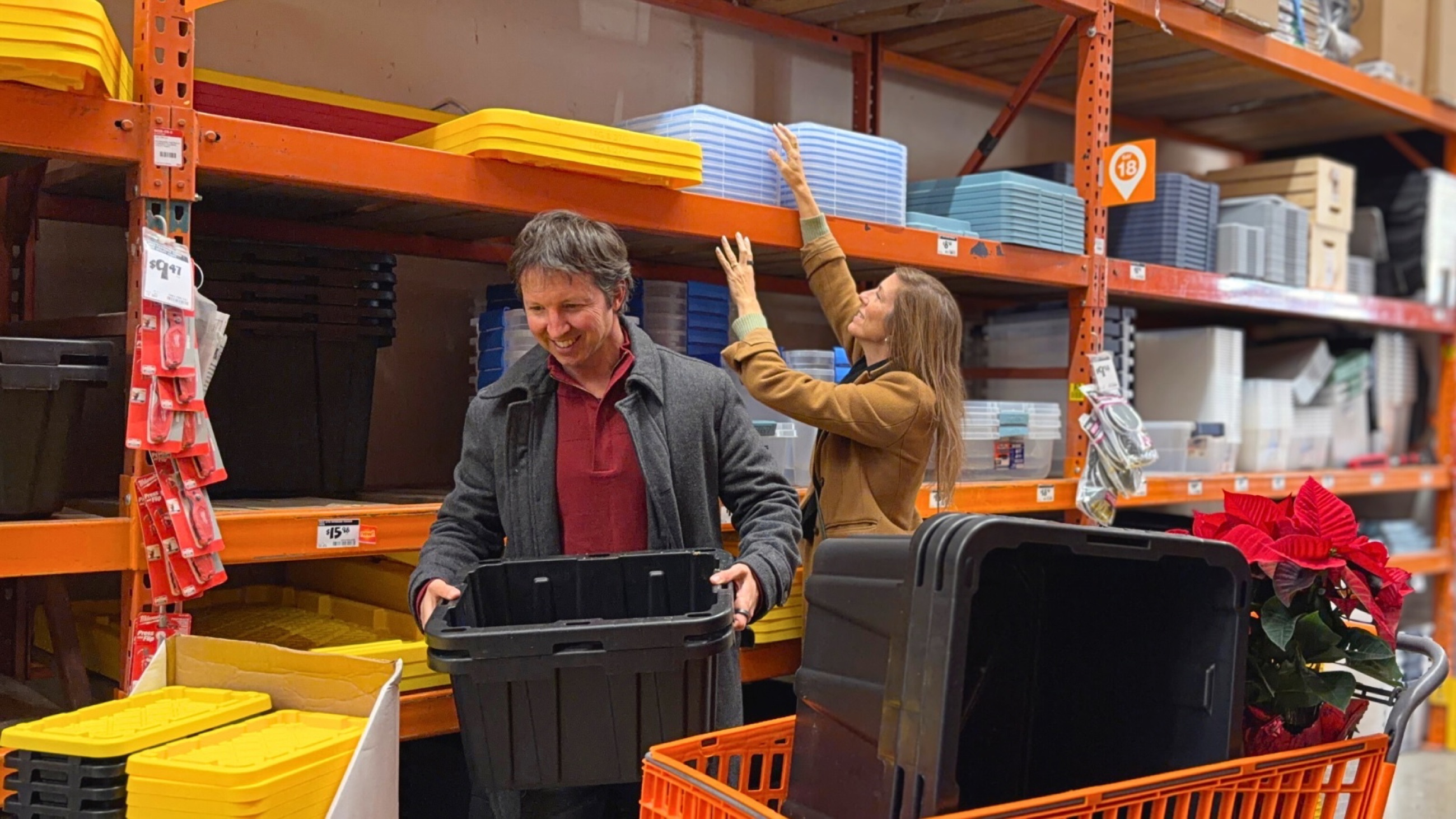 Choosing durable bins at Home Depot for the move and the years of storage that would follow.
The 10-by-10 limit mattered less as a number than as a boundary. Anything kept had to share that fixed footprint with everything else we believed belonged to a later chapter.
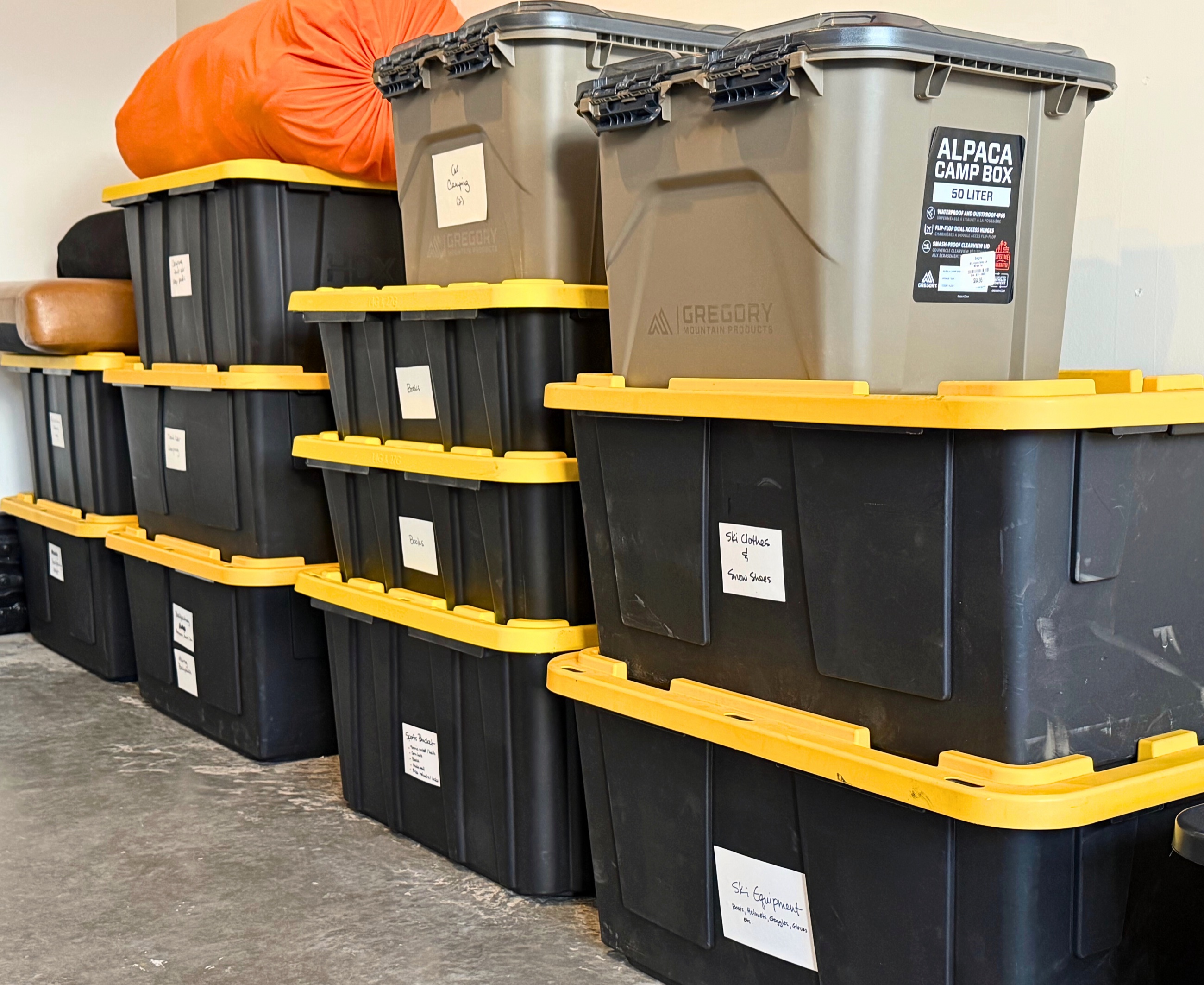 The household reduced to labeled bins, each one assigned a place in the 10-by-10 storage unit.
Testing What We Could Carry
Storage settled what could stay in the United States. A full packing trial settled the harder question: what could move with us.
One Saturday, we packed as though the first flight left the next morning. Suitcases opened across the floor. Clothing was folded, weighed, and adjusted again. Every item was judged on size, weight, purpose, and how often we would actually use it.
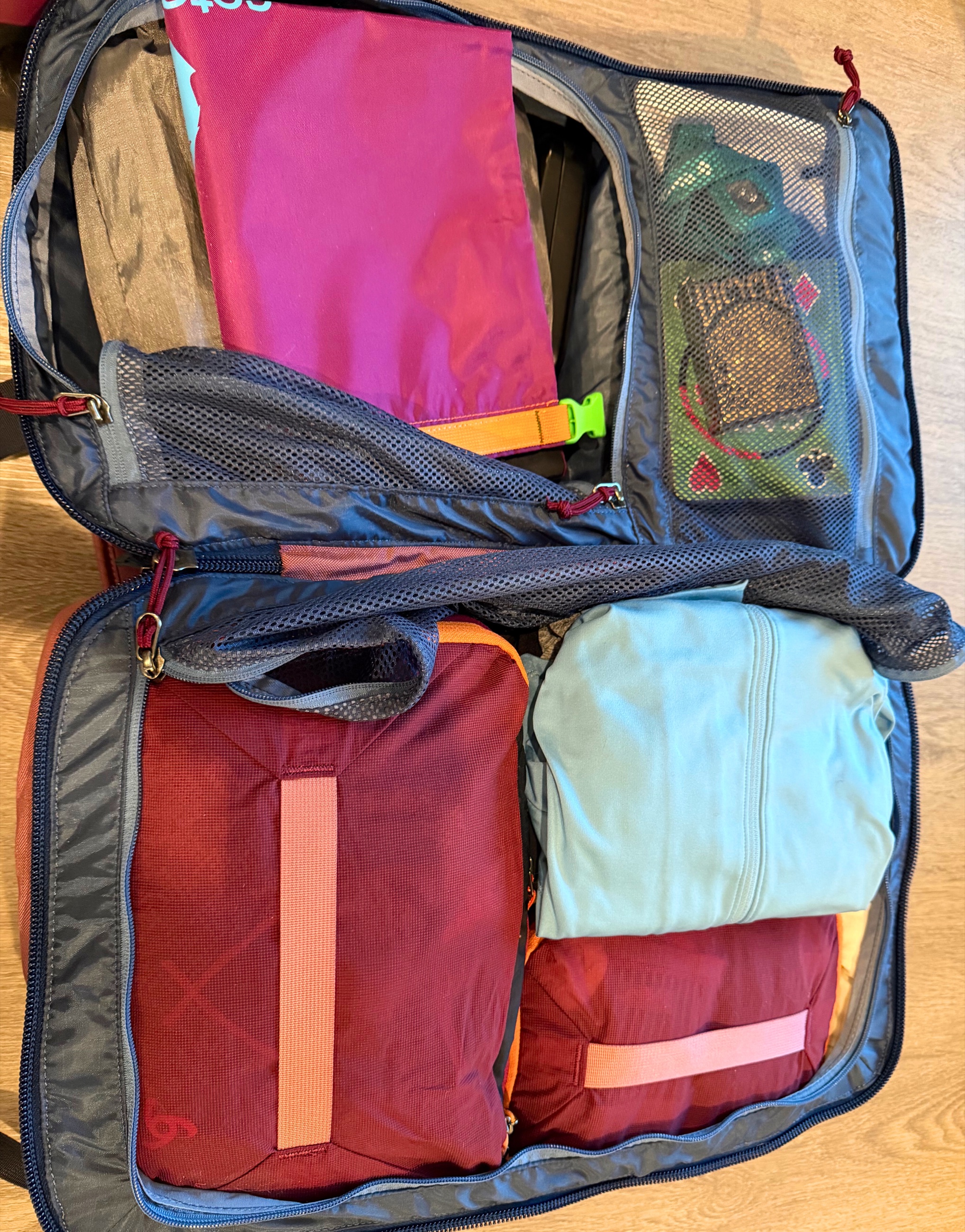 The first complete packing trial showed how quickly clothing, equipment, and small necessities consumed the available space.
The failures showed up fast. Shoes took up a share of space that had looked reasonable in a closet and looked absurd inside a suitcase. Vitamins and supplements did the same thing in miniature. A shelf of individual bottles became, once packed, a heavy and disorganized mass of plastic that needed to be poured into a few labeled bags.
Tech gear, including laptops, phones, microphones, drives, chargers, and cables, claimed more room than expected. Airline battery rules pushed most of it into carry-ons that were already full.
We weighed each checked bag and reworked the contents until both sat under the 50-pound airline limit. Some items moved from one case to another. Some went into storage. Others joined the donation pile that afternoon.
The first attempt held too much, and problems that seemed minor item by item became obvious once everything sat on the floor at once. That was the point of running the test early: correcting the plan on a Saturday in Reno rather than at an airline counter a couple of months later.
Designing a Life Across Borders
The itinerary went through the same process at a larger scale. We did not start by listing places we wanted to see. We started by naming the conditions required to live and work well for weeks at a stretch: manageable weather, walkable and safe neighborhoods, reliable internet, groceries and a place to exercise nearby, visa limits we could actually track, and monthly costs that did not treat every stop as a special occasion.
The map came after those conditions.
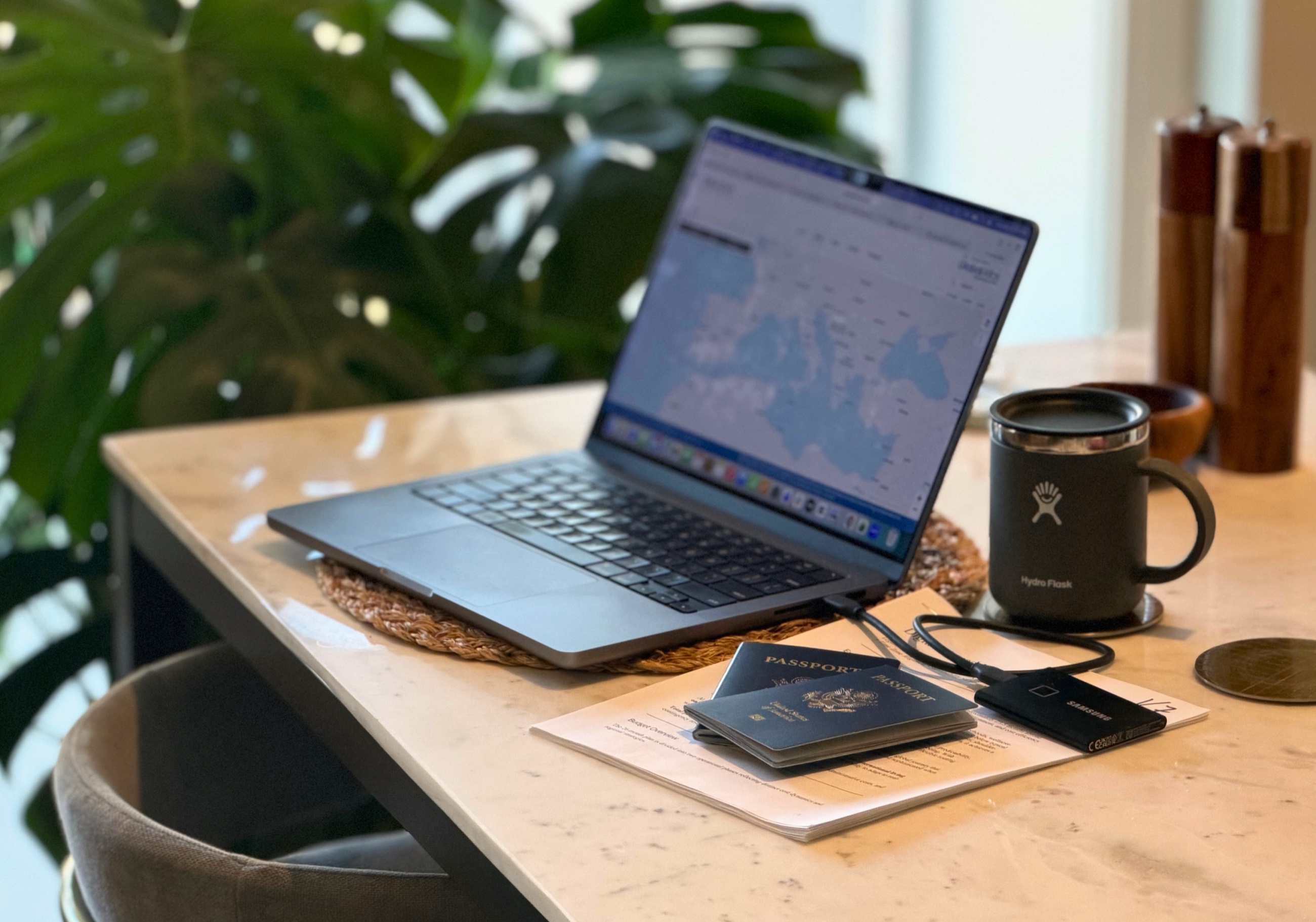 Passports, route maps, files, and reservations turned a long itinerary into a sequence that could actually be managed.
Climate shaped more than comfort. It affected sleep, walking outdoors, working hours, and how much cold-weather or warm-weather gear we would need to carry at any given stop. We built the route around moderate seasons wherever the calendar allowed it.
Visa rules set firmer limits, especially the Schengen restrictions, which forced us to track days conservatively and leave room for delayed flights, changed plans, or short excursions rather than building a schedule that worked only if every date held firm.
Price alone could not determine the route. We would not have a vehicle. A cheap apartment with poor transit, weak internet, or limited walkability could cost more in time and friction than a pricier one in a better location. Health and safety mattered on the same scale: access to fresh food and regular exercise, along with enough stability to hold a routine for a month at a time.
The route also had to support the actual work of running Some Great Place. Photogenic destinations were insufficient if they made ordinary life difficult.
Uncertainty remained. The itinerary was designed to absorb it. We anticipate the plan will flex as we gain experience and adjust for seasonality that brings tourism crowds and prices, and alternate stops along our journey as we learn more. The schedule is locked for a rolling three months as we advance book our Airbnbs, but beyond that it remains subject to change to adapt where needed. We anticipate eleven countries and seventeen cities in our first year abroad, a deliberate return to the United States at about eight months in, rather than at the end, and a second year of travel beginning in South America before returning to Europe, which is still being drawn.
The goal was to make the first version workable and leave enough room to adjust it as we learned more from lived experience.
Building the System Underneath
A settled home carries invisible infrastructure. The internet works. Mail arrives at the right address. Financial accounts recognize the usual location. A needed item can usually be ordered and delivered within a day or two.
Moving breaks each of those assumptions, so the weeks before departure were spent building smaller, portable versions of the same infrastructure.
We shifted our primary mobile service to Google Fi, added Airalo eSIMs for local data as we crossed borders, and used WhatsApp for day-to-day contact overseas. A travel router and VPN gave our devices the same private network in each apartment or Airbnb instead of trusting whatever open Wi-Fi came with the address.
Files were backed up to the cloud and to a physical drive. Apple AirTags went into every checked bag, giving us a better chance of locating delayed luggage.
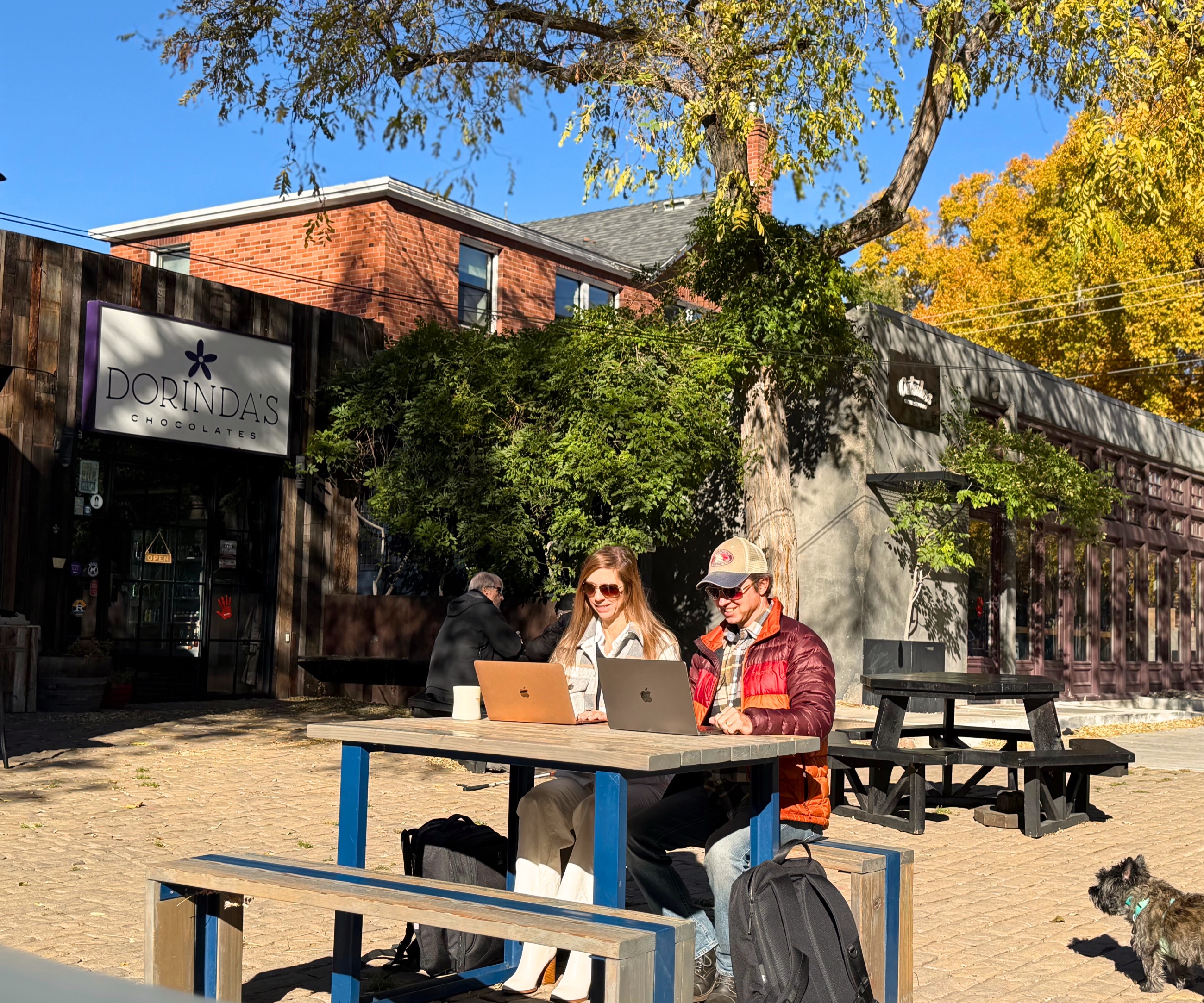 Working together outside Dorinda’s Chocolates as the systems behind Some Great Place became increasingly portable.
The mobile setup was intentionally smaller than the household infrastructure it replaced. Every added system was one more thing to charge, update, and remember, so the goal was the smallest setup that still held.
The five principles we had been testing against for months were simplicity, predictability, visibility, health, and margin. At this point they were less a philosophy than a way to settle an argument quickly: Does this addition reduce a real risk, or does it merely feel responsible?
Simplicity cut the number of things that could break. Predictability made costs easier to see coming. Visibility meant one dashboard, rather than five apps, tracking where the money actually went. Health shaped the route and the daily setup more than any spreadsheet did. Margin left room for a cancelled flight or a plan that turned out wrong.
When the Plan Became Real
For months, the trip lived in the abstract: in route maps, account setups, spreadsheets, and reservations dated far enough out that they did not feel real yet.
The apartment changed that.
Empty cabinets did the work first. Then the furniture disappeared in a pattern that had nothing to do with sentiment and everything to do with logistics. Whatever sold or found a taker first left first.
Storage bins replaced bookshelves along the same wall they had always occupied. The garage turned into a staging area, one labeled column of bins at a time. Suitcases stayed open on the floor for testing instead of waiting in a closet for the next trip.
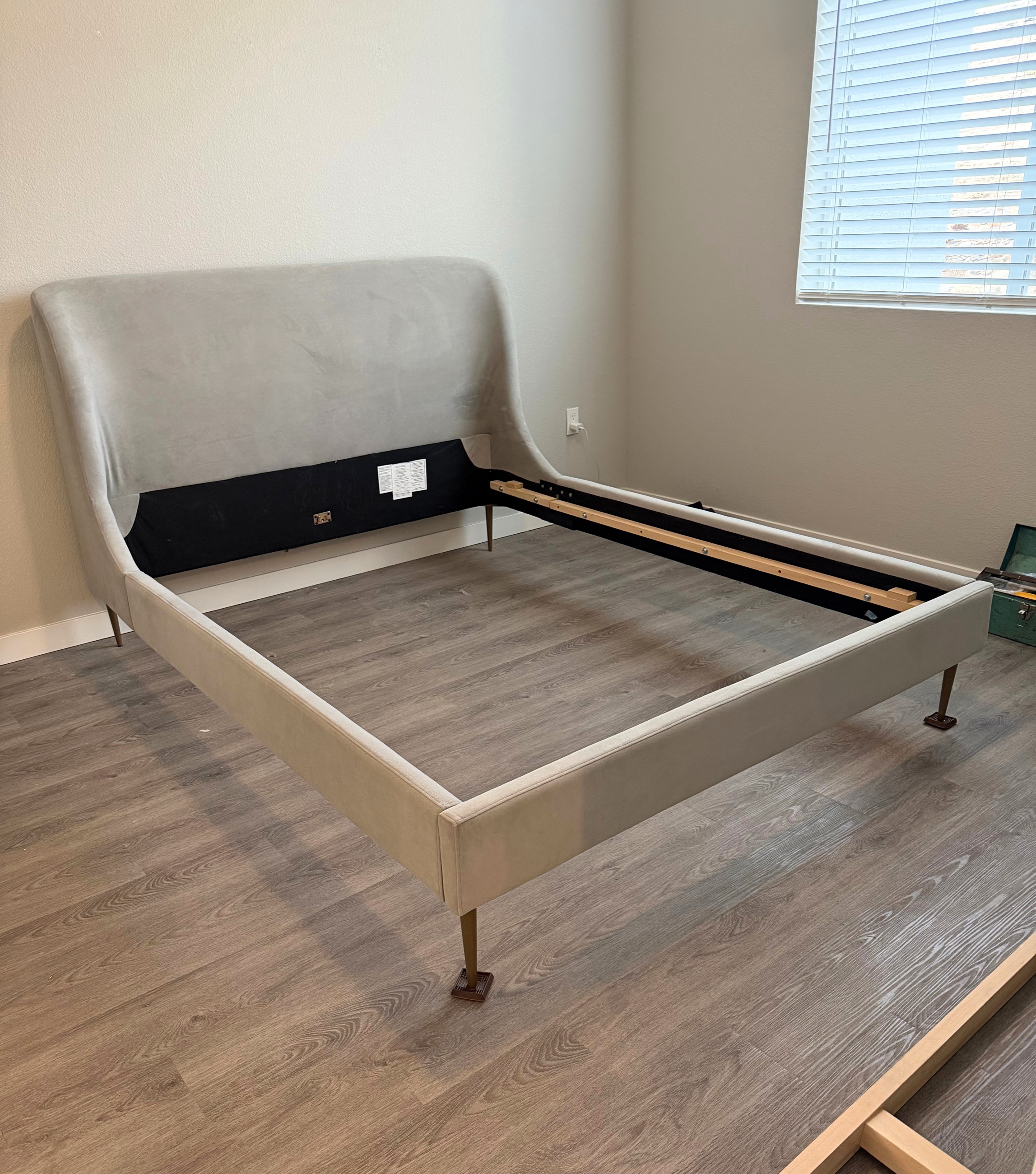 The bedroom reduced to a frame and open floor as the final pieces of the apartment came apart.
Errands changed character too. A drive to drop off boxes at Catholic Charities closed out one piece of the household for good. A trip to Home Depot for storage bins set the actual dimensions of what would remain. Cancelling a subscription cut one more line connecting us to the address.
Each task moved the plan a little closer to something we were doing rather than something we were still deciding.
By the final week, the couch stood alone in the living room, the last piece of a household that had otherwise already left. The room held less, but everything still in it had somewhere specific to go: into the truck, into a suitcase, or into someone else’s home.
The trip had not started yet. The life that came before it already had.
What Preparation Actually Bought Us
What this work actually produced was evidence: which shoes did not fit, which items needed repacking, which bag came in three pounds over.
None of it was dramatic. All of it was useful, because a plan that survives only on paper is not actually a functional plan.
Preparation produced a starting configuration, tested once under real conditions, with enough slack built in to be wrong about some of it and correct course later.
That is a more modest result than the language of downsizing usually promises, and a more useful one.
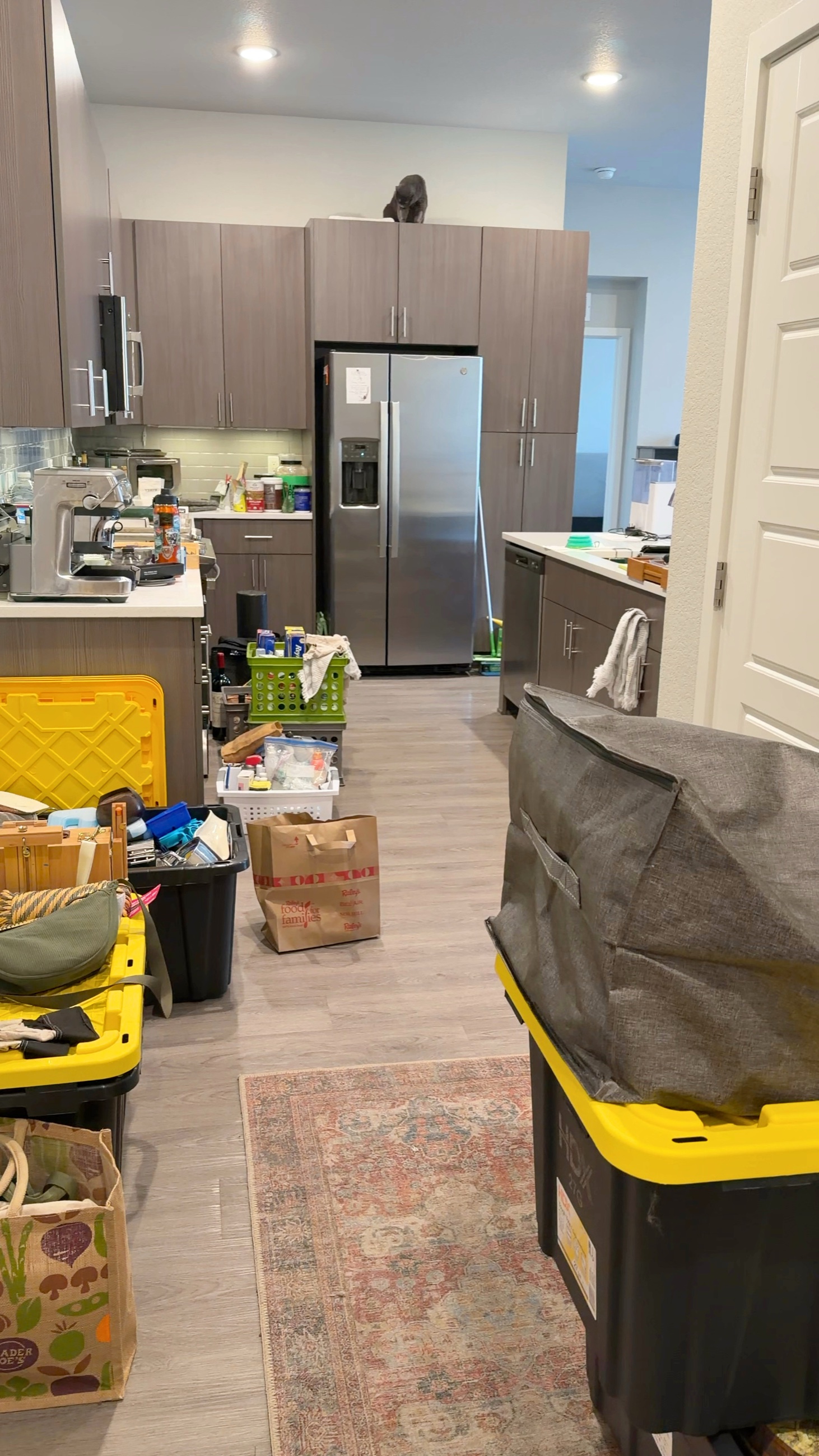 The remaining household gathered into bins, bags, and final decisions before the apartment was cleared.
Practical Notes
- Run a full packing trial before departure. Pack every category at once and weigh each bag; testing clothing, shoes, tech, and supplements separately hides the cumulative problem.
- Treat the airline weight limit as a hard ceiling with margin built in, not a target to meet exactly. Scales vary, and something always gets added later.
- Assign every possession one of four destinations, sell, donate, store, or carry, before packing starts. An undecided category is where delays accumulate.
- Set the storage-unit size before filling it. A fixed limit forces real decisions; an open-ended one does not.
- Replace cardboard with matched, stackable bins for anything going into long-term storage.
- Keep batteries and essential work equipment in carry-ons, and check current airline rules before the final pack.
- Build redundancy where it actually matters, especially communications, documents, money, and creative files. Skip duplicate gear that adds weight without solving a substantial risk.
- Expect to revise the system. The first version of a packing plan or route is a working draft, not a final answer.