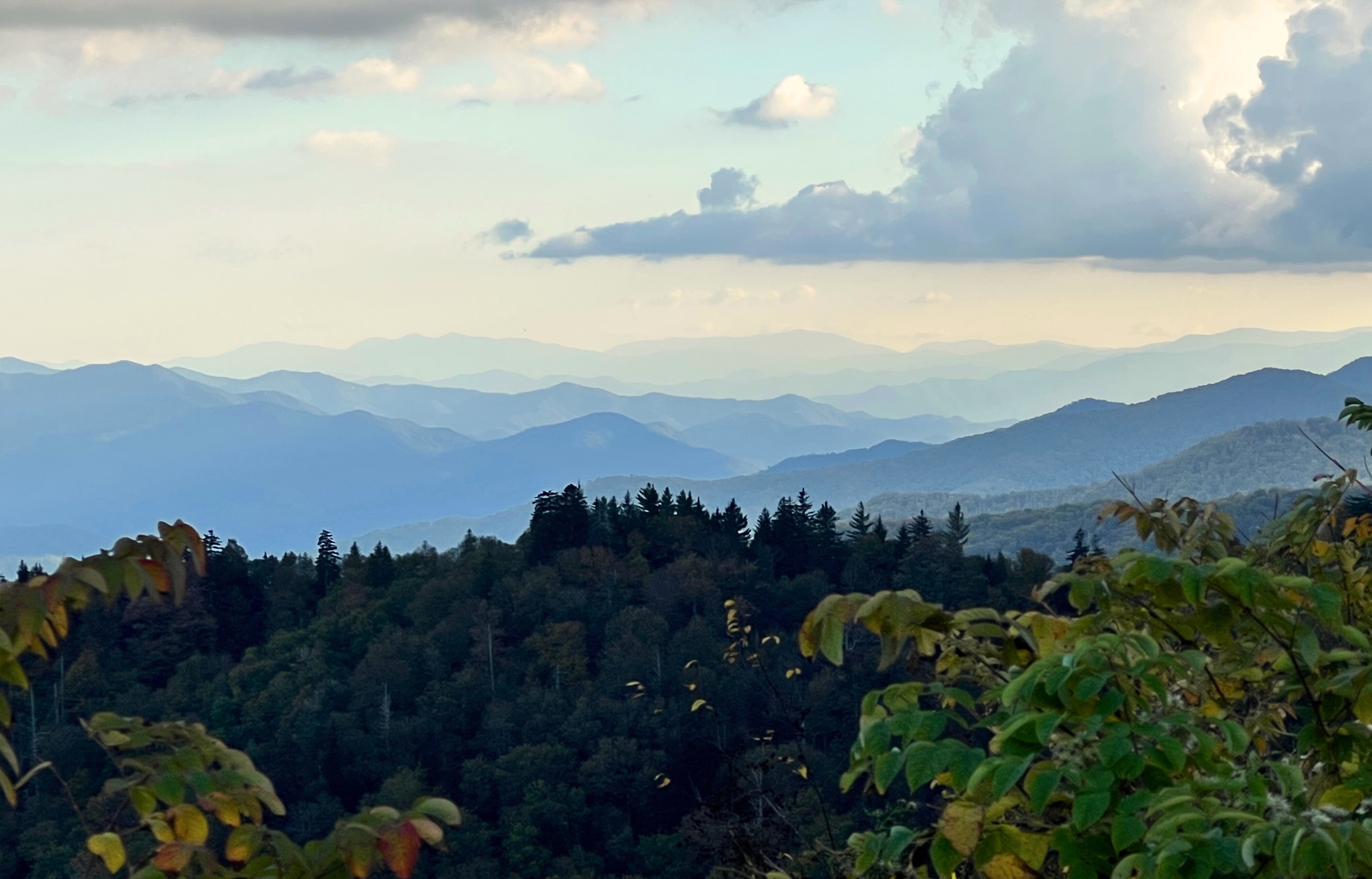
 Ridgelines receding in blue haze at Great Smoky Mountains National Park.
A Southern road trip can move through several versions of America in the span of a few days. One road passes through brick downtowns, Bible Belt manners, Alpine facades, mountain forests, neon spectacle, gas-station abundance, and riverfront revival. Material is never the problem. Deciding what holds the route together is.
For this trip, the center was the Smokies. Canton and Woodstock framed the journey with the warmth of northern Georgia. Helen made the turn toward themed tourism. Gatlinburg and Pigeon Forge showed how mountain access becomes entertainment infrastructure. Chattanooga gave the road a final river-city pause before the flight west.
Watch the accompanying short: The Great Smoky Mountains: Clarity & Beauty
Canton and Woodstock: Hospitality Before the Mountains
Northern Georgia gave the trip its first note: hospitality expressed through ordinary time. In Canton, our friends welcomed us with grilled meals, long dinners, local drives, and the kind of unhurried conversation that makes a visit feel rooted rather than scheduled.
Canton sits along the Etowah River, near enough to Atlanta to feel connected and far enough to keep its own pace. The food was better and more varied than a passing traveler might expect. We ate fresh seafood at Goin’ Coastal, Mexican food on Main Street, and dinner with mountain views at Nuevos Amigos Cocina Mexicana. We also found time for Italian food, gym sessions, and pickleball. Even short travel feels better when normal routines remain intact.
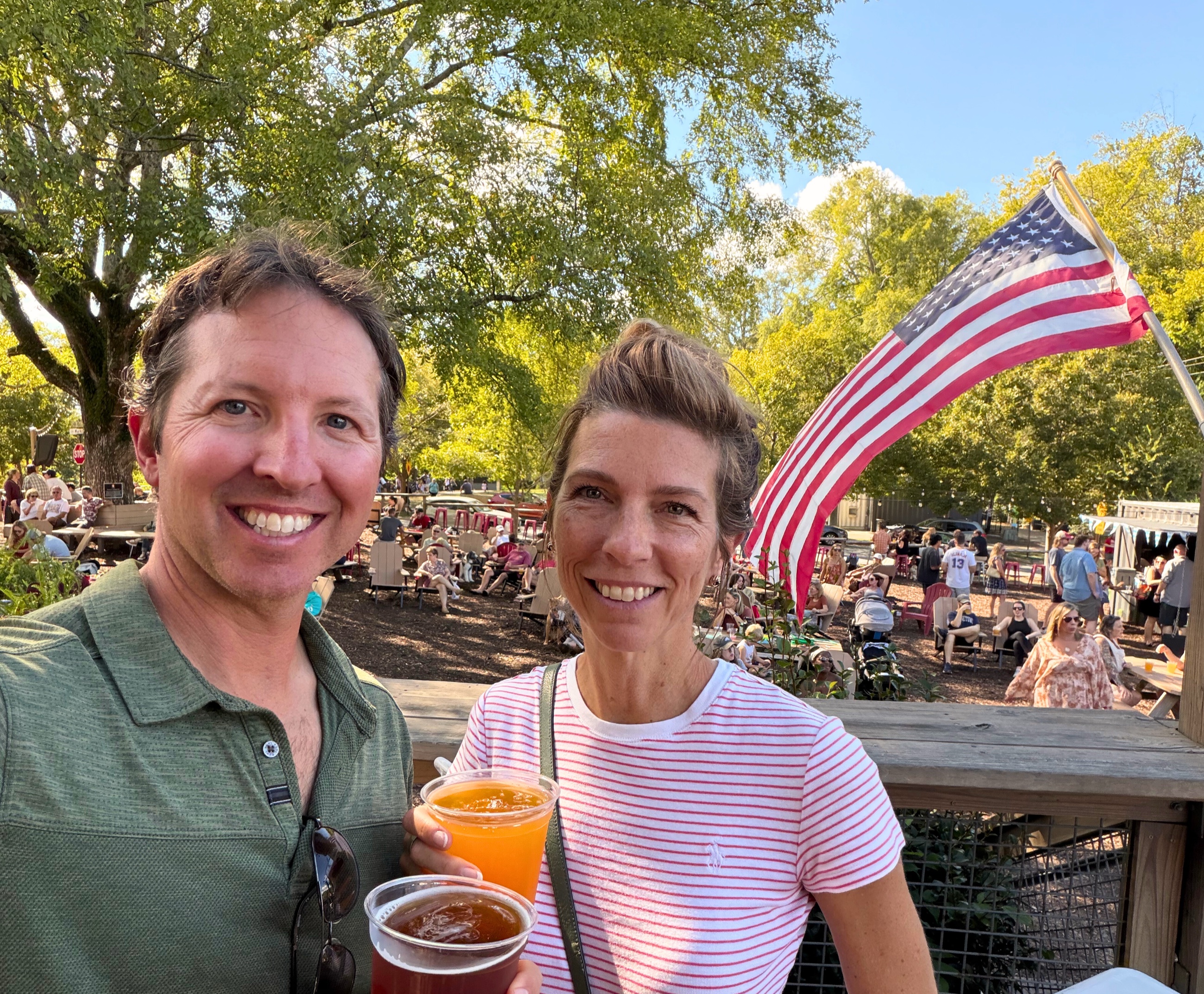 Oktoberfest at Reformation Brewery in Woodstock, Georgia.
Woodstock extended the same thread in a more walkable downtown form. Restored brick buildings, brewery tables under the trees, dinner conversations, and self-serve wine flights at Deep Roots Wine Market gave the town a settled, self-assured feel, the kind that doesn’t come from performing for visitors.
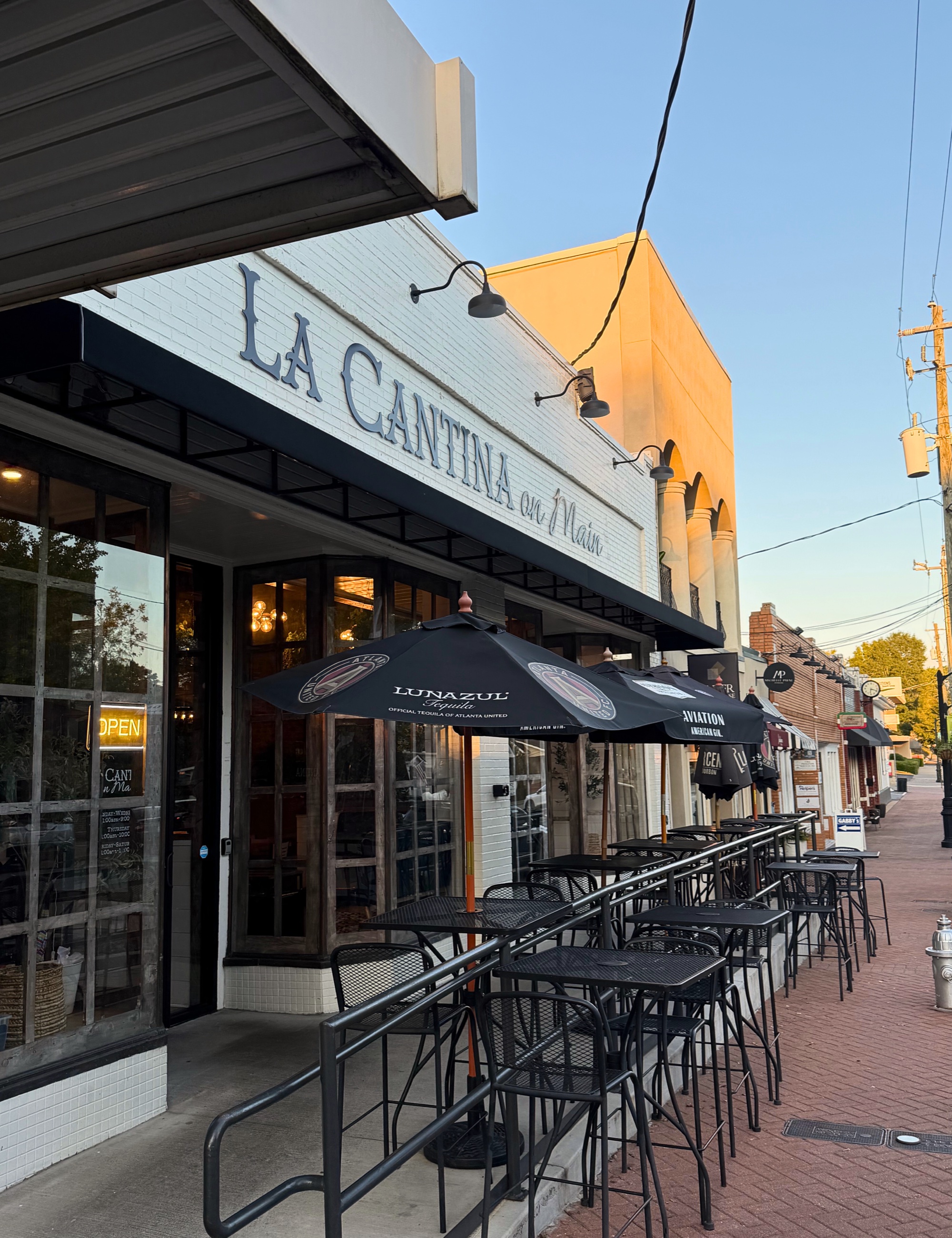 La Cantina on Main, Canton, Georgia.
Two days of people, homes, and unhurried meals changed how the rest of the trip read. The commercial stretches ahead, Helen’s storefronts, Gatlinburg’s strip, Pigeon Forge’s marquee lights, were easier to place once we had already seen what hospitality looked like without a cash register in the middle of it.
Helen: Bavaria in the Georgia Hills
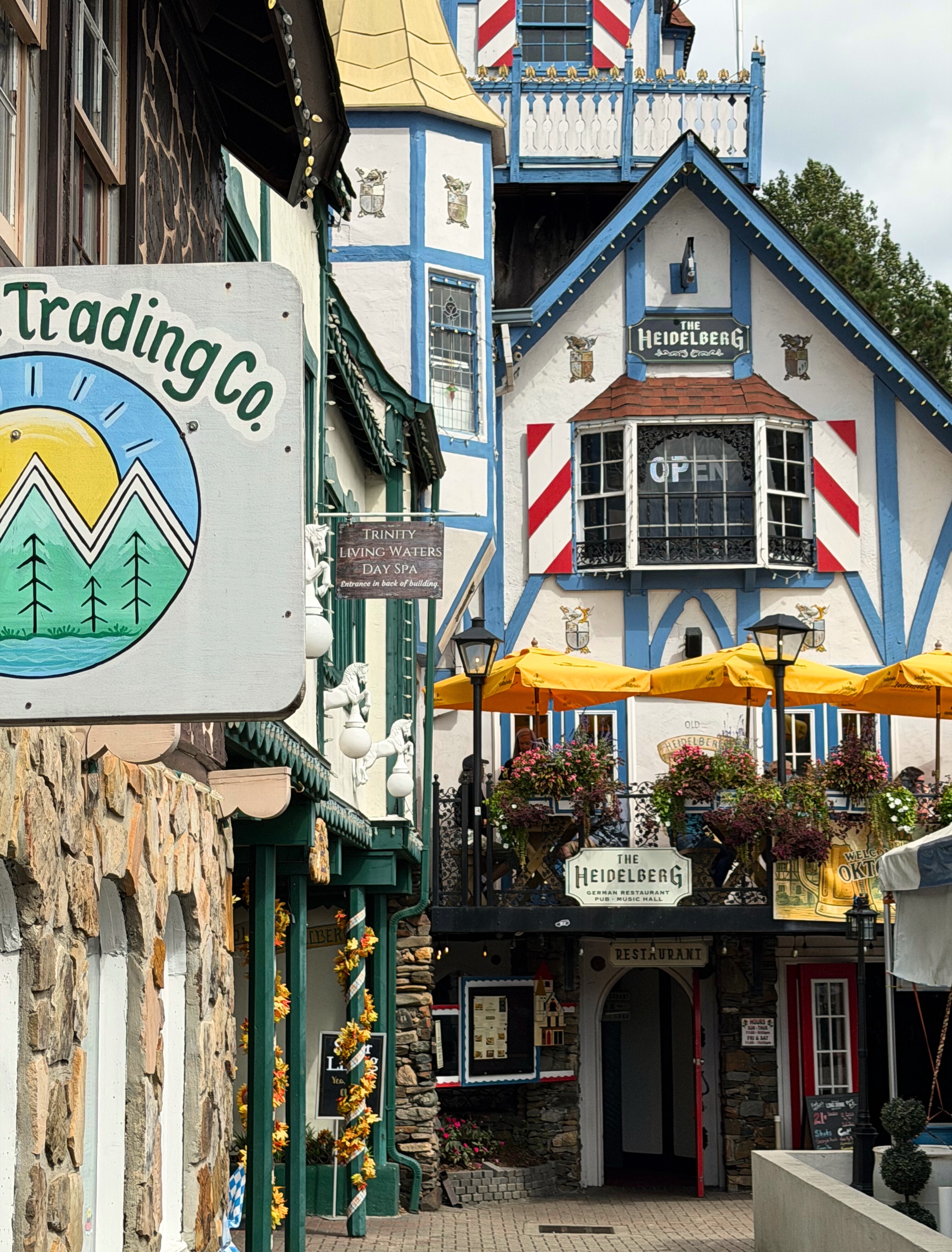 Heidelberg House, Helen, Georgia.
Driving northeast toward Tennessee, we stopped in Helen, Georgia, an Appalachian town rebuilt as a Bavarian village. The town chose this look on purpose, and did so almost overnight by small-town standards. In the late 1960s, as the local timber and rail economy that had sustained the town for decades went into decline, a group of business owners hired an artist to redesign the storefronts in Alpine style, betting that tourism could replace what logging no longer supported. Downtown building codes were rewritten to require the look: gabled rooflines, flower boxes, half-timbering, German signage. The Chattahoochee River still runs through the middle of it, the one feature the redesign didn’t have to invent.
Judged purely on authenticity, Helen looks like a stunt. Judged as a civic decision made under economic pressure and carried through for more than fifty years, it looks like a bet that paid off. With a resident population in the low hundreds and millions of visitors each year, the tension between local survival and visitor performance is visible on every block downtown, and by most measures, the town has won that bet.
We ate Sauerbraten and bratwurst at The Heidelberg, took in the built scenery, and kept moving. Helen worked best as a hinge in the trip: a roadside signal that the mountains ahead would not be experienced through wilderness alone.
The Smokies: An Accessible Wilderness
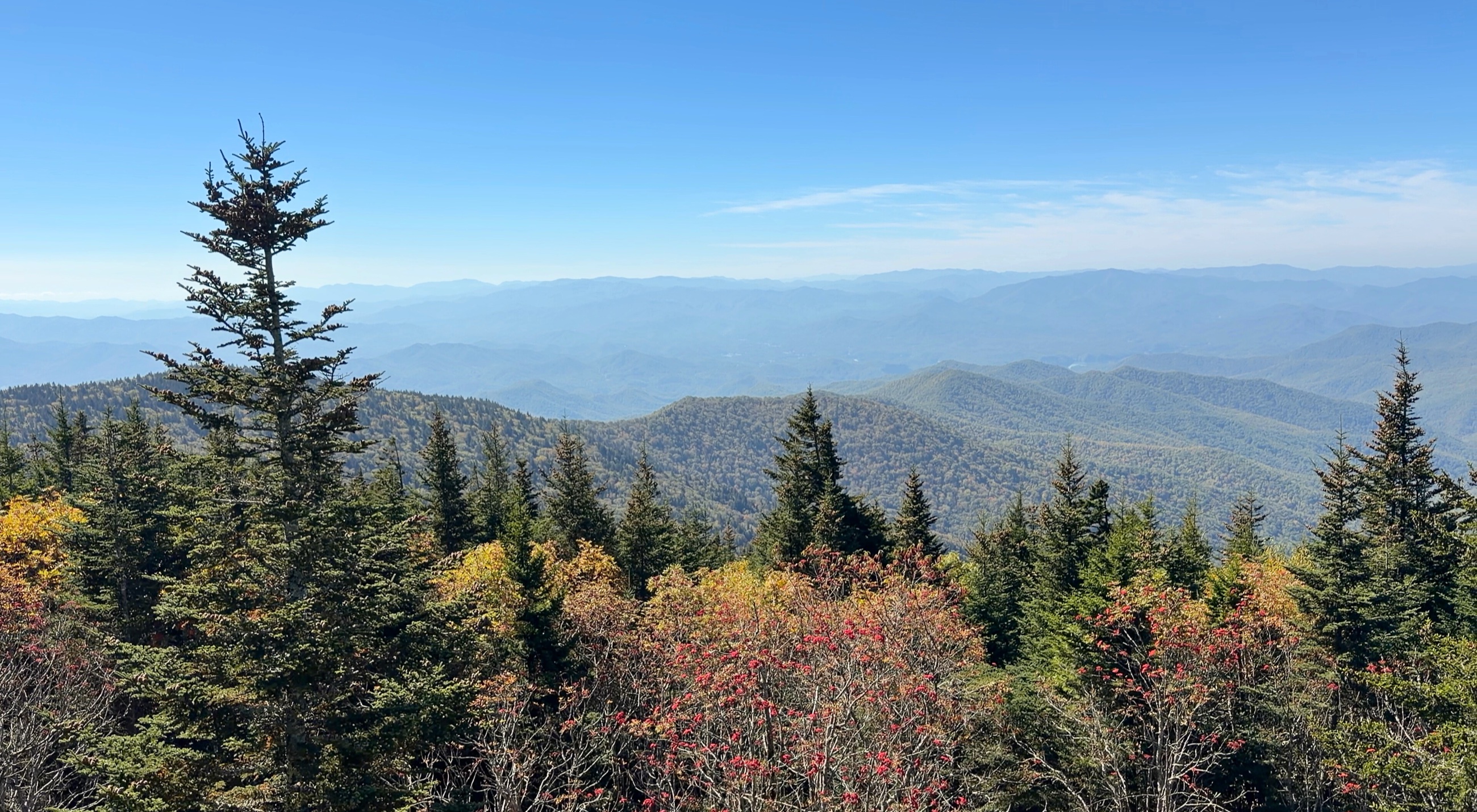 Autumn color and the mountain horizon at Great Smoky Mountains National Park.
Great Smoky Mountains National Park is one of the clearest examples of public beauty at scale. It is America’s most visited national park, helped by geography, road access, proximity to major population centers, and the unusual fact that entrance remains free.
The park does not open with the hard vertical drama of Yosemite or the exposed sweep of the desert West. The Smokies gather slowly. Cove hardwood forest covers the slopes, one of the most biologically dense temperate ecosystems in North America; the park is sometimes called the salamander capital of the world for the sheer range of species living in its damp understory. Mist softens the distances. The ridgelines recede into bands of blue and gray. The mountains feel old because they are old, worn down by time rather than sharpened by it, among the oldest ranges on the continent.
At Oconaluftee, elk moved through the river and meadow. They had disappeared from these mountains by the 1800s and were reintroduced in 2001, so watching them wade the Oconaluftee felt like a small, ongoing act of restoration, not a wildlife show staged for passing cars. The Oconaluftee entrance also sits at the edge of the Qualla Boundary, home to the Eastern Band of Cherokee Indians and the closest living link to a homeland that covered these mountains for centuries before removal. We didn’t linger there on this trip, but the park’s road signs and place names carry that history whether a visitor stops for it or not.
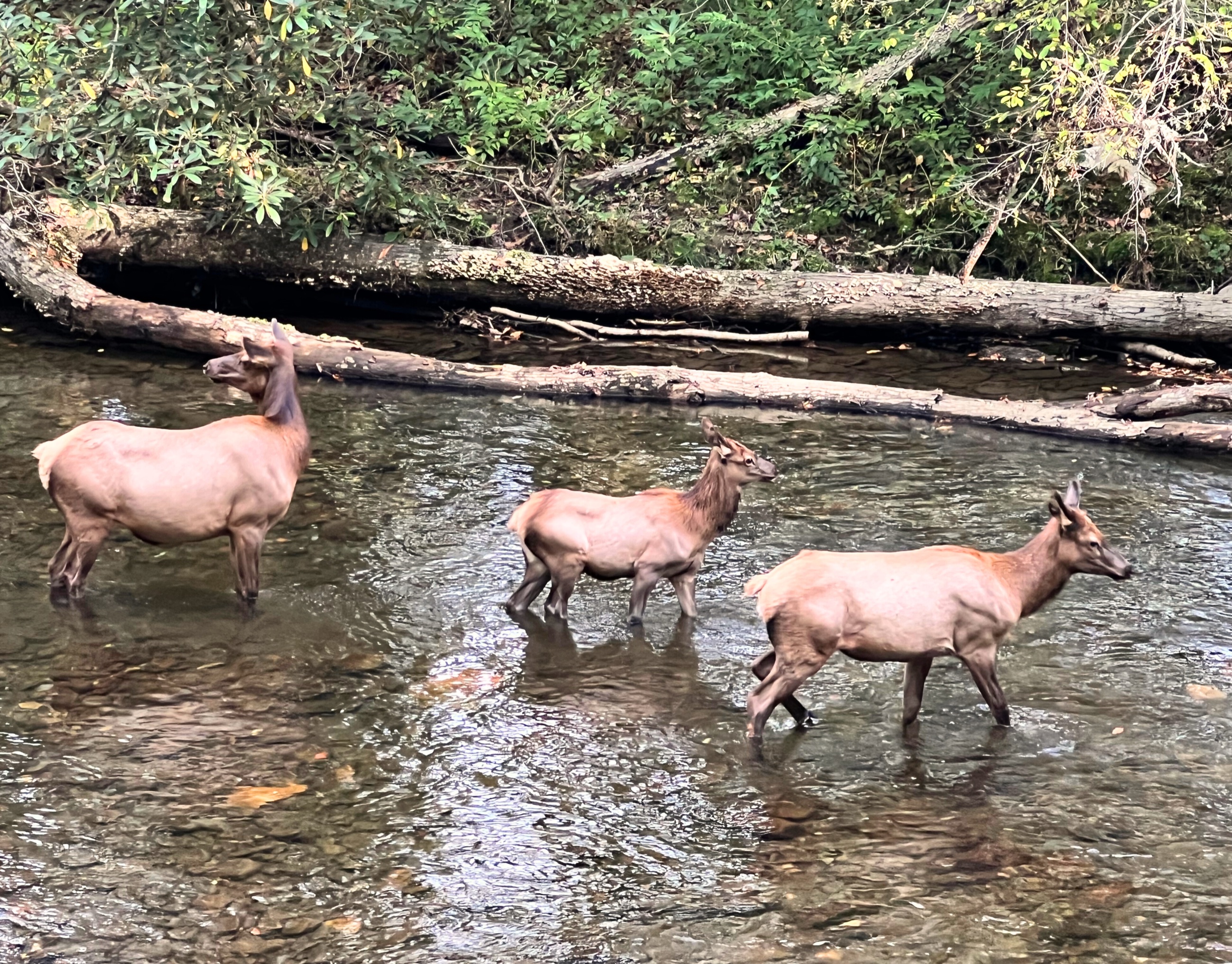 Elk wading through the Oconaluftee River in Great Smoky Mountains National Park.
From Newfound Gap, we drove to Clingmans Dome, the highest point in Tennessee at 6,643 feet. The observation tower offers wide views when the weather cooperates, and for us it did. The site also marks the highest elevation along the Appalachian Trail, which gave the moment a second layer of meaning. Having spent time on portions of the Pacific Crest Trail in the West, we felt the quiet connection between two long American walking routes.
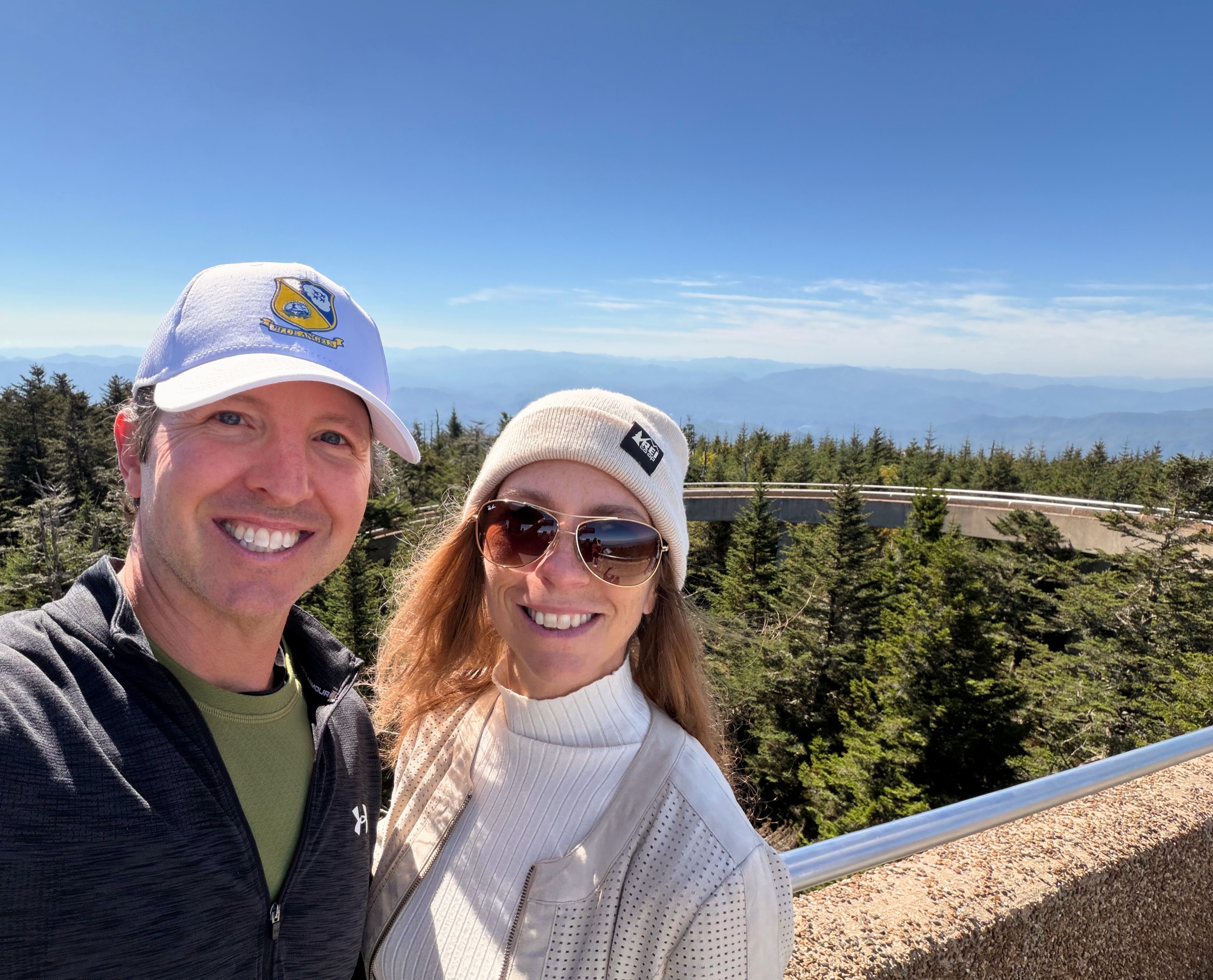 Atop Clingmans Dome, the highest point in Great Smoky Mountains National Park.
The Smokies are accessible in a way that can make them feel crowded, but that accessibility is part of their democratic character. The park belongs to families in minivans, serious hikers, retired couples, road trippers, school groups, and people who may never set foot in a more remote national park. That broadness defines the park as much as its ridgelines do.
Gatlinburg, Pigeon Forge, and the Roadside Machine
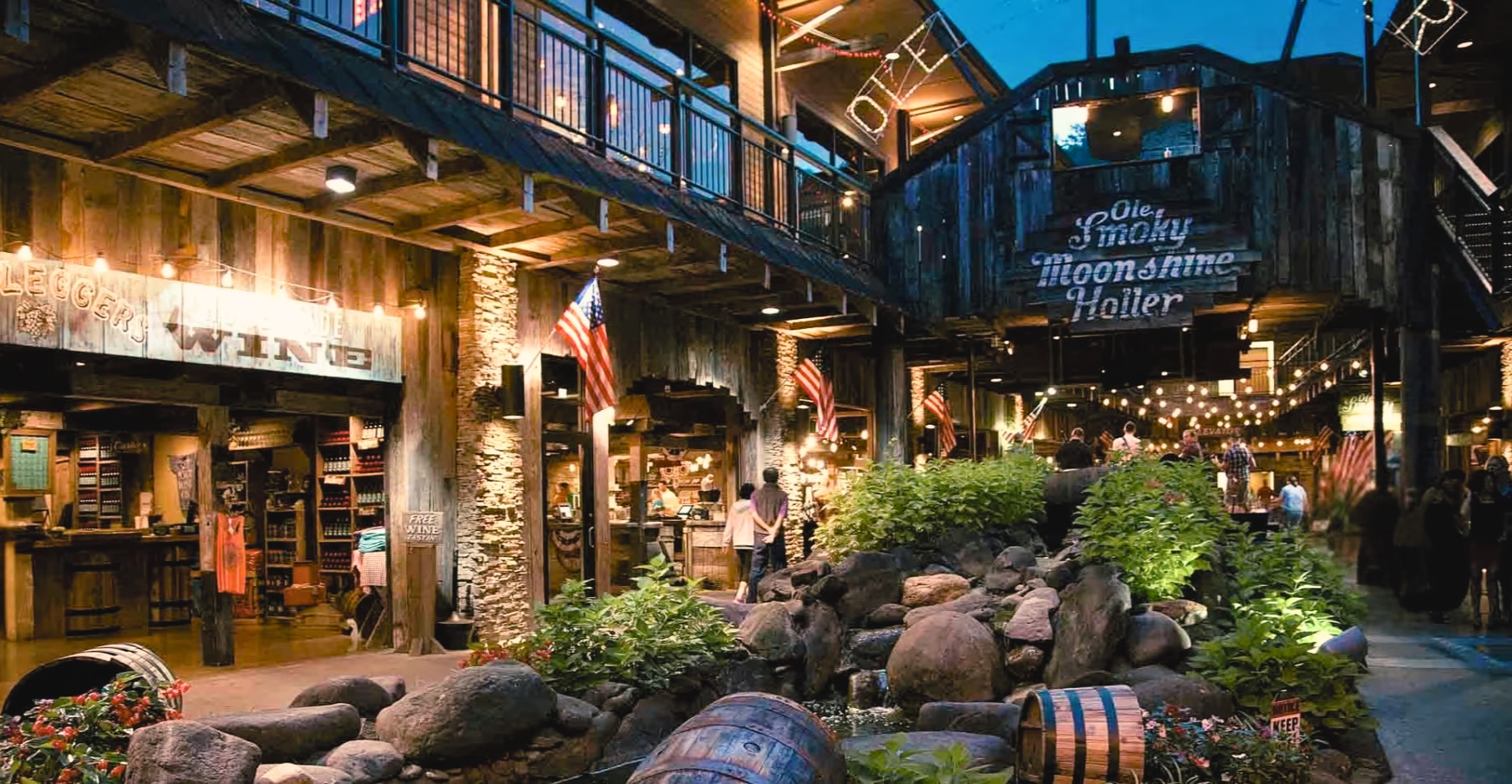 Ole Smoky Distillery, Gatlinburg, Tennessee.
Gatlinburg is the mountain gateway turned visitor corridor: part Southern town, part souvenir district, part performance of Tennessee mountain culture. We ate at Smith & Son Corner Kitchen, stopped at Ole Smoky Distillery for flavored moonshine flights, and heard a bluegrass band play “Rocky Top.” It was designed for visitors, clearly, but design and local identity are not always cleanly separable in a town shaped by tourism over generations.
We finished the evening with barbecue at Bennett’s Pit Bar-B-Que: pulled pork, brisket, ribs, and sides that tasted like family recipes, not restaurant standards.
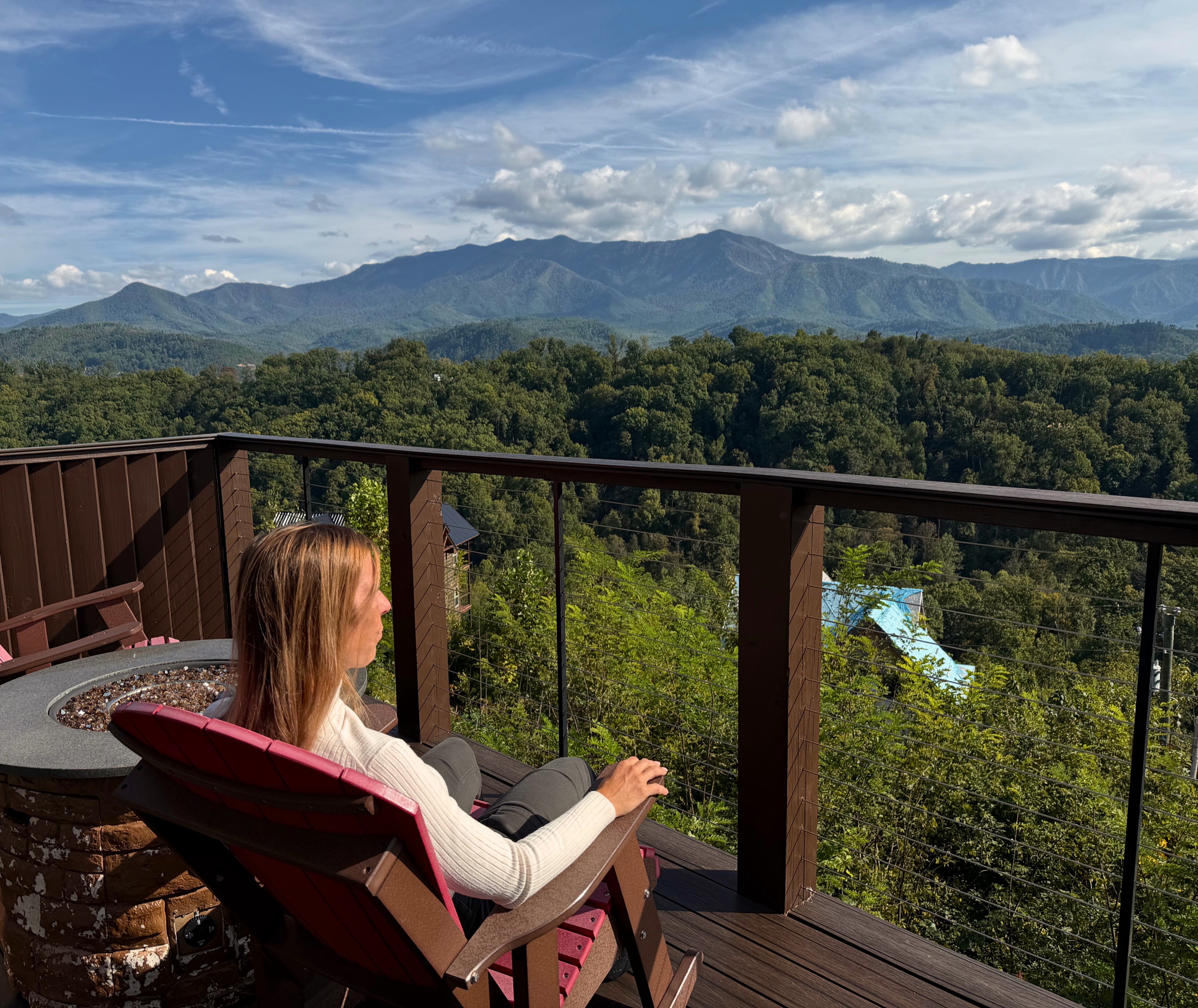 Morning relaxation with mountain views, Gatlinburg, Tennessee.
The next morning, Pigeon Forge pushed the contrast further. Attractions, themed restaurants, theaters, towers, signs, and entertainment complexes lined the main strip in a long commercial procession. We did not need to stop to understand the proposition. Pigeon Forge is spectacle by accumulation.
The road version of that same abundance appeared again at Buc-ee’s. It is part travel center, part food hall, part retail maze, part folk phenomenon, with beaver-branded everything and bathrooms famous enough to become their own marketing channel. We also stopped at Black Rifle Coffee, where the patriotic branding was as legible as the caffeine level.
These places are as much a part of the American road as any overlook or trailhead. They show what happens when mobility, branding, convenience, appetite, and regional identity get built at interstate scale.
Chattanooga: A Riverfront Pause
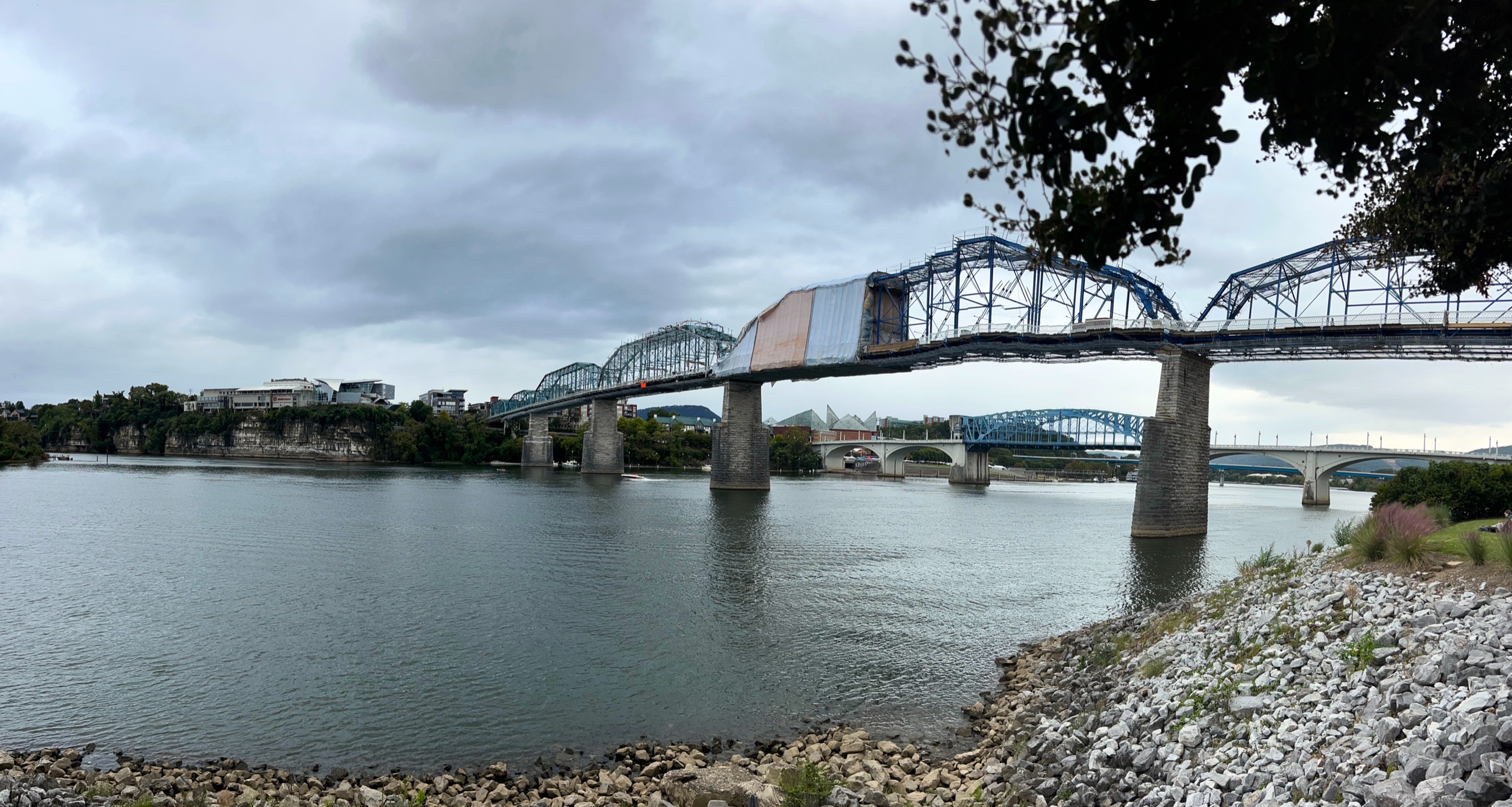 The Walnut Street Bridge under renovation, seen from the riverbank near Coolidge Park.
Chattanooga gave the trip its final change of register. We ate at The Feed Table & Tavern, walked near Coolidge Park along the riverfront, and looked toward Lookout Mountain. The Walnut Street Bridge was closed for renovations, but the city still gave a clear impression: industrial bones, outdoor access, arts energy.
Lookout Mountain carries more than a skyline view. The ridge was the site of the November 1863 Battle of Lookout Mountain, part of the Chattanooga Campaign that broke Confederate control of the city and opened the route Sherman’s army would later take toward Atlanta. None of that history announces itself from the riverfront. It sits under the scenery the way most Southern history does, close enough to reach if you go looking for it.
The city deserves a longer visit. On this route, though, Chattanooga worked as a closing movement before the return through Atlanta. After the enclosed abundance of Pigeon Forge and Buc-ee’s, the riverfront gave the eye room again.
What the Road Clarified
This trip worked because each stop was allowed to carry a different kind of weight. Canton and Woodstock offered hospitality. Helen offered constructed identity. The Smokies offered old mountains, restored wildlife, and public access. Gatlinburg, Pigeon Forge, Buc-ee’s, and Black Rifle Coffee showed the commercial grammar of the Southern road. Chattanooga suggested a future stay.
What connected them was hospitality in different registers: a home-cooked meal, a downtown brewery, a themed village, a free national park, a moonshine counter, a roadside travel center, a river city that deserved more time than we gave it. Some of that hospitality was personal. Some of it was built for a visitor’s dollar. Both were real, and the difference between them stayed noticeable all the way to Chattanooga.
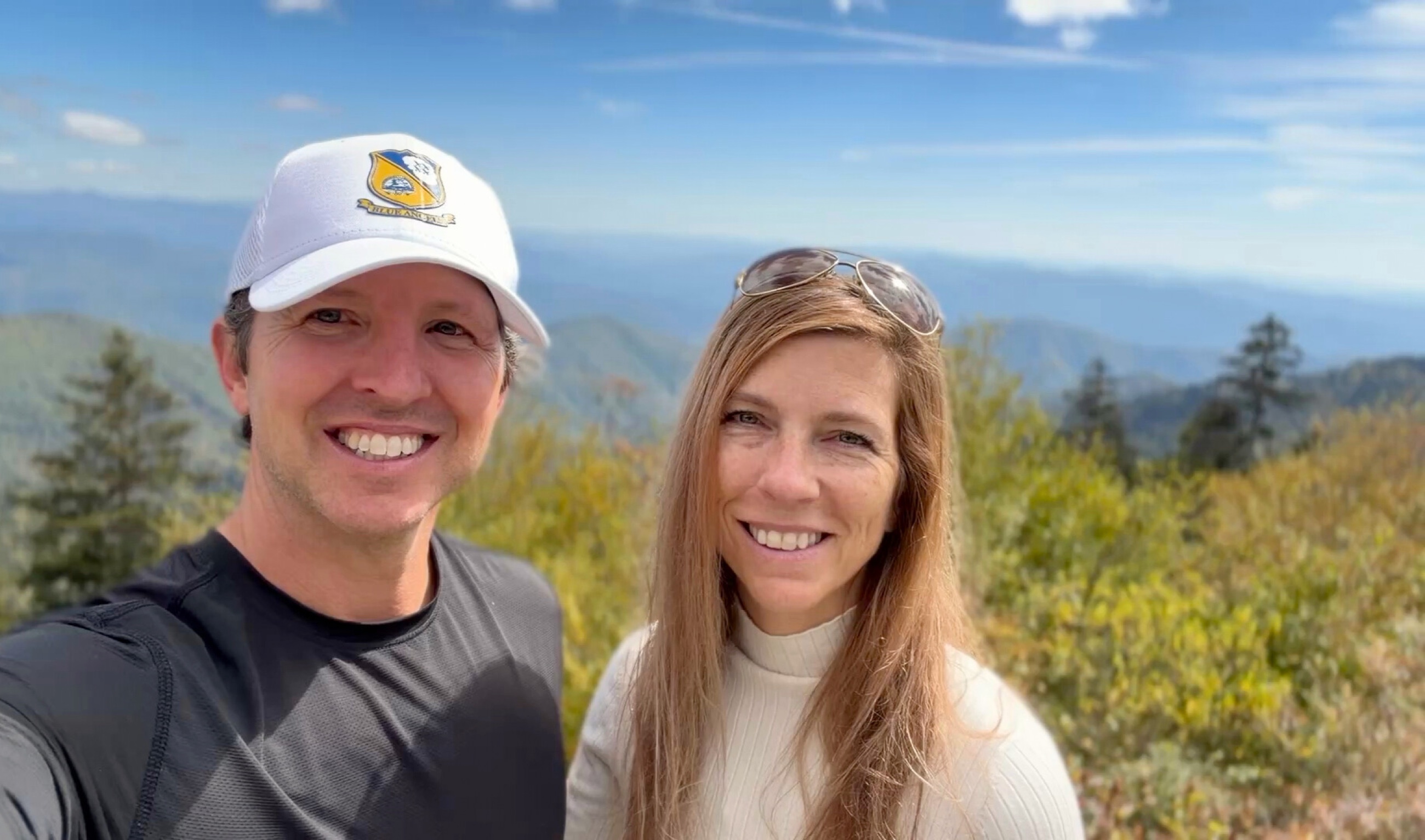 Together in Great Smoky Mountains National Park, with the ridgelines falling away behind us.
Practical Notes
- Route shape: Northern Georgia worked as the social and hospitality frame; Great Smoky Mountains National Park should be treated as the center of gravity.
- Best natural stop: Great Smoky Mountains National Park, especially Oconaluftee, Newfound Gap, and Clingmans Dome when visibility is good.
- Best cultural contrast: Helen, Georgia, because its Bavarian identity raises useful questions about tourism, reinvention, and civic survival.
- Best roadside contrast: Pigeon Forge and Buc-ee’s, if approached as American road culture rather than as places to linger.
- Chattanooga: A single afternoon undersells it. The riverfront, Lookout Mountain, and the arts district need more time than a passing stop allows.
- Costs from the original trip: Airfare ran about $620 plus miles, and our share of the Gatlinburg Airbnb was $672. Staying with friends, sharing transportation, cooking some meals, and avoiding pricier tourist traps kept the trip manageable. The national park itself was free.