Lagos, Portugal

1 article

We spent six nights in Lagos after an overnight stop in Faro, staying close enough to reach the historic center, waterfront, groceries, cafés, and the cliff walks around Ponta da Piedade on foot. Lagos worked well as a compact coastal stop rather than a fully tested long-stay base. Its strongest qualities were pedestrian scale, immediate access to the Algarve's beaches and ochre cliffs, a historic center with substantial Portuguese and Atlantic history, and an atmosphere calm enough to accommodate both remote work and an unusually social week with friends. It best suits travelers who want a smaller Portuguese town with coastal walking, architectural detail, and straightforward daily logistics. Its principal limitation is that a stay of less than a week does not reveal the full realities of long-term workability, cost, transportation, fitness, or seasonal crowd pressure.

At a Glance

Length of stay
6 nights
Neighborhood
Within walking distance of Lagos's historic center and the coastal paths toward Ponta da Piedade
Cost level
Not assessed comprehensively during the short stay
Walkability
Very good for the old town, waterfront, groceries, cafés, beaches, and Ponta da Piedade; the compact scale made most daily movement possible without local transportation
Transportation
Reached by regional train from Faro; the town itself was manageable on foot, while excursions into the inland Algarve were easier by car
Workability
Adequate for a short apartment-based stay, although the week was unusually social and did not establish a normal long-stay work routine
Cultural depth
High for a town of its size, with Phoenician, Roman, Visigothic, Moorish, medieval Portuguese, maritime, religious, and colonial histories visible within the old quarter
Principal strength
The close integration of a walkable historic town with beaches, cliff paths, and Atlantic scenery
Principal limitation
The short stay did not provide enough evidence to assess Lagos fully as a month-long remote-work base, particularly during the more crowded summer season

Practical Highlights

Accommodation
The apartment supported work, groceries, and shared meals with visiting friends throughout the stay
Groceries and daily routine
The stay included grocery shopping and substantial cooking at home; because the apartment became a gathering place for several friends, shared meals shaped the week more than restaurant exploration; the experience also showed the difference between a short social stop and a longer stay in which grocery, work, sleep, and fitness routines have time to stabilize
Transportation
We traveled from Faro to Lagos by regional train after meeting friends at Faro station; within Lagos, the historic center and coastline were accessible on foot; a visit to friends staying in the hills above Silves required road transportation, illustrating that inland Algarve excursions are less practical without a car
Beaches and coastal walks
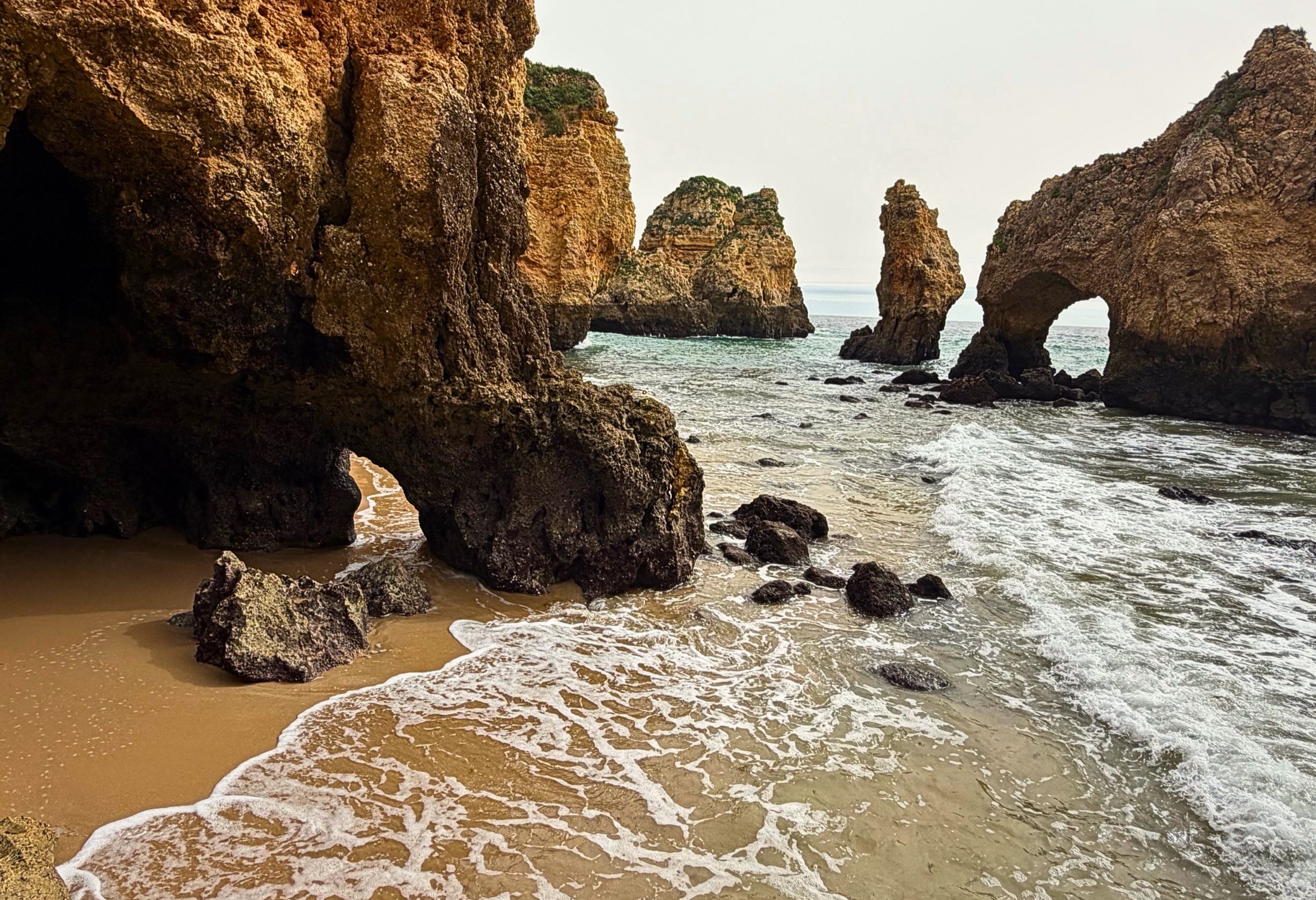
Ponta da Piedade was the defining natural feature of the stay, with cliff-top paths, wooden stairways, sea arches, grottoes, and small coves below the ochre rock; Praia da Dona Ana and the beaches along this stretch were readily accessible from town; the coastline was better suited to walking and visual exploration during this early-March stay than to sustained swimming or beach routines
Cultural highlights
The historic center included sections of the medieval walls, Forte da Ponta da Bandeira, Igreja de Santa Maria, and Igreja de Santo António, whose gilded Baroque interior and narrative azulejos were among the most substantial artistic sites encountered; the streets also revealed two defining elements of Portuguese urban design, patterned calçada pavement and tiled façades
Historical context
Lagos carries a long sequence of Phoenician, Roman, Visigothic, Moorish, medieval Portuguese, and Atlantic histories; its maritime importance is closely associated with Infante Dom Henrique and early Portuguese expansion; the former Mercado de Escravos, associated with the early Atlantic slave trade, also stands within the old quarter
Seasonality
Early March offered mild walking weather and a subdued pace, with Lagos functioning as a calm coastal town rather than a heavily pressured resort