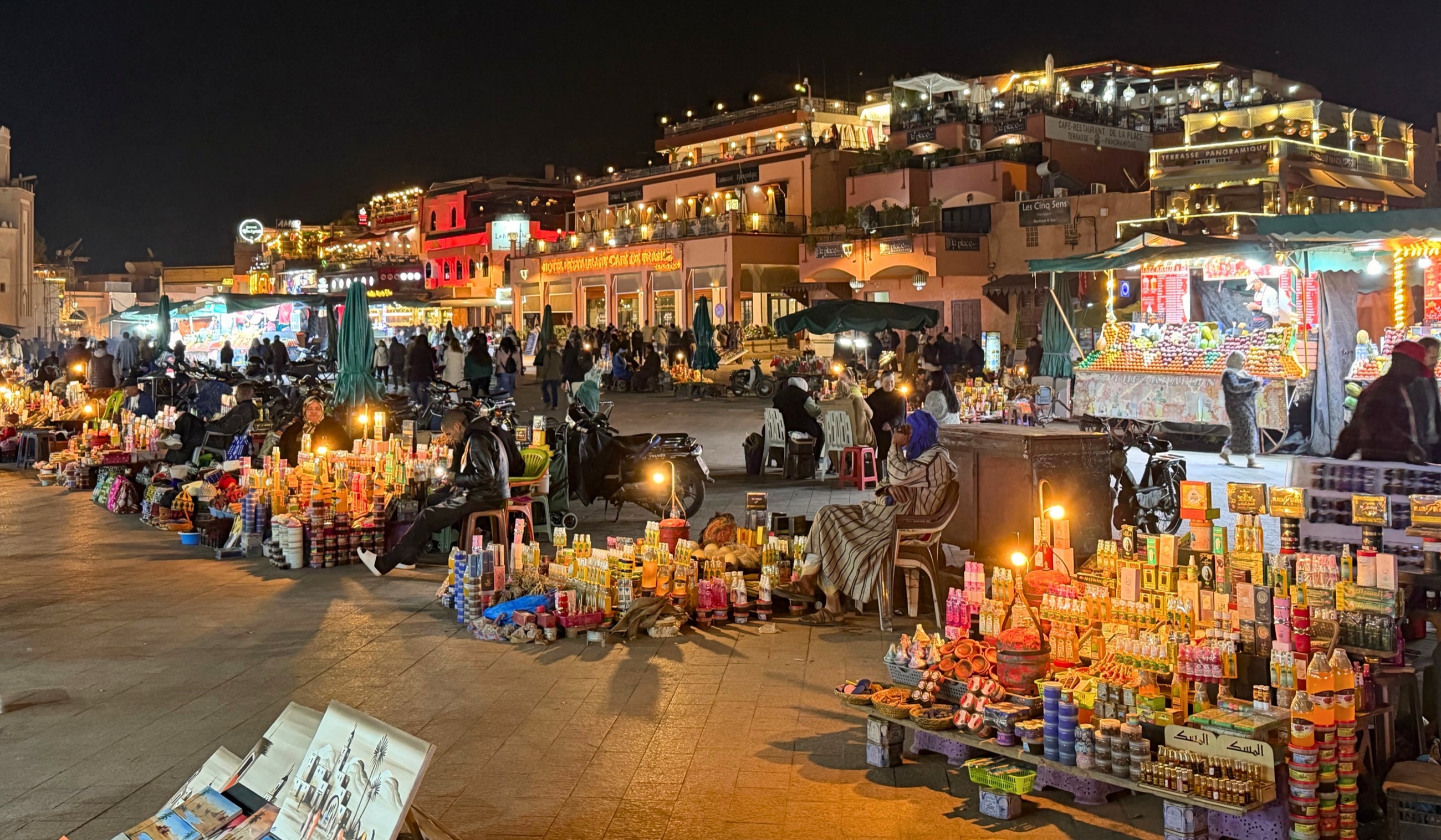
Marrakesh, Morocco

1 article

We spent three days and two nights inside the medina, staying in a traditional riad deep within Marrakesh's old walled city. This was a short cultural stop rather than a long-stay base, but it revealed the medina's defining contrasts quickly: dense public lanes and inward-facing domestic calm, concentrated artisan trade, religious practice structuring the day, and historic buildings still serving contemporary life. Marrakesh suits travelers who value architecture, markets, food culture, and sustained sensory intensity. Its principal trade-offs are navigation, luggage access, mopeds in narrow lanes, and the limited usefulness of the medina for establishing a remote-work routine.

At a Glance

Length of stay
3 days, 2 nights
Neighborhood
Inside the medina, Marrakesh's historic walled city
Cost level
Not assessed comprehensively during the short stay
Walkability
Entirely walkable within the medina, but navigation is difficult and routes are irregular; offline maps and a pinned accommodation location were essential
Transportation
Cars stop at the medina gates; airport transfer required a driver to the nearest gate, followed by an escort on foot through the lanes
Workability
Not meaningfully assessed; the medina is better suited to a short cultural stay than to establishing a conventional remote-work routine
Cultural depth
Very high, with Almohad, Saadian, Islamic, Jewish, and artisan histories concentrated within the old city
Principal strength
An unusually dense encounter with Moroccan architecture, craft traditions, markets, religion, and public life
Principal limitation
Disorientation, difficult luggage access, and constant pedestrian negotiation with carts and mopeds inside narrow lanes

Practical Highlights

Accommodation
We stayed in a traditional riad built around an interior courtyard, with shared spaces and a rooftop terrace concealed behind a plain street entrance; the inward-facing design provided a marked contrast to the noise and movement outside
Connectivity and navigation
We downloaded offline maps and pinned the riad before leaving it for the first time; this was necessary because the medina does not follow a visible grid, and even short diversions can make orientation difficult
Transportation
The riad arranged an airport driver and staff escort; the driver brought us to a medina gate, where vehicle access ended, and an employee helped carry luggage through the remaining passages on foot; travelers with substantial luggage should arrange the same service in advance rather than plan to navigate independently on arrival
Walking conditions
The medina's lanes are narrow, crowded, and shared by pedestrians, carts, bicycles, and mopeds; walking required keeping to the right, listening for engines, and treating every turn as a navigation decision
Markets and shopping
The souks remain organized partly by trade, with specialized areas for leather, metalwork, textiles, dyes, spices, baskets, ceramics, and jewelry; for travelers moving continuously, consumables such as spices and tea were more practical purchases than fragile ceramics or bulky craft goods
Cultural highlights
Jemaa el-Fnaa, Bahia Palace, Koutoubia Mosque, El Badi Palace, the mellah, and the specialized souks provided the principal cultural framework for the stay; the architecture was especially revealing, as many traditional homes and riads turn inward around courtyards, while parts of the historic Jewish quarter show different exterior patterns linked to their own social and architectural history
Religious and civic life
The call to prayer from multiple mosques structured the day across the medina, while Jemaa el-Fnaa changed character after dark as food stalls, musicians, performers, and crowds filled the square